
TL;DR:
- Proper temperature settings and regular coil cleaning significantly reduce refrigerator energy costs.
- Organizing the fridge and limiting door open time improves efficiency and prevents energy waste.
- Upgrading to modern ENERGY STAR models may save money long-term, but smart habits have greater impact.
Southern California homeowners know better than most what a painful shock a high electric bill can be. With some of the highest residential electricity rates in the country, every kilowatt counts. What many people overlook is that the refrigerator runs 24 hours a day, 365 days a year, quietly pulling power while everything else in the house sits idle. It’s often the single biggest energy user in your kitchen. The good news is that a handful of practical, proven adjustments can meaningfully reduce what your fridge costs you each month, without spending a lot of money.
Table of Contents
- Optimize refrigerator and freezer temperatures
- Organize and use your fridge efficiently
- Maintain and clean for peak performance
- Upgrade to efficient models and choose the right design
- Why energy-saving habits matter more than expensive upgrades
- Get expert help maximizing your fridge’s efficiency
- Frequently asked questions
Key Takeaways
| Point | Details |
|---|---|
| Optimal temperature | Set your fridge to 37°F and freezer to 0°F for best savings and food safety. |
| Daily efficiency habits | Limit door openings and keep items organized for quick access to reduce energy use. |
| Regular maintenance | Clean coils and check gaskets to maintain efficiency and avoid wasting electricity. |
| Upgrade wisely | Replace old refrigerators and choose energy-efficient models to save hundreds over time. |
Optimize refrigerator and freezer temperatures
Your refrigerator works harder than it needs to when the temperature is set too low. This is one of the most common and costly mistakes homeowners make, and it’s also one of the easiest to fix.
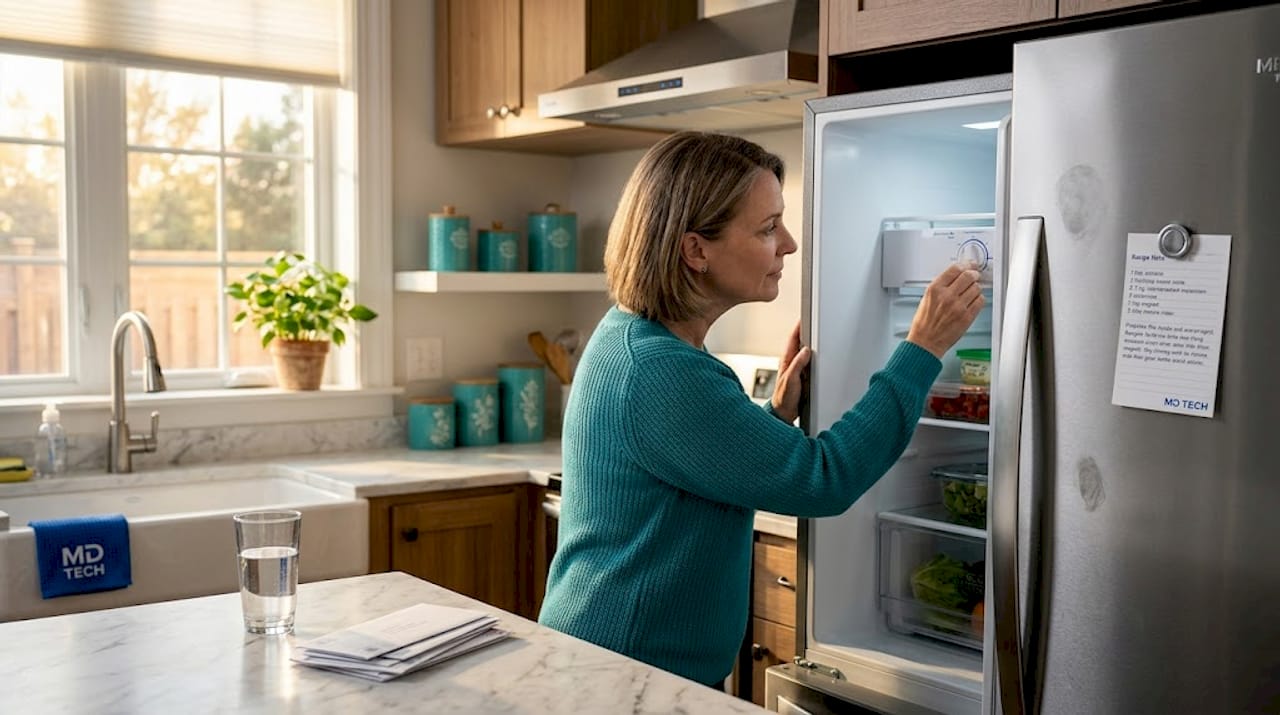
According to Consumer Reports, you should set your fridge to 37°F and your freezer to 0°F for the best balance of food safety and energy efficiency. Going just a few degrees lower might feel like extra insurance for your food, but it actually wastes a significant amount of electricity without any measurable benefit.
Here’s something that surprises a lot of people: for every 10°F you drop below the recommended setting, your refrigerator uses roughly 25% more energy. If your freezer is set to negative 10°F because someone bumped the dial years ago, you could be throwing away a quarter of the energy your freezer uses every single day. Over a full year in Southern California, that adds up fast.
The bigger problem is that most built-in temperature dials are notoriously unreliable. The number printed on the dial rarely reflects the actual internal temperature. A setting labeled “3” on one brand might read 40°F on a thermometer, while the same setting on a different model reads 33°F. You simply cannot trust the dial alone.
Temperature versus energy consumption
| Fridge setting | Actual temp | Estimated energy impact |
|---|---|---|
| Too warm | Above 40°F | Food safety risk |
| Optimal | 35°F to 38°F | Baseline energy use |
| Slightly too cold | 32°F to 34°F | Up to 10% more energy |
| Too cold | Below 30°F | Up to 25% more energy |
| Freezer optimal | 0°F | Baseline energy use |
| Freezer too cold | Negative 10°F | Up to 25% more energy |
Pro Tip: Buy two inexpensive refrigerator thermometers, one for the fridge and one for the freezer. Place them in the middle of each compartment, away from walls and vents. Check them after 24 hours and adjust your settings accordingly. This one step, which costs about five dollars total, can immediately reveal whether you’re wasting energy right now.
Good maintenance for longer lifespan always starts with understanding what your appliance is actually doing, not what you assume it’s doing. Temperature calibration is step one, and it costs nothing except a few minutes of your time.
Organize and use your fridge efficiently
Setting the right temperature is step one, but your daily habits also make a huge difference in energy use. The way your household interacts with the refrigerator every day can quietly add to your bill in ways you’d never expect.
Every time you open the refrigerator door, cold air spills out and warm room-temperature air rushes in. Your compressor then has to kick on and bring the interior back down to temperature. This cycle is normal, but it becomes a serious energy drain when doors are held open for too long or opened repeatedly within a short time. On a warm Southern California afternoon when your kitchen is 80°F, that warm air intrusion hits even harder.
The key to refrigerator efficiency is minimizing the time the door stays open and having a clear system so you always know where things are. When people stand in front of an open fridge browsing, the temperature inside can drop several degrees in under a minute.
Here are practical organization steps that make a real difference:
- Group by frequency of use. Items you grab every morning, like coffee creamer, juice, and butter, should be at the front of a dedicated shelf. You open, grab, and close. Done in three seconds.
- Use clear containers. When food is visible, you don’t have to dig or wonder what’s inside. This alone cuts browsing time dramatically.
- Label leftovers with dates. You’ll stop throwing away mystery containers and spend less time investigating what’s still good.
- Keep the fridge at about 75% capacity. A fridge that’s too empty loses cold air quickly when opened. One that’s overpacked restricts airflow between shelves, creating warm spots.
- Store ready-to-eat snacks at eye level. What people see first is what they grab first, which means fewer seconds with the door open.
- Avoid putting warm food directly inside. Let leftovers cool to room temperature first. Placing hot food in the fridge forces the compressor to work overtime.
Pro Tip: Designate a “snack zone” for kids on one clearly marked shelf. Fill it with grab-and-go items like cheese sticks, yogurt cups, and cut fruit. Children spend far less time standing in front of an open fridge when they know exactly where their options are. This small change can noticeably reduce door-open time in busy households.
Sticking to reasonable maintenance schedules and understanding the role of refrigeration in the home makes it easier to build these habits naturally rather than treating them as burdens.
Maintain and clean for peak performance
Good organization helps daily performance, but keeping components clean is just as critical for efficiency and long-term savings. Dirt and neglect are among the most common reasons refrigerators use more energy than they should.
The condenser coils in your refrigerator release heat from inside the unit to the surrounding room. When those coils are coated in dust, pet hair, and debris, they can’t release heat efficiently. The compressor then has to run longer and work harder to keep the inside cold. It’s a direct relationship: dirtier coils equal higher energy use.
“Dirty coils act like a blanket over the heat exchange surface, insulating what’s supposed to radiate heat outward. It’s the same principle as a clogged cooling fan on a PC. You wouldn’t run a computer with a blocked cooler, and your refrigerator deserves the same respect. Vacuum the fins gently to avoid bending them, and your compressor will thank you.” — U.S. Department of Energy
Beyond coils, the door gaskets (the rubber seals around the doors) need regular attention. A gasket that has cracks, tears, or weak spots lets cold air leak out constantly, even when the door is closed. Your compressor runs to compensate. A quick test: place a dollar bill in the closed door. If it slides out without resistance, your seal is weak enough to waste energy.
Here’s a numbered maintenance checklist with recommended frequency:
- Clean condenser coils every 6 to 12 months. Use a vacuum or a coil brush. If you have pets that shed, clean every 3 to 4 months.
- Inspect door gaskets once a year. Look for cracks, tears, and areas where the seal feels loose against the frame.
- Check the defrost drain annually. A blocked drain leads to water pooling and ice buildup that strains the system.
- Clean interior surfaces and shelves monthly. Spills create odors and, over time, affect how well cold air circulates.
- Verify the fridge is level twice a year. An uneven refrigerator can cause door seal issues and force the motor to work unevenly.
- Check for frost buildup in manual-defrost models monthly. Excess frost forces the compressor to work harder to maintain temperature.
Understanding the defrost cycle explained helps you recognize when frost buildup is becoming a problem before it escalates. Similarly, knowing how insulation boosts appliance efficiency gives you a fuller picture of why these maintenance steps matter so much in hot SoCal weather.
Pro Tip: Set a recurring reminder on your phone labeled “Fridge coil check” for every six months. In areas of Orange County and Los Angeles County where construction dust, dry air, and pet dander are common, this reminder can prevent the kind of slow efficiency loss that sneaks up on you over time.
Upgrade to efficient models and choose the right design
Ongoing maintenance has its limits, especially with older appliances. Here’s how to assess if a swap is the right move.
Refrigerators built more than 15 years ago use 35% more energy than current ENERGY STAR certified models. That’s not a small difference. On a Southern California electric bill, running an old fridge versus a new efficient one could mean paying an extra $50 to $80 per year just for the refrigerator alone. Over a decade, that’s real money.
ENERGY STAR estimates that certified models save up to $340 over 10 years compared to side-by-side models built to 2016 standards. That savings calculation doesn’t even account for SoCal’s above-average electricity rates, which means your actual savings could be higher.
Not all refrigerator designs are equal when it comes to energy use. Top-freezer models are the most efficient design category. French door and side-by-side models are popular but tend to use more power. Fewer doors generally means fewer seals to maintain and less thermal transfer every time a door opens.
Comparison of common refrigerator types
| Fridge type | Relative energy use | Best feature | Drawback |
|---|---|---|---|
| Top-freezer | Lowest | Most efficient design | Less stylish |
| Bottom-freezer | Moderate | Easy fridge access | Slightly more energy |
| Side-by-side | Higher | Large capacity | More energy, harder to seal |
| French door | Higher | Fashionable, spacious | Highest energy use |
| Counter-depth | Varies | Space-saving | Limited storage |
When shopping, also look for models that use low-GWP (global warming potential) refrigerants. These newer refrigerants are better for the environment and often signal a newer, more optimized mechanical design overall.
Signs it’s time to consider an upgrade:
- Your fridge is over 15 years old. The efficiency gap compared to new models is too significant to ignore.
- It runs almost constantly. A healthy compressor cycles on and off. Constant running is a warning sign.
- Your energy bills have climbed with no clear explanation. An aging compressor draws increasing power as it degrades.
- Repairs are costing more than the appliance is worth. If you’ve spent $300 in repairs on a 14-year-old fridge, a new one is probably the better investment.
- The freezer struggles to stay below 10°F. Freezer performance loss is a strong sign of compressor decline.
For more on this decision, the why upgrade old appliances guide breaks down the financial math clearly. You can also review energy efficient appliance basics to understand what certifications and ratings actually mean before you shop. For those looking at accessory upgrades, quality energy-saving fridge filters are another way to support your appliance’s performance between major upgrades.
Why energy-saving habits matter more than expensive upgrades
Here’s a perspective you won’t hear from appliance retailers: the biggest gains in refrigerator efficiency almost never come from buying something new. They come from changing small, daily behaviors that you’ve probably never thought about twice.
We’ve worked with homeowners across Orange County and Los Angeles County who were convinced their high electric bills meant they needed a brand-new refrigerator. In many cases, a coil cleaning, a gasket replacement, and a temperature calibration cut their fridge’s energy draw by 15 to 20 percent. That’s without spending more than $20.
Southern California’s climate amplifies this reality. When your kitchen sits at 78°F or higher for six months of the year, every inefficiency in your refrigerator costs you proportionally more than it would for a homeowner in a cooler climate. A dirty coil or a warm temperature setting that might waste $10 per year in Minnesota could waste $30 or more in Anaheim or Torrance.
The benefits of energy-efficient appliances are real, but they’re not a substitute for smart habits. Think of a new ENERGY STAR fridge as the ceiling on your efficiency potential, and your daily behaviors as the floor. Most people are living far closer to the floor than they realize.
“The most powerful energy-saving tool in your kitchen isn’t a $1,200 appliance. It’s a five-dollar thermometer, a vacuum, and five minutes every six months.”
Diligence consistently beats dollars when it comes to appliance efficiency. You don’t need to upgrade to save money. You need to pay attention.
Get expert help maximizing your fridge’s efficiency
Ready to take the next step toward lower bills and a more efficient kitchen? Sometimes the best move is getting a professional set of eyes on your appliance.
Our licensed technicians serve homeowners throughout Orange County and Los Angeles County and specialize in diagnosing exactly what’s costing you money. Whether it’s a failing gasket, an aging compressor, or a question about whether repair or replacement makes more sense, our team can help you make the right call. Check out our repair vs replacement guide to understand your options before you spend a dollar. If you need hands-on help, our Samsung appliance repair experts and full-service team are just a booking form away. You can also explore our appliance parts replacement resources if a specific component is the issue.
Frequently asked questions
How often should I clean my refrigerator’s coils for energy savings?
Clean your refrigerator coils every 6 to 12 months, or more often if you have pets or significant dust, to maintain optimal efficiency. As the U.S. Department of Energy notes, dirty coils strain the compressor the same way a clogged cooler stresses a PC.
Does keeping my fridge fuller help save energy?
Yes, a fuller fridge retains cold temperatures better when opened, reducing how hard the compressor has to work. Just avoid overpacking, which blocks airflow between shelves and creates warm spots.
Is it worth replacing an old but working refrigerator?
Fridges over 15 years old use 35% more energy than modern efficient models, so replacing them typically pays off through ongoing energy savings, especially in high-rate markets like Southern California.
What’s the ideal fridge and freezer temperature for energy efficiency?
Set your refrigerator to 37°F and your freezer to 0°F for the best balance of food safety and energy efficiency. Going colder than these settings wastes energy with no benefit to your food.
Do door-in-door refrigerators use more energy?
Yes, refrigerators with more doors use more energy than simpler designs because more door seals create more opportunities for heat transfer and air leakage. Top-freezer models with a single door design remain the most efficient option available.