
Tired of watching utility bills climb every month due to outdated appliances? Homeowners across Orange and Los Angeles Counties are increasingly seeking ways to cut household expenses while making smarter choices for sustainable living. Exploring the features and standards behind energy-efficient appliances reveals how these products deliver reliable performance at a lower long-term cost. With clear efficiency benchmarks and advanced technology, you can reduce waste and support a greener future without sacrificing convenience.
Table of Contents
- What Makes An Appliance Energy Efficient
- Types Of Energy Efficient Appliances Available
- Key Features And Performance Standards
- How Energy Efficiency Lowers Utility Costs
- Rebates, Incentives, And Tax Credits Explained
- Comparing Energy Efficient Vs. Traditional Models
Key Takeaways
| Point | Details |
|---|---|
| Energy Efficiency Defined | Energy efficiency goes beyond electricity consumption, focusing on reducing power usage while maintaining performance. |
| Financial Incentives | Various rebates and tax credits make energy-efficient appliances more accessible, enhancing their economic appeal. |
| Technological Advancements | Modern appliances utilize advanced technologies to minimize energy waste, leading to substantial savings and improved performance. |
| Comparative Benefits | Energy-efficient models offer lower operating costs, reduced environmental impact, and superior functionality compared to traditional appliances. |
What Makes an Appliance Energy Efficient
Understanding what defines an energy-efficient appliance goes beyond simple electricity consumption. Energy efficiency represents a comprehensive approach to reducing power usage while maintaining optimal performance. Appliance efficiency standards establish critical benchmarks that guide manufacturers and consumers toward more sustainable technology.
At its core, an energy-efficient appliance incorporates several key characteristics:
- Uses significantly less electricity compared to standard models
- Meets or exceeds national and state efficiency requirements
- Incorporates advanced technological design to minimize energy waste
- Provides equivalent or superior performance while consuming less power
- Includes clear energy rating labels indicating efficiency levels
Modern energy-efficient appliances leverage cutting-edge technologies to achieve remarkable power savings. These technologies might include improved insulation, advanced compressor designs, smart sensors that optimize operational cycles, and precision-engineered components that reduce friction and energy loss.
Energy-efficient appliances aren’t just about saving money—they represent a critical strategy for reducing overall environmental impact and supporting sustainable living.
National appliance efficiency standards ensure that consumers have access to products engineered with energy conservation in mind. These standards continuously evolve, pushing manufacturers to develop increasingly sophisticated and environmentally responsible technologies.
Pro Tip: When shopping for energy-efficient appliances, always check the Energy Star rating and compare the estimated annual energy costs to maximize your long-term savings.
Types of Energy Efficient Appliances Available
The world of energy-efficient appliances has dramatically expanded, offering consumers a wide range of options to reduce electricity consumption and environmental impact. Super-efficient equipment encompasses multiple household and commercial product categories designed to minimize energy waste while maintaining high performance standards.
Here are the primary categories of energy-efficient appliances available today:
- Refrigeration Units
- Advanced compressor technologies
- Improved insulation systems
- Smart temperature management
- Laundry Appliances
- High-efficiency washers with reduced water consumption
- Dryers with moisture sensors and low-heat settings
- Eco-friendly wash cycles
- Kitchen Appliances
- Induction cooktops with precise energy control
- Convection ovens with improved heat distribution
- Dishwashers with water and energy-saving modes
- Climate Control Systems
- Smart thermostats with learning capabilities
- Energy-efficient heat pumps
- Zoned heating and cooling systems
International energy efficiency initiatives have been instrumental in driving technological innovations that make these appliances increasingly sophisticated and environmentally responsible. Modern energy-efficient appliances integrate advanced sensors, intelligent software, and precision-engineered components to optimize energy consumption across various operational scenarios.
Energy-efficient appliances represent more than just technological advancement—they are a critical strategy for reducing household energy expenditures and minimizing carbon footprints.
Consumers can now select from an impressive array of appliances that not only perform their core functions effectively but also contribute to broader sustainability goals. These technologies continue to evolve, offering increasingly intelligent and resource-conscious solutions for home and commercial environments.
Here’s how common appliance types compare in efficiency technologies and potential savings:
| Appliance Type | Notable Efficiency Technology | Estimated Energy Savings |
|---|---|---|
| Refrigerator | Smart compressors, insulation | Up to 40% lower usage |
| Washing Machine | Eco modes, moisture sensing | Up to 30% lower usage |
| Oven/Cooktop | Induction, convection airflow | Up to 20% lower usage |
| HVAC System | Smart thermostats, zoned control | Up to 50% lower usage |
Pro Tip: When purchasing energy-efficient appliances, compare the estimated annual energy costs and look for Energy Star certifications to maximize long-term savings and environmental benefits.
Key Features and Performance Standards
Energy efficiency standards represent a critical framework that ensures appliances deliver optimal performance while minimizing energy consumption. The U.S. Department of Energy (DOE) plays a pivotal role in establishing and enforcing these comprehensive guidelines across multiple product categories.
Key performance standards for energy-efficient appliances typically include:
- Minimum Energy Efficiency Requirements
- Specific kilowatt-hour consumption limits
- Annual energy use calculations
- Standardized testing protocols
- Operational Performance Metrics
- Temperature maintenance capabilities
- Cooling and heating efficiency ratings
- Water and electricity consumption benchmarks
- Technological Compliance Criteria
- Smart sensor integration requirements
- Advanced control system specifications
- Minimum efficiency reporting value (MERV) standards
Modern energy-efficient appliances must undergo rigorous testing to demonstrate compliance with these multifaceted performance standards. Manufacturers must provide detailed documentation proving their products meet or exceed established efficiency benchmarks, ensuring consumers receive high-quality, environmentally responsible technology.
Performance standards are not static—they continuously evolve to drive technological innovation and promote increasingly sustainable product design.
The complexity of these standards reflects the sophisticated engineering behind contemporary energy-efficient appliances. By establishing clear, measurable criteria, regulatory bodies encourage manufacturers to develop increasingly intelligent and resource-conscious technologies that benefit both consumers and the environment.
Pro Tip: Always request detailed efficiency ratings and comparative performance data when selecting new appliances to make the most informed and economically sound decision.
How Energy Efficiency Lowers Utility Costs
Energy-efficient appliances represent a strategic approach to reducing household utility expenses while simultaneously minimizing environmental impact. By consuming significantly less electricity than traditional models, these innovative technologies offer homeowners a powerful method of controlling monthly energy expenditures.
The financial benefits of energy-efficient appliances can be substantial and quantifiable:
- Immediate Cost Reductions
- 10-50% lower energy consumption
- Reduced monthly utility bills
- Faster return on initial investment
- Long-Term Financial Advantages
- Cumulative savings over appliance lifetime
- Lower maintenance and replacement costs
- Increased home value and marketability
- Environmental and Economic Impact
- Reduced carbon footprint
- Decreased demand on electrical grid
- Support for sustainable technology development
Upgraded efficiency standards demonstrate remarkable potential for consumer savings. For instance, improvements in washer and dryer technologies can help U.S. consumers save billions annually in electric bills, proving that smart appliance choices translate directly into tangible financial benefits.
Energy efficiency is not just an environmental strategy—it’s a sophisticated financial planning tool that pays dividends through reduced utility expenses.
The economic advantages extend beyond immediate cost savings. Energy-efficient appliances typically feature advanced technologies that enhance performance, reduce wear and tear, and provide more reliable long-term operation. This means consumers not only save on monthly bills but also enjoy higher-quality, more durable household equipment.
Pro Tip: Calculate potential savings by comparing the annual energy cost of your current appliances with energy-efficient models, factoring in both purchase price and expected utility bill reductions.
Rebates, Incentives, and Tax Credits Explained
Energy efficiency programs provide strategic financial incentives that help consumers offset the initial costs of purchasing energy-efficient appliances. These comprehensive support mechanisms make sustainable technology more accessible by reducing the financial barriers that often prevent homeowners from making environmentally responsible choices.
The primary types of financial incentives typically include:
- Utility Company Rebates
- Direct cash back on energy-efficient appliance purchases
- Varying amounts based on product type and efficiency rating
- Immediate reduction in upfront costs
- Federal Tax Credits
- Dollar-for-dollar reductions in tax liability
- Specific credits for different appliance categories
- Annual updates to eligible technologies
- State-Level Incentives
- Additional financial support beyond federal programs
- Region-specific rebate structures
- Complementary financing options
Energy efficiency financial support aims to accelerate the adoption of sustainable technologies by making them more economically attractive. These programs are designed not just as consumer benefits, but as strategic tools for reducing overall energy consumption and supporting broader environmental goals.
Financial incentives transform energy-efficient appliances from a premium choice to an economically sensible investment for conscientious homeowners.
Navigation of these incentive programs requires careful research and timing. Homeowners should regularly check utility company websites, state energy offices, and federal tax credit resources to maximize their potential savings. The landscape of rebates and credits is dynamic, with programs frequently updating their offerings and eligibility requirements.
Here’s a quick overview of the main financial incentives available for energy-efficient appliances:
| Incentive Type | Who Offers It | Typical Benefit |
|---|---|---|
| Utility Rebate | Electric/gas companies | $25-$400 per appliance |
| Federal Tax Credit | IRS/government | Up to 30% of purchase |
| State Incentive | State energy officials | Additional rebates |
Pro Tip: Create a dedicated folder to track all rebate receipts, efficiency ratings, and tax credit documentation to streamline your potential savings and ensure you don’t miss any financial benefits.
Comparing Energy Efficient vs. Traditional Models
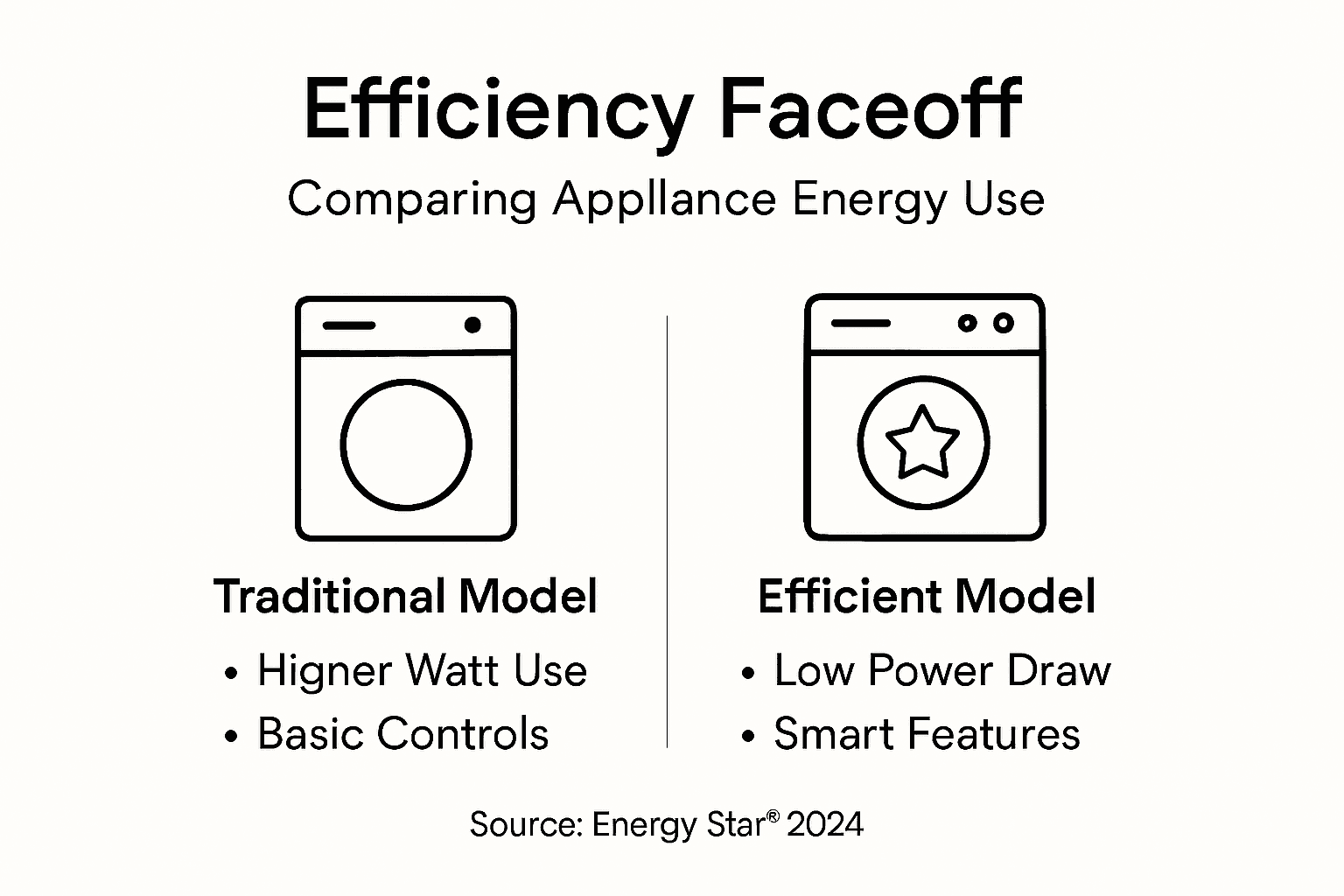
Energy-efficient appliance standards reveal significant performance differences between traditional and modern models. These benchmarks demonstrate that contemporary technologies can deliver superior functionality while dramatically reducing energy consumption and operational costs.
Key comparative aspects between energy-efficient and traditional appliances include:
- Energy Consumption
- Traditional models: Higher electricity usage
- Energy-efficient models: 10-50% lower energy consumption
- Long-term savings potential
- Operating Costs
- Traditional models: Higher monthly utility expenses
- Energy-efficient models: Reduced ongoing operational costs
- Faster financial return on investment
- Environmental Impact
- Traditional models: Higher carbon emissions
- Energy-efficient models: Reduced greenhouse gas production
- Smaller overall ecological footprint
Green technology comparisons highlight that while energy-efficient appliances might initially cost more, their lifetime value significantly outweighs the upfront price difference. Advanced engineering allows these models to maintain or exceed performance standards of traditional appliances while consuming substantially less energy.
The true value of energy-efficient appliances extends beyond monetary savings—they represent a meaningful commitment to sustainable living and environmental responsibility.
Modern energy-efficient appliances incorporate sophisticated technologies like smart sensors, advanced insulation, and precision-engineered components. These innovations enable them to operate more intelligently, adapting to usage patterns and minimizing unnecessary energy expenditure in ways traditional models cannot.
Pro Tip: When comparing appliance models, calculate the total cost of ownership by adding purchase price to estimated annual energy costs to make a truly informed decision.
Ensure Your Energy Efficient Appliances Perform at Their Best
Choosing energy efficient appliances is a smart way to reduce utility costs and minimize environmental impact as the article highlights. However, even the most advanced appliances need expert care to maintain their peak performance and maximum energy savings. Common challenges include unexpected breakdowns, inefficient operation, or installation issues that can negate the benefits of super-efficient technologies.
Don’t let appliance problems undermine your energy savings. At Appliances Repair MD Tech, we specialize in professional repair and installation services for refrigerators, washers, dryers, ovens, dishwashers, and HVAC systems throughout Orange County and Los Angeles County. Our licensed technicians understand the specific needs of energy efficient models and ensure your appliances run reliably and cost-effectively.
Take control of your home’s energy use today with fast and trusted service from experts who put your savings first. Book an appointment online now at Appliances Repair MD Tech and protect your investment in energy efficient technology. Discover how easy it is to keep your appliances running smart and saving money with Appliance Repair Services. Act now to maximize efficiency and lower your monthly bills.
Frequently Asked Questions
What are the benefits of choosing energy-efficient appliances?
Energy-efficient appliances save on electricity bills, reduce environmental impact, and often have advanced features that improve overall performance.
How do energy-efficient appliances compare to traditional models in terms of energy consumption?
Energy-efficient appliances typically use 10-50% less energy than traditional models, leading to significant long-term savings on utility costs.
What should I look for when shopping for energy-efficient appliances?
Always check for the Energy Star rating and compare estimated annual energy costs to ensure you maximize your savings and eco-friendliness.
Do energy-efficient appliances really reduce my carbon footprint?
Yes, these appliances consume less electricity, which translates to reduced greenhouse gas emissions, contributing to a smaller overall ecological footprint.