
Switching to ductless air conditioning could cut your cooling bills by up to 35% compared to running a traditional central AC system in your Orange or Los Angeles County home. Most homeowners assume ductless systems are either too expensive or too complicated to be worth it. That’s a misconception worth clearing up. This article walks you through exactly how mini-split systems work, what they cost, how they stack up against central AC, and how to decide if one is right for your home.
Table of Contents
- What is ductless air conditioning?
- How ductless AC systems work
- Ductless vs central air: Efficiency and cost comparison
- Advantages and limitations of ductless mini-split systems
- Is ductless AC right for your Orange or LA County home?
- Upgrade your home cooling with expert help
- Frequently asked questions
Key Takeaways
| Point | Details |
|---|---|
| Energy savings potential | Ductless mini-splits can cut cooling bills by 20-40% compared to central AC. |
| Flexible installation | Ductless AC systems fit homes without ductwork, additions, or those needing zoned comfort. |
| Long-term cost advantage | Despite higher upfront cost, mini-splits offer significant ROI and maintenance savings. |
| Local incentives available | California homeowners may qualify for rebates and discounts on energy-efficient ductless solutions. |
| Professional maintenance required | Annual service and filter cleaning ensure ductless systems remain efficient and warranties stay valid. |
What is ductless air conditioning?
Ductless air conditioning is exactly what it sounds like: a cooling system that delivers conditioned air directly into your living space without relying on a network of ducts running through your walls and ceilings. The system is commonly called a mini-split, and it’s made up of two main parts: an outdoor unit (which houses the compressor and condenser) and one or more indoor air handling units mounted on your walls or ceiling.
These two units are connected by a small bundle of refrigerant lines, a power cable, and a condensate drain line. That bundle runs through a small hole in your wall, typically about three inches wide. Ductless AC connects outdoor and indoor units via refrigerant lines, delivering conditioned air directly without any ductwork at all.
Here’s why that matters for homes in Orange and LA Counties:
- Older homes built before central AC was standard often lack duct infrastructure entirely
- Room additions like garages, sunrooms, or ADUs (accessory dwelling units) are expensive to connect to existing duct systems
- Retrofitting ducts into an existing home can cost thousands of dollars and require major construction
- Apartments and condos often prohibit duct modifications, making ductless the only viable option
- Targeted cooling means you only condition the rooms you actually use
For HVAC maintenance in California, understanding your system type is the first step toward keeping it running efficiently year after year.
How ductless AC systems work
Now that we’ve defined mini-splits, let’s reveal how they actually deliver cooling and heating in your home. The process relies on the refrigeration cycle, which moves heat from inside your home to the outdoors rather than generating cold air from scratch.
Here’s the step-by-step process:
- Compression: The outdoor compressor pressurizes refrigerant gas, raising its temperature significantly
- Condensation: The hot refrigerant releases heat to the outside air through the condenser coil
- Expansion: The refrigerant passes through an expansion valve, dropping in pressure and temperature rapidly
- Evaporation: The cold refrigerant absorbs heat from your indoor air through the evaporator coil inside the wall unit
- Reversal for heating: A reversing valve flips the cycle direction, pulling heat from outside air and delivering it indoors
Mini-splits operate on the heat pump principle using this refrigeration cycle, with a reversing valve enabling both heating and cooling from a single system. That means you get year-round comfort from one installation.
The real efficiency advantage comes from the inverter compressor. Unlike traditional AC units that switch fully on or off, an inverter compressor adjusts its speed continuously to match your exact cooling demand. It’s like the difference between a car that only runs at full throttle or completely off versus one with a smooth accelerator. The result is less energy waste and more consistent temperatures.
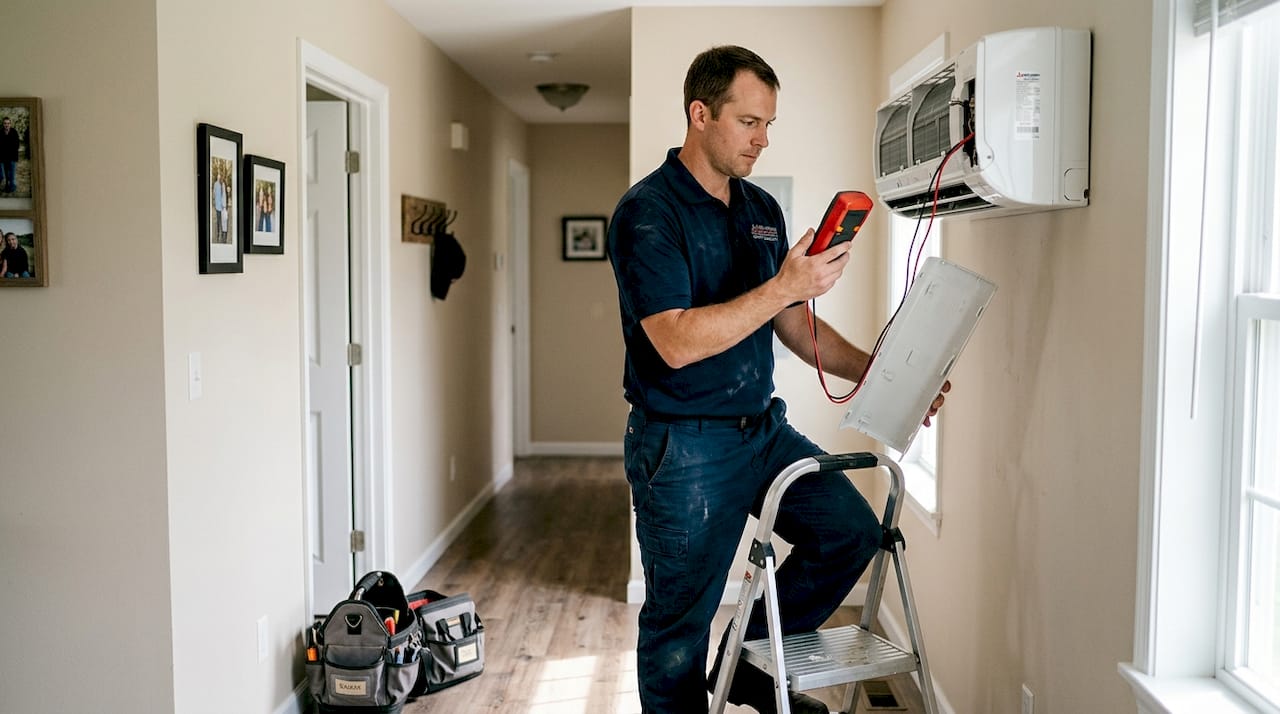
Pro Tip: Schedule a professional tune-up every year before summer hits. Keeping refrigerant levels correct and coils clean can preserve up to 95% of your system’s original efficiency rating over its lifespan. Our high efficiency HVAC guide covers what to check and when.
Ductless vs central air: Efficiency and cost comparison
Understanding how the system works sets the stage for comparing its real-world efficiency and costs. The numbers here are where most homeowners have their “aha” moment.
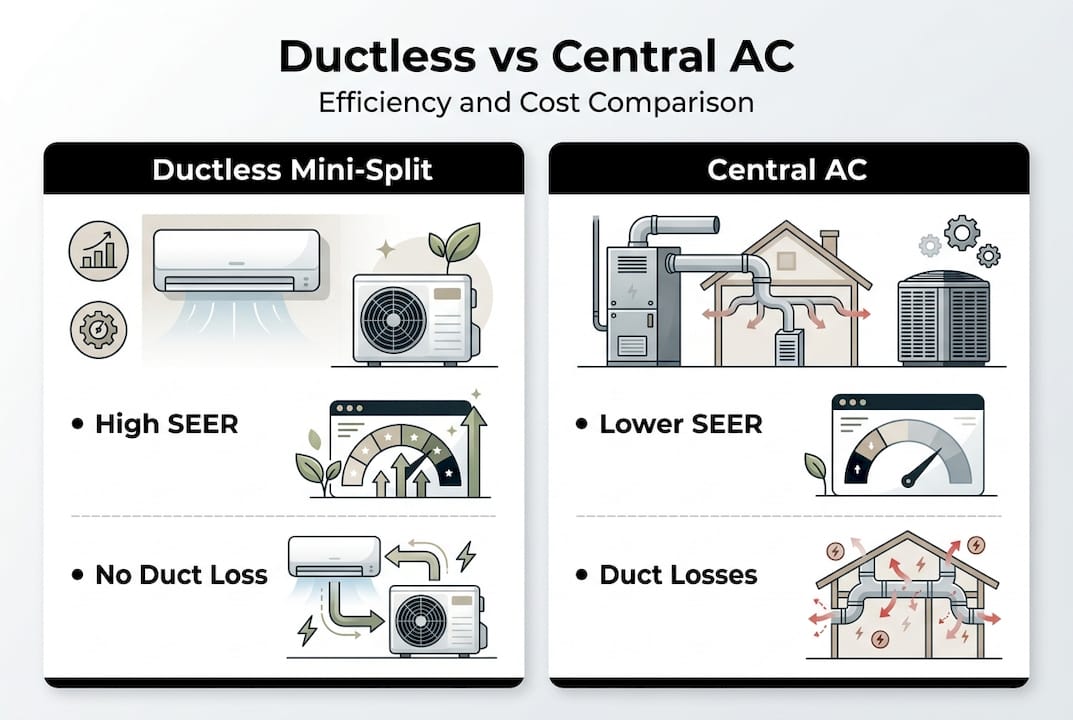
Efficiency ratings at a glance:
| Feature | Ductless mini-split | Central AC |
|---|---|---|
| SEER rating range | 20 to 33+ | 13 to 21 |
| Duct energy loss | None | 20% to 40% |
| Zoning capability | Yes, per room | Limited |
| Annual cost (1,800 sq ft) | $800 to $1,100 | $1,100 to $1,500 |
| Single-zone install cost | $3,000 to $8,000 | N/A |
| Multi-zone install cost | $10,000 to $20,000 | $7,000 to $15,000+ |
SEER (Seasonal Energy Efficiency Ratio) measures how efficiently a system cools per unit of electricity. Mini-splits reach SEER ratings of 20 to 33+ compared to 13 to 21 for central AC, and they eliminate the 20 to 40% energy loss that happens when cooled air travels through leaky ducts. Zoning alone can reduce your energy use by an additional 20 to 30%.
Key insight: A typical 1,800 square foot home in Orange County running a ductless system can save $300 to $700 per year on cooling costs compared to central AC. Over a 10-year period, that’s real money back in your pocket.
Installation costs for mini-splits run $3,000 to $8,000 for a single zone and $10,000 to $20,000 for multi-zone setups. Compare that to central AC with new ductwork, which can easily exceed $15,000. The mini-split cost benchmarks show operating savings of 15 to 35% thanks to inverter technology and the elimination of duct losses.
Homes that benefit most from ductless over central:
- Homes without existing ductwork
- Homes with only one or two rooms that need cooling
- Properties with room additions or detached structures
- Older homes where duct installation would require major renovation
For tips on reducing long-term costs, our guide on annual HVAC service savings breaks down exactly what regular maintenance saves you over time.
Advantages and limitations of ductless mini-split systems
With the comparison in mind, let’s review what makes ductless mini-splits uniquely valuable and where they might fall short.
Advantages:
- Energy savings: No duct losses and inverter technology deliver consistent efficiency gains
- Flexible installation: No major construction required; most installs finish in one day
- Zoning control: Each indoor unit operates independently, so you cool only occupied rooms
- Heating included: Heat pump capability means one system handles both seasons
- Long-term ROI: Higher upfront cost is typically recovered within 5 to 8 years through lower bills
- Quiet operation: Indoor units run at whisper-quiet levels, often below 30 decibels
- California rebates: Many utility programs in Orange and LA Counties offer rebates for qualifying high-efficiency mini-splits
Limitations:
- Visible indoor units: Wall-mounted units are noticeable and not everyone loves the look
- Upfront cost: Higher initial investment than window units or portable AC
- Filter maintenance: Indoor units require filter cleaning every 4 to 6 weeks during heavy use
- Professional installation required: DIY installs void warranties and can cause performance issues; always use a licensed technician
Pro Tip: Look for mini-split models rated for cold climates if you want reliable heating. Some models heat effectively down to -13°F, which is far more than you’ll ever need in Southern California, but it signals strong performance in mild weather too. Check top-rated mini-split brands before you buy.
For homes in Orange and LA Counties, mini-splits are cheaper long-term in no-duct scenarios, especially given California’s above-average electricity rates and available incentive programs. Keeping your system in top shape with regular HVAC maintenance protects both your investment and your energy savings.
Is ductless AC right for your Orange or LA County home?
Finally, let’s outline exactly how you can assess whether a mini-split makes sense for your home in Orange or LA County. This isn’t a one-size-fits-all decision, but a few key questions make it straightforward.
Step-by-step evaluation:
- Check your existing ductwork: Do you have ducts in good condition? If yes, central AC may still be cost-effective. If no ducts exist, ductless is almost always the better choice
- Identify your cooling zones: Do you need whole-home cooling or just specific rooms? Ductless excels at targeted, room-by-room comfort
- Assess your home’s age and layout: Older homes and those with additions are prime candidates for ductless systems
- Calculate your energy goals: If reducing your monthly bill is a priority, ductless delivers measurable savings
- Research local rebates: Check with Southern California Edison, SoCalGas, or your local utility for current incentive programs before purchasing
Quick decision guide:
| Your situation | Best fit |
|---|---|
| No existing ductwork | Ductless mini-split |
| Room addition or ADU | Ductless mini-split |
| Whole-home cooling with good ducts | Central AC |
| Cooling 1 to 3 rooms only | Ductless mini-split |
| Tight renovation budget | Ductless mini-split |
| Large home, all rooms used daily | Central AC or multi-zone ductless |
Ductless mini-splits offer cost-effective cooling through zoning for variable use, especially in mild climates like ours, and they avoid the expense of duct retrofits in older homes. If you’re unsure about your ductwork condition, our team handles professional duct installation and can assess whether your existing system is worth keeping. For a broader look at your options, our residential HVAC choices guide covers everything available to California homeowners in 2026.
Upgrade your home cooling with expert help
You now have a clear picture of how ductless AC works, what it costs, and whether it fits your home. The next step is getting the right professional involved before you spend a dollar.
Our licensed technicians serve homeowners across Orange and Los Angeles Counties, handling everything from new ductless installations to repairs and annual tune-ups. Whether you need local HVAC repair experts for an existing system or want to explore a full upgrade, we make the process simple. Our HVAC maintenance services keep your mini-split running at peak efficiency year after year. Not sure whether to fix your current system or replace it? Our repair vs replacement guide gives you a clear framework to decide. Book online today and get a same-day quote.
Frequently asked questions
How does ductless air conditioning differ from central AC?
Ductless AC uses wall-mounted indoor units connected to an outdoor compressor via refrigerant lines, while central AC pushes conditioned air through a network of ducts installed throughout the home. The key difference is that ductless delivers air directly to each room, eliminating duct-related energy losses entirely.
Are ductless AC systems more energy efficient?
Yes. Mini-splits carry SEER ratings of 20 to 33+ compared to 13 to 21 for central AC, and they eliminate the 20 to 40% energy loss that occurs in ductwork, making them significantly more efficient in most home scenarios.
What does installation usually cost for a ductless AC?
Single-zone installs run $3,000 to $8,000 and multi-zone systems range from $10,000 to $20,000. That’s often less than installing central AC with new ductwork, which can exceed $15,000.
Are rebates or incentives available for ductless AC in California?
Yes. California homeowners can often qualify for rebates on mini-split installations through utility programs like Southern California Edison. Check with your local utility and ask your installer about qualifying models before you purchase.
Do ductless AC systems require professional maintenance?
Yes. Professional installation protects your warranty and ensures correct performance. Beyond installation, plan to clean filters every 4 to 6 weeks and schedule annual professional servicing to maintain peak efficiency.