
TL;DR:
- Tankless water heaters heat water on demand, eliminating standby energy loss common in traditional tanks. They are more energy-efficient, last longer, but require proper sizing for home demand and infrastructure readiness. Professional assessment and installation are crucial for maximizing benefits and avoiding common sizing and maintenance pitfalls.
Your traditional water heater is running right now, burning gas or electricity to keep 40-80 gallons of water hot, even though nobody in your house needs hot water at this moment. That standby energy loss can account for up to 20-30% of your home’s total water heating costs. If you’ve been wondering what is a tankless water heater and whether switching makes sense for your Orange County or Los Angeles home, this guide covers exactly that: how these units work, what they actually save you, where they fall short, and how to size one correctly so you don’t end up with cold showers.
Table of Contents
- What is a tankless water heater and how does it work?
- Energy efficiency and cost benefits compared to traditional water heaters
- Comparing tankless and storage water heaters: Size, flow, and installation
- Is a tankless water heater right for your Orange County or Los Angeles home?
- What most guides miss: Sizing, simultaneous use, and local climate insights
- Get expert tankless water heater installation and repair in Orange and Los Angeles Counties
- Frequently asked questions
What is a tankless water heater and how does it work?
A tankless water heater, also called an on-demand water heater, heats water directly as it flows through the unit rather than storing it in a tank. The moment you open a hot water tap, cold water travels through a pipe into the heater, where a gas burner or electric element raises the temperature instantly. When you close the tap, the heater shuts off completely. No stored water, no standby heat loss.
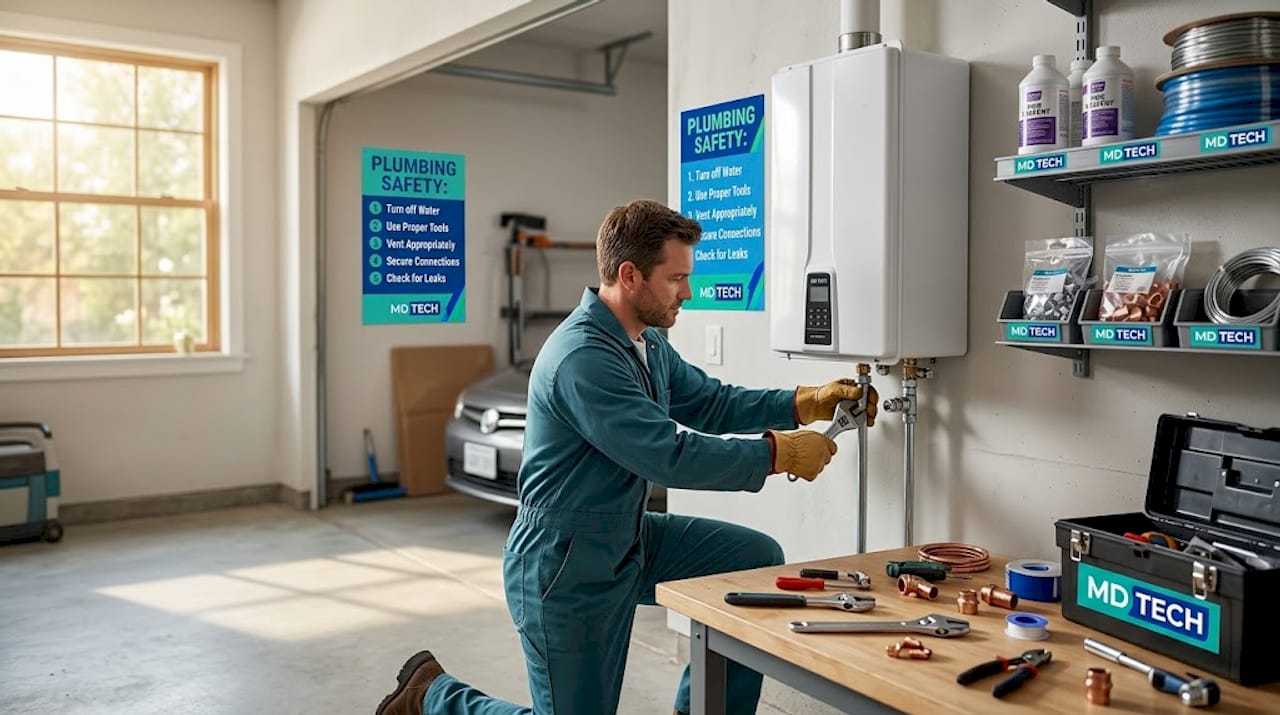
This design means standby losses are eliminated, which is the core reason these units run more efficiently than conventional tanks. You are not paying to keep water hot all night while everyone sleeps or all day while everyone is at work.
Here is what to know about the two main types:
- Gas-fired tankless heaters have inputs less than 200,000 Btu/h and require proper venting to exhaust combustion gases. They heat water faster and handle higher flow rates.
- Electric tankless heaters have inputs of 12 kW or less and are simpler to install but draw significant amperage, often requiring electrical panel upgrades.
- Most residential models deliver 2-5 gallons per minute (GPM) at a given temperature rise, meaning output depends on both your incoming water temperature and how hot you need it.
- Understanding your water heater repair basics also helps when evaluating any system’s long-term serviceability.
Pro Tip: Before purchasing, add up the GPM ratings of every fixture you might run at the same time, like a shower at 2 GPM plus a dishwasher at 1.5 GPM. That sum is your minimum required flow rate. Undersizing is the single most common mistake homeowners make, and it results in lukewarm water during peak morning hours.
Energy efficiency and cost benefits compared to traditional water heaters
The financial case for going tankless is real, but it requires you to think in years rather than months. The upfront investment is higher, but the ongoing cost picture tilts in favor of tankless for most households.
Tankless water heaters are 24-34% more energy efficient than conventional storage tanks in homes using fewer than 41 gallons of hot water per day. For an average household in Orange County or Los Angeles, that kind of daily usage covers two to three showers, a load of dishes, and some general use. Most smaller households fall well within this range.
The savings show up clearly over time:
- Annual utility savings: Eliminating standby loss can save $100-$200 annually on gas bills for a typical household.
- Longer lifespan: Tankless units last 15-20 years, nearly double the 8-12 year lifespan of a conventional storage tank.
- Fewer replacements: Two full tank replacements could cost you $1,500-$3,000 over the same period a single tankless unit operates. That math matters.
- Higher upfront cost: Professional installation runs $1,000-$6,000 depending on the unit and whether gas lines or electrical panels need upgrading.
Efficiency note: Homes using under 41 gallons daily can see energy savings of 24-34%. For larger households, pairing multiple tankless units or using tankless for targeted hot water zones can still deliver meaningful savings.
The break-even point varies. A gas-fired tankless unit in a medium-sized home in Anaheim or Pasadena, where utility rates are relatively high, often pays back the premium in six to ten years. After that, it is simply cheaper to operate. Learning more about water heater energy efficiency can help you model your specific savings scenario before committing.
Comparing tankless and storage water heaters: Size, flow, and installation
Understanding the structural differences between these two systems helps you make a confident decision rather than a hopeful one.
Tankless units deliver hot water without any stored supply, which means they depend entirely on their flow rate capacity. If your household’s simultaneous demand exceeds 5 GPM, a single unit may not keep up. Storage tanks, by contrast, hold 40-80 gallons ready to go and can satisfy multiple fixtures at once, as long as you don’t drain the tank.
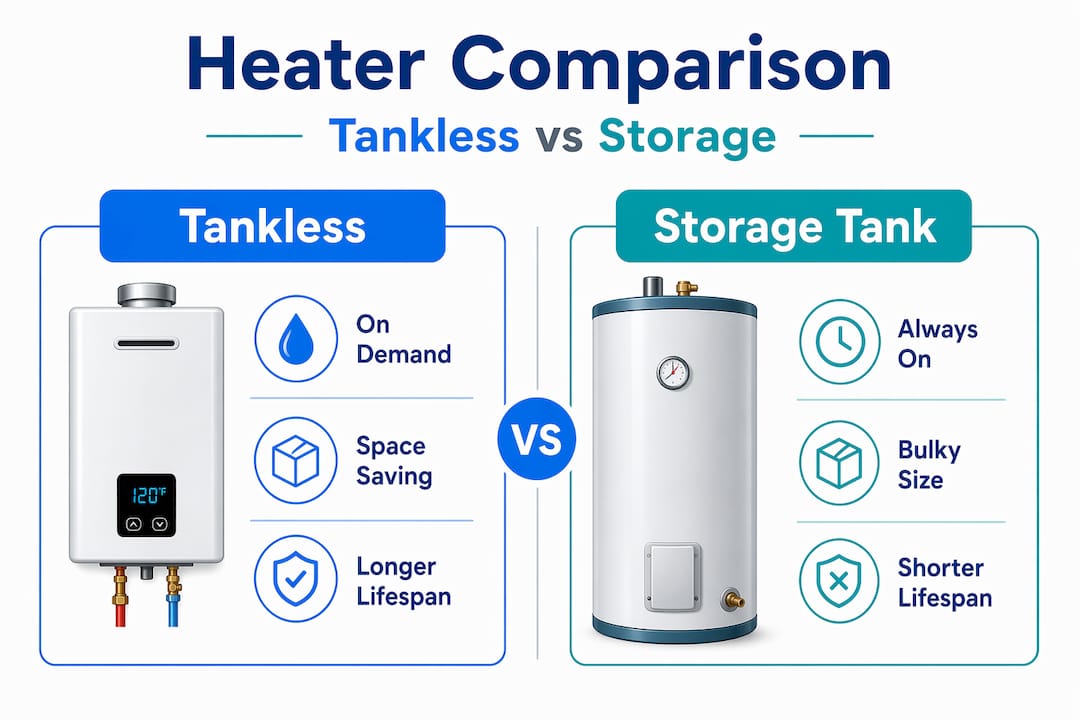
| Feature | Tankless water heater | Storage tank heater |
|---|---|---|
| Upfront cost | $1,000-$6,000 installed | $300-$1,500 installed |
| Lifespan | 15-20 years | 8-12 years |
| Energy efficiency | 24-34% better (low-use homes) | Baseline |
| Space usage | Wall-mounted, compact | Floor space required |
| Flow capacity | 2-5 GPM per unit | 40-80 gallon reserve |
| Installation complexity | Moderate to high | Low to moderate |
A few practical points worth knowing:
- Sizing matters more with tankless. Proper sizing requires a GPM and temperature rise calculation, not just matching a tank’s “first-hour rating.” Many homeowners skip this step and regret it.
- Storage tanks corrode from the inside out, making leaks and early failure common near the end of their lifespan.
- Tankless units need periodic descaling, especially in areas with hard water. Orange County water tends to run moderately hard, so flushing with a descaling solution annually is standard practice.
- Understanding common appliance repairs across your home systems helps contextualize the maintenance commitment tankless units require.
Pro Tip: Do not size a tankless unit by comparing it to your current tank’s gallon capacity. That is comparing apples to engines. Instead, calculate the GPM demand at your expected temperature rise. In Southern California, incoming water sits around 60-70°F in winter, so hitting 120°F output means a 50-60°F rise, which is substantial and directly affects the heater’s output capacity.
Is a tankless water heater right for your Orange County or Los Angeles home?
Not every home is a strong candidate for tankless, and the decision is worth thinking through rather than defaulting to whatever the installer recommends.
Here is a structured way to evaluate it:
- Assess your household’s peak hot water demand. Count how many fixtures run simultaneously during your busiest morning hour and add up their GPM. If that total exceeds 5 GPM regularly, plan for two units or a hybrid approach.
- Check your utility infrastructure. Gas-fired tankless units need adequate gas line capacity, and electric models may require a panel upgrade to 200 amps. Both add to installation cost.
- Calculate total cost of ownership over 15 years, not just the purchase price. Factor in installation, energy savings, and the avoided cost of one or two tank replacements.
- Evaluate your available space. Tankless units mount directly on a wall and free up significant floor space in a garage or utility closet, which matters in tighter LA or OC homes.
- Think about long-term plans. If you are adding solar panels in the next few years, an electric tankless heater pairs well with solar-generated electricity, potentially making your hot water nearly free.
Homes using less than 41 gallons daily are consistently the best candidates. Larger families with high simultaneous use may need multiple units, which changes the math significantly. Checking a repair vs replacement guide can also clarify whether your current tank is worth holding onto a few more years or whether now is the right time to switch.
What most guides miss: Sizing, simultaneous use, and local climate insights
Most articles on tankless water heaters tell you they are efficient and save money, then leave you to figure out the hard part alone. Here is what those articles skip.
The undersizing problem is far more common than people realize. A technician who sizes by matching your old tank’s gallon capacity will almost certainly pick a unit that cannot keep up during a real-world morning rush. The right method, confirmed by sizing experts, is to calculate your peak GPM demand multiplied by your required temperature rise. Anything else is guessing.
In Orange County, incoming groundwater temperature sits around 65-70°F in summer and drops toward 60°F in winter. To deliver a comfortable 120°F shower, you need a 50-60°F temperature rise. A unit rated at 5 GPM at a 35°F rise will only deliver around 2.5 GPM at a 70°F rise. That means your “5 GPM unit” cannot actually run two showers simultaneously in January. This is not a minor caveat. It is a core specification that most buyers never check.
Simultaneous use is the second problem nobody warns you about clearly. A household running two showers, a dishwasher, and filling a kitchen sink at the same time can easily hit 6-8 GPM, which exceeds what any single residential unit can handle. In a larger LA home or a rental property with multiple units, you either need two tankless heaters running in parallel or a different system entirely.
The good news is that a proper load analysis from a licensed professional eliminates all of this guesswork. Having regular plumbing checks also catches issues like scale buildup, pressure fluctuations, and venting problems early, before they reduce efficiency or cause failure. The homeowners who are unhappy with their tankless units almost always either bought the wrong size or skipped maintenance. Both are preventable.
Get expert tankless water heater installation and repair in Orange and Los Angeles Counties
Knowing the advantages of tankless water heaters is one thing. Getting the installation right is another. A professional sizing assessment, proper gas line or electrical evaluation, and correct unit selection can mean the difference between a system that saves you money for 20 years and one that leaves you frustrated with lukewarm water.
At Appliances Repair MD Tech, our licensed technicians serve homeowners and property managers throughout Orange County and Los Angeles County. We handle everything from initial sizing consultations to full installation, descaling maintenance, and repair of existing units. Use our repair vs replacement guide to decide whether your current system deserves attention or replacement. Pair that with scheduled plumbing checks to keep your investment running at peak efficiency. When you are ready to move forward, our team offers plumbing and pipe services tailored to local conditions, from Irvine to Pasadena. Book online or call to get started.
Frequently asked questions
How much energy can a tankless water heater save compared to a traditional tank?
Tankless water heaters can be 24-34% more energy efficient than traditional tank models, saving homeowners up to $100-$200 annually on gas bills by removing standby heat loss from the equation entirely.
Are tankless water heaters suitable for large households with multiple simultaneous hot water uses?
Tankless units have flow rate limits, typically 2-5 GPM; high-demand homes with multiple simultaneous fixtures may require two units running in parallel or a hybrid approach to meet peak needs without temperature drops.
What factors should I consider when sizing a tankless water heater?
Proper sizing depends on your peak GPM demand and required temperature rise; undersizing happens when installers match tank gallon capacity instead of calculating actual flow and thermal requirements.
How long do tankless water heaters typically last compared to traditional tanks?
Tankless units typically last 15-20 years with proper maintenance, nearly double the 8-12 year average lifespan of conventional storage tank models.
Are tankless water heaters more expensive to install than traditional models?
Yes, installation costs range from $1,000 to $6,000 nationally, higher than a conventional tank, but energy savings and the avoided cost of replacement over a longer lifespan often close that gap within a decade.