
TL;DR:
- Cold showers often indicate problems with your water heater, and diagnosing issues can save time and money.
- Essential safety steps include turning off power or gas and using proper tools before attempting repairs or replacements.
Cold showers aren’t just unpleasant. They signal something is wrong with one of the most used appliances in your home. A solid water heater repair guide gives you the power to diagnose the problem before calling anyone, saving both time and money. Whether you’re dealing with no hot water, a pilot light that won’t stay lit, or strange rumbling sounds from the tank, most issues follow a predictable pattern. This guide covers what tools you need, how to fix the most common failures step by step, and how to know when a professional is the right call.
Table of Contents
- Key takeaways
- Your water heater repair guide starts here: tools and safety
- Step-by-step DIY water heater repair procedures
- Common mistakes and troubleshooting tips
- Verifying repairs and maintaining performance
- My take on DIY water heater repair
- When Appliancesrepairmdtech makes the difference
- FAQ
Key takeaways
| Point | Details |
|---|---|
| Know the signs early | Inconsistent hot water, odd noises, and visible leaks are the clearest signals that repair is overdue. |
| Safety before everything | Always shut off power or gas before touching any component on your water heater. |
| Thermostat sweet spot | Set your thermostat to 120°F for safety and energy savings without sacrificing comfort. |
| The 50% rule matters | If repair costs exceed 50% of a new unit’s price on a heater older than 8 years, replacement wins. |
| Flush annually | Sediment buildup is the leading cause of noise and efficiency loss. Flushing once a year prevents both. |
Your water heater repair guide starts here: tools and safety
Before you touch a single component, you need the right tools and a clear plan for staying safe. Water heaters run on either gas or electricity, and each type has specific hazards that demand respect.
Here’s what belongs in your toolkit before starting any DIY water heater repair:
| Tool / Material | Purpose |
|---|---|
| Multimeter | Tests voltage and continuity on heating elements and thermostats |
| Pipe wrench | Loosens and tightens fittings for valves and connections |
| Flathead and Phillips screwdrivers | Access panels and terminal covers |
| Replacement heating elements | Core fix for electric heaters with no hot water |
| Plumber’s tape (Teflon tape) | Seals threaded connections to prevent leaks |
| Bucket and garden hose | Drains sediment during flushing |
| Non-contact voltage tester | Confirms power is off before you touch wires |
| Thermometer | Verifies actual water temperature at the tap |
Safety gear is not optional. Wear rubber-soled shoes, insulated gloves, and safety glasses for every repair session. For electric water heaters, shut off the breaker at the panel and use your non-contact voltage tester to confirm there is zero current before removing any cover plate.
Gas water heaters require a different approach. Turn the gas control knob to “Pilot” or “Off” and wait at least five minutes for gas to clear before working near burner components. Review the appliance repair safety steps from Appliancesrepairmdtech if you want a full pre-work checklist.
Pro Tip: Keep your model number handy before ordering any replacement parts. Water heater components are not universal. Buying the wrong element or thermostat wastes both time and money.
Step-by-step DIY water heater repair procedures
This section covers the four most common repair scenarios homeowners face. Work through the one that matches your symptoms.
No hot water on an electric heater
- Go to your electrical panel and flip the breaker for the water heater to the “Off” position.
- Use your non-contact voltage tester at the heater’s access panel to confirm no power is present.
- Remove the upper and lower access panels by unscrewing the covers.
- Pull back the insulation carefully and locate the thermostat and heating element behind each panel.
- Set your multimeter to the resistance setting and place the probes on the heating element terminals. A reading of zero or very high resistance means the element has failed.
- Shut off the cold water supply valve at the top of the tank.
- Attach a garden hose to the drain valve at the tank’s base and route it outside or to a floor drain. Open the drain valve and let the tank empty.
- Use a heating element wrench to unscrew the failed element counterclockwise.
- Install the new element, apply plumber’s tape to the threads, and tighten it firmly.
- Close the drain valve, remove the hose, and turn the cold water supply back on. Let the tank fill completely before restoring power.
Thermostat failure on an electric heater
Electric water heaters have two thermostats, upper and lower. If water is lukewarm rather than cold, the lower thermostat is usually failing. If there’s no hot water at all, start with the upper unit. With power off and confirmed by your voltage tester, press the red reset button on the upper thermostat first. If tripping it repeatedly doesn’t resolve the issue, test each thermostat with a multimeter and replace the one showing no continuity.
Relighting a gas water heater pilot light
Pilot light failure within one to five seconds of releasing the pilot button almost always points to a bad thermocouple. Here’s the fix sequence:
- Turn the gas control knob to “Off” and wait five minutes.
- Remove the burner access cover at the base of the heater.
- Locate the thermocouple. It’s the thin copper rod positioned so its tip sits inside the pilot flame.
- Unscrew the thermocouple from the gas valve and the bracket holding it near the burner.
- Take the old thermocouple to a hardware store and match it by length and fitting size.
- Thread the new thermocouple in by hand first, then snug it with a wrench. Do not overtighten.
- Follow the manufacturer’s relight instructions printed on the heater’s label to relight the pilot.
- Hold the pilot button down for 30 to 60 seconds after ignition to let the thermocouple heat up before releasing.
Pro Tip: If the pilot relights but goes out again within a few minutes, check for drafts near the heater or a blocked flue. A dirty pilot orifice is another common culprit you can clean gently with compressed air.
Replacing a pressure relief valve
The T&P valve is a critical safety device. Testing it annually by lifting the lever for three to five seconds tells you whether it’s working. If water keeps dripping or the lever feels stuck, replacement is mandatory since T&P valves cannot be repaired. A replacement valve must match the pressure and temperature ratings printed on the original.
To replace it, turn off power or gas and shut off the cold water supply. Drain about two gallons from the tank to drop the water level below the valve. Unscrew the discharge pipe, then unscrew the valve itself. Apply plumber’s tape to the threads of the new valve and install it by hand, then tighten with a wrench. Reattach the discharge pipe and restore water and power.
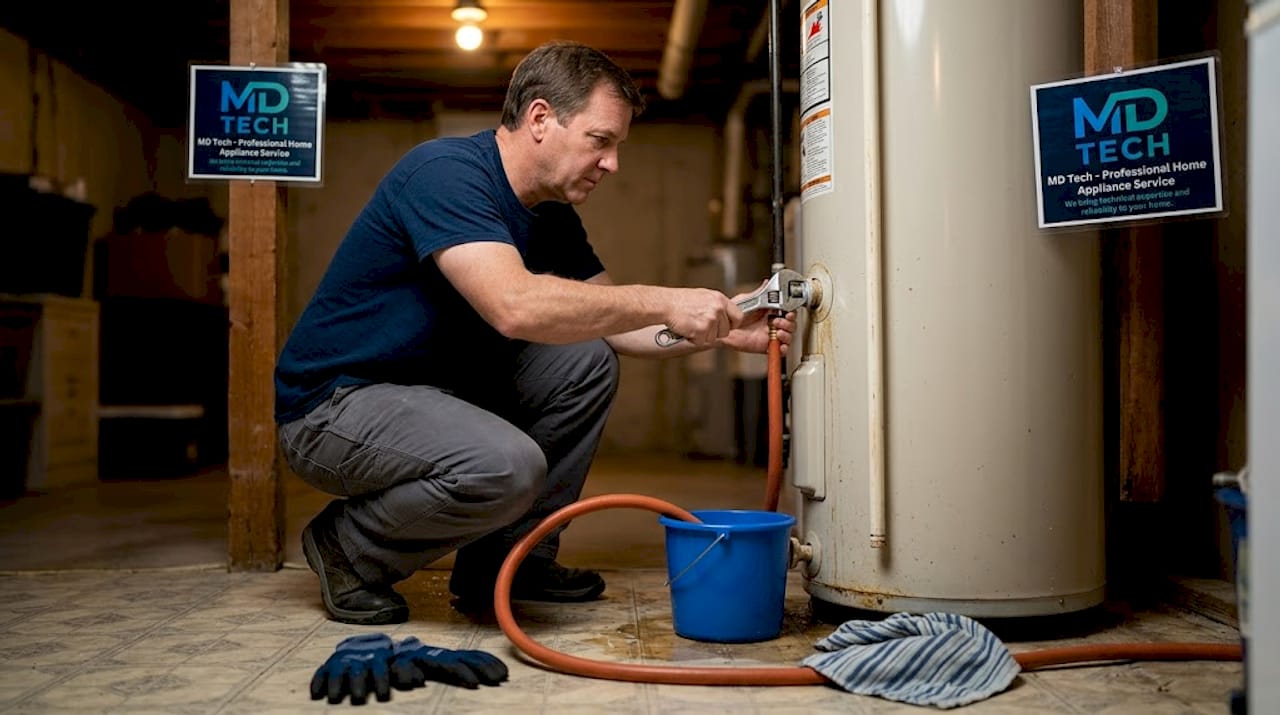
Flushing sediment is one of the best single actions you can take. Sediment as thin as 6 mm forces the burner to work harder and creates that popping or rumbling sound you might hear. Flush by attaching a hose to the drain valve, turning off the heater, and letting water run out until it flows clear.
Common mistakes and troubleshooting tips
Knowing what not to do saves you from creating a bigger problem than you started with.
- Skipping the power shutoff. This is the most dangerous mistake in DIY water heater repair. Even a brief contact with a live element can cause serious injury. Always verify with a tester, not just by flipping the breaker.
- Not testing components before replacing them. Buying a new heating element when your thermostat was actually the problem wastes money. Test every component with a multimeter before ordering parts.
- Overtightening threaded connections. Plumbing fittings have limits. Overtightening cracks the fitting or strips threads, creating a leak worse than the one you fixed.
- Ignoring the 50% rule. Repair costs between $150 and $700 cover most water heater work. If your estimate approaches half the cost of a new unit and your heater is over 8 years old, replacement makes more financial sense.
When to stop and call a professional: If you smell gas at any point during your repair, stop immediately, leave the area, and call your gas utility. Gas component work beyond a thermocouple replacement, such as gas valve replacement or flue repair, carries real fire and explosion risk. Licensed gas line work is not a corner to cut.
Strange noises that persist after flushing, water that is inconsistently hot even with a new thermostat, or visible corrosion on the tank itself are all signs that professional water heater repair services belong in your next call.
Verifying repairs and maintaining performance
Once you’ve completed your repair, the job isn’t finished until you verify everything is working correctly and set your heater up for long-term reliability.
Turn the water supply back on and watch every connection you touched for 10 minutes. Even a slow drip becomes a flood if left unchecked. Restore power or relight the pilot, then give the heater 45 to 60 minutes to fully recover before testing at the tap.
Check the actual temperature with a thermometer at your kitchen faucet after a full heat cycle. The DOE recommends 120°F for most households as the right balance of safety and efficiency. At 140°F, severe burns occur within two seconds of contact. At 120°F, you have over five minutes of exposure before burn risk becomes serious.
Here’s how the main thermostat settings compare:
| Temperature Setting | Pros | Cons |
|---|---|---|
| 110°F | Very low burn risk, lowest energy cost | Risk of Legionella bacteria growth in tank |
| 120°F | Safe for most households, 3 to 5% energy savings per 10 degrees vs. 140°F | May not satisfy dishwashers without booster heaters |
| 140°F | Kills bacteria effectively, suits dishwashers without internal heaters | Scalding risk, higher energy bills |
| 140°F + thermostatic mixing valve | Bacteria control with safe delivery temperature | Adds upfront cost for mixing valve installation |
For ongoing maintenance, flush the tank once a year to remove sediment. In hard water areas like much of Southern California, flushing every six months makes a measurable difference in both noise levels and recovery times. Test your T&P valve annually and replace it if it’s over 10 years old, even if it appears to work correctly.
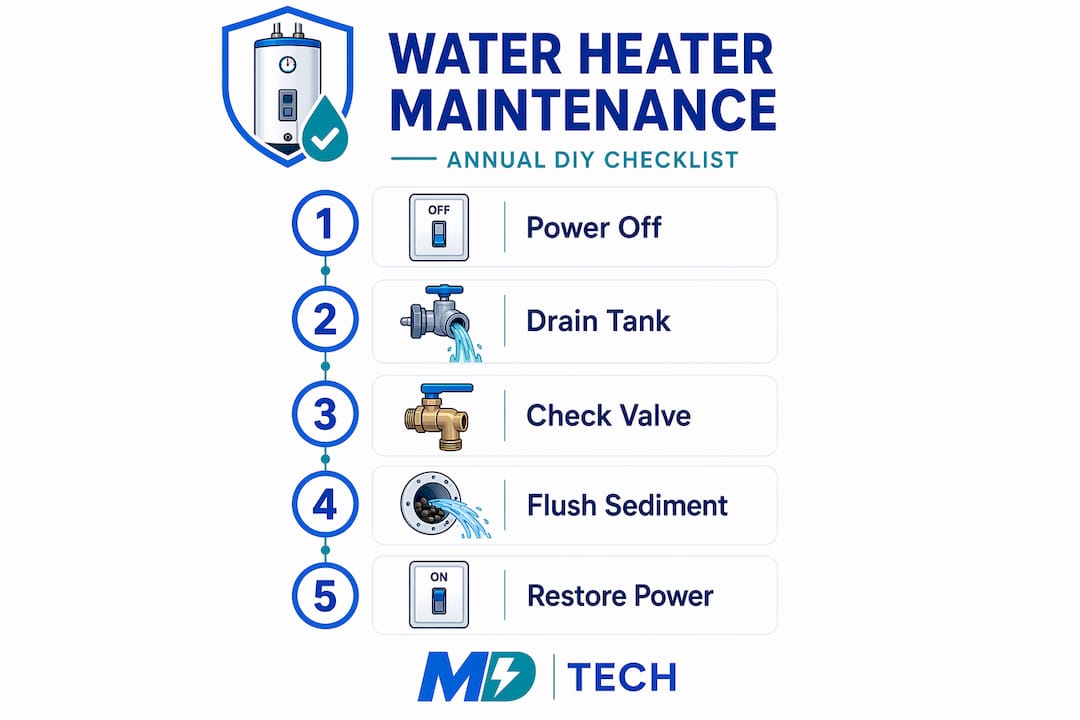
Pro Tip: Mark your calendar for an annual maintenance check every fall before you start running the heat. Demand on your water heater increases in winter, and it’s far better to find a failing element in October than on a cold January morning.
My take on DIY water heater repair
I’ve worked with homeowners across Orange County and Los Angeles who were convinced their water heater was finished, only to find a $30 thermocouple was all that stood between them and a $1,200 replacement bill. DIY water heater repair saves real money when you apply it correctly.
What I’ve seen cause the most trouble isn’t lack of skill. It’s overconfidence around gas components. I’ve watched homeowners attempt gas valve replacements after watching a five-minute video, and those situations tend to end with a service call that costs three times what a straightforward professional repair would have. The electric water heater repair guide steps in this article are genuinely manageable for a careful homeowner. Gas work beyond a thermocouple is a different matter.
The other thing I’ve noticed is how many replacements happen that shouldn’t. People see a leak and assume the tank is done. Most of the time, a leaking drain valve or a T&P valve that needs replacement is a $20 fix. Understanding your unit and checking water heater repair basics before you panic saves both money and a unit that has years of life left.
My honest advice: do the diagnostic work first, price out the repair, and apply the 50% rule without emotion. If the numbers say repair, repair it. If they say replace, don’t throw money at a unit that’s past its useful life. And whenever gas is involved and you’re not completely sure, call a licensed tech. That call is not an admission of defeat. It’s good judgment.
— MDTECH
When Appliancesrepairmdtech makes the difference
Sometimes a repair goes beyond what a wrench and a multimeter can solve. That’s where Appliancesrepairmdtech comes in.
Appliancesrepairmdtech serves homeowners throughout Orange County and Los Angeles County with licensed technicians who handle everything from heating element replacements to gas valve repairs and full unit installations. Same-day appointments are available for urgent situations, and every estimate is honest with no surprise fees after the fact. If you’re weighing whether to repair or replace, read the repair vs. replacement breakdown to make a confident decision before spending a dollar. For jobs that need new parts sourced and installed correctly, the appliance parts replacement guide from Appliancesrepairmdtech walks through exactly what to expect. Book online or call directly to get your hot water back fast.
FAQ
How much does water heater repair typically cost?
Most water heater repairs run between $150 and $700 depending on the component. Simple thermocouple or thermostat replacements sit at the lower end, while full heating element or valve replacements cost more.
What are the main signs you need water heater repair?
The clearest signs are no hot water, inconsistent water temperature, popping or rumbling sounds from the tank, visible rust in the water, or water pooling around the base of the unit.
Can I repair a gas water heater myself?
You can safely relight the pilot and replace a thermocouple yourself, but complex gas component work such as gas valve replacement carries real safety risks and should be handled by a licensed technician.
What temperature should my water heater be set to after repair?
Set your thermostat to 120°F. The DOE recommends this setting as the right balance between burn prevention and energy savings for most households.
How often should I flush my water heater?
Flush your tank at least once a year to remove sediment. If you live in a hard water area, every six months keeps efficiency and noise levels in check.