
TL;DR:
- California mandates low-GWP refrigerants like R-32 and R-454B for all new residential HVAC systems starting in 2025.
- Heat pumps and smart HVAC systems offer significant energy savings and environmental benefits in Southern California.
- Certified installation and proper system sizing are essential to maximize efficiency and safety under new regulations.
California just changed the rules on every new HVAC system installed in your home. Starting in 2025, the state requires low-GWP refrigerants for all new residential equipment, phasing out the widely used R-410A. For homeowners in Orange and Los Angeles Counties, this is not a distant policy shift. It affects every quote you get, every system you replace, and every contractor you hire. In this article, you will learn exactly what the new rules mean for your home, which technologies deliver the best comfort and savings in 2025, and how to make smart upgrade decisions that pay off for years.
Table of Contents
- New California mandates for HVAC systems in 2025
- Top HVAC technologies: What sets 2025 systems apart
- Heat pumps and ductless solutions: Local advantages and trade-offs
- Getting smart: Controls, automation, and grid-aware HVAC
- Expert perspective: What most HVAC guides won’t tell you
- Upgrade your comfort with local HVAC experts
- Frequently asked questions
Key Takeaways
| Point | Details |
|---|---|
| New regulations | Low-GWP refrigerants and heat pumps are now required for new California HVAC systems. |
| Smart, efficient tech | AI-driven controls and zoning boost comfort and cut energy use by up to 30%. |
| Local fit matters | Heat pumps and mini-splits pay off best in Orange/LA climates, especially with proper install and incentives. |
| Real-world trade-offs | Expect some retrofits to raise short-term bills, but long-term greenhouse gas savings are significant. |
New California mandates for HVAC systems in 2025
If you are planning to replace or install a new HVAC system this year, the regulatory landscape looks very different from just two years ago. California now requires that all new residential HVAC equipment use low-GWP refrigerants, specifically types with a Global Warming Potential below 750. The two most common compliant options are R-32 and R-454B, both of which are significantly less harmful to the climate than the R-410A systems that dominated the market for decades.
This matters for a practical reason beyond environmental policy. R-32 and R-454B are classified as A2L refrigerants, meaning they are mildly flammable. That is not a reason to panic, but it does mean installation and service must be handled by certified technicians who have completed specific A2L safety training. Do not let anyone cut corners here.
At the same time, 2025 Title 24 mandates under California’s Building Energy Efficiency Standards push hard toward heat pumps for new single-family homes, along with tighter envelope and ventilation requirements. The good news: these mandates stack with federal Inflation Reduction Act credits of $2,000 or more, plus utility rebates from Southern California Edison and SoCalGas programs. That combination can meaningfully offset your upfront costs.
Here is a quick summary of the major 2025 regulatory changes:
| Requirement | What changed | Who it affects |
|---|---|---|
| Refrigerant type | R-410A banned for new installs; R-32/R-454B required | All new HVAC installs |
| Heat pump mandate | Required for new single-family homes per Title 24 | New construction and full replacements |
| Installer certification | A2L refrigerant safety training required | All HVAC contractors |
| Federal IRA credits | Up to $2,000+ for qualifying heat pump installs | Homeowners upgrading systems |
| Utility rebates | SCE and other utilities offer stacking incentives | Orange/LA County residents |
Key compliance facts you should not ignore:
- Existing R-410A systems can still be repaired and maintained. The phasedown applies to new equipment only.
- Permits are required for most full system replacements in both Orange and LA Counties.
- Certified installers are not optional for A2L systems. Ask for proof of training before signing any contract.
- You can still be cutting HVAC energy use significantly even while meeting the new rules.
“The 2025 California Energy Code is not just about emissions. It is a full reset of what a compliant, efficient home system looks like.”
Now that you have seen why 2025 marks a new era for HVAC rules, let’s get practical about the technology changes these laws are driving.
Top HVAC technologies: What sets 2025 systems apart
Those state mandates quickly lead to the next question: what cutting-edge systems best fit your home in 2025? The short answer is that the gap between a standard system and a top-tier 2025 system is bigger than it has ever been.
Heat pumps are the headline story. Unlike traditional air conditioners that only cool, a heat pump moves heat in both directions, cooling in summer and heating in winter. Field demonstrations showed 44 to 90% GHG reduction compared to gas systems, which is a remarkable range that depends on your home’s size, insulation, and local utility mix. For Orange and LA County homes, which rarely see freezing temperatures, heat pumps perform at their best.

Smart and AI-driven systems are the second major leap. Modern HVAC units with IoT connectivity can sense occupancy, adjust output in real time, and even predict when a component is about to fail before it actually does. Smart HVAC systems with variable-speed compressors and automated zoning deliver energy savings of 10 to 30% compared to older single-stage equipment. That is not a marketing claim. It reflects real operational differences in how the equipment runs.
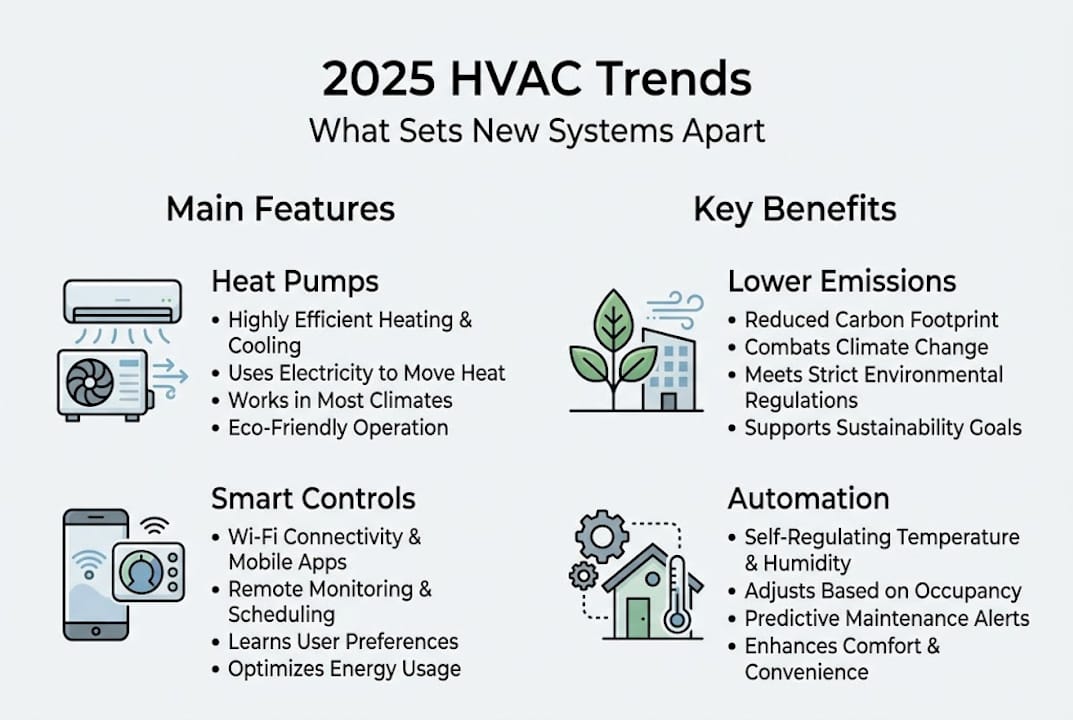
Ductless mini-splits deserve special mention for older homes and room additions. Our ductless air conditioning guide covers the basics, but the key point is that these systems bypass leaky duct networks entirely. Combined with variable speed motors, they maintain precise temperatures without the energy waste of constant on-off cycling.
| System type | Key advantage | Best for | SEER2 range |
|---|---|---|---|
| Heat pump | Heats and cools; low GHG | New installs, replacements | 15 to 22+ |
| Variable-speed AC | Precise comfort, quiet | Whole-home upgrades | 18 to 26 |
| Ductless mini-split | No duct losses, zoning | Retrofits, additions | 20 to 28+ |
| Standard central AC | Lower upfront cost | Budget-limited replacements | 14 to 16 |
Top features to look for in any 2025 system:
- Variable-speed compressor for quieter, more efficient operation
- Wi-Fi enabled thermostat with app control and scheduling
- MERV-13 compatible filter slots for better indoor air quality
- A2L refrigerant compatibility to meet California’s new rules
Pro Tip: If your home has existing ductwork in good condition, a ducted heat pump is often the most cost-effective upgrade. If ducts are old or absent, go ductless. Our high-efficiency HVAC guide can help you think through the decision.
Heat pumps and ductless solutions: Local advantages and trade-offs
But should every home make the switch? Let’s look closer at the pros and some hidden trade-offs for Orange and LA County residences.
The climate here is genuinely ideal for heat pump and ductless technology. Mild winters mean heat pumps almost never have to work in extreme cold, which is where older heat pump models historically struggled. You get the full efficiency benefit without the performance penalty that homeowners in colder states sometimes experience.
Ductless mini-splits are especially powerful for retrofit situations. Older homes in neighborhoods like Pasadena, Anaheim, or Long Beach often lack modern ductwork or have leaky systems that waste 20 to 30% of conditioned air before it reaches the room. Ductless systems eliminate that loss entirely and can achieve SEER2 ratings above 28, which is exceptional efficiency. Zoning also means you only condition rooms that are actually occupied, which adds up quickly on your monthly bill.
That said, there are real trade-offs worth knowing. Upfront costs for a quality heat pump or multi-zone mini-split system are higher than a basic central AC replacement. Depending on your home’s electrical panel, you may also need an upgrade to support the new equipment, which adds to the project budget. And while heat pumps reduce GHG significantly over time, some homeowners do see a modest utility bill increase in the first year as they adjust usage habits and the system optimizes to their home.
Three upgrade tips for Orange and LA County homeowners:
- Get a Manual J load calculation before any install. This tells your contractor exactly what size system your home needs. Oversized systems short-cycle and waste energy.
- Stack your rebates. Federal IRA credits, state programs, and utility incentives can be combined. Ask your installer specifically about all available programs before you commit.
- Check your electrical panel first. A 200-amp panel is generally sufficient for most heat pump installs, but older homes may need an upgrade. Budget for this possibility early.
“In Orange and LA Counties, a high-SEER2 ductless or heat pump system is not just an environmental choice. It is the most practical choice for the climate you actually live in.”
For more guidance on making the right call for your specific situation, our resource on choosing residential HVAC in California and our energy-efficient HVAC guide walk through the decision in detail.
Getting smart: Controls, automation, and grid-aware HVAC
Leveraging the latest tech does not stop with hardware. 2025’s big advances are also in the brains of your system.
AI-driven HVAC controls have moved from a luxury feature to a practical tool. These systems use sensors throughout your home to track occupancy, humidity, and temperature in real time. They learn your schedule over days and weeks, then adjust output automatically so you are never cooling an empty house. Smart HVAC automation with variable-speed compressors and predictive maintenance alerts can cut energy costs by 10 to 30%, which on a typical SoCal home translates to real money every month.
Grid-responsive features are particularly relevant for Southern California homeowners. SoCal’s electric grid faces peak demand stress on hot summer afternoons. Smart HVAC systems can pre-cool your home in the morning when electricity rates are lower, then reduce output during peak hours. This protects you from time-of-use rate spikes without sacrificing comfort. Some utility programs even pay you a small credit for participating in demand response events.
Indoor air quality is the third pillar of 2025 smart HVAC. With wildfires a recurring reality in LA and Orange Counties, IAQ features like MERV-13 filtration and UV air purifiers are not optional extras anymore. They are practical tools for protecting your family during smoke events. The best 2025 systems integrate air quality sensors that automatically boost filtration when outdoor air quality drops.
Must-have smart features for your 2025 HVAC upgrade:
- Learning thermostat with occupancy detection and remote app control
- Predictive maintenance alerts that notify you before a breakdown happens
- Grid-responsive scheduling to avoid peak-rate electricity periods
- MERV-13 or better filtration with real-time air quality monitoring
- Zoned temperature control for multi-room comfort without wasted energy
Pro Tip: Pair your smart thermostat with your utility’s demand response program. You can often earn bill credits just for allowing the system to slightly adjust your settings during grid stress events. Most homeowners never notice the difference in comfort.
For ongoing performance, regular HVAC maintenance for California homeowners is what keeps all these smart features working as intended year after year.
Expert perspective: What most HVAC guides won’t tell you
Here is the honest truth that most articles skip over. New equipment does not automatically mean lower bills from day one. A heat pump installed in a home with poor insulation, an undersized electrical panel, or a contractor who skipped the load calculation will underperform no matter how advanced the technology is. We have seen this pattern repeatedly in Orange and LA County homes.
The long-term GHG wins are real, and they matter. But the short-term financial picture depends heavily on how well the system is matched to your specific home and how effectively you stack available rebates. The real-world energy savings that manufacturers advertise assume optimal conditions. Getting there requires a certified local installer who knows the 2025 codes, understands A2L refrigerant safety, and will take the time to size the system correctly.
Do not DIY an A2L refrigerant system. This is not a scare tactic. The mild flammability of R-32 and R-454B requires specific tools, ventilation practices, and training. The savings are not worth the risk.
Upgrade your comfort with local HVAC experts
The 2025 HVAC landscape rewards homeowners who move forward with the right information and the right team. New refrigerant rules, heat pump mandates, and smart technology all point in the same direction: working with certified local technicians is no longer optional, it is essential.
Our local HVAC repair experts in Orange and Los Angeles Counties are trained on the latest 2025 codes, A2L refrigerant safety, and heat pump installations. Whether you need a full system upgrade or want to start with a professional HVAC tune-up service to assess your current equipment, we are ready to help you get the most out of every dollar you invest. Book your appointment online and take the first step toward a more comfortable, efficient home this year.
Frequently asked questions
What refrigerant is required for new HVAC installs in California in 2025?
California requires low-GWP refrigerants like R-32 or R-454B for all new residential HVAC systems. R-410A is no longer permitted for new equipment installations.
Will upgrading to a heat pump cut my energy bills?
Heat pumps can significantly improve efficiency, but some SoCal retrofits see a modest bill increase initially while long-term GHG reductions are substantial. Results depend on your home’s insulation, sizing, and how well rebates are applied.
Can I still repair an older HVAC with R-410A after 2025?
Yes, you may continue to maintain and repair existing R-410A systems. The R-410A phaseout applies only to new equipment installations, not to servicing systems already in place.
Are smart/AI HVAC controls worth it in mild SoCal climates?
Absolutely. Smart HVAC controls can save 10 to 30% on energy costs, and grid-responsive features are especially valuable in Southern California where time-of-use electricity rates can spike significantly during peak hours.
Recommended
- HVAC tune-ups: boost efficiency 20% & home comfort
- Role of HVAC in Home Comfort – Why It Matters
- Role of HVAC in Homes: Cut Energy Use by Up to 30% in 2026
- Annual HVAC inspection boosts efficiency, saves money 2026
- HYGIENE: Nachrüsten und Erweitern von Klimatechnik – optimale Hygiene durch einfache Wartung und Reinigung inklusive – hotelimpulse