
Your refrigerator stops cooling on a Sunday night, or your washer quits mid-cycle right after you thought the warranty expired. That sinking feeling is familiar to homeowners across Orange County and Los Angeles County. The good news is that warranty coverage is often more layered than it appears, and knowing exactly where to look can save you hundreds of dollars in unexpected repair bills. This guide walks you through every step to verify your appliance warranty, understand what each type of coverage actually protects, and avoid the mistakes that leave homeowners paying out of pocket.
Table of Contents
- What you need before you check your warranty
- Step-by-step: How to verify your appliance’s warranty coverage
- Comparing coverage: Manufacturer vs. home warranty plans
- Key pitfalls: What can void or limit your warranty coverage
- California law and your rights on appliance warranties
- We help Orange County and Los Angeles County homeowners get covered repairs done right
- Frequently asked questions
Key Takeaways
| Point | Details |
|---|---|
| Gather key info first | Always locate your appliance’s model, serial number, and proof of purchase before checking warranty coverage. |
| Check all warranty layers | Review manufacturer, retailer, credit card, and home warranty options for overlapping or extended protection. |
| Avoid voiding coverage | DIY repairs, unauthorized service, or improper care can void your warranty and leave you responsible for costs. |
| Use California’s legal backup | The Song-Beverly Act gives California homeowners extra remedies if appliance problems aren’t fixed after reasonable attempts. |
What you need before you check your warranty
Before you make a single phone call or visit a manufacturer’s website, gather your documents. Trying to check warranty status without the right information is like trying to file a tax return without your W-2. You will waste time and likely get incomplete answers.
The primary method to check warranty status is to locate your model and serial number, confirm your purchase date from your receipt or manual, and then visit the manufacturer’s website. These three pieces of information are the foundation of every warranty lookup, regardless of brand.
Model and serial numbers are usually printed on a label inside the door frame of refrigerators, on the back panel of washers and dryers, or inside the door of dishwashers and ovens. Take a photo of that label the moment you find it. Receipts fade, manuals get lost, but a photo in your phone’s camera roll stays accessible.
When you register appliance warranties right after purchase, you create a digital record that manufacturers can pull up instantly. Unregistered appliances often require more documentation to process a claim, which slows everything down.
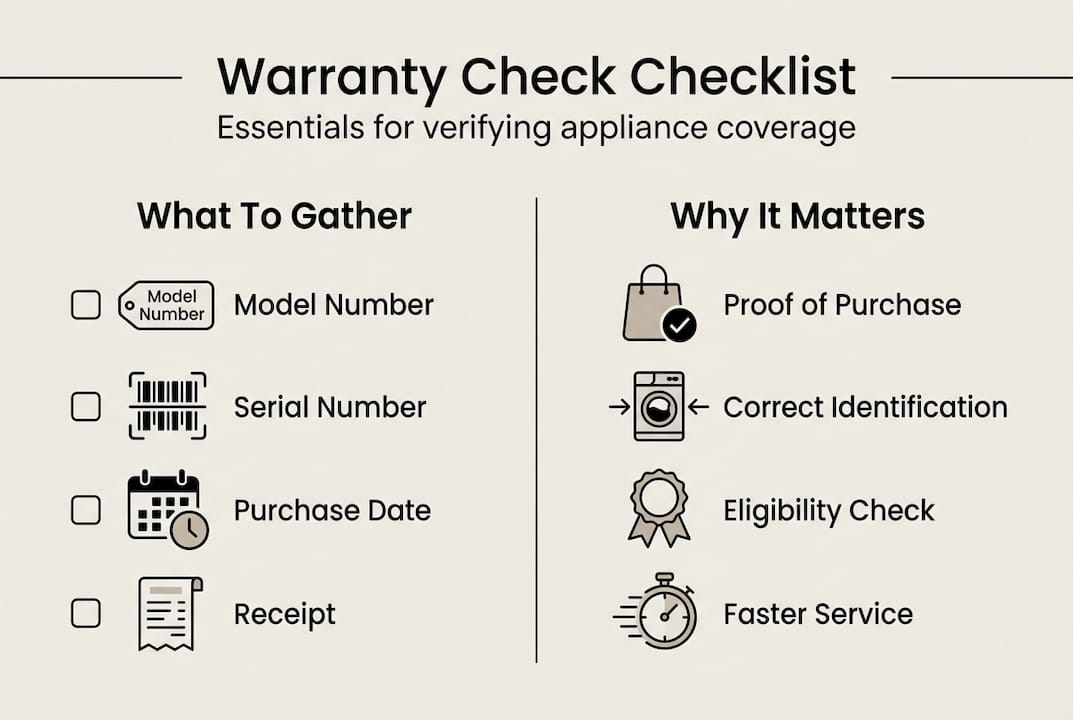
Warranty check checklist
| Item | Why you need it | Where to find it |
|---|---|---|
| Model number | Identifies your exact appliance | Door frame, back panel, or inside door |
| Serial number | Encodes manufacture date | Same label as model number |
| Purchase date | Starts the warranty clock | Receipt, bank statement, or email confirmation |
| Retailer name | Needed for retailer warranty claims | Receipt or order confirmation |
| Owner’s manual | Contains warranty terms | Original box or manufacturer website |
| Registration status | Speeds up claims | Manufacturer’s website account |
Pro Tip: Photograph your receipt and the appliance label on the same day you bring the appliance home. Store both images in a dedicated folder labeled with the appliance name and purchase year.
Step-by-step: How to verify your appliance’s warranty coverage
Once your documents are ready, work through these steps in order. Skipping ahead often means missing coverage you actually have.
- Visit the manufacturer’s website. Brands like Samsung, Whirlpool, GE, and LG all have warranty lookup tools. Enter your model and serial number to see the coverage period and what is included.
- Check your retailer’s warranty policy. Home Depot, Best Buy, and Costco each offer their own protection plans that may extend beyond the manufacturer’s coverage. Pull up your original purchase confirmation to see if you opted in.
- Review your credit card benefits. Many Visa Signature and Mastercard World cards automatically double the manufacturer’s warranty up to one additional year. Call the number on the back of your card and ask specifically about purchase protection.
- Check your home warranty plan. If you have a home warranty, check manufacturer and retailer warranty first, then use the home warranty as a secondary layer for appliances no longer covered by the original policy.
- Document every step. Write down the date, time, and name of every representative you speak with. Screenshot every warranty lookup result. This record protects you if a claim is disputed later.
Understanding the role of warranty in repairs helps you decide whether to file a claim or pay out of pocket for a minor fix. Sometimes a small repair costs less than a home warranty service call fee.
One of the most common mistakes homeowners make is not registering their appliance after purchase. The second most common is losing the receipt. Both create friction when you need a claim processed fast.
If proof of purchase isn’t available, warranty may default to the manufacture date encoded in the serial number.
Pro Tip: Register your product the same day you unbox it. Most manufacturers have a registration page that takes under three minutes to complete, and it can save hours of back-and-forth later.
For a broader overview of how these protections work together, the appliance warranty basics page breaks down each coverage type in plain language.
Comparing coverage: Manufacturer vs. home warranty plans
After you identify which warranties apply, you need to understand what each one actually covers and where it falls short.
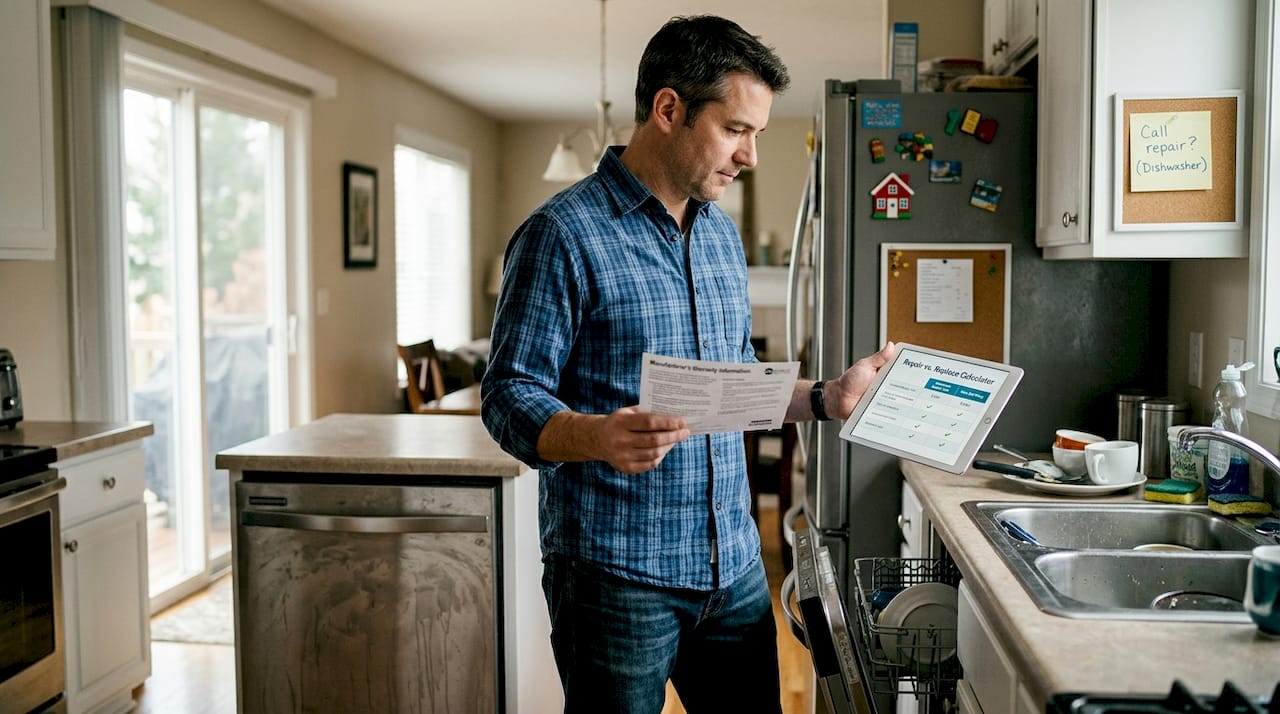
Manufacturer warranties mainly cover parts and labor for the first year, while home warranties pick up after that period but come with more exclusions and annual caps.
Coverage comparison table
| Feature | Manufacturer warranty | Home warranty plan |
|---|---|---|
| Coverage period | Typically 1 year (some parts longer) | Annual contract, renewable |
| What’s covered | Defects in parts and workmanship | Mechanical breakdowns from normal use |
| Claim process | Contact manufacturer directly | File claim through plan provider |
| Cost to you | Included in purchase price | $400 to $700 per year plus service fees |
| Exclusions | Misuse, unauthorized repairs | Pre-existing issues, improper install, cosmetic damage |
| Payout limits | Usually no cap | Typically $2,000 to $7,000 per appliance |
Knowing these limits helps you make smarter decisions about repair vs replacement when a claim is denied or a cap is reached.
Typical exclusions across both warranty types include:
- Pre-existing conditions present before coverage began
- Cosmetic damage like dents, scratches, or discoloration
- Damage from improper installation or non-standard electrical connections
- Failures caused by power surges or flooding
- Normal wear items like filters, belts, and light bulbs
Home warranties are not insurance, and denied claims for neglect are common.
Review the service warranty guide to understand how service warranties differ from both manufacturer and home warranty plans, especially for repairs done by independent technicians.
Key pitfalls: What can void or limit your warranty coverage
Understanding what you’re covered for is only half of the equation. Guard your protections by avoiding these all-too-common pitfalls.
DIY repairs, modifications, and improper maintenance often void your warranty entirely, and manufacturers require that you use an authorized service provider to keep coverage intact.
Here are the most common warranty-voiding behaviors:
- Attempting DIY repairs or replacing parts yourself without authorization
- Using a non-authorized repair company, even if they are licensed
- Skipping routine maintenance like cleaning coils, filters, or drain lines
- Running the self-clean cycle on an oven that has a known heating element issue
- Connecting an appliance to a non-standard voltage or outlet
- Failing to report a defect within the warranty period
Power surges are a particularly sneaky exclusion. If a surge damages your refrigerator’s control board, most manufacturer warranties will not cover it. A surge protector costs under $30 and can prevent a $400 repair bill.
Knowing how to choose repair services that are authorized by your appliance’s manufacturer is one of the most important steps you can take to protect your coverage. The benefits of insured repairs go beyond just warranty compliance. Licensed, insured technicians protect you from liability if something goes wrong during the repair.
Pro Tip: Always read your warranty’s fine print before scheduling any repair. A five-minute review can prevent a costly mistake that voids your entire coverage.
California law and your rights on appliance warranties
If warranty coverage fails you or you hit a roadblock, California law provides another important layer of protection.
The Song-Beverly Consumer Warranty Act requires manufacturers to repair, replace, or refund a defective appliance if the defect cannot be corrected after a reasonable number of attempts. This applies to all express warranties on appliances purchased for personal use in California.
For Orange County and Los Angeles County homeowners, this law is a meaningful backstop. Here is what it covers:
- The right to a free repair if a defect appears during the warranty period
- The right to a replacement appliance if the same defect recurs after multiple repair attempts
- The right to a full refund if neither repair nor replacement resolves the issue
- Protection against manufacturers who delay or deny valid warranty claims
- Coverage for all appliances sold with an express warranty in California
To use these rights, document every repair attempt. Keep copies of all service orders, technician notes, and communication with the manufacturer. If you reach a point where the same problem has been repaired two or three times without resolution, you have grounds to escalate under the Song-Beverly Act. Learn more about your protections through California warranty law details.
We help Orange County and Los Angeles County homeowners get covered repairs done right
Navigating warranty claims is stressful enough without also worrying about finding a qualified technician who won’t accidentally void your coverage. That’s where we come in.
At Appliances Repair MD Tech, our licensed technicians serve homeowners throughout Orange County and Los Angeles County with fast, authorized repair services for refrigerators, washers, dryers, ovens, dishwashers, and more. We understand how manufacturer warranties work and how to document repairs so your claim stays intact. Whether your appliance is still under warranty or you need a reliable repair after coverage expires, we make the process straightforward. Book an appointment online today and let us handle the hard part.
Frequently asked questions
What if I can’t find my appliance receipt?
If your receipt is missing, most manufacturers use the serial number to determine your warranty based on the appliance’s manufacture date. Contact the manufacturer directly with your serial number and they can usually confirm coverage.
Are repairs covered if I use a non-authorized service company?
Using a non-authorized repair service can void your warranty entirely. Always confirm that your technician is authorized by the manufacturer before scheduling any work.
How long do manufacturer warranties typically last?
Most manufacturer warranties cover parts and labor for one year, though sealed system components like compressors are often covered for five years or longer.
What’s excluded from a California home appliance warranty?
Home warranties commonly exclude pre-existing conditions and improper installation, as well as cosmetic damage and failures caused by neglect or misuse.
Can I make a claim under California’s consumer warranty law?
Yes. If repeated repairs fail to fix the same defect, the Song-Beverly Act entitles you to a replacement or full refund, making it one of the strongest consumer protections available to California homeowners.