
TL;DR:
- Most homeowners do not set or update their thermostats, missing savings opportunities.
- Smart thermostats offer automatic adjustments, maximizing energy efficiency with less user effort.
- Proper scheduling and maintenance can reduce home energy use by up to 10 to 30 percent.
Most homeowners in Orange and Los Angeles counties have a programmable thermostat sitting on their wall with zero programs set. They might as well have a manual dial. Studies show that programmable thermostats save energy only when actually programmed, and many never are. Meanwhile, your HVAC system accounts for nearly half of your monthly utility bill. A few deliberate thermostat changes can cut heating and cooling costs by up to 10% annually, and smart thermostat users are already pulling ahead with even greater efficiency gains. This guide gives you the practical steps to stop wasting that potential.
Table of Contents
- Understanding the role of thermostats in home energy use
- Types of thermostats and their impact on efficiency
- Best temperature settings for comfort and savings
- Programming and special considerations for Orange and LA County homes
- Why most homes miss out on real thermostat savings
- Expert help for smarter, more efficient homes
- Frequently asked questions
Key Takeaways
| Point | Details |
|---|---|
| Thermostats drive efficiency | Thermostats are the central control point for reducing HVAC energy waste through precise temperature management. |
| Smart and programmable outperform manual | Properly programmed or automated thermostats can save up to 10 percent on heating and cooling bills. |
| Follow DOE setpoint advice | Use recommended temperature settings year-round for maximum comfort and lower energy costs. |
| Local climate matters | Programming for Orange and LA County seasonal patterns ensures comfort and savings aligned with local conditions. |
| Behavior matters most | The biggest efficiency gains come when homeowners actively use features and check their settings regularly. |
Understanding the role of thermostats in home energy use
To understand how you can capture real energy savings, let’s first clarify what a thermostat actually does inside your system.
Your thermostat is the brain of your entire HVAC setup. It watches the indoor temperature constantly and tells your heating or cooling equipment when to run and when to stop. That simple on/off cycle is how your home maintains a comfortable temperature without running the system nonstop. Without a thermostat, your air conditioner or furnace would either run continuously or shut off entirely, both of which waste enormous amounts of energy.
The real power comes from automation. According to Energy Saver, thermostats regulate HVAC operation by monitoring indoor temperature and cycling heating and cooling systems on and off to maintain setpoints, reducing energy waste through automated scheduling and setbacks. A “setback” is when the thermostat dials the temperature up or down during times you’re sleeping or away from home, so your system isn’t working hard to maintain a comfort level nobody is benefiting from.
Understanding how HVAC systems work makes it clear why thermostat control is so pivotal. When your system runs less frequently and for shorter cycles, it uses less electricity or gas, reduces wear and tear on equipment, and extends the lifespan of costly components like compressors and heat exchangers.
| Thermostat action | Energy impact |
|---|---|
| No setback (constant 72°F) | Maximum energy use, highest bill |
| 8-hour daytime setback | Up to 10% annual savings |
| Night and daytime setback combined | Compounded savings throughout the year |
| Smart geofencing (auto-away) | Savings even with unpredictable schedules |
Our homeowner’s guide to thermostats breaks this down further, including guidance on matching thermostat features to your specific system type. For a broader look at how your whole system fits together, our energy efficient HVAC guide covers equipment upgrades and system-level decisions that work alongside smart thermostat use.
Remember: Your thermostat doesn’t cool or heat your home faster by setting an extreme temperature. Setting your thermostat to 65°F when you walk in from a hot day doesn’t speed up cooling. Your system runs at the same rate regardless. All that does is risk overcooling and wasted energy.
Types of thermostats and their impact on efficiency
Once you know the basic function of a thermostat, it’s critical to understand how different types stack up for energy-saving potential.
There are three main categories, and they are not equal in performance.
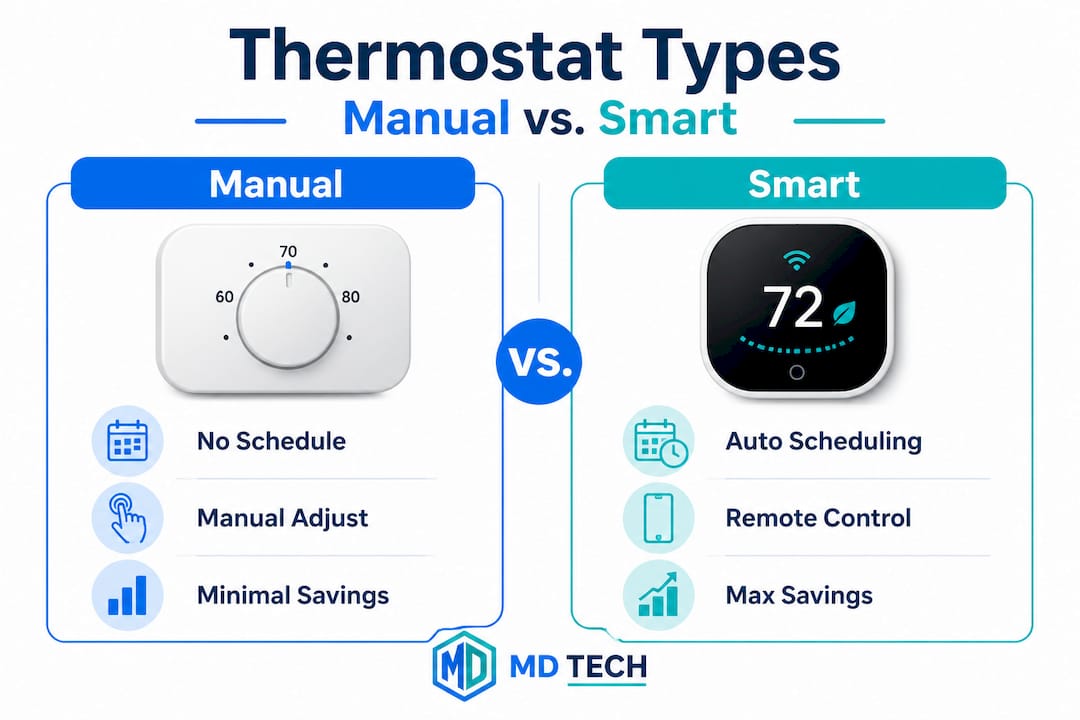
Manual thermostats require you to physically adjust the temperature every time you want a change. No schedules. No automation. If you forget to turn it down before bed or before leaving for work, your system just keeps running. These are the least efficient option because they rely entirely on consistent human action, which most busy homeowners simply can’t maintain.
Programmable thermostats are a major step forward. They let you set daily and weekly schedules with multiple time blocks. The DOE confirms that programmable thermostats enable daily and weekly schedules with six or more settings, allowing 7 to 10°F setbacks for 8 hours per day, saving up to 10% annually on heating and cooling. That is real money. For a family in Anaheim or Torrance paying $200 per month in energy costs, 10% is $240 back in their pocket each year.
The catch is that many homeowners set them up once and never update them. Schedules drift out of alignment with actual routines. The program that made sense in January doesn’t match the summer schedule when kids are home all day.
Smart thermostats solve that problem. They learn your habits automatically, use geofencing to detect when you’ve left the house, and adjust on their own. Research published in Nature Energy found that smart thermostat users operate 1 to 2°F more efficiently on average compared to manual adjustment users, with average US daytime settings running about 70.1°F in winter and 72.1°F in summer. That efficiency gap adds up significantly over months and years. Smart thermostats also connect to apps, so you can make changes remotely if plans change unexpectedly.
Pro Tip: If your household has irregular work schedules or rotating shifts, a smart thermostat with geofencing is almost certainly worth the upgrade cost. It removes the guesswork entirely. Learn more about pairing smart controls with HVAC zones if you want to control different areas of your home independently.
Key differences at a glance:
- Manual thermostats: No automation, savings depend entirely on user discipline
- Programmable thermostats: Schedule-based savings, best for households with consistent daily routines
- Smart thermostats: Learning and location-based automation, best for irregular schedules and maximum hands-off efficiency
- Smart home integration: Some smart thermostats work with smart home energy solutions for layered automation across appliances and lighting
| Type | Automation level | Estimated annual savings |
|---|---|---|
| Manual | None | Minimal |
| Programmable | Schedule-based | Up to 10% |
| Smart | Adaptive and location-based | 10%+ with less effort |
Best temperature settings for comfort and savings
Knowing which thermostat to choose is just part of the equation. How you set and use it every day is where the results come home.
The U.S. Department of Energy has clear, research-backed recommendations. For summer, the DOE recommends setting your thermostat to 78°F when you’re home, and raising it to 85 to 88°F when you’re away. For winter, keep it at 68 to 70°F while you’re awake and active at home, then set it lower when you’re sleeping or out of the house.
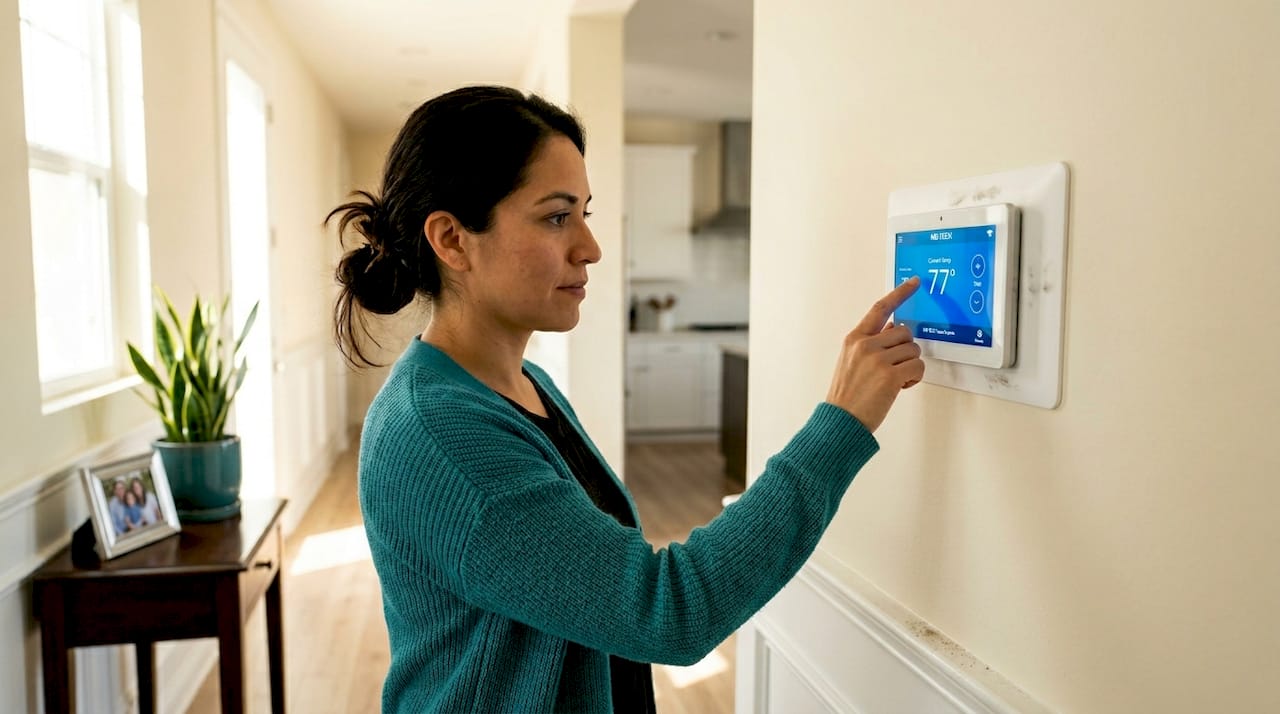
Every degree above 78°F in summer saves you 1 to 3% on cooling costs. That means bumping from 72°F up to 78°F could cut your cooling bill by 6 to 18%. In Southern California, where air conditioning runs for a large portion of the year, that is substantial savings compounded over every warm month.
Practical setpoints to use as your starting guide:
- Summer, home: 78°F
- Summer, away: 85 to 88°F
- Winter, home and awake: 68 to 70°F
- Winter, asleep or away: 60 to 65°F
- Transitional months (spring and fall): Use natural ventilation when outdoor temps allow, and delay turning on HVAC entirely
Efficiency callout: Research from Nature Energy found that smart thermostat users maintain settings 1 to 2°F more efficient than average, even without consciously trying, simply because the system adjusts automatically.
One common mistake is setting extreme temperatures hoping your system will catch up faster. Your HVAC delivers conditioned air at a constant rate regardless of how far the thermostat is from the current room temperature. Setting it to 60°F when you want 75°F does not cool the room faster. It just overshoots and wastes energy getting there. This is a surprisingly persistent myth that costs homeowners real money.
Pro Tip: On very hot days in Orange or Los Angeles County, pre-cool your home in the morning when outdoor temperatures are cooler, then let the thermostat hold the temperature rather than fighting the afternoon heat peak. This is more efficient than blasting the AC against the day’s hottest point.
The HVAC energy-saving impact can be dramatic when setpoints are dialed in correctly. Up to 30% in energy reduction is achievable across your whole home when thermostat strategy combines with proper equipment maintenance.
Programming and special considerations for Orange and LA County homes
With the right schedule and an understanding of your specific system, homeowners in Southern California can get even more out of each thermostat adjustment.
Step-by-step guide to programming your thermostat:
- Start by mapping your actual daily routine. Write down when you wake up, leave home, return, and go to sleep on both weekdays and weekends. Be honest. Don’t plan for the schedule you wish you kept.
- Enter your wake time and set the temperature to your comfort setpoint. For summer, that’s 78°F. For winter, 68 to 70°F.
- Set a “leave” time about 30 minutes after you usually head out, and program the setback temperature. For summer, go up to 85°F. For winter, drop to 62°F.
- Set your “return home” time about 30 minutes before you typically arrive so the house is comfortable when you walk in.
- Set a “sleep” time temperature. Cooler is typically better for sleep quality and saves energy simultaneously.
- Review and update the schedule every season or whenever your routine changes significantly.
Heat pump users need special attention. If your home in Orange County or the LA area uses a heat pump instead of a gas furnace, you need to handle setbacks differently. The DOE warns that for heat pumps, large temperature setbacks can trigger auxiliary electric heat strips, which are far less efficient and can quickly erase any savings from the setback itself. Standard programmable thermostats are not recommended for heat pump systems unless they have specific heat pump compatibility or adaptive recovery features.
Heat pump owners: Choose a smart thermostat designed for heat pump systems, or stick to moderate setbacks of 2 to 3°F rather than large swings. The efficiency math changes significantly with this equipment type.
For homes with irregular schedules, travel, or varying occupancy, programmable thermostat savings only materialize when programs are actually used and kept current. Smart thermostats with geofencing handle this automatically by detecting when everyone has left the house and adjusting without any manual input. Pairing this technology with a well-maintained system means double the benefit.
Pro Tip: Schedule an annual HVAC inspection every year before summer heat peaks. A thermostat doing its job perfectly can’t compensate for a dirty coil or refrigerant issue that cuts your system’s efficiency in half. Review our HVAC tune-up guide to know exactly what a proper seasonal checkup should include.
Why most homes miss out on real thermostat savings
After all these details, let’s step back and look at what’s actually holding most homeowners back from capturing these efficiency wins.
Here is the honest truth: the technology is not the barrier. Modern thermostats, even basic programmable models, are capable of delivering the savings we’ve described. The real obstacle is human behavior and the habits we build around our home systems.
We’ve seen this pattern repeatedly. A homeowner installs a programmable thermostat, sets a schedule during installation, and then never touches it again. Life changes. Work schedules shift. Kids go back to school. The schedule that saved money in October is now running the heat full blast through an empty house every afternoon in June because nobody updated it. The savings potential sits untouched because the follow-through never happened.
There’s also a widespread habit of overriding programmed settings manually. You come home tired, the house feels slightly warm, you push the temperature down to 70°F, and then forget to let the program resume. Over time, manual overrides become the norm and the programming becomes meaningless. This is exactly the scenario where smart thermostats prove their worth. They don’t rely on you remembering to reset anything.
Another overlooked factor is simply not knowing what features your thermostat has. Many models include vacation hold modes, adaptive recovery (which learns how long your system needs to reach temperature and starts early), and humidity control integration. These features can recover a meaningful portion of “lost” savings on their own, but most homeowners never activate them.
The fix is not complicated. Spend 15 minutes each season reviewing your thermostat program. Update it for the new season’s schedule. Turn on any smart features your model offers. If you’re unsure what your thermostat is capable of, check its manual or contact a technician. Thinking about HVAC and home comfort as a system, not just individual settings, changes how you approach this maintenance entirely.
The homeowners who consistently capture thermostat savings are not doing anything technically complicated. They’re simply staying engaged with the tool they already own.
Expert help for smarter, more efficient homes
Getting the most from your thermostat is one piece of a larger efficiency puzzle, and professional support can lock in lasting results across your whole system.
At MDTECH Appliance Repair, we provide full HVAC repair services in Orange County and the greater LA area, including thermostat assessment, installation, and system diagnostics. If you’re unsure whether your thermostat is compatible with your current system, miscalibrated, or simply not performing as it should, our licensed technicians can evaluate everything in a single visit. We also offer complete HVAC tune-up services that prepare your system to work efficiently alongside any thermostat upgrade. Explore our HVAC maintenance guide or book an appointment online today to get your home running at its most efficient.
Frequently asked questions
How much money can I actually save with a programmable thermostat?
Programming setbacks of 7 to 10°F for 8 hours daily can cut heating and cooling bills by up to 10% annually, which translates to real dollar savings depending on your usage and local utility rates.
What temperature should I set my thermostat to for the best savings?
Set your summer temperature at 78°F when home and 85 to 88°F when away. In winter, 68 to 70°F while home and lower when asleep or out of the house delivers the best balance of comfort and efficiency.
Are smart thermostats really better than programmable ones?
Smart thermostats consistently outperform programmable models because they adapt to your routine automatically. Research shows smart users average 1 to 2°F more efficient settings without extra effort.
What should heat pump users do differently with thermostats?
Avoid large temperature setbacks with heat pump systems because they can trigger costly auxiliary electric heat. Use a smart or heat-pump-specific thermostat with adaptive controls and keep setbacks moderate.
Why don’t more homeowners get these energy savings?
Most homeowners don’t update thermostat programs when routines change, and many override settings manually without resetting them. Features go unused simply because many thermostats aren’t programmed consistently or updated for seasonal shifts.
Recommended
- Unlock HVAC efficiency: The homeowner’s guide to thermostats
- What is energy efficient HVAC: A 2026 homeowner’s guide
- What Is Energy Efficient Appliance and How It Reduces
- How water heaters impact energy efficiency: key facts
- Clean Home Energy Savings: Lowering Costs in Texas
- Smart energy solutions for sustainable tiny homes