
TL;DR:
- Annual professional inspections and proper detection devices are vital for gas appliance safety.
- Regular visual checks and smart habits can prevent roughly 80% of home gas incidents.
- Consulting trained technicians is essential for detecting hidden risks and ensuring safety.
Gas appliances keep your home warm, your meals cooked, and your water hot every single day. But when something goes wrong, the consequences can be severe and fast-moving. Annual professional inspection of every gas appliance in your home is essential for safety, efficiency, and preventing carbon monoxide poisoning. For homeowners across Orange and Los Angeles counties, following a clear, step-by-step safety checklist is not just a good idea — it is the kind of practical habit that protects your family, your property, and your peace of mind.
Table of Contents
- Key criteria for gas appliance safety at home
- Gas appliance safety checklist: Step-by-step guide
- Spotting trouble: Warning signs and emergency actions
- Comparison: Professional vs. DIY gas appliance safety measures
- Why checklists aren’t enough: The real impact of expert eyes
- Stay safe and stress-free with expert appliance support
- Frequently asked questions
Key Takeaways
| Point | Details |
|---|---|
| Annual inspections vital | A yearly professional check is the single most effective way to ensure gas appliance safety at home. |
| Detector placement matters | Correctly installed and tested detectors catch gas and carbon monoxide dangers before they become critical. |
| Warning signs demand action | Sudden smells, yellow flames, or headaches are urgent signals to evacuate and call professionals immediately. |
| Professionals catch hidden threats | Expert inspections find leaks or issues missed by checklists, giving homeowners true peace of mind. |
| Declutter and vent | Keeping areas clear and vents open reduces the risk of fire or gas buildup around your appliances. |
Key criteria for gas appliance safety at home
With the stakes in mind, let’s define the essential ground rules for safely operating your home’s gas appliances.
Every home is different, but the fundamental criteria for gas appliance safety are consistent across all property types. Whether you have a gas range in a Fullerton kitchen or a gas water heater in a Pasadena garage, the same basic principles apply. Understanding these criteria upfront gives you a clear framework before you start working through the detailed checklist.
The three pillars of gas appliance safety are professional oversight, detection systems, and daily habits. None of these work in isolation. You need all three working together to create a truly safe environment.
- Schedule at least one annual professional inspection per year for every gas-powered appliance in your home, including your furnace, water heater, dryer, and stove.
- Install working carbon monoxide (CO) and gas detectors on every floor of your home, near sleeping areas, and close to appliances.
- Keep all flammable materials, including paper towels, curtains, and cleaning supplies, well away from gas appliances at all times.
- Never block air vents, exhaust pipes, or combustion air openings, even temporarily.
- Review your home’s full home safety checklist each season to stay ahead of potential hazards.
“Most gas appliance incidents are preventable. The combination of professional inspections and smart daily habits addresses the overwhelming majority of risks before they become emergencies.”
Research consistently shows that simple detection and maintenance habits address roughly 80% of reported gas incidents at home. The remaining risks require a professional’s trained eye and calibrated equipment, which we will cover later. For now, these core criteria set the foundation everything else builds on.
Gas appliance safety checklist: Step-by-step guide
Building on these criteria, use this checklist to keep your home safe year-round.
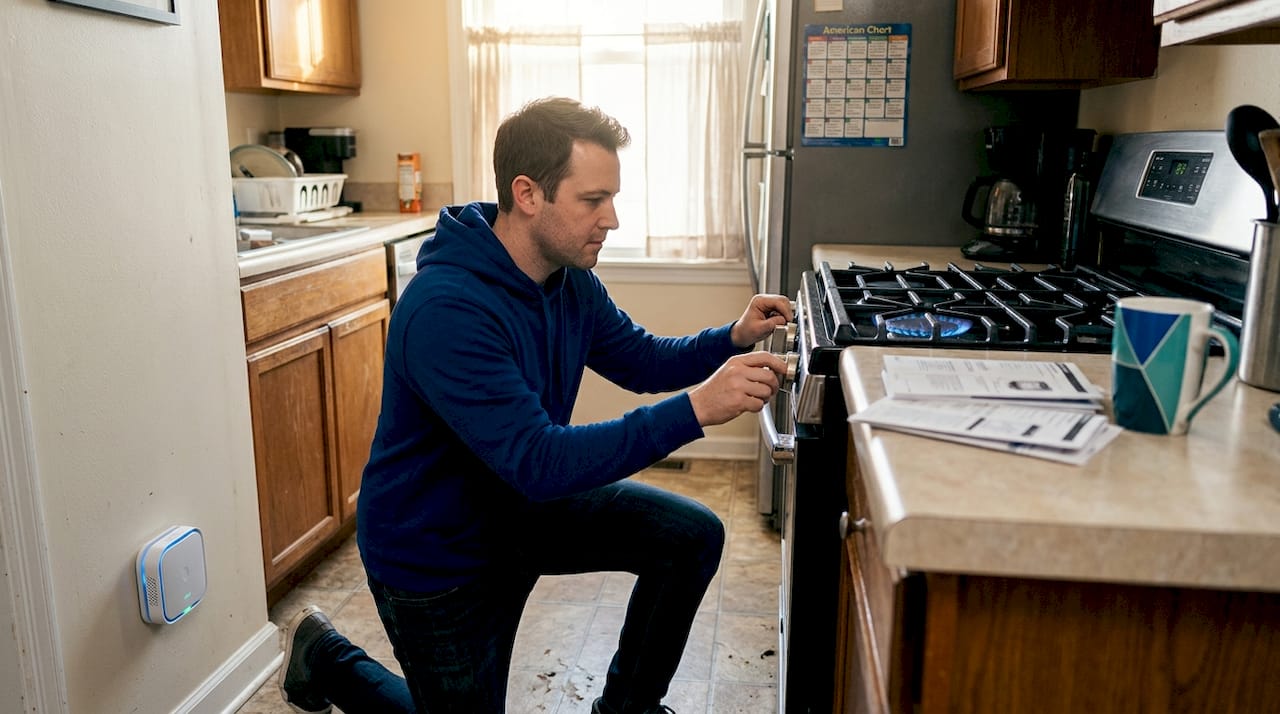
This is the practical core of gas appliance safety. Print it, save it on your phone, or post it somewhere visible. The goal is to turn these steps into muscle memory so you catch problems early, before they escalate into something dangerous or expensive.
The complete checklist
-
Schedule an annual professional inspection. A certified technician will examine every gas appliance, check connections, test pressure, and look for early signs of wear or leaks. This one step alone prevents more accidents than any other action on this list.
-
Install gas and CO detectors correctly. Place CO detectors near appliances, in sleeping areas, and on every level of your home. Test every detector once a month by pressing the test button. Replace batteries annually or use plug-in models with battery backup.
-
Test your detectors monthly. Set a calendar reminder. Many homeowners install detectors and forget about them for years. A detector with dead batteries offers zero protection.
-
Check pilot lights regularly. A healthy pilot light burns a steady blue flame. If you see orange or yellow, that is a warning sign that something is wrong with combustion.
-
Look and sniff around appliances even when they are off. A faint sulfur or rotten egg smell near a gas appliance, even one that is not running, means gas is escaping somewhere. Do not ignore it.
-
Keep combustibles clear. Keep the area around every gas appliance free of grease, paper, clothing, cleaning products, and anything else that can catch fire or interfere with airflow.
-
Inspect vents and exhaust pathways. Walk outside and visually check that dryer exhaust vents, furnace flues, and water heater vents are clear of debris, bird nests, and obstructions. Blocked vents are one of the leading causes of CO buildup indoors.
-
Check flexible gas connectors for aging. The corrugated metal or rubber hoses connecting your appliances to the gas line can crack or corrode over time. If yours look discolored, kinked, or brittle, schedule a timely gas line check immediately.
-
Look for soot or scorch marks. Dark staining near burners or the back of an appliance can indicate incomplete combustion, which produces carbon monoxide as a byproduct.
-
Know the warning signs. Refer to your list of appliance repair warning signs before assuming something minor is normal.
Pro Tip: Set the first of each month as your “detector test day.” While you are at it, do a quick visual pass of every gas appliance in your home. The whole routine takes under five minutes and could be the five minutes that prevents a catastrophe.
Some additional habits worth building into your routine:
- Never use a gas stove or oven as a space heater, even briefly.
- Always light the match or igniter before turning on the burner if you are using a manual-light appliance.
- Turn off all burners and pilots before leaving for vacation.
- If a burner does not light within a few seconds, turn it off and let the gas clear for a minute before trying again.
Spotting trouble: Warning signs and emergency actions
While regular checks reduce risk, knowing what to watch and what to do in an emergency can save lives.
Even the most diligent homeowner can be caught off guard. Gas issues sometimes develop between inspection cycles. Recognizing the earliest warning signs gives you a critical window to act before a small problem becomes a dangerous one.
Warning signs to watch for
- Yellow or orange flames on your stove burners or furnace. Blue flames mean complete, efficient combustion. Yellow or orange flames mean the appliance is not burning cleanly and may be producing carbon monoxide.
- Gas odor near appliances that are off. Natural gas is odorless in its natural state, but utility companies add a chemical called mercaptan to give it that distinctive rotten egg smell. Any time you catch that odor, take it seriously.
- Soot deposits around burners, furnace openings, or near vents.
- Recurring pilot light outages. If a pilot light keeps going out, the cause is not random. It is a sign of a faulty thermocouple, drafting issues, or a gas supply problem.
- Unexplained headaches, dizziness, or nausea in family members, especially when spending time near a specific appliance. These are classic symptoms of low-level CO exposure. Check your appliance trouble signs if you notice these patterns.
What to do in a gas emergency
If you smell gas inside your home, follow these steps without hesitation:
- Do not flip any light switches, use your phone inside, or operate any electrical devices. A single spark can ignite escaping gas.
- Evacuate immediately, leave the door open as you go, and get everyone including pets out of the building.
- Do not try to find the leak yourself.
- Once safely outside and away from the building, call 911 and your gas company. In Southern California, that means calling SoCalGas at their emergency line.
- Do not re-enter the home until emergency responders confirm it is safe.
Pro Tip: Save your gas company’s emergency number in your phone right now. In a real emergency, you will not want to be searching for it.
For less urgent issues, such as a yellow flame or a suspected minor leak, a gas range repair guide can help you understand what to tell a technician. However, always err toward caution. If something feels wrong, call a professional.
| Warning sign | Urgency level | Recommended action |
|---|---|---|
| Rotten egg smell | Critical | Evacuate and call 911 immediately |
| Yellow or orange flames | High | Stop using appliance, call technician |
| Soot deposits on appliance | High | Schedule inspection within 48 hours |
| Pilot light keeps going out | Moderate | Schedule professional inspection |
| Unexplained dizziness indoors | High | Ventilate, check CO detectors, call pro |
When a technician responds to a suspected gas appliance issue, they use pressure testing and calibrated leak detection tools to find problems invisible to the naked eye. These tools detect gas concentrations as low as a few parts per million, far below what the human nose can pick up.
Comparison: Professional vs. DIY gas appliance safety measures
Not all gas appliance safety steps are equal. Here is how to decide which tasks need a certified pro and which you can manage yourself.
One of the most common questions homeowners ask is: “What can I do myself, and when do I absolutely need to call someone?” The answer matters both for your safety and your budget. Understanding the boundary between DIY safety habits and professional services keeps you protected without overspending.
| Task | DIY? | Professional required? | Why |
|---|---|---|---|
| Test CO and gas detectors | Yes | No | Simple button press, anyone can do it |
| Visual flame color check | Yes | No | Visible to the naked eye |
| Clear area around appliances | Yes | No | Basic housekeeping |
| Check exterior vent for blockages | Yes | No | Visual check from outside |
| Gas line pressure testing | No | Yes | Requires calibrated equipment |
| Leak detection with tools | No | Yes | Requires professional-grade sensors |
| Flexible connector replacement | No | Yes | Involves live gas lines |
| Furnace heat exchanger inspection | No | Yes | Requires disassembly and expertise |
| CO safety calibration | No | Yes | Technical and liability-intensive |
The CPSC reports that improper venting and fuel use contributes to roughly 100 CO-related deaths per year in the United States. Many of these incidents involve situations where a trained eye would have caught the problem during a routine visit.
When you schedule a professional gas appliance inspection, here is what you are actually paying for:
- Pressure testing that identifies leaks too small to smell.
- Combustion analysis that checks whether appliances are burning gas cleanly.
- Vent and flue inspection using cameras or measurement tools.
- Documentation you can use for insurance and home sale purposes.
- A second set of trained eyes on systems you look at every day but may not truly see.
For broader home systems, an annual HVAC inspection often includes gas furnace checks and can cover multiple safety concerns in one visit. This is a smart way to consolidate costs while maximizing coverage.
DIY safety habits are genuinely valuable. They catch obvious problems, keep your appliances running efficiently, and create a baseline of awareness. But they are not a substitute for professional-level testing. Think of DIY as the daily maintenance and professional inspections as the deep diagnostic, both necessary, neither optional.
Why checklists aren’t enough: The real impact of expert eyes
Here is a perspective most articles do not mention: following a checklist faithfully is genuinely valuable, but it creates a specific kind of confidence that can actually create a blind spot.
When homeowners go through a safety checklist and everything looks fine, they often feel fully covered. And in fairness, that checklist probably did catch the obvious stuff. The burners look blue, the area is clear, and the detector beeped when you tested it. Good. You have handled the 90% that homeowners can handle.
But the last 10% is where the serious incidents live. A micro-fracture in a gas connector that is not yet leaking enough to smell. A heat exchanger that has a hairline crack visible only with a camera. A flue that is venting slightly incorrectly, slowly building CO levels that sit just below your detector’s alarm threshold. These are the risks that trained technicians find routinely because they know exactly where to look and what instruments to use.
We have seen firsthand in Orange and LA counties how often the “everything looks fine” home turns out to have an issue hiding behind the wall or inside the appliance cabinet. The checklist is not the destination. It is the floor, not the ceiling.
There is also the question of what you do when something changes. If you are considering updating older units, understanding the benefits of upgrading gas appliances can help you make a smarter, safer choice. Newer appliances come with better safety features, more efficient combustion, and fewer aging components to worry about.
Real peace of mind comes from pairing consistent personal habits with scheduled professional visits. That combination creates overlapping layers of protection. When one layer has a gap, the other catches it. That is not overcaution. That is how safety actually works.
Stay safe and stress-free with expert appliance support
When you are ready to go beyond checklists or need a professional fix, local experts are a click away.
Following a safety checklist is a powerful first step, but there are moments when you need a trained technician to step in and take over. Whether you need a full inspection, a repair, or guidance on an older system, professional support removes the uncertainty entirely.
Our team serves homeowners across Orange and Los Angeles counties with fast, reliable appliance repair and gas system support. From routine safety inspections to urgent repairs, we connect you with licensed technicians who know your area and your appliances. If you are dealing with an older unit, explore our repair vs replacement guide to make a confident, cost-smart decision. For specific appliance brands, our Samsung appliance repairs team is ready to help. And if you want to handle minor maintenance yourself, our repair guide for appliance parts walks you through the basics safely. Your household’s safety should never feel like guesswork.
Frequently asked questions
How often should I have my gas appliances checked?
Have your gas appliances inspected by a qualified technician at least once a year, as annual inspections are essential for both safety and efficiency.
Where should I install gas and carbon monoxide detectors?
Install gas detectors low to the ground near appliances and CO detectors at eye level or higher near bedrooms and on each floor of your home, testing all of them monthly.
What immediate actions should I take if I smell gas in my home?
Evacuate immediately, avoid using any electronics or switches while inside, and call 911 or your gas company only after you are safely outside and away from the building.
Can I perform gas appliance maintenance myself?
You can handle basic safety checks, visible inspections, and detector testing, but repairs and hidden risk detection require a professional, as annual inspections catch what checklists miss.
Why are regular vent checks important?
Blocked or damaged vents allow carbon monoxide to accumulate indoors, and the CPSC links improper venting directly to preventable CO poisoning deaths each year.