
TL;DR:
- Property managers in Orange and Los Angeles Counties are responsible for proactive maintenance, inspections, and vendor management to ensure habitability and legal compliance. Regular budgeting, preventive maintenance, and thorough documentation help reduce emergency costs and legal risks. Building strong vendor relationships and upgrading proactively improve tenant retention and property value.
Managing rental properties in Orange County and Los Angeles County is nowhere near as simple as taking repair calls and sending a technician. California habitability laws require property managers to coordinate vendors, schedule inspections, and keep every unit livable at all times, or face serious legal and financial consequences. A broken refrigerator or a failed furnace can trigger rent withholding, code violations, or even lease termination. Property managers who treat maintenance as an afterthought are leaving money and legal protection on the table. This article walks you through what the job actually demands, what it costs, and how to run maintenance the right way.
Table of Contents
- What property managers actually do in maintenance
- maintenance costs: benchmarking and budgeting in OC/LA
- Legal responsibilities and habitability in California
- Best practices for managing appliance and maintenance issues
- A contrarian take: maintenance management beyond compliance
- Take maintenance management to the next level with MD Tech appliance repair
- frequently asked questions
Key Takeaways
| Point | Details |
|---|---|
| Managers prevent costly risks | Property managers help avoid legal and financial issues through proactive maintenance and compliance. |
| Budget benchmarks matter | Knowing regional cost averages guides smart planning and protects profitability. |
| Legal compliance is essential | Staying current with California habitability laws and local regulations is critical for property managers. |
| Proactive is better than reactive | Preventive maintenance saves money and improves tenant satisfaction much more than reactive repairs. |
What property managers actually do in maintenance
Let’s be direct: property managers are not just middlemen who forward repair requests. They are the operational backbone keeping a property legally compliant, physically sound, and financially performing. That means juggling multiple moving parts every single week.
Core maintenance responsibilities include:
- Managing appliance repair vendors and ensuring work is completed on time and within budget
- scheduling quarterly or semi-annual inspections to catch small problems before they become costly
- responding to emergency maintenance requests within legally required timeframes
- tracking open work orders and following up until each issue is fully resolved
- verifying all repairs meet California’s implied warranty of habitability, which requires rental units to be safe and livable at all times
The implied warranty of habitability is not optional. Property managers in OC and LA must ensure coordinated repairs, routine inspections, and vendor management all support compliance with this standard.
Appliance issues deserve special attention because they directly affect habitability. A refrigerator that stops cooling, an in-unit washer that leaks, or an air conditioning unit that fails in July is not a minor inconvenience in Southern California. It is a potential habitability violation. That is why smart managers invest in appliance maintenance services before breakdowns happen, not after.
Regular inspections also surface problems in systems that often go unnoticed until they fail catastrophically. Understanding how routine inspections protect property is part of what separates proactive managers from reactive ones.
Pro tip: Build a simple vendor contact sheet organized by trade, appliance type, and typical response time. When an emergency hits, you need answers in minutes, not hours.
maintenance costs: benchmarking and budgeting in OC/LA
Knowing what maintenance should cost is half the battle. Without benchmarks, you’re either overpaying vendors or under-budgeting and getting caught off guard when a major system fails.
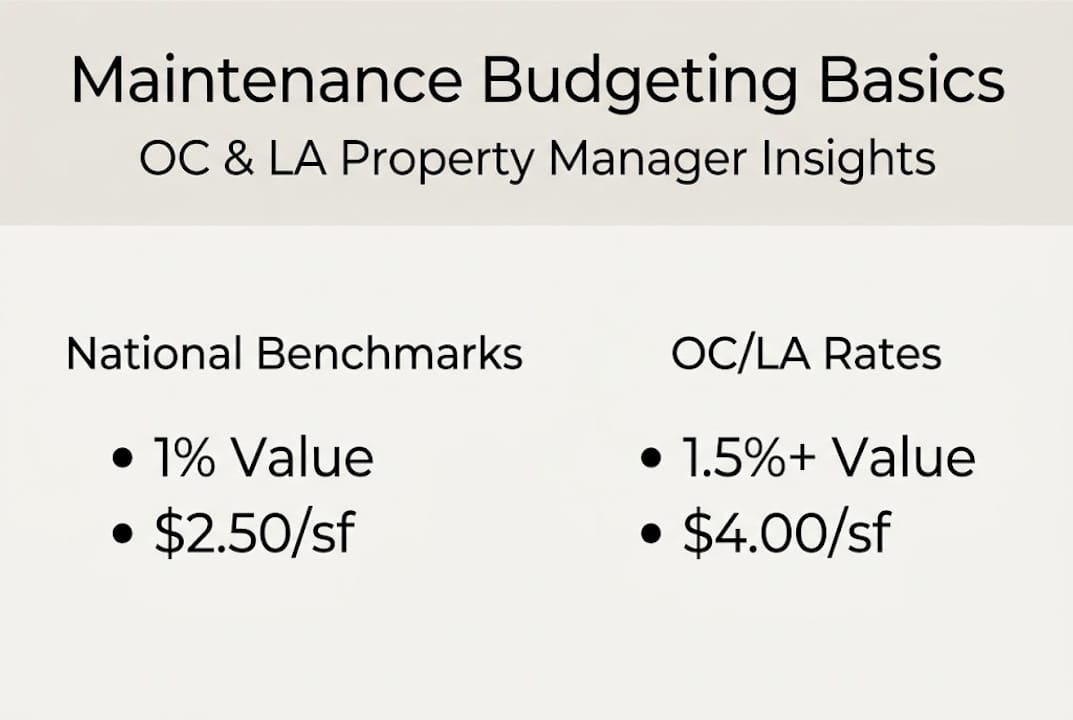
Here is how maintenance costs break down across industry-standard benchmarks and Southern California specifics:
| metric | national benchmark | OC/LA benchmark |
|---|---|---|
| % of property value (annual) | 1% to 3% | 1.5% to 3%+ depending on age |
| cost per unit/door | $1,000 to $3,000 | $2,000 to $4,000+ |
| % of gross rent | 5% to 15% | 10% to 15% (high-cost market) |
| cost per square foot | $0.90 to $1.30 | $2.75 to $4.00 |
| emergency call premium | baseline rate | 3x planned maintenance cost |
That last row deserves a second look. Emergency calls run three times the cost of scheduled maintenance. A repair that would cost $150 as a planned service call can balloon to $450 or more when it’s urgent and after hours.
For Orange County and Los Angeles County properties, the cost-per-square-foot metric is especially telling. At $2.75 to $4.00 per square foot annually, a 1,500-square-foot unit might require between $4,125 and $6,000 per year in maintenance alone. That is real money, and it needs a real budget line.
Key budgeting principles for OC/LA managers:
- Reserve a dedicated maintenance fund, not just a general property account
- Factor in regional price premiums for labor and materials in coastal and metro areas
- Budget separately for appliance lifecycle replacement versus routine repairs
- Track actual vs. budgeted maintenance monthly to catch overruns early
Understanding how timely maintenance prevents surprises can reframe the entire conversation from “expense” to “asset protection.” Property managers who embrace preventive maintenance savings typically see significantly lower emergency repair bills year over year. A well-structured maintenance scheduling system is not overhead. It is strategy.
Legal responsibilities and habitability in California
California has some of the strongest tenant protections in the country, and Orange County and Los Angeles County property managers operate squarely in that environment. Understanding the legal framework is not optional. It is core to the job.
Here is a clear breakdown of who is responsible for what:
| responsibility | property manager | tenant |
|---|---|---|
| appliance breakdown (normal use) | manager | not tenant |
| damage from tenant negligence | not manager | tenant |
| habitability-affecting repairs | manager (urgent) | not tenant |
| cosmetic issues (minor) | negotiable by lease | tenant may handle |
| coastal corrosion (OC properties) | manager (special materials) | not tenant |
When managers fail to act, California law gives tenants real options. After giving 30 days’ written notice, tenants may use the repair-and-deduct remedy up to one month’s rent, and they can exercise this right twice per year. If conditions become uninhabitable, tenants can also withhold rent or terminate their lease outright.
Key legal obligations for California property managers in 2026:
- respond to habitability repairs promptly, typically within 30 days of written notice at most
- document every repair request and response, creating a paper trail that protects you legally
- use appropriate materials in coastal OC properties, where salt air accelerates corrosion on appliances, pipes, and fixtures
- be aware of LA-specific inspection triggers, where city housing inspections can be initiated by tenant complaints
- never retaliate against tenants who exercise their legal maintenance rights
“When maintenance is neglected, California law does not wait for the manager to catch up. California tenant law gives renters real power to act, and courts tend to side with them.”
A concrete area where this plays out is plumbing. A failed pipe or a backed-up drain can make a unit uninhabitable within hours. Getting familiar with the basics of a residential plumbing inspection can help you catch vulnerabilities before a tenant is forced to act on their legal rights.
Best practices for managing appliance and maintenance issues
Knowing the rules matters. But executing well under pressure is where most managers either build or lose their reputation. These practices separate the average from the excellent.
Build a preventive maintenance calendar. The single biggest differentiator between high-performing and struggling property managers is scheduled attention. Every appliance, every system, every unit should have a service date on the calendar. Don’t wait for failure.
Core best practices include:
- conduct appliance checks at each tenant turnover, documenting condition with photos and written notes
- schedule semi-annual system reviews for refrigerators, washers, dryers, and range appliances
- create a written communication log for every maintenance request, even verbal ones get followed up in writing
- pre-qualify vendors before you need them, not during a crisis
- respond quickly to every request, even if the fix takes time. tenants forgive delays far more easily than silence
Vendor selection in Orange County and LA deserves its own focus. The market is large, but not every repair company understands the regional quirks, coastal corrosion, older building stock in LA, HOA restrictions on service windows, and licensed technician requirements. Look for companies with demonstrated local experience.
Pro tip: Review your most common repair types from the past 12 months. If one category keeps appearing, it is telling you something. Address the pattern, not just each incident.
For properties where appliance issues are frequent, affordable appliance repair partnerships can reduce per-call costs through volume or preferred-vendor agreements. And before authorizing any major repair, use accurate service estimates to validate that you are getting fair pricing. This protects your budget and your credibility with property owners.
Documentation is not paperwork for its own sake. It is your legal defense, your maintenance history, and your proof of compliance all in one.
A contrarian take: maintenance management beyond compliance
Most articles about property maintenance stop at compliance. Do the repairs, meet the legal minimums, move on. But here is the uncomfortable truth: managers who only aim for compliance are running a cost center, not a strategy.
The managers who consistently retain tenants, attract quality residents, and command above-market rents in Orange County and LA are not just fixing what breaks. They are upgrading proactively. A new energy-efficient dishwasher or a smart thermostat is not just a nice feature. It signals to a tenant that the property is managed with care, and that translates directly into lease renewals.
Reactive maintenance always costs more in the long run. A neglected appliance that finally fails mid-lease costs you the repair, possible habitability risk, and maybe a good tenant who decides not to renew. Prevention through a structured preventive maintenance approach is the only maintenance model that actually builds asset value over time.
The best property managers we work with don’t think about maintenance as a burden. They treat it as their most reliable ROI lever.
Take maintenance management to the next level with MD Tech appliance repair
You now have a clearer picture of what great maintenance management looks like in Orange County and Los Angeles County. The next step is having the right service partners in place before you need them.
At MD Tech appliance repair, we work directly with property managers across OC and LA to deliver fast, reliable appliance repair and maintenance services backed by licensed technicians. Whether you manage a single-family rental or a multi-unit building, our team handles everything from Samsung appliance repairs to full system diagnostics. Not sure if a repair makes sense? Our appliance parts replacement guide and repair vs replacement insights help you make smart decisions every time. Book online or call us to get started.
frequently asked questions
What maintenance tasks are property managers responsible for in Orange County and Los Angeles?
Property managers coordinate repairs, schedule inspections, manage vendors, and ensure legal compliance for appliances and all property systems. They are the primary point of accountability for keeping units safe and livable.
How much should property managers budget for maintenance annually?
In Southern California, maintenance budgets typically run between $2.75 and $4.00 per square foot or 1% to 3% of property value annually. OC and LA market costs often push toward the higher end of both ranges.
What legal risks do property managers face when maintenance is neglected?
Tenants in California can use repair-and-deduct up to one month’s rent, withhold rent, or terminate leases if units become uninhabitable. Local laws in LA and OC add further exposure through mandatory inspections and coastal compliance rules.
How can property managers reduce maintenance emergencies and costs?
Scheduling regular preventive checks and building relationships with reliable vendors dramatically reduces emergency call frequency, since emergency repairs cost roughly three times more than planned ones. Prevention is always cheaper than crisis response.