
Most homeowners assume appliance maintenance is an unnecessary expense until a major breakdown forces an emergency repair costing thousands. The truth is counterintuitive: spending a small amount on regular upkeep prevents the very failures that drain your budget. Well-maintained HVAC systems last their full design lifespan, while neglect causes premature failure and professional inspections prevent up to 70% of breakdowns. This guide reveals how strategic maintenance extends appliance life, slashes repair costs, improves energy efficiency by up to 30%, and protects your home from safety hazards you might never see coming.
Table of Contents
- Key takeaways
- How regular maintenance extends appliance lifespan
- Preventing costly repairs through proactive upkeep
- How maintenance improves energy efficiency and safety
- Knowing when to repair versus replace your appliances
- Protect your home appliances with expert maintenance and repair
- Frequently asked questions about scheduling regular maintenance
Key Takeaways
| Point | Details |
|---|---|
| Extends appliance lifespan | Regular maintenance helps your appliances reach their designed lifespan by preventing minor issues from becoming major failures. |
| Preventive inspections cut failures | Annual professional inspections can prevent the majority of breakdowns by catching worn parts and leaks early so repairs stay affordable. |
| Energy efficiency up to 30% | Regular upkeep boosts energy efficiency and can lower utility bills by up to 30 percent. |
| Lower repair costs through upkeep | Proactive maintenance minimizes expensive emergency repairs by addressing issues while they are small and inexpensive. |
How regular maintenance extends appliance lifespan
Your refrigerator, washer, dryer, and HVAC system are designed to last 10 to 20 years, but only if you treat them right. Maintenance catches small issues before they cascade into major failures that force premature replacement. A refrigerator compressor running with dirty coils works harder, generating excess heat that shortens its life by years. Clean coils and proper calibration keep the unit running at design efficiency, preserving the lifespan engineers intended.
Annual inspections by professionals allow timely repairs that prevent breakdowns entirely. When a technician spots a worn belt, loose connection, or early refrigerant leak, fixing it costs far less than waiting for complete failure. Professional inspections prevent up to 70% of appliance failures, transforming potential disasters into minor tune-ups. This proactive approach means your appliances reach their expected lifespan instead of dying halfway through.
Consider these maintenance actions that directly extend appliance life:
- Cleaning refrigerator coils every six months prevents compressor strain
- Replacing HVAC filters quarterly maintains airflow and reduces system stress
- Inspecting washer hoses annually catches cracks before they burst
- Clearing dryer vents prevents overheating and motor burnout
Pro Tip: Set calendar reminders for routine checks every six months so you never miss critical maintenance windows. Most smartphones let you create recurring alerts that ensure your appliances get the attention they need exactly when they need it.
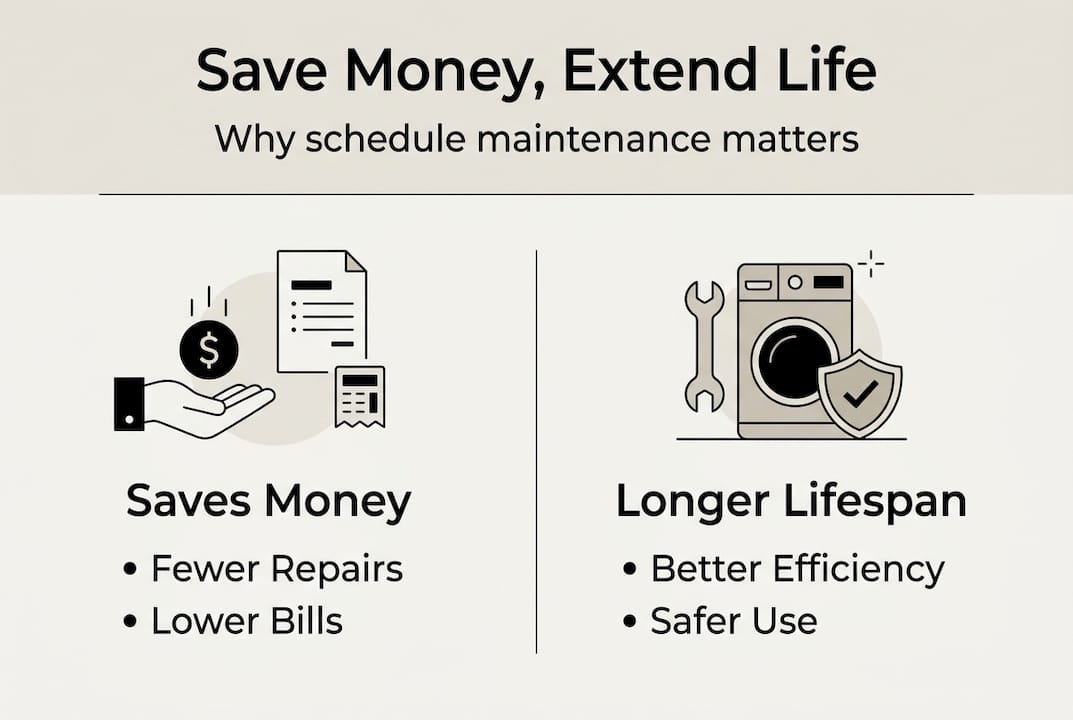
Following expert tips for longevity transforms maintenance from a chore into a strategic investment. You’re not just cleaning parts; you’re actively preventing the wear patterns that kill appliances early. The difference between a 10-year lifespan and a 15-year lifespan often comes down to whether you stayed ahead of minor issues or let them compound into catastrophic failures.
Preventing costly repairs through proactive upkeep
The financial argument for maintenance becomes crystal clear when you compare costs. Minor issues typically cost $50 to $200 to fix during routine service. Ignore that same issue, and it escalates into failures requiring $500 to $2,000 in emergency repairs or even full replacement. $100 in annual maintenance prevents $500+ repairs, while yearly upkeep costs $150 to $300 compared to $5,000 to $8,000 replacement expenses.
Regular upkeep mitigates emergency breakdowns that disrupt your daily life and carry premium pricing. When your refrigerator dies on a Saturday night, you pay rush fees and lose hundreds in spoiled food. When a technician catches the failing component during scheduled maintenance, you pay standard rates and avoid the chaos entirely. The math is simple: proactive beats reactive every single time.
Common maintenance tasks that prevent expensive repairs include:
- Tightening electrical connections before they arc and damage circuit boards
- Lubricating moving parts to prevent friction wear and motor burnout
- Testing safety switches to ensure they function before failures occur
- Calibrating thermostats so systems don’t overwork and fail prematurely
To maximize these savings, follow this structured approach:
- Create a maintenance schedule listing each appliance and its service intervals
- Budget $150 to $300 annually for professional inspections and tune-ups
- Keep detailed records of all service visits and repairs performed
- Address any issues technicians identify immediately, before they worsen
- Track your spending to see how maintenance costs compare to avoided repairs
Pro Tip: Prioritize maintenance on appliances older than five years, as they’re entering the phase where component wear accelerates and failure risk climbs sharply. Your newer appliances need attention too, but older units deliver the biggest return on maintenance investment.
When you schedule appliance maintenance consistently, you shift from crisis management to strategic planning. Instead of wondering when the next breakdown will strike, you control the timeline. The repair over replace guide shows how this approach keeps appliances running reliably for their full design life, maximizing your original investment.

How maintenance improves energy efficiency and safety
Dirty, poorly maintained appliances consume significantly more electricity than clean, calibrated units. The efficiency gains translate directly into lower utility bills month after month. Maintenance reduces HVAC energy usage by 15-20%, air conditioning by up to 20%, with overall household savings reaching 30% when you maintain all major appliances. A refrigerator with clean coils uses 25% less energy than one with dust-caked coils forcing the compressor to run constantly.
These savings compound over years. If your monthly utility bill drops from $200 to $150 through better appliance efficiency, you save $600 annually. Over a decade, that’s $6,000 in your pocket instead of the utility company’s. The initial maintenance investment pays for itself many times over through reduced energy consumption.
| Appliance Type | Energy Savings | Annual Dollar Impact |
|---|---|---|
| HVAC system | 15-20% reduction | $180-$300 saved |
| Refrigerator | 20-25% reduction | $40-$60 saved |
| Washer/Dryer | 10-15% reduction | $30-$50 saved |
| Dishwasher | 10-15% reduction | $20-$35 saved |
Beyond financial benefits, maintenance protects your family from hidden dangers. Regular inspections identify safety hazards before they cause injury, property damage, or health problems. Maintenance prevents hazards like refrigerant leaks, poor airflow, and fire risks from lint buildup in dryers. These aren’t theoretical concerns; house fires from dryer lint kill dozens annually, while carbon monoxide from malfunctioning furnaces sends thousands to emergency rooms.
Common hazards detectable during professional inspections include:
- Refrigerant leaks that release toxic chemicals into your home
- Lint accumulation in dryer vents creating fire hazards
- Mold growth in HVAC systems spreading allergens through air ducts
- Blocked airflow causing carbon monoxide buildup from gas appliances
- Electrical shorts that could spark fires inside appliance housings
- Gas line leaks near stoves and water heaters
Understanding why maintenance matters means recognizing that your appliances aren’t just convenience items. They’re complex systems with real safety implications when neglected. The technicians’ role in appliance safety extends far beyond fixing what’s broken; they catch problems you’d never notice until disaster strikes. A trained eye spots warning signs invisible to homeowners, turning potential tragedies into simple fixes.
Knowing when to repair versus replace your appliances
Maintenance extends appliance life, but every unit eventually reaches the point where replacement makes more financial sense than continued repairs. The 50% rule advises against repairs costing more than half the replacement price, especially for units older than eight years with rising failure risk. This threshold helps you avoid throwing good money after bad on appliances approaching end of life.
The decision involves multiple factors beyond simple repair cost. Age matters significantly because older appliances lack the energy efficiency of modern units, meaning continued operation costs more monthly even if the repair itself is affordable. A 15-year-old refrigerator might run fine after a $300 compressor repair, but it uses twice the electricity of a new Energy Star model, costing you $10 monthly in excess power.
| Scenario | Repair | Replace |
|---|---|---|
| Unit under 5 years, minor issue | ✓ Usually best choice | Wait unless severely damaged |
| Unit 5-10 years, moderate repair | Evaluate cost vs 50% rule | Consider if approaching 50% threshold |
| Unit over 10 years, major repair | Rarely worthwhile | Usually smarter long-term |
| Frequent breakdowns | Throwing money away | End the repair cycle |
Follow this evaluation process when facing repair decisions:
- Calculate the repair cost as a percentage of replacement price
- Assess the appliance age and compare to its expected lifespan
- Review your repair history for patterns of recurring failures
- Research energy efficiency improvements in newer models
- Factor in safety concerns if the unit has known hazards
- Consider whether the appliance meets your current household needs
Some situations clearly favor one choice over another. If your three-year-old dishwasher needs a $150 pump replacement, repair makes obvious sense. If your 12-year-old dryer needs a $400 motor and has already required two other repairs this year, replacement stops the bleeding. The gray area between these extremes requires honest assessment of total ownership costs, not just immediate repair expenses.
The repair vs replacement guide provides detailed frameworks for these decisions, while fix vs replace appliances explores the nuanced considerations beyond simple cost calculations. Maintenance plays a crucial role here too: well-maintained appliances reach their full lifespan, making repair worthwhile longer. Neglected units fail prematurely, often requiring replacement years before a maintained equivalent would need it.
Protect your home appliances with expert maintenance and repair
Now that you understand how strategic maintenance saves thousands while extending appliance life, the next step is connecting with professionals who make it effortless. MDTECH serves Orange and Los Angeles Counties with comprehensive appliance maintenance and repair services designed specifically for homeowners who want to maximize their investments. Their licensed technicians catch problems early, perform thorough inspections, and provide honest guidance on the repair vs replacement decision so you never waste money on the wrong choice.
Whether you need routine maintenance for your refrigerator, emergency repair for a broken washer, or expert assessment of an aging HVAC system, MDTECH’s team brings decades of combined experience to every service call. They specialize in major brands including Samsung appliance repair and provide detailed guidance through their appliance parts replacement guide when components need updating. Schedule your maintenance today and stop gambling with expensive breakdowns when prevention costs a fraction of emergency repairs.
Frequently asked questions about scheduling regular maintenance
How often should I schedule maintenance for home appliances?
Major appliances like refrigerators, washers, and HVAC systems benefit from annual professional inspections, while simpler tasks like cleaning dryer vents and replacing HVAC filters should happen quarterly. Scheduling maintenance twice yearly for older appliances over eight years catches accelerating wear before failures occur.
What is the average cost of regular appliance maintenance?
Professional maintenance typically costs $150 to $300 annually per appliance, covering inspection, cleaning, calibration, and minor adjustments. This investment prevents $500 to $2,000 in emergency repairs and extends lifespan by years, delivering 5 to 10 times return through avoided replacement costs.
Can maintenance really lower my utility bills?
Absolutely, with documented savings of 15 to 30% on energy costs when appliances run at peak efficiency. Clean coils, proper calibration, and optimal airflow reduce electricity consumption month after month, translating to hundreds in annual savings that continue for the appliance’s entire remaining life.
When is it better to replace rather than repair?
Replace when repair costs exceed 50% of replacement price, especially for units over eight years old with history of multiple failures. Also consider replacement if the appliance lacks modern safety features, uses significantly more energy than current models, or no longer meets your household needs regardless of repair cost.
Are professional inspections really necessary or can I do maintenance myself?
Homeowners can handle basic tasks like cleaning filters and coils, but professional inspections catch hidden issues requiring specialized knowledge and tools. Technicians identify refrigerant leaks, electrical problems, and safety hazards invisible to untrained eyes, making annual professional service essential for comprehensive protection and maximum appliance lifespan.
Recommended
- Why Schedule Appliance Maintenance: Prevent Costly Repairs
- Schedule Annual HVAC Service: 25% Longer Life, 20% Savings
- Why Regular Appliance Maintenance: Expert Tips for Longevity
- Guide to Washer Maintenance for Longer Life
- Coffee Machine Service Contracts | Maintenance Plans | Devon Somerset