
TL;DR:
- Common oven issues include heating element failure, sensor problems, and control board malfunctions.
- Basic troubleshooting steps like power resets and visual inspections can often fix common problems.
- Regular maintenance and avoiding self-clean misuse extend oven lifespan and prevent costly repairs.
A malfunctioning oven rarely announces itself with a simple, easy-to-diagnose sign. More often, it starts small: a dish that won’t cook evenly, a temperature that seems off, or a door that no longer seals right. Left unchecked, these small quirks can turn into full breakdowns. In fact, self-clean misuse and foil are among the leading contributors to oven failures in American homes. Knowing what to look for, how to troubleshoot safely, and when to call a professional can save you hundreds of dollars and a lot of unnecessary stress.
Table of Contents
- Top 6 common oven malfunctions and how to spot them
- Basic troubleshooting steps every homeowner should try
- Electric vs gas ovens: Differences in repair and safety risks
- When to repair vs replace: Making the smart decision
- Our expert perspective: Preventing oven failures before they start
- Get trusted service for your oven repairs in Orange & LA Counties
- Frequently asked questions
Key Takeaways
| Point | Details |
|---|---|
| Heating issues most common | Element and sensor problems are the leading causes of oven breakdowns. |
| Troubleshoot safely first | Homeowners should try simple checks before calling a technician. |
| Gas ovens require pros | DIY repairs are safest with electric ovens; gas oven fixes should be professional. |
| Repair vs replace criteria | Repair if under $800 and less than 15 years old; otherwise consider replacement. |
| Preventive habits matter | Avoiding foil and self-clean cycles extends oven lifespan and reliability. |
Top 6 common oven malfunctions and how to spot them
Most oven problems fall into a surprisingly short list of categories. Once you know what to look for, spotting them early becomes second nature.
Here are the six most frequent oven malfunctions homeowners in Orange and Los Angeles Counties encounter:
- Heating element failure. If your electric oven won’t heat or you see visible cracks and blistering on the element, it likely needs replacement. This is one of the most common issues and one of the easier fixes. You can learn more if your oven not heating up is your primary concern.
- Temperature sensor problems. When your oven runs too hot or too cold even though you set it correctly, a faulty temperature sensor (also called an RTD sensor) is usually to blame. It reads the heat inside the cavity and signals the control board.
- Control board issues. The control board is the oven’s brain. When it fails, you may see error codes, unresponsive buttons, or the oven cycling on and off without reason.
- Door latch and seal malfunctions. A worn door gasket lets heat escape, which drives up your energy use and ruins cook times. A broken latch can keep a self-cleaning cycle from even starting.
- No power or unresponsive controls. This is often a tripped circuit breaker or a failed control panel. It can also indicate a deeper electrical issue worth diagnosing quickly.
- Uneven cooking and hot spots. If one side of your casserole burns while the other stays raw, the convection fan, a failing element, or poor sensor calibration is likely the cause.
Edge cases like power surges and self-clean overuse can quietly damage circuit boards and thermal fuses over time, even when no single incident stands out. This is why regular inspection matters as much as reactive repair.
Basic troubleshooting steps every homeowner should try
Once you recognize the symptoms, here’s what you can safely do before picking up the phone. A few simple checks can save you a service call.
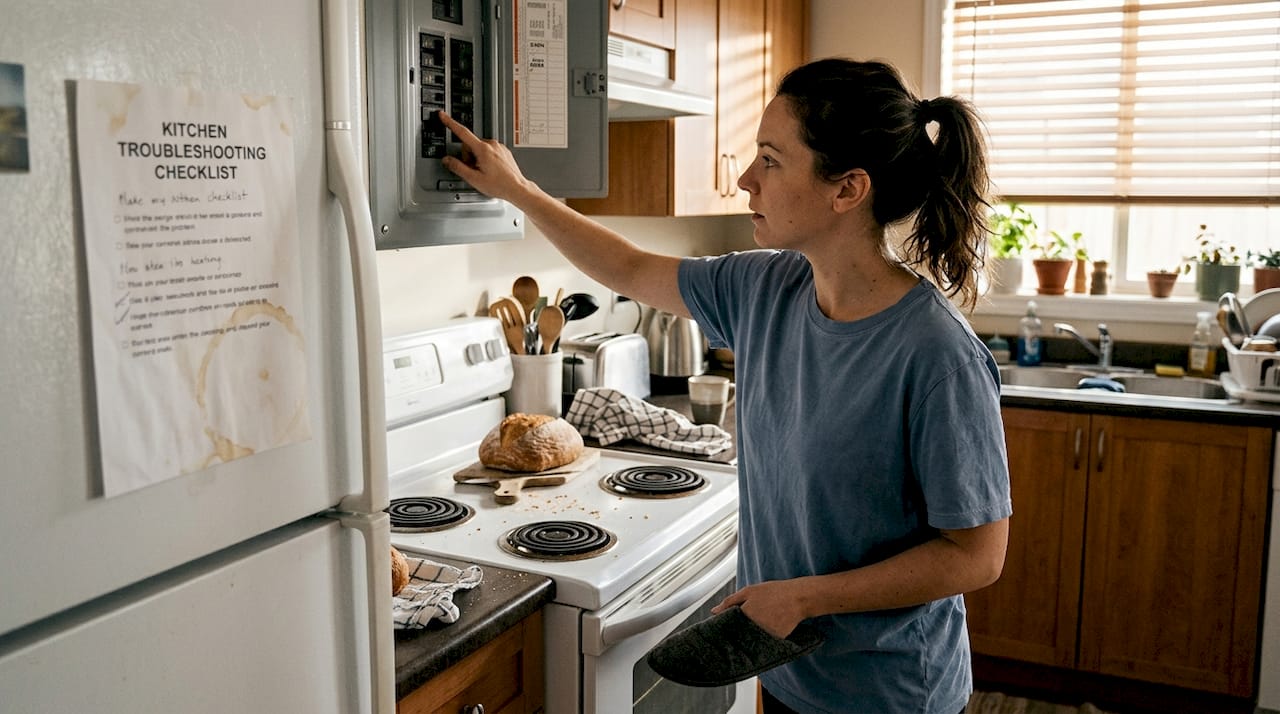
- Disconnect power first. Before touching anything inside your oven, unplug it or switch off its dedicated circuit breaker. For gas ovens, locate the shutoff valve behind or beneath the unit and close it.
- Do a visual inspection. Look at the heating elements for cracks, burns, or separated coils. Check the door gasket for tears. Scan the control panel for any signs of melting or discoloration.
- Reset your circuit breaker. Flip the breaker to the oven fully off, wait 60 seconds, then restore power. This resets the electronics and often clears a temporary fault.
- Test heating elements with a multimeter. A multimeter (an inexpensive tool that measures electrical resistance) can confirm whether an element is drawing current. No reading means no function, and the element needs swapping.
- Calibrate or reset the controls. Many modern ovens allow a manual temperature offset of up to 35 degrees Fahrenheit through the settings menu. Check your model’s manual for exact steps.
Pro Tip: Place an oven thermometer on the center rack and let the oven preheat fully. If the thermometer reads more than 25 degrees off your set temperature, regular oven calibration is overdue and worth scheduling.
Basic troubleshooting like breaker checks, control resets, and visual inspections are the first line of defense before calling in a technician. For a more structured approach, our step-by-step oven repair guide walks you through the process with detailed instructions. Homeowners who follow these steps see successful oven repairs about 85% of the time on simpler issues.
Electric vs gas ovens: Differences in repair and safety risks
Depending on your oven type, the best approach to repairs can change dramatically. What’s a manageable weekend fix on an electric unit can become a genuine safety hazard on a gas model.
Electric ovens give homeowners the most room for safe DIY repairs. Swapping a bake or broil element is straightforward: disconnect power, unscrew the old element, and connect the new one. Control boards and temperature sensors are also replaceable with basic tools and some patience.
Gas ovens are a different story. The igniter, gas valve, and burner assembly all involve components that can create fire or carbon monoxide risk if mishandled. Ventilation is also a factor: a partially blocked flue or exhaust vent can push dangerous gases back into your kitchen.
Here’s a quick comparison to help you decide:
| Repair type | Electric oven | Gas oven |
|---|---|---|
| Heating element swap | DIY-friendly | Not applicable |
| Igniter replacement | Not applicable | Professional recommended |
| Temperature sensor | DIY with care | Professional recommended |
| Control board | DIY advanced | Professional recommended |
| Door gasket | DIY-friendly | DIY-friendly |
| Gas valve repair | Not applicable | Professional only |
Brand reliability also plays a role. Electric ovens are easier for DIY element swaps, while gas ovens add complexity that typically warrants professional service.
Brands like Bosch and Whirlpool consistently score well for build quality and part availability, making repairs more straightforward. Brands like Samsung and LG can present challenges due to proprietary parts and more complex control systems.
Pro Tip: If you smell gas or suspect a leak at any point, leave the house immediately and call your gas utility. Do not attempt any repair. You can review our full gas oven repair guide and information on gas range repairs for what to expect from a professional service visit.
When to repair vs replace: Making the smart decision
After examining repair approaches, you need a clear framework for deciding whether to fix your oven or retire it. The answer usually comes down to three factors: age, repair cost, and brand reliability.
Lifespan benchmarks to keep in mind:
- Most ovens are built to last 10 to 20 years depending on brand and usage
- After the 10-year mark, repair frequency tends to increase
- An oven older than 15 years that needs a major repair is usually a replacement candidate
The general rule of thumb: repair if the cost is under $800 and the unit is younger than 10 to 15 years. Beyond those thresholds, a new appliance often makes more financial sense.
Brand reliability matters here too. Bosch and Whirlpool ovens show repair rates of 8 to 11%, while Samsung and LG models come in at 18 to 20%. That gap becomes significant when you’re deciding whether to invest in another repair.
| Brand | Estimated repair rate | Repair worthwhile under 10 yrs? |
|---|---|---|
| Bosch | 8% | Yes |
| Whirlpool | 11% | Yes |
| GE | 13% | Yes |
| LG | 18% | Evaluate carefully |
| Samsung | 20% | Evaluate carefully |
“If your oven is under 10 years old and the repair cost is below $800, fixing it almost always beats buying new. Above those thresholds, replacement typically delivers better long-term value.”
Use our repair vs replacement guide to run a quick cost-benefit analysis before making any final call.
Our expert perspective: Preventing oven failures before they start
Here’s something most repair articles skip: the majority of oven breakdowns we see are entirely avoidable. After years of servicing ovens across Orange and Los Angeles Counties, the pattern is clear.
Overuse of the self-cleaning cycle is a bigger problem than most homeowners realize. That cycle runs your oven at temperatures above 900 degrees Fahrenheit, which can blow thermal fuses, crack elements, and stress the control board. Limiting self-cleaning to two or three times a year makes a measurable difference.
Lining the oven bottom with aluminum foil is another habit that destroys ovens quietly. It blocks airflow, traps heat unevenly, and can permanently damage the oven’s interior coating.
Choosing the right brand at purchase time also reduces your long-term repair bills significantly. Proper prevention includes avoiding foil and self-clean overuse, proper cookware selection, and sticking with reliable brands like Bosch or GE Profile.
For ongoing peace of mind, local oven repair and scheduled maintenance visits catch small problems before they become expensive ones. Prevention is almost always cheaper than repair.
Get trusted service for your oven repairs in Orange & LA Counties
When troubleshooting steps don’t solve the problem or the repair involves gas components, it’s time to bring in a professional you can trust.
MDTECH connects homeowners across Orange and Los Angeles Counties with certified appliance repair technicians who handle everything from heating element swaps to complex control board diagnostics. Our oven repair specialists arrive equipped for fast, accurate diagnosis, so you’re not left guessing. If your appliance is a Samsung model, our dedicated Samsung appliance repair team knows exactly where those units tend to fail. Not sure whether to fix or replace? Use our repair vs replacement advice resource, then book a service visit online to get a firm answer from a licensed technician.
Frequently asked questions
What are the most common oven malfunctions homeowners face?
Heating elements, sensors, controls, and seals are the most frequent sources of oven trouble, often caused by normal wear or avoidable habits like foil use and self-clean overuse.
Is it safe to repair an oven yourself?
Basic troubleshooting is safe for most electric ovens, but gas ovens are riskier and igniter or valve work should always go to a licensed technician.
How can I prevent oven malfunctions?
Avoid overusing the self-clean function, never line the oven floor with foil, and prevent with regular maintenance to catch early warning signs before they become costly repairs.
What should I do if my oven has no power?
Check the circuit breaker, confirm the outlet is live, and try a control reset; troubleshooting includes breaker checks and control resets as the first steps before calling a technician.
How long should an oven last before needing replacement?
Most ovens last 10 to 20 years; plan to replace yours if repair costs exceed $800 or the unit is older than 15 years.