
Most washer repairs land between $150 and $250, with the typical homeowner paying around $200 to $220 for a service call plus parts and labor. A top-load washer generally lasts about a decade to slightly over a decade, front-loaders last somewhat less, and that lifespan matters just as much as the repair quote itself.
TL;DR:
- Repair costs typically range from $150 to $250, with the average around $220, but prices can sometimes exceed $400, especially for complex parts.
- Major trouble spots like control boards and sealed-tub bearings often push repair bills above $400 to $800, making replacement more cost-effective.
- Front-load washers and smart models generally cost more to repair due to their complex design and electronics, with median repair costs over $150.
- A repair quote exceeding 50% of a new washer’s price, combined with machine age over 8-11 years or multiple recent repairs, suggests replacement may be wiser.
- Many minor repairs, such as belt or hose replacements, are DIY-friendly, but sealed-tub or electronic repairs require professional service to avoid voiding warranties or causing further damage.
Table of Contents
- What Does Washer Repair Cost on Average?
- How Much Does It Cost to Repair Each Washer Part?
- Why Do Washer Repair Costs Vary by Type and Brand?
- What Determines the Final Repair Bill?
- When Should You Repair vs. Replace Your Washer?
- Can You Fix a Washer Yourself, or Should You Call a Pro?
- How Can You Lower Your Washer Repair Costs?
- What Makes MDTECH’s Washer Repair Pricing Different
- Is the 50% Rule Actually the Right Way to Decide?
- Ready for a Transparent Washer Repair Quote?
- Sources
What Does Washer Repair Cost on Average?
National data tends to cluster in a tight band once you strip out the outliers. Angi’s 2026 figures put typical repairs at $180 to $250, with many households landing near $220. Thumbtack’s numbers run a bit wider, roughly $128 to $324, with a median closer to $204. ConsumerAffairs reports a similar spread of $150 to $500 with an average nearer $180. Line those three up and you get a realistic planning range: budget $150 to $250 for a routine fix, and know that a small handful of jobs will run well past that.
The final number breaks into three pieces that rarely show up as one clean line item on an invoice:
- Diagnostic or service call fee: usually $100 to $150, sometimes waived if you approve the repair on the spot
- Parts: anywhere from $12 for an inlet valve to $500 for a motor, depending on what failed
- Labor: billed hourly in most markets, or bundled into a flat rate for common jobs
Here’s what that looks like in practice. A stuck drain hose or a worn belt is a simple fix, often $75 to $150 total once the tech is on-site. A bad water inlet valve or door latch is a typical fix, usually $150 to $280 with parts and an hour of labor. A failed motor or control board is where costs jump, frequently $400 to $700 or more once you add diagnostic time, part sourcing, and installation.
Quick reference: the single most useful number to remember is $220. It’s the rough center of gravity across Angi, Thumbtack, and ConsumerAffairs data, and it’s a fair baseline to compare any quote against before you decide whether it’s high, low, or right on target.
How Much Does It Cost to Repair Each Washer Part?
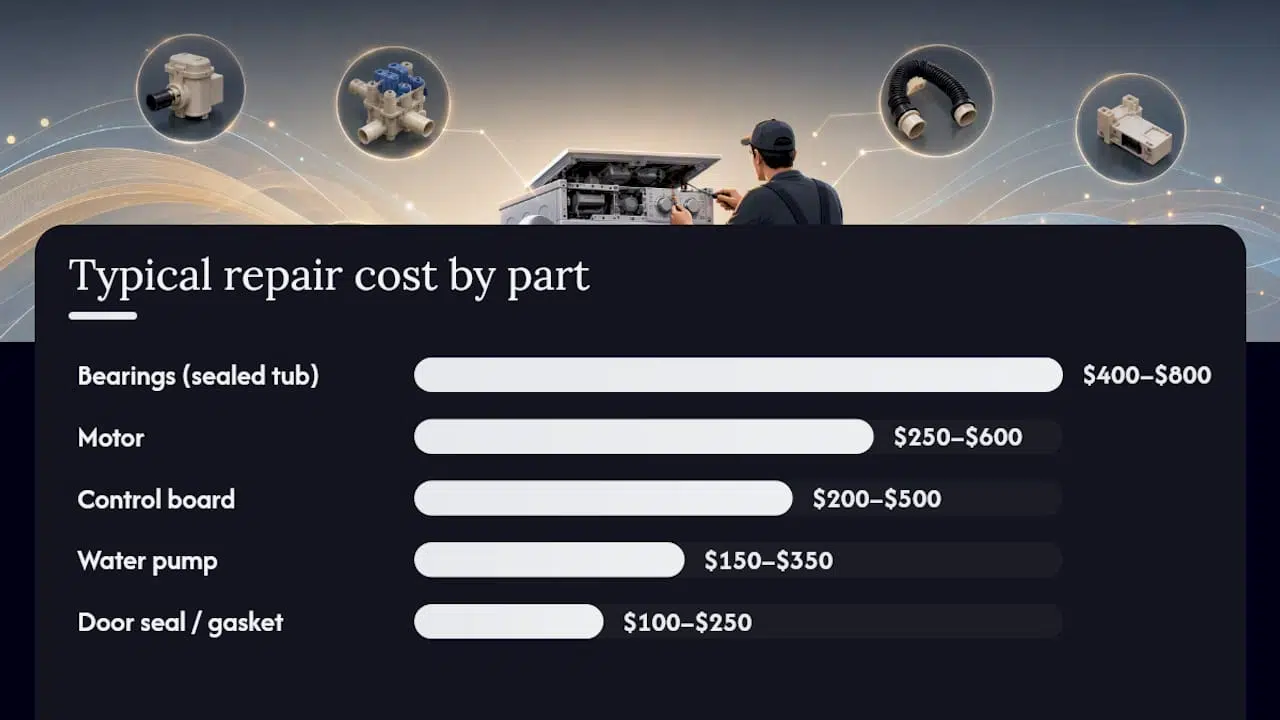
Not all failures cost the same, and knowing which part broke tells you almost as much as the estimate itself. Here’s how the major repairs typically break down, combining parts and labor:
- Water pump: $150 to $350 total (part alone runs $35 to $200, per Thumbtack)
- Belt replacement: $100 to $200, one of the cheaper fixes since the part itself is inexpensive
- Control board: $200 to $500, and sometimes higher on smart or electronics-heavy models
- Motor: $250 to $600, with the part alone costing $150 to $500
- Door seal or gasket: $100 to $250, common on front-loaders with rubber door boots
- Bearings (sealed tub): $400 to $800 or more
- Inlet valve: $100 to $220, with the part itself typically $12 to $150
Two repairs deserve extra attention because they’re where “affordable fix” quietly turns into “maybe just replace it.” Control boards are expensive because they’re often model-specific electronics that can’t be repaired, only swapped, and sourcing the exact board for a discontinued model sometimes takes days and drives up the price. Sealed-tub bearing failures are the other landmine. On many front-load washers, the bearing sits inside a tub assembly that was never designed to be opened. When a technician says “bearing replacement,” confirm whether that means swapping a bearing or replacing the entire tub assembly, because those two jobs live in completely different price tiers, often the difference between a $200 fix and a $700 one.
Motor repairs sit in a similar spot. A washer motor rarely fails outright, but when it does, you’re paying for both an expensive part and the labor to access it, since motors are usually buried under the drum and require partial disassembly to reach.
Statistic to keep in mind: control board and sealed-tub bearing jobs are the two repairs most frequently cited across Angi, Thumbtack, and HomeGuide data as pushing total repair costs past $400 to $800, which is exactly the zone where the repair-vs-replace math starts to matter.
Brand and part availability add another layer of variability. A common part for a mainstream top-load brand might ship overnight from a local distributor. The same part for a less common front-load model might need to come from a regional warehouse, adding a few days and sometimes a rush fee to the final bill.
Why Do Washer Repair Costs Vary by Type and Brand?
Washer design has a direct, measurable effect on repair cost, and it’s not just marketing hype about “premium” machines being pricier to fix.
Top-load washers are generally the cheapest to service. The mechanics are simpler, the drum tub usually isn’t sealed, and most repair techs can access the motor, pump, and belt without major disassembly. Expect routine repairs in the $100 to $300 range.
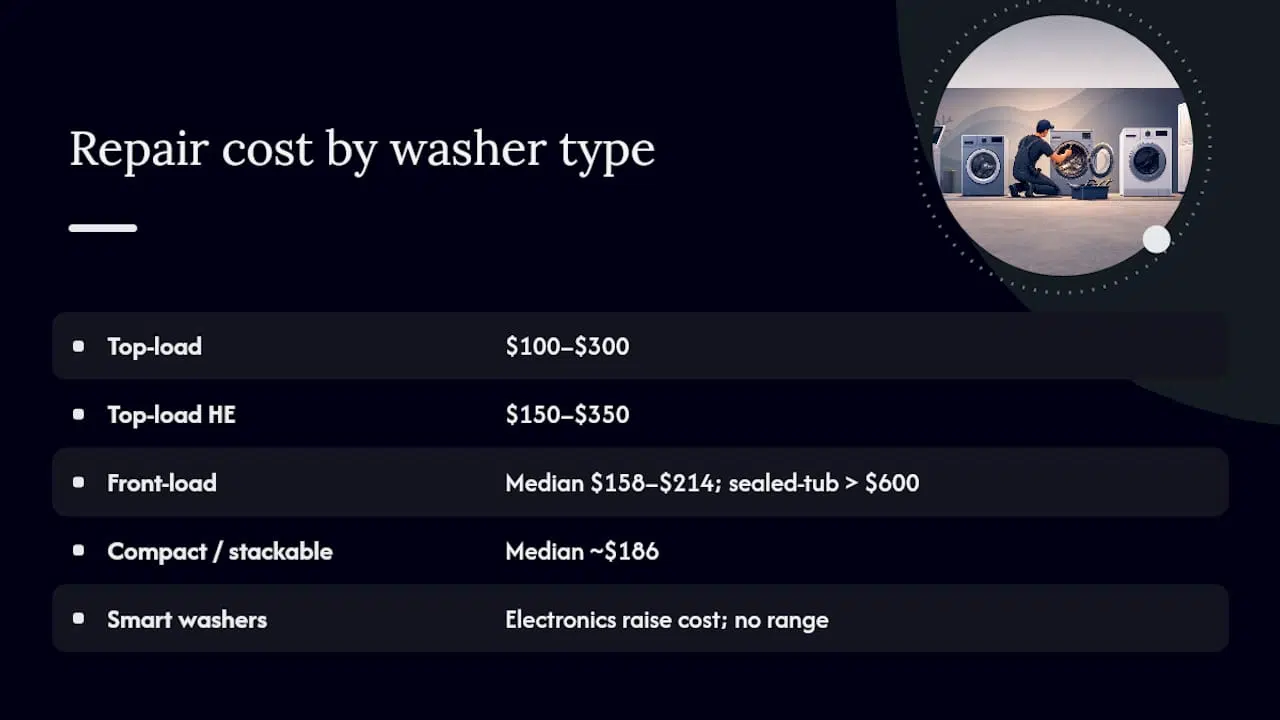
Top-load HE (high-efficiency) models cost a bit more, typically $150 to $350, because they trade the center agitator for more complex drive systems and sensors that manage water levels and load balance.
Front-load washers run higher across the board, with Consumer Report data showing median repair costs of $158 to $214, and that’s before factoring in a sealed-tub bearing failure that can push things past $600. The sealed design that makes front-loaders water-efficient also makes them harder to service.
Compact and stackable units average around $186 for a median repair, per the same Consumer Reports data, but tight installation spaces (closets, tight laundry nooks) can add labor time.
Smart washers with Wi-Fi connectivity, touchscreens, and app controls add electronics that can fail independently of the mechanical parts, and those control modules are rarely cheap to replace.
Brand matters mostly through part sourcing and design complexity rather than some brands being inherently “worse.” Electronics-heavy brands with proprietary control boards tend to cost more when those boards fail, simply because there’s no generic substitute. On the other end, some manufacturers cover motors under extended warranties (often 5 to 10 years), which can make an otherwise pricey motor repair effectively free if the machine is still within that window. If you’re deciding between top-load and front-load for a replacement, factor long-term repair cost into that decision, not just the sticker price.
What Determines the Final Repair Bill?
An estimate is really four separate numbers stacked together, and understanding each one helps you compare quotes instead of just reacting to a total.
The diagnostic or service call fee is usually the first charge you’ll see, typically $100 to $150. Many companies apply this fee toward the repair cost if you approve the job on the spot, but not all do, so it’s worth asking before the technician arrives. Our guide on diagnostic fee practices breaks down exactly how that credit typically works.
Labor rates vary by region but generally fall between $50 and $150 per hour. Many repair companies quote flat rates for common jobs (belt swap, valve replacement) rather than hourly time, which protects you from a slow diagnosis eating into the bill.
A few other factors move the needle:
- After-hours or emergency service often adds a premium, sometimes 1.5x the standard rate
- Travel charges are more common in rural areas or for same-day requests in dense urban zones
- OEM parts cost more than aftermarket equivalents but usually install faster and carry better warranties
- Sourcing delays on rare parts can add labor hours if the technician has to make a second visit
Pro Tip: Ask upfront whether the service fee is waived or credited if you approve the repair. Many technicians will apply it toward your final invoice, but they won’t always volunteer that unless you ask directly.
Local labor markets and contractor overhead also shift estimates above the national averages you’ll see quoted online, since disposal fees and mobilization costs vary by region.
When Should You Repair vs. Replace Your Washer?
The clearest rule in the industry is the 50% rule: if a repair quote exceeds half the cost of a comparable new washer, replacement usually makes more financial sense. With new washers commonly priced between $500 and $1,000, that puts the replacement threshold around $250 to $500 for most households.
Age matters just as much as the dollar figure. Follow this quick sequence when a quote lands on your counter:
- Check the age. Top-load washers typically last 10 to 14 years; front-loaders run 8 to 11. A machine near either ceiling is a poor repair candidate regardless of the quote.
- Apply the 50% rule. Divide the repair quote by the price of a similar new unit. Anything above 50% leans toward replacement.
- Count recent repairs. If this is the second or third service call in six months, that pattern is often more predictive of future failure than the price of any single repair.
- Weigh efficiency gains. A newer high-efficiency replacement can offset its higher price over time through lower utility costs, which sometimes tips a borderline decision toward buying new even when a repair is technically affordable.
Here’s a worked example. Say a 9-year-old front-loader needs a $450 sealed-tub bearing repair, and a comparable new washer costs $800. That repair is 56% of replacement cost, just over the threshold, and the machine is already past the midpoint of its expected lifespan. Replacement wins that math. For a full walkthrough of this decision, our repair vs. replacement guide covers additional edge cases.
Can You Fix a Washer Yourself, or Should You Call a Pro?
Some washer problems are genuinely DIY-friendly. Replacing a supply hose ($10 to $30 in parts), swapping a worn belt ($15 to $40), or clearing a clogged drain pump filter are all within reach for a patient homeowner with basic tools. The catch isn’t the part cost, it’s the time and the risk of stripping a fastener or misreading which part actually failed.
Anything involving the sealed tub, the motor, or the control board belongs to a licensed technician. These jobs require specialized tools, carry real electrical risk, and a botched attempt can void whatever warranty coverage remains on the machine. Our troubleshooting guide for local homeowners walks through which symptoms are safe to investigate yourself.
Before calling anyone, jot down the model number, the washer’s age, the exact symptoms, and any recent repair history. That handful of details lets a technician quote you accurately over the phone instead of padding the estimate for unknowns.
Pro Tip: Take a photo of the model and serial number tag before you call. It’s usually inside the door frame on front-loaders or under the lid on top-loaders, and having it ready shaves real time off the diagnostic call.
How Can You Lower Your Washer Repair Costs?
A few habits meaningfully reduce how often you’ll need a repair call in the first place, and a few smart questions reduce the bill when you do.
Start with warranty coverage. Check whether your washer is still under a manufacturer or retailer warranty, and ask specifically whether it covers parts, labor, or both, since some warranties only cover one.
Basic maintenance prevents a surprising share of common failures:
- Wipe the door gasket dry after each load to prevent mold and seal degradation
- Leave the door slightly open between washes on front-loaders
- Level the machine so vibration doesn’t stress bearings and hoses
- Avoid overloading, which strains the motor and belt over time
If you’re facing multiple appliance issues at once, bundling a washer and dryer repair visit into one call often saves on the service fee compared to booking two separate appointments.
Pro Tip: If a technician is already on-site for a diagnostic, ask whether a second, smaller issue can be addressed in the same visit. Many companies won’t charge a second service fee for work done in the same appointment.
What Makes MDTECH’s Washer Repair Pricing Different
MDTECH’s technicians are licensed and have handled washer repairs across Orange County and Los Angeles County, which means pricing conversations start from real local labor conditions instead of a national average pulled from a spreadsheet. Every estimate is broken into line items: diagnostic fee, parts, and labor, so you see exactly what you’re paying for before any work begins.
Online booking means you can schedule a diagnostic visit without a phone tag marathon, and the diagnostic fee policy is disclosed upfront rather than buried in fine print. That transparency matters most on the expensive repairs, control boards, motors, sealed-tub bearings, where a vague verbal quote can hide a much bigger bill.
Certifications, technician credentials, and customer testimonials will be added here for publication.
Is the 50% Rule Actually the Right Way to Decide?
The 50% rule gets repeated everywhere, and it’s a decent starting filter, but it’s not the whole answer. A $300 repair on a 3-year-old washer and a $300 repair on a 12-year-old washer are not the same decision, even though the rule treats them identically if the replacement cost is the same. Age and repair history deserve equal weight, arguably more.
What conventional advice underplays is the pattern of repeated failures. One repair call rarely means much. A second or third call within six months on the same machine is a far stronger signal than any single price tag, and it’s the detail most cost calculators ignore entirely.
If you take one thing from this guide, prioritize the diagnostic conversation over the quote itself. Ask what specifically failed, whether it’s a wear-and-tear part or a sign of a bigger mechanical issue, and how old the machine is relative to its expected lifespan. The dollar figure matters less than what it’s actually paying for.
— MDTECH
Ready for a Transparent Washer Repair Quote?
Getting a straight answer about washer repair cost shouldn’t require three phone calls and a guessing game. MDTECH gives you licensed local technicians, line-item pricing instead of a vague estimate, and a diagnostic fee policy that’s disclosed before anyone shows up at your door.
Before you book, have a few details ready: your washer’s model number, its approximate age, the exact symptoms you’re seeing, and whether it’s had any recent repairs. That information helps our technicians arrive prepared instead of diagnosing from scratch, which often shortens the visit and keeps labor time down.
If a repair quote comes back high enough to make you second-guess it, our repair vs. replacement breakdown walks through the same decision framework covered here, applied to your specific situation. Ready to get a real number instead of a national average? Book a diagnostic visit with MDTECH and find out exactly what your washer needs.
Sources
- How Much Does Washing Machine Repair Cost? 2026 Data | Angi
- Should You Repair or Replace Your Broken Washing Machine? – Consumer Reports
- Washing Machine Repair Cost | Thumbtack
- Cost to repair a washing machine – ConsumerAffairs