
A water filter and a water softener do different jobs, so one cannot stand in for the other. A softener removes the dissolved calcium and magnesium that cause hard water and scale. A filter removes things like chlorine, sediment, bad taste and certain contaminants. If your problem is white crust on faucets and a dishwasher that leaves spots, you want a softener. If your problem is taste, odor or a specific contaminant, you want a filter. Many homes in Orange County and Los Angeles County end up with both.
We repair and install appliances across both counties, so we see what hard water does to dishwashers, washers and water heaters every week. This guide explains the difference, how to decide, and how to order the equipment if you install both.
TL;DR
- A softener removes hardness minerals (calcium and magnesium). A filter removes contaminants and taste or odor compounds. Neither does the other’s job.
- Hard water is not a health concern but an aesthetic and equipment one: scale on fixtures, pipes and appliances.
- If you install both, put the filter first and the softener after it, so the softener’s resin is protected.
- Check your water provider’s annual quality report before you buy anything, and look for NSF/ANSI certification.
- Softeners use water and salt to regenerate. Choose a demand-initiated model and size it to your actual hardness and usage.
Table of Contents
- What a water softener does
- What a water filter does
- Filter vs. softener at a glance
- Do you need a softener? Start with your local water
- Do you need a filter? Start with the contaminant
- Whole-house filter vs. softener
- The right order if you install both
- What about water use and your bill?
- How to choose a certified product
- Our perspective: what we see in Orange County and LA homes
- When hard water has already hit your appliances
- A simple way to decide
- FAQ
- Sources
What a water softener does
A standard residential softener is a cation exchange system. As the EPA explains, it swaps the calcium and magnesium ions in hard water for sodium or potassium ions. The minerals stay in the resin tank, and periodically the system flushes them out with a brine solution and sends that to the drain.
The result is water that rinses soap more easily and stops building scale. The EPA notes that hard water can leave scale on plumbing fixtures and appliances and can damage a home’s plumbing system.
What a softener does not do: it is not a filter. It will not remove chlorine, sediment, lead, PFAS or bacteria. Treating it as a purification device is the most common mistake we hear from homeowners.
What a water filter does
A filter targets contaminants rather than hardness. The technology depends on the target:
- Sediment filters catch sand, rust and silt.
- Activated carbon filters reduce chlorine, taste, odor and some organic chemicals.
- Reverse osmosis (RO) removes a wider range of dissolved substances, usually at a single tap for drinking water.
For specific health-related contaminants, the technology matters. For PFAS, for example, the EPA’s treatment fact sheet lists granular activated carbon, anion exchange, reverse osmosis and nanofiltration as effective options. A plain sediment cartridge would not qualify.
A standard filter will not remove hardness. You can run the best carbon filter on the market and still get scale on your showerhead.
Filter vs. softener at a glance
| Water softener | Water filter | |
|---|---|---|
| Main target | Calcium and magnesium (hardness) | Chlorine, sediment, taste, odor, some contaminants |
| Fixes | Scale, spotting, soap that will not rinse | Taste, smell, cloudiness, specific contaminants |
| Health role | None (hardness is an aesthetic issue) | Can reduce certain contaminants, depending on type |
| Needs | Salt or potassium, drain connection, regeneration water | Cartridge or media replacement on a schedule |
| Typical location | Whole house, at the main line | Whole house or a single tap |
| Relevant NSF standard | NSF/ANSI 44 | NSF/ANSI 42 and 53, among others |
Do you need a softener? Start with your local water
The EPA’s advice is to first confirm that a softener is truly needed. Its guide says hard water is an aesthetic concern, and that you should consider a softener mainly if hardness in your area is substantial or an appliance manufacturer recommends it.
In Southern California, hardness varies a lot by where you live. Water here comes from a mix of local groundwater and imported supplies, and the blend changes from city to city. A coastal Orange County home can have noticeably softer water than one inland. Do not rely on a neighbor’s experience in another city. Pull your own provider’s annual water quality report, which lists hardness, and compare it to a hardness test.
Signs that hardness may be costing you:
- White or chalky scale on faucets and shower glass.
- Cloudy glasses and spotted dishes even after a dishwasher cycle.
- Stiff laundry and soap that never seems to rinse off.
- Reduced flow from clogged aerators or showerheads.
- Scale inside a water heater, a kettle or an ice maker.
If none of those apply, you may not need a softener at all.
Do you need a filter? Start with the contaminant
Filters make sense when you can name what you want out. Common reasons are chlorine taste, sediment from older pipes, or a specific concern flagged in your utility’s report. Lead is a good example of why testing matters: LADWP’s quality report notes that lead in drinking water mainly comes from service lines and plumbing parts, so it depends on your building’s pipes, not just the city’s supply. If you suspect lead, ask a certified lab to test your tap and look for a filter certified for lead reduction.
If your concern is drinking water only, a point-of-use filter at the kitchen sink is often more practical than treating every drop that enters the house.
Whole-house filter vs. softener
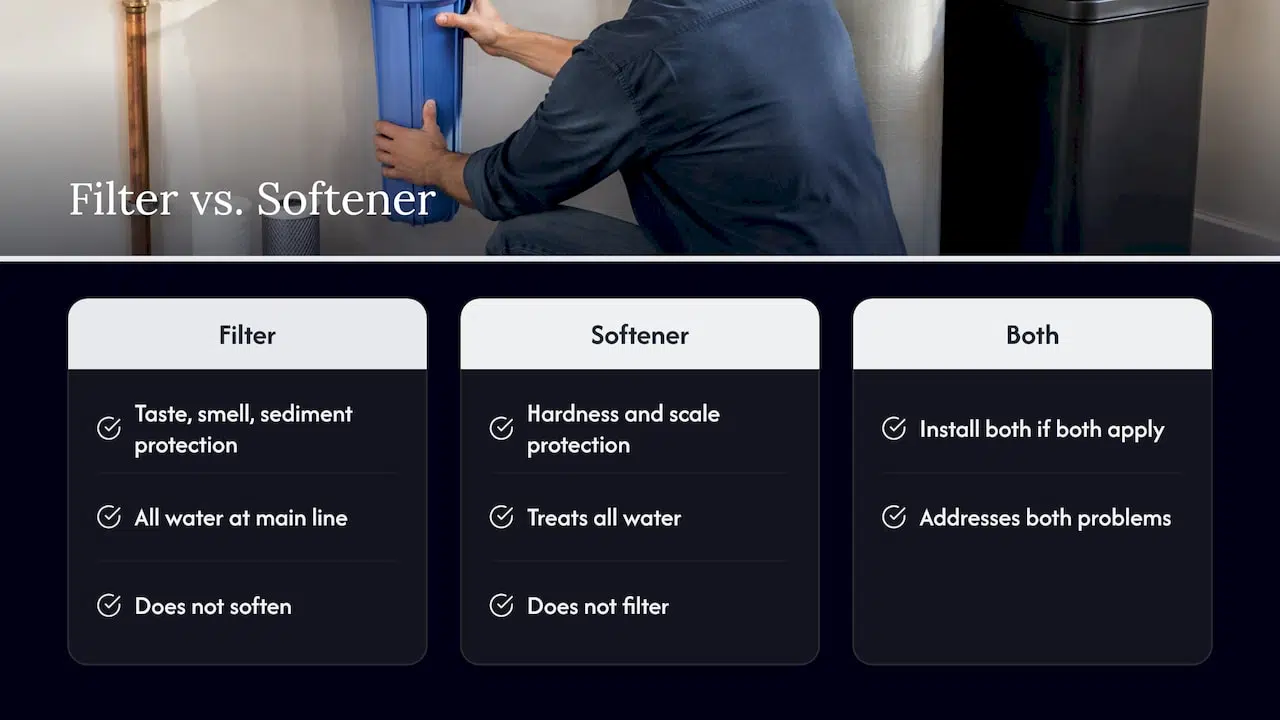
A whole-house filter treats all water at the main line, usually with sediment and carbon stages. It improves taste and smell at every tap and shower and protects fixtures from sediment. It does not soften.
A whole-house softener treats all water for hardness. It protects the water heater, dishwasher, washer and pipes from scale. It does not make water cleaner or safer to drink.
So the question is not which is better. It is which problem you have. If the answer is both, install both.
The right order if you install both
The standard treatment sequence puts filtration ahead of the softener. NSF and the EPA’s guide both support treating the order as a design question, and the logic is straightforward. Sediment and chlorine can foul or degrade the ion exchange resin in a softener over time. A filter upstream removes them first and extends the softener’s life.
A typical sequence looks like this:
- Sediment filter at the main line.
- Carbon filter, if you want chlorine and taste removed.
- Softener.
- Optional: a point-of-use RO unit at the kitchen sink for drinking water.
RO is the one to be careful with. The EPA’s guide describes it as resource-intensive, and experts typically see it as a last step for specific, serious contaminants, rejecting roughly 15 to 30 percent of incoming water as brine. Do not buy it as a softening shortcut.
What about water use and your bill?
Softeners do use water. During regeneration they flush brine to the drain, so a softener adds some water use and salt cost. The EPA guide recommends demand-initiated regeneration (DIR), which starts a cycle only when needed, rather than on a fixed timer that wastes water. It also notes that efficient units certified to NSF/ANSI 44 use 5 gallons or less per 1,000 grains of hardness removed.
Three practical points from the same guide:
- Do not oversize. A bigger unit is not better. It can regenerate inefficiently and waste water and salt. Size by your hardness and daily usage, not by square footage.
- Consider a bypass for outdoor use. Plumbing a bypass line for lawn irrigation or filling a pool keeps you from softening water that does not need it.
- Check local rules. Some jurisdictions limit or restrict softener installation because of wastewater concerns. Check with your city or water district before you buy. Salt-free conditioners are a different technology, so confirm what a product actually does before you pay for it.
Filters use less water, but the cartridges need replacing. A clogged filter cuts flow and stops doing its job. We cover this in more detail in our guide on why filter replacements matter.
How to choose a certified product
There are no federal regulations for residential water treatment units, so the quality claim on the box is only as good as the testing behind it. NSF says voluntary standards confirm that a product performs as claimed and meets safety requirements. Look for:
- NSF/ANSI 44 for cation exchange softeners. The standard itself sets minimum requirements for materials, design, construction and performance of residential softeners.
- NSF/ANSI 42 for aesthetic effects like chlorine taste and odor, and NSF/ANSI 53 for health-related contaminants.
- A certification that names the specific contaminant you care about. A filter certified for chlorine taste is not automatically certified for lead.
Our perspective: what we see in Orange County and LA homes
We are an appliance repair and installation company, not a water treatment retailer, and that shapes how we look at this. We see the downstream effect: scale in dishwashers, heating elements that work harder, and fill valves and hoses that clog. When a customer calls about a dishwasher that no longer cleans well, hard water is one of the first things we check. Our article on dishwasher hard water damage walks through the signs.
Our view is simple. Test first, treat the problem you actually have, and do not buy a system because of a sales pitch. A softener is worth considering if your water is hard and you want to protect appliances and plumbing. A filter is worth it if taste, odor or a named contaminant bothers you. And if you do both, the order matters.
We also see installations go wrong in ordinary ways: water lines that are too tight against the unit, missing drain connections, or equipment that was never connected properly to appliances. If you want a refresher on what proper setup involves, our step-by-step appliance installation guide covers the basics, and our explainer what is a water softener goes deeper on the equipment itself.
— MDTECH
When hard water has already hit your appliances
If scale has already affected your dishwasher, washer, ice maker or water heater, the fix is to repair the appliance and then deal with the cause. We repair kitchen and laundry appliances in Orange County and Los Angeles County, and we handle plumbing repair and installation as well. You can book an appliance repair online, or look at our plumbing and installation services if you are adding equipment. Not sure whether to repair or replace an older unit? Our repair vs. replacement guide lays out the factors.
A simple way to decide
- Read your water quality report. It comes from your utility and lists hardness and regulated contaminants.
- Look at the symptoms. Scale and spotting point to hardness. Taste and smell point to a filter.
- Test what you cannot see. Use a certified lab if you suspect lead or another specific contaminant.
- Choose certified equipment matched to the problem, sized to your hardness and household usage.
- Install in the right order, filter first and softener second.
- Maintain it. Refill salt, replace cartridges on schedule and have the system checked if flow drops.
FAQ
Does a water softener also filter?
No. A softener swaps calcium and magnesium for sodium or potassium, and it is designed for that job only. It will not remove chlorine, sediment, lead or PFAS. If you need those out, add a filter certified for them.
Do water softeners make your water bill go up?
Slightly, in most cases. Softeners use water during regeneration, and you also pay for salt. A demand-initiated model sized to your actual hardness and usage keeps that to a minimum, and the EPA notes that efficient NSF/ANSI 44 units use 5 gallons or less per 1,000 grains removed.
What is the correct order for water treatment?
Filter first, softener second. Sediment and chlorine can damage the softener’s resin, so the filter protects it. If you add RO for drinking water, place it last, at the tap where you need it.
What is the downside of a water softener?
The main downsides are water and salt use, upfront cost, maintenance and, in some areas, local restrictions on installation. Softened water also adds sodium, so check with your doctor if you are on a sodium-restricted diet. If your water is only mildly hard, the benefit may not justify the cost.
Sources
- Soften Water Without Wasting It: Guide to Selecting and Maintaining a Water-Efficient Water Softener (EPA)
- Cation Exchange Water Softeners (EPA WaterSense)
- NSF Standards for Water Treatment Systems (NSF)
- NSF/ANSI 44 preview (ANSI)
- PFAS treatment fact sheet (EPA)
- Drinking Water Quality report (LADWP)