
A Kenmore refrigerator that stops cooling is usually one of a short list of problems: dirty condenser coils, a wrong temperature setting, a stalled fan, a frosted-over evaporator, a bad door seal, or, less often, a failing compressor system. Most of the cheap causes can be ruled out in about 15 minutes. The expensive ones show up with clear symptoms, and this guide shows you how to tell them apart, whether you own a standard Kenmore or a Kenmore Elite.
TL;DR
- Check the basics first: temperature settings, door seals, blocked vents and dusty condenser coils cause a large share of warm-fridge calls.
- If the freezer is cold but the fresh food section is warm, suspect the evaporator fan, a frost blockage or the defrost system.
- If both sections are warm and the fridge runs nonstop, look at the condenser fan, the start relay and the compressor.
- Kenmore Elite models with through-the-door ice and more electronics are costlier to repair, so weigh age and repair cost before you commit.
- If you live in Orange County or Los Angeles County, we can diagnose it on site and tell you honestly whether a repair makes sense.
Table of Contents
- Start with the five-minute checks
- Match what you see to the likely cause
- Freezer works, but the fridge is warm
- Both sections are warm
- Kenmore Elite: why it can be a different story
- Signs the compressor is failing
- What not to do
- Repair or replace a Kenmore fridge?
- Our perspective: diagnose before you decide
- Need a technician in Orange or LA County?
- FAQ
- Sources
Start with the five-minute checks
Before you pull anything apart, rule out the simple causes. They cost nothing and they come up constantly.
- Check the temperature settings. The RepairClinic guide for Kenmore refrigerators lists a set point that is too high among the most common causes. Someone may have bumped the dial or touchpad while cleaning. The usual target is 34 to 40°F in the fresh food section and 0 to 5°F in the freezer, according to the same guidance.
- Look at the door seals. Close a dollar bill in the door at several points. If it slides out without resistance, warm air is leaking in. Cracked, curled or dirty gaskets keep the compressor running and the box warm.
- Clear the air vents. Cold air moves from the freezer to the fresh food side through vents. A tall container or a bag of frozen vegetables pushed against them can block it. iFixit’s troubleshooting page for a fridge not cooling while the freezer works covers airflow problems of this type.
- Listen. Can you hear the compressor and fans? A quiet, silent unit with lights on points to a different problem than a unit that runs loudly all day.
- Check the location. Whirlpool’s product help notes that its refrigerators are designed for indoor household use in spaces between 55°F and 110°F. A fridge in a hot Southern California garage in late summer can struggle for that reason alone. Check your own manual for your model’s range.
If all five look fine, move on to matching the symptom to a cause.
Match what you see to the likely cause
The table below is a starting point, not a verdict. Many symptoms overlap, and a technician confirms the cause with a meter and a look inside the cabinet.
| What you notice | Most likely causes | Who should handle it |
|---|---|---|
| Freezer cold, fridge warm | Evaporator fan, blocked vents, frost on evaporator, damper problem | You can check vents and frost; a technician replaces fans and defrost parts |
| Both sections warm, compressor runs constantly | Dirty coils, condenser fan, sealed-system issue | You can clean coils; a technician handles the rest |
| Both sections warm, clicking sound at the back | Start relay or compressor not starting | Technician |
| Both sections warm, no sound at all | Power, control board, or compressor failure | Check the outlet and breaker, then call a technician |
| Fridge cools, but too weakly, and the door is leaky | Worn gasket, door not aligned | Often a simple gasket replacement |
| Water pooling and frost, then warm | Defrost heater, thermostat or control failure | Technician |
Freezer works, but the fridge is warm
This is the most common version of the problem, and it is also the best news. When the freezer stays cold, the cooling system itself is generally working. What is failing is the delivery of that cold air.
RepairClinic’s guidance on this symptom points to the evaporator fan motor and blocked return air vents as the usual culprits, with frost on the evaporator coils from a failed defrost system or a poor door seal as another cause that restricts airflow.
What you can check
- Evaporator fan. Open the freezer door and press the door switch. In many models you will hear the fan run. A silent fan, a grinding sound or a fan blade that does not spin freely suggests the motor needs replacing.
- Frost. A thick frost layer on the freezer’s back panel means the defrost system is not clearing the evaporator coils. The coil can freeze over and stop air from reaching the fridge section.
- Damper. A damper is a small door that controls how much cold air enters the fresh food side. If it is stuck closed, the fresh food section warms up even with a cold freezer.
If you find ice buildup and want to speed up thawing, be careful. iFixit advises against using a hair dryer on the freezer interior because it can warp plastic components. A steamer or bowls of hot water set in the bottom of the freezer are the gentler options. Unplug the unit first.
If the ice returns within days of defrosting, the defrost heater, defrost thermostat or control board is probably at fault, and you will keep fighting the same freeze-up until it is replaced. Our own page on a refrigerator that is not cooling while the freezer works goes into these causes in more depth.
Both sections are warm
When neither compartment cools, the problem sits closer to the heart of the system. Work through these in order, from cheapest to most expensive.
Dirty condenser coils
The condenser coils release heat from the system. When they are coated in dust and pet hair, the fridge cannot shed heat, runs constantly and cools poorly. Many guides advise cleaning coils every six months, but Home Appliance Fixing notes that homes with shedding pets or dusty air may need it every 8 to 12 weeks.
Here is how to do it safely:
- Unplug the refrigerator.
- Find the coils, either behind the lower front grille or on the back panel.
- Use a coil brush and a vacuum with a brush attachment to remove dust.
- Clean the area around the compressor too.
- Plug the unit back in and give it several hours to recover.
If you need to pull the refrigerator out, put down a protective mat, hardboard or cardboard. Fridgementor warns that heavy wheels can gouge hardwood or tear linoleum, a mistake that can cost more than the repair.
The condenser fan
After you clean, the fridge may still run constantly even though the coils are spotless. In that case, look at the fan near the compressor. Home Appliance Fixing describes a common scenario in which the real culprit is a stopped condenser fan, sometimes jammed by a wad of lint. With the unit unplugged, spin the blade by hand. If it is gummed up, clean it. If it is free but never turns when the compressor runs, the motor needs replacing.
Start relay and compressor
If you hear a click at the back followed by silence, the compressor may be trying and failing to start. A bad start relay is a relatively small part, while a failed compressor is the costly end of the range. Telling them apart requires electrical testing, so this is where we recommend you stop and call a technician.
Kenmore Elite: why it can be a different story
Kenmore Elite refrigerators often pack more features: through-the-door ice and water, dual evaporators, electronic controls and sensors. These are nice to have, and they add more parts that can fail.
Plainpaper’s reliability analysis describes through-the-door ice as the “Achilles heel” of refrigerator reliability, because it needs a dual cooling arrangement to keep the door ice frozen while the rest of the fridge stays above freezing. The same piece describes a “repairability paradox”: the most technologically advanced models tend to be more fragile and costlier to fix than simpler ones.
What that means for you in practice:
- A warm Elite with a cold freezer is still most often an airflow or defrost issue, just like a standard model.
- A sealed-system or control board failure on a feature-heavy model can cost far more than the same failure on a basic one.
- Model and serial numbers matter. Find the label inside the fresh food compartment and note both before you call. They let a technician check parts and likely faults ahead of time.
We repair Kenmore units across both counties. See our pages on Kenmore refrigerator repair in Orange County and Kenmore refrigerator repair across Orange and Los Angeles counties.
Signs the compressor is failing
Compressor failure is the diagnosis everyone fears, and people often jump to it too early. It does happen, though. HomeServe lists these warning signs of a failing refrigerator compressor:
- The refrigerator runs constantly, for more than 24 hours.
- Unusual loud noises such as buzzing, clicking or grinding.
- Excessive energy consumption.
- Failure to hold the set temperature even when the thermostat is right.
HomeServe also says a healthy refrigerator typically runs about 40 to 80 percent of the time, and that electrical trouble in the compressor can trip circuit breakers when the motor tries to cycle on.
Two cautions. First, nonstop running is also what a dirty condenser or a dead condenser fan produces, so clean and check those first. Second, if you see the breaker trip repeatedly, stop trying to restart the unit. Leave it unplugged and call a technician, because repeated restarts can make an electrical fault worse.
What not to do
- Do not open sealed-system lines. Refrigerant work needs licensed handling. Leave it to a professional.
- Do not work on a plugged-in fridge. Unplug it before touching fans, coils or wiring.
- Do not chip ice with sharp tools. You can puncture the evaporator, which turns a small repair into a replacement.
- Do not keep guessing at parts. Replacing a board or fan because a forum suggested it can add up quickly, and the fault often sits elsewhere.
Repair or replace a Kenmore fridge?
Once you know the cause, the money question comes next. Two ideas help.
First, age. VerticalRent puts the average refrigerator lifespan at roughly 10 to 14 years, with feature-heavy models often at the shorter end of that range. Second, the 50 percent rule: the same source says replacement generally makes sense when the unit has passed 75 percent of its expected life and the repair costs more than half the price of a comparable new one. A younger unit with a quality repair, such as a compressor fix, can often run another 8 to 10 years, according to that source.
A rough way to use this:
| Situation | Usually sensible |
|---|---|
| Under 8 years old, fan, relay, gasket, defrost part | Repair |
| 8 to 12 years old, mid-priced repair | Compare the repair quote to a new unit |
| Over 12 years old, compressor or sealed-system failure | Replacement is usually the better value |
| Elite model with board and ice system faults | Get a written quote and weigh against a new one |
For more, read our guides on repair versus replacement, how long appliances last and what to expect on refrigerator repair costs.
Our perspective: diagnose before you decide
We work on refrigerators, washers, dryers, ovens, dishwashers, HVAC and plumbing in Orange County and Los Angeles County, and the pattern with warm Kenmore fridges is consistent: people reach a conclusion before anyone has measured anything. The online verdict is “it’s the compressor,” and the household starts pricing a new refrigerator. Often it was a fan, a frozen evaporator or a coil clogged by dust.
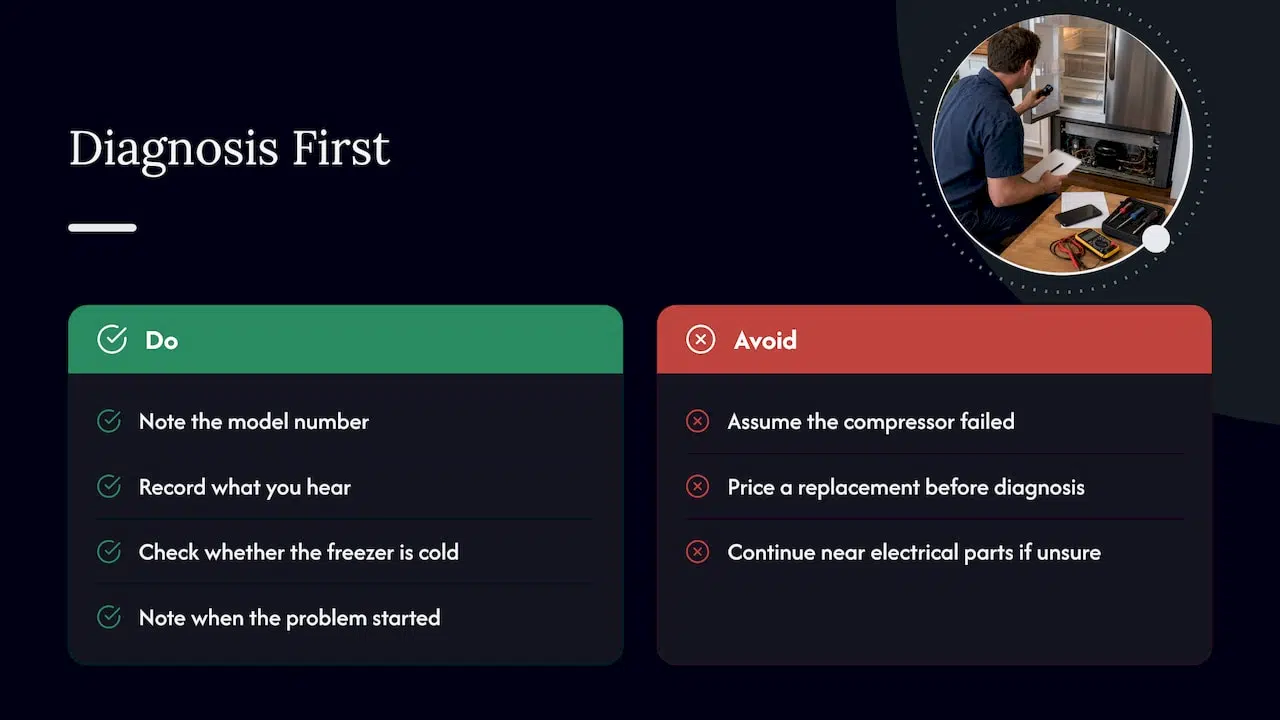
Our view is simple. A good diagnosis comes first, and a clear explanation comes second. You should know what failed, what the fix involves, and whether it is worth doing on a unit of your age. If the honest answer is that a replacement makes more sense, we would rather say so than sell you a repair that will not pay off.
It also helps if you do the early checks yourself. Note the model number, what you hear, whether the freezer is cold and when the problem started. That information shortens the visit and makes the diagnosis sharper. And if you are unsure at any point, especially around electrical parts, stop and call.
— MDTECH
Need a technician in Orange or LA County?
If the checks above did not fix it, our licensed technicians can diagnose your Kenmore on site and explain your options before any work begins. You can book online through our appliance repair services page, or read about our refrigeration repair in Orange County. We do not publish flat prices for repairs, because the cost depends on the fault and the model.
FAQ
Why is my Kenmore refrigerator not cooling but the freezer is working?
The freezer is usually fine, and the cold air is not reaching the fresh food side. The usual causes are a failed evaporator fan motor, blocked air vents, or frost on the evaporator coils from a defrost problem. Clear the vents first, then check the freezer for a thick frost layer and listen for the fan.
What are signs of a failing fridge compressor?
Look for constant running for more than 24 hours, loud buzzing, clicking or grinding, high energy use, and a fridge that will not reach its set temperature. Breakers that trip when the motor tries to start are another sign. Clean the coils and check the condenser fan before you assume the compressor is dead.
How long do refrigerators typically last?
Research cited by VerticalRent puts the typical lifespan at about 10 to 14 years, and tech-heavy models often last 7 to 10 years. Premium or simpler designs can last longer. Age is one of the main factors in deciding whether a repair is worthwhile.
Is a Kenmore Elite harder to fix than a regular Kenmore?
Often, yes. More electronics, dual cooling systems and through-the-door ice mean more parts that can fail, and some of those parts cost more. The basic checks and the most common causes are the same for both. A written diagnosis tells you what your specific unit needs.
How often should I clean the condenser coils?
Six months is the standard advice. If you have shedding pets or a dusty home, 8 to 12 weeks is more realistic according to Home Appliance Fixing. Clean the fan blade near the compressor at the same time, since lint there blocks airflow even when the coils are clean.
Sources
- Kenmore Refrigerator Not Cooling, Solutions and Repair Parts (RepairClinic)
- Fridge Not Cooling But Freezer Works (iFixit)
- Not Cooling, Both Sections (Whirlpool Product Help)
- How to Clean Refrigerator Coils (Home Appliance Fixing)
- How to Clean Refrigerator Coils (Fridgementor)
- Refrigerator Compressor Replacement (HomeServe)
- Which Brand Refrigerator Are Most Durable? (Plainpaper)
- Appliance Repair vs. Replacement (VerticalRent)