
TL;DR:
- Regular filter replacement prevents performance failure and reduces energy costs in HVAC and water systems. Neglecting filters causes contamination, equipment damage, and health hazards, especially with expired water filters releasing harmful substances. Monitoring filter load with pressure gauges and replacing filters according to household conditions ensures safety, efficiency, and appliance longevity.
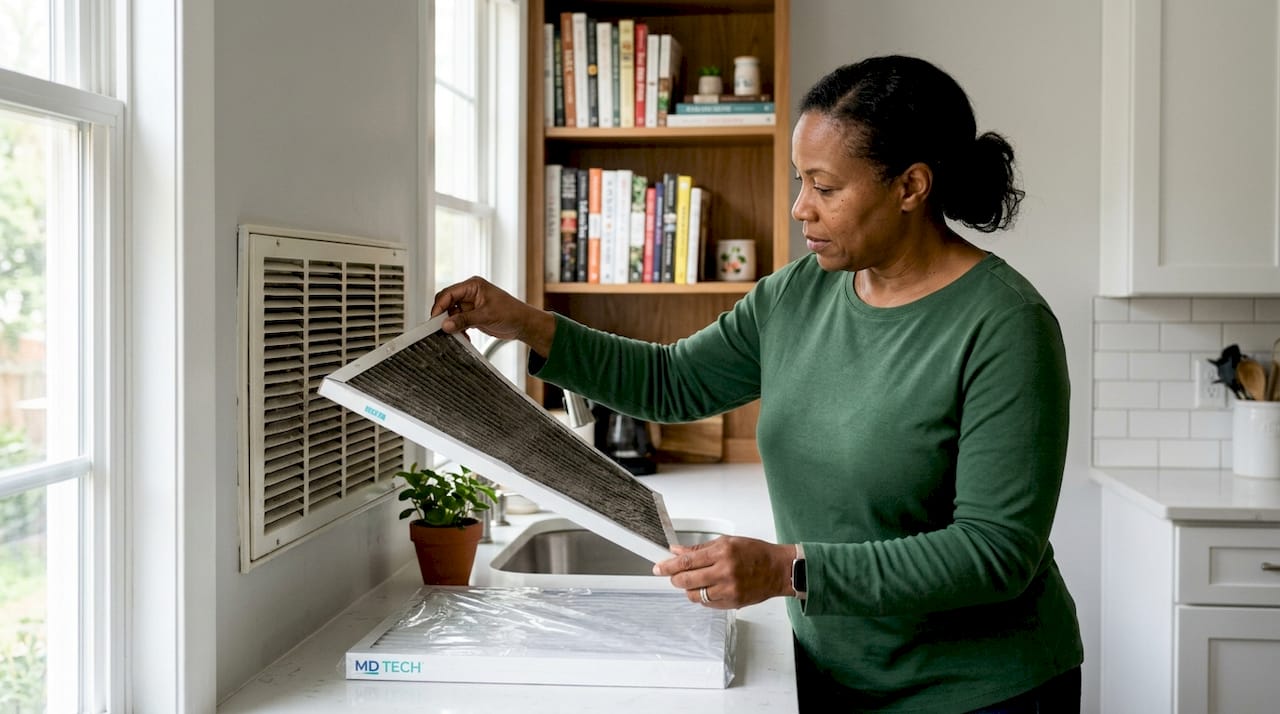
Regular filter replacement is defined as the scheduled removal and substitution of spent filtration media in HVAC systems, water purifiers, and air purifiers before saturation causes performance failure. Skipping this task costs you more than clean air or water. Replacing HVAC air filters on schedule can cut heating and cooling energy use by up to 15%, according to energy efficiency research. Expired water filters do not simply stop working. They actively release trapped contaminants back into your drinking water. Understanding why filter replacements matter is the first step toward protecting your home, your appliances, and your family’s health.
Why filter replacements matter: the core case
Filters work by physically capturing particles, adsorbing chemicals, and removing odors as air or water passes through the media. Every particle a filter captures reduces its remaining capacity. Over time, the media saturates and the filter can no longer do its job.
The consequences go beyond reduced performance. Clogged air filters force your HVAC system to pull harder against restricted airflow, consuming more electricity and stressing the blower motor and heat exchanger. That extra strain shortens equipment life and raises your monthly utility bill.
Water filters face a different but equally serious problem. Carbon media saturates and then reverses its function. A carbon filter running 1–2 months past its replacement date drops filtration effectiveness by 20–50%. That is not a gradual decline. It is a cliff.
The filter maintenance significance extends to safety, not just efficiency. Regulatory bodies and industry standards in food and beverage production treat timely filter replacement as a compliance requirement because contamination from expired filters causes product recalls. The same logic applies to your home.
Pro Tip: Set a physical reminder on your water filter housing with a marker. Write the replacement date directly on the unit so you see it every time you open the cabinet.
What are the specific risks of neglected air vs. water filters?
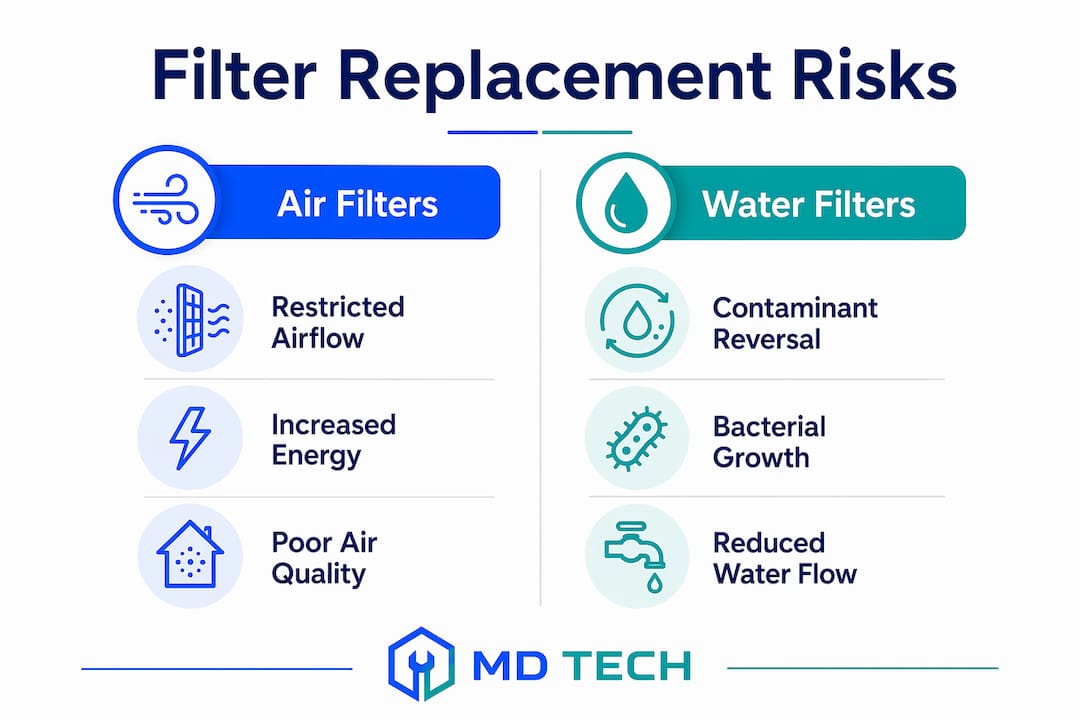
The risks of neglected filters differ sharply by type. Knowing which failure mode applies to your system helps you prioritize correctly.
Air filter failure: what actually happens
A clogged HVAC filter does not just reduce airflow. It creates a pressure imbalance that forces the system to work against itself. Restricted airflow increases energy consumption and accelerates wear on the blower motor, coils, and compressor. Repair costs from neglected filters routinely exceed the cost of a year’s worth of replacements.
Indoor air quality also drops. Dust, pet dander, mold spores, and pollen that a fresh filter would capture instead recirculate through your living space. For households with asthma or allergies, this is a direct health trigger.
Air purifier filters carry an additional nuance. Gas and odor filters saturate faster than particle filters and stop removing chemicals while appearing to function normally. You cannot see or smell the failure. The unit runs, the fan moves air, but the chemical filtration is gone.
Water filter failure: the contamination reversal
Expired water filters present a more alarming risk than most homeowners realize. When carbon media is exhausted, it stops adsorbing contaminants and begins releasing them. Contaminant breakthrough can push heavy metals like lead and PFAS into your drinking water at concentrations higher than your unfiltered tap water.
Bacterial growth compounds the problem. Carbon filters rely on residual chlorine in tap water to suppress microbial growth. Once the filter depletes that chlorine, bacteria colonize the media and multiply rapidly. The water coming out of an overdue filter can carry far more bacteria than water straight from the tap.
| Risk category | Air filter | Water filter |
|---|---|---|
| Primary failure mode | Restricted airflow, particle recirculation | Contaminant breakthrough, bacterial growth |
| Health impact | Allergens, mold spores in living space | Heavy metals, PFAS, bacteria in drinking water |
| Appliance impact | HVAC motor and compressor stress | Reduced flow, sediment damage to fixtures |
| Warning signs | Reduced airflow, dusty vents, higher bills | Odor, taste change, slow flow rate |
| Severity if ignored | Higher energy costs, equipment failure | Active health hazard, worse than no filter |
An overused filter can be worse than no filter at all. That is not a hypothetical. It is the documented outcome of bacterial colonization and contaminant release in expired carbon media.
How often should you replace different home filters?
Replacement intervals vary by filter type, household conditions, and local environment. Manufacturer schedules assume average conditions, which may not match your home.
Standard replacement schedules by filter type
- HVAC air filters (fiberglass, 1-inch): Every 30 days in high-use or pet households; every 60–90 days in low-use homes.
- HVAC air filters (pleated, 4-inch media): Every 6–12 months depending on air quality and household size.
- Carbon water filters (under-sink or pitcher): Every 2–6 months. Unique water sources with heavy sediment or organic matter require more frequent changes.
- Reverse osmosis membranes: Every 2–3 years under normal use.
- Air purifier HEPA filters: Every 12–18 months; gas and odor filters every 3–6 months.
Factors that change your schedule
Household size matters. More people means more cooking, more skin cells, more humidity, and more contaminants cycling through your systems. Pet ownership accelerates HVAC filter loading significantly.
Local air quality is equally important. Wildfire smoke events in Southern California, for example, can load an HVAC filter in days rather than months. Magnehelic gauges measure actual pressure drop across a filter, telling you precisely when loading has reached the replacement threshold. This method outperforms fixed calendar schedules because it responds to real conditions rather than assumed ones.
Source water quality affects water filter life just as dramatically. Well water or water with high sediment content clogs carbon media faster than municipal water. Local water quality variations mean manufacturer guidelines are a starting point, not a guarantee.
Pro Tip: After a wildfire or major dust event in your area, check your HVAC filter immediately. Do not wait for your scheduled date. A single smoke event can saturate a filter that had weeks of life left.
What practical steps keep your filters working and your home safe?
Good filter maintenance is less about discipline and more about building the right habits and knowing what to watch for.
- Track replacement dates in writing. A calendar reminder works, but writing the date on the filter housing itself creates a physical cue you see every time you interact with the appliance.
- Buy certified filters. For HVAC systems, look for filters with a MERV rating appropriate for your system. For water, NSF/ANSI certification confirms the filter removes what the label claims. An uncertified filter may offer no real protection.
- Never clean a carbon water filter instead of replacing it. Rinsing a carbon cartridge does not restore adsorption capacity. It removes loose sediment but leaves the saturated media in place. Replacement is the only fix.
- Watch for early warning signs. Reduced water flow, a new taste or odor in filtered water, dusty return vents, or a sudden spike in your energy bill all signal a filter that needs attention now, not at the next scheduled date.
- Account for unexpected events. Wildfires, construction near your home, or a burst of spring pollen can shorten filter life dramatically. Build flexibility into your schedule rather than treating it as fixed.
Following a structured appliance maintenance schedule that includes filter checks alongside other routine tasks keeps you from treating filter replacement as an afterthought. The benefits of replacing filters on time compound over months. Lower energy bills, longer appliance life, and cleaner air and water are the direct results.
Key Takeaways
Regular filter replacement is the single most cost-effective maintenance task a homeowner can perform, protecting air quality, water safety, and appliance efficiency simultaneously.
| Point | Details |
|---|---|
| Energy savings are real | Timely HVAC filter changes cut energy consumption by up to 15%, reducing monthly bills. |
| Expired water filters cause harm | Overdue carbon filters release heavy metals and bacteria at levels worse than unfiltered tap water. |
| Schedules depend on your conditions | Household size, pets, and local air or water quality all shorten standard replacement intervals. |
| Pressure-based monitoring beats calendars | Magnehelic gauges measure actual filter loading, replacing guesswork with real data. |
| Certified filters are non-negotiable | NSF/ANSI and MERV ratings confirm a filter performs as labeled; uncertified products may offer no protection. |
The maintenance habit most homeowners skip until it costs them
After years of working on appliances across Orange County and Los Angeles County, I have seen one pattern repeat itself constantly. Homeowners replace filters after something breaks, not before. A refrigerator water filter runs two years past due. An HVAC system fails in August. A water purifier starts tasting strange. The repair call comes in, and the root cause is almost always the same: a filter that should have been changed months ago.
The part that surprises most people is the reversal effect. They assume an old filter is neutral, that it just stops working. Learning that an expired carbon filter actively contaminates your water is genuinely alarming to most homeowners I talk to. It changes how seriously they take the replacement schedule going forward.
My honest recommendation is to stop treating filter replacement as a chore and start treating it as a check on your home’s health. The cost of a replacement filter is trivial compared to an HVAC repair or a water system flush. The importance of filter changes is not about being meticulous. It is about avoiding the expensive and avoidable.
— MDTECH
Professional filter and appliance support from Appliancesrepairmdtech
Appliancesrepairmdtech serves homeowners and renters across Orange County and Los Angeles County with licensed technicians who handle HVAC maintenance, water filtration systems, and full appliance repair.
If your HVAC system is running harder than it should, your water tastes off, or you are unsure which filter your system needs, the team at Appliancesrepairmdtech can assess and resolve it quickly. The HVAC repair service covers filter evaluation, system cleaning, and component repair in a single visit. For broader appliance concerns, the appliance parts replacement guide walks you through what to replace and when. Book online or call to schedule a same-day or next-day appointment.
FAQ
Why do filter replacements matter for HVAC efficiency?
Dirty HVAC filters restrict airflow and force the system to consume more energy, increasing bills and accelerating component wear. Replacing filters on schedule can reduce energy consumption by up to 15%.
How often should I replace my water filter?
Most carbon water filters need replacement every 2–6 months. Households with high sediment or organic matter in their water supply should replace filters more frequently than manufacturer guidelines suggest.
Can an old water filter make my water worse than tap water?
Yes. An expired carbon filter can release trapped heavy metals and PFAS at concentrations higher than your source water, and bacterial colonization of the media raises bacteria counts well above untreated tap levels.
What signs tell me a filter needs replacing sooner than scheduled?
Reduced water flow, new odors or tastes in filtered water, dusty HVAC vents, and unexpected spikes in your energy bill all indicate a filter that has reached or exceeded its capacity.
Is a magnehelic gauge worth using for HVAC filter management?
A magnehelic gauge measures actual pressure drop across your HVAC filter, signaling replacement based on real loading rather than a fixed calendar date. This approach is especially useful after wildfire smoke or heavy pollen events that rapidly saturate filters.