
TL;DR:
- Neglected filters cause appliance inefficiency, higher energy bills, and costly breakdowns in Southern California homes. Regular filter replacement prevents damage, extends appliance lifespan, and saves homeowners hundreds annually. Expert assistance can ensure proper maintenance, especially for hard-to-access filters or complex systems.
Neglected filters are quietly one of the leading causes of appliance inefficiency and unexpected repair bills in Orange County and Los Angeles County homes. Most homeowners don’t realize that a clogged HVAC filter or a gunked-up dishwasher screen can spike energy use, shorten appliance life, and even trigger costly breakdowns. The good news is that filter replacement is one of the simplest, most affordable forms of home maintenance you can do. This guide walks you through every filter type in your home, when to replace them, and exactly how to do it right.
Table of Contents
- Why filter replacement matters
- Types of filters in household appliances and HVAC
- How to know when to replace filters
- Step-by-step filter replacement: best practices
- The overlooked impact of filter maintenance: our expert take
- Get expert help for filter replacement and appliance care
- Frequently asked questions
Key Takeaways
| Point | Details |
|---|---|
| Essential for efficiency | Replacing filters regularly keeps appliances running efficiently and saves energy costs. |
| Easy to overlook | Filters in dishwashers, HVAC systems, and refrigerators are often neglected, leading to expensive repairs. |
| Clear signs for change | Performance drops, odors, or visible dirt indicate it’s time to replace your appliance filters. |
| DIY or professional help | Most filters can be replaced by homeowners, but expert service ensures correct installation and optimal results. |
Why filter replacement matters
Every filter in your home has one job: stop unwanted particles from circulating where they shouldn’t. HVAC filters block dust and pollen from clogging your air handler. Refrigerator water filters catch sediment and chlorine before it reaches your glass. Dishwasher filters keep food debris from redepositing on your clean plates. When any of these filters get overloaded, performance drops and your appliances start working harder than they need to.
Here’s what actually happens inside a neglected appliance:
- Reduced airflow forces motors and compressors to run longer and hotter
- Trapped debris creates friction and wear on internal components
- Bacterial growth on wet filters like those in dishwashers and washing machines spreads odors
- Higher energy draw shows up directly on your monthly utility bill
- Shortened lifespan across the board, from refrigerators to HVAC systems
Understanding the dishwasher filter function gives you a clearer picture of how even small filters play a critical role in daily appliance performance.
A dirty filter doesn’t just reduce efficiency. It puts mechanical stress on every connected component. Replacing a $10 filter now can prevent a $400 compressor repair later.
Southern California’s air quality also plays a unique role. The region regularly experiences wildfire smoke, high pollen seasons, and construction dust. Homes in Anaheim, Burbank, or Long Beach are dealing with particulate loads that make filter replacement more urgent than in many other parts of the country. Consistent filter care, combined with good kitchen appliance cleaning habits, can meaningfully lower your household operating costs year after year.
After establishing the importance of filter replacement, let’s explore the types of filters and where they’re found throughout the home.

Types of filters in household appliances and HVAC
Most homes have more filters than their owners realize. Knowing where each one lives and how often it needs attention is the foundation of good maintenance.
Here’s a quick overview of the major filter categories:
- HVAC and furnace filters: Located in the return air duct or air handler unit; catch airborne particles that would otherwise coat your coils and blower motor
- Refrigerator water filters: Typically located inside the fridge compartment or in the grille at the bottom; filter sediment and chlorine from your ice and water dispenser
- Refrigerator air filters: Smaller and less well-known; absorb odors inside the fresh food compartment
- Dishwasher filters: Found at the bottom of the tub, beneath the spray arm; trap food particles to prevent recirculation
- Washing machine filters: Located near the pump or in the door gasket area on front-loaders; catch lint, coins, and debris
- Dryer lint traps: The most frequently replaced and most frequently ignored filter in the home; a clogged lint trap is a fire hazard and efficiency killer
| Appliance | Filter location | Primary function | Recommended replacement interval |
|---|---|---|---|
| HVAC system | Return air duct or air handler | Trap dust, pollen, allergens | Every 1 to 3 months |
| Refrigerator (water) | Inside fridge or base grille | Remove sediment, chlorine | Every 6 months |
| Refrigerator (air) | Inside fridge compartment | Absorb odors | Every 6 months |
| Dishwasher | Bottom of tub under spray arm | Capture food debris | Clean monthly, replace as needed |
| Washing machine | Near pump or door gasket | Trap lint and debris | Clean monthly |
| Dryer lint trap | Inside door opening | Prevent lint buildup and fire risk | After every cycle |
For refrigerator owners specifically, the step-by-step refrigerator maintenance guide covers everything from coil cleaning to water filter schedules. And if you’re wondering about your washing machine’s filter situation, the washing machine service page breaks down what professional maintenance looks like when routine cleaning isn’t enough.
Knowing which filters need attention is just the start. Understanding when to replace them is key to avoiding breakdowns.
How to know when to replace filters
Appliances rarely announce a problem outright. They drop hints. Learning to read those hints early saves you money and keeps your equipment running at its best.
The most common signs that a filter needs attention include:
- Visible dirt or buildup: If you can see gray coating on an HVAC filter or food residue on a dishwasher screen, it’s overdue for attention
- Reduced airflow or performance: Rooms that don’t cool or heat as well, dishes that come out with food residue, or laundry that smells musty after washing
- Unusual odors: Musty, stale, or sewage-like smells from appliances that used to be odor-free are a reliable warning sign
- Higher energy bills: When your utility costs climb without a clear reason, an overworked appliance due to a blocked filter is often the culprit
- More noise than usual: Strained motors trying to push air or water through a clogged filter often produce humming or rattling sounds
The 7 signs you need appliance repair article walks through these warning signals in more detail, helping you decide whether a simple filter swap will fix the issue or whether a technician should take a look.
Studies show that HVAC systems with dirty filters use 5 to 15 percent more energy than systems with clean ones. In a Southern California summer, where air conditioning runs for months, that energy penalty adds up fast.
Pro Tip: Create a simple filter replacement calendar at the start of each year. Mark HVAC filters for replacement every 60 to 90 days, refrigerator filters for every six months, and dishwasher filter cleaning for the first of every month. A phone reminder takes 30 seconds to set and can save you hundreds in repair costs.
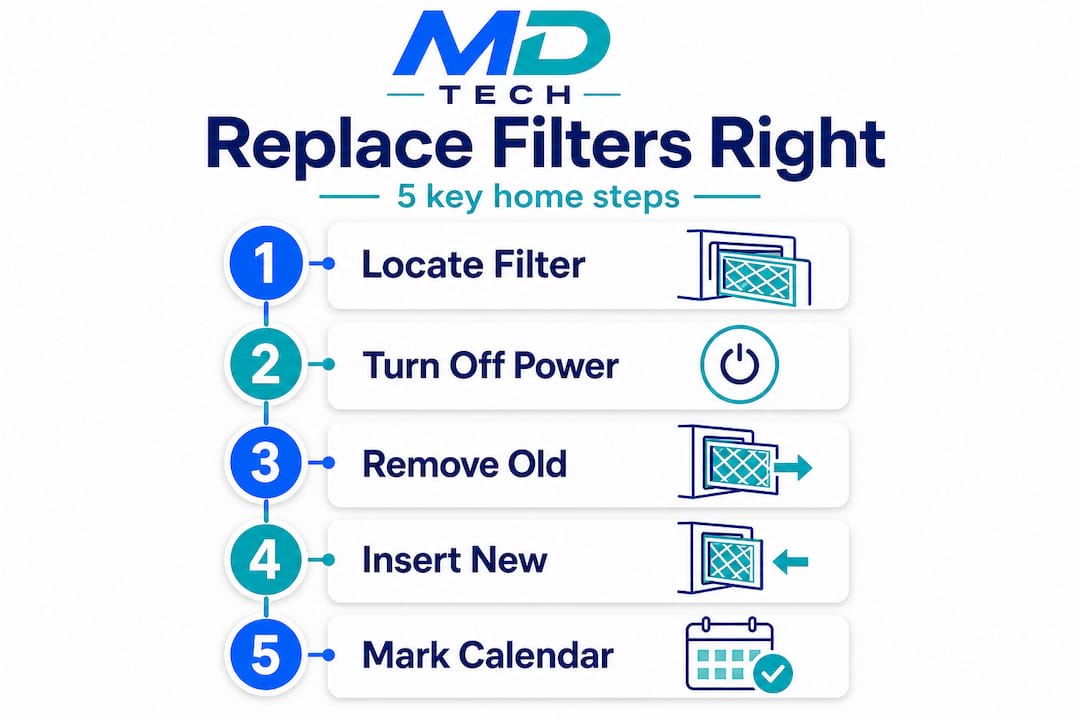
Once you know it’s time to swap a filter, following the best practices for replacement ensures you avoid common mistakes.
Step-by-step filter replacement: best practices
Filter replacement is straightforward when you follow a consistent process. Rushing it or skipping steps is where most homeowners run into trouble, either damaging the appliance or installing the wrong filter type.
Here’s the universal process that applies across all major appliance and HVAC filter types:
- Turn off or unplug the appliance first. For HVAC systems, switch the thermostat to “off” at the unit itself, not just the thermostat. For refrigerators and dishwashers, unplug or trip the circuit breaker before touching internal components.
- Locate the filter using your owner’s manual. Filter locations vary even within the same appliance brand. A quick search of your model number plus “filter location” pulls up the exact diagram.
- Remove the old filter carefully. Slide it out slowly to avoid shaking loose trapped debris into the appliance. For HVAC systems, have a trash bag ready to slide the old filter directly into.
- Clean the filter housing. Wipe down the area with a damp cloth before installing the new filter. Old debris left behind will shorten the life of your brand-new filter immediately.
- Install the new filter in the correct orientation. Most HVAC filters have an arrow printed on the side showing airflow direction. Installing it backward restricts airflow and defeats the purpose of the replacement.
- Reassemble and restore power. Secure any access panels, reconnect power, and run the appliance briefly to confirm everything is operating normally.
| Appliance | Key step to get right | Common mistake to avoid |
|---|---|---|
| HVAC | Check airflow arrow direction on filter | Installing filter backward |
| Refrigerator water filter | Flush 2 to 3 gallons of water after install | Skipping the flush; drinking filtered water immediately |
| Dishwasher | Twist and lock filter back into place | Leaving filter loose so it rattles during cycles |
| Washing machine | Clear lint and debris from the housing | Letting water spill without a towel ready |
| Dryer lint trap | Remove all lint, check for tears in screen | Ignoring small tears that let lint into the duct |
For a broader look at tackling appliance parts yourself, the appliance filter replacement guide covers the principles behind safe DIY part replacement. If dishwasher maintenance is a priority in your home, the dishwasher repair workflow guide provides a detailed look at how professionals approach the process from start to finish.
Pro Tip: Always use manufacturer-approved or OEM (original equipment manufacturer) replacement filters. Aftermarket filters can fit physically but may use lower-grade media that fails to trap particles effectively, reducing air quality and appliance protection. The few dollars you save upfront can cost you significantly more if the wrong filter lets debris into your appliance.
The overlooked impact of filter maintenance: our expert take
After years of working with homeowners across Orange County and Los Angeles County, one pattern stands out clearly: most people dramatically underestimate how often a “big” appliance repair traces back to a neglected filter. We’ve seen HVAC systems replaced prematurely because owners didn’t know filters existed beyond the visible return-air grille. We’ve seen refrigerator compressors burn out because an owner never replaced the water filter and sediment backed up into the cooling system.
Here’s an opinion that might surprise you: filter maintenance is actually more important than most appliance repairs. A repair fixes damage after it’s already happened. Filter maintenance prevents the damage from occurring in the first place. And yet homeowners spend significant time researching repair services but almost no time building a filter replacement routine.
The real-world numbers back this up. A homeowner who consistently replaces HVAC filters, refrigerator filters, and cleans dishwasher filters on schedule can realistically expect to save $300 to $600 per year in reduced energy costs and avoided repairs. Over a decade, that’s real money. Over the lifespan of a home, it’s a major difference in total maintenance costs.
Understanding the role of HVAC maintenance in home comfort is one of the best things you can do as a property owner in Southern California. And when you combine that knowledge with consistent appliance cleaning practices, you create a home that simply breaks down less often.
The uncomfortable truth is this: most appliance breakdowns are preventable. Not all of them, but a significant majority. And filter neglect is one of the most preventable causes of all.
Get expert help for filter replacement and appliance care
You now have everything you need to build a solid filter replacement routine at home. But sometimes the right filter is hard to find, the access panel won’t budge, or you want the confidence that comes from knowing a licensed technician handled it correctly.
Our team serves homeowners across Orange County and Los Angeles County with professional appliance maintenance, filter replacement, and full repair services. Whether you’re dealing with a Samsung appliance that needs a certified filter swap, or you want a technician to handle expert appliance part replacement to protect your warranty and performance, we’re ready to help. Not sure whether to repair or replace an older appliance entirely? Our repair vs replacement guide gives you a clear framework for making that decision confidently. Book your appointment online or call us directly for fast, local service you can trust.
Frequently asked questions
How often should HVAC filters be replaced in Southern California homes?
HVAC filters should typically be replaced every one to three months, but homes with pets, allergies, or exposure to wildfire smoke may need changes as frequently as every four to six weeks.
What are the signs a dishwasher filter needs replacement?
Signs include lingering odors, visible debris buildup on the filter screen, and dishes that come out with food particles still on them. Dishwasher filter maintenance improves cleaning performance and should be checked at least monthly.
Does replacing filters improve appliance lifespan?
Yes, regular filter changes reduce mechanical strain, prevent debris buildup in motors and pumps, and lower operating temperatures across appliances. Filter replacement increases appliance efficiency and longevity for dishwashers, HVAC units, refrigerators, and more.
Do I need a professional to replace appliance filters?
Most standard filters can be swapped by homeowners following their owner’s manual. However, professional help ensures the right part is used, proper installation is confirmed, and any underlying issues that a filter change alone won’t solve get identified quickly.