
TL;DR:
- An air handler is the indoor component of your HVAC system that circulates and conditions air throughout your home, working with an outdoor unit like a heat pump or air conditioner. It contains essential parts such as the blower, coil, filter, and dampers, and relies on a separate heat source for heating or cooling. Regular maintenance, including filter changes and coil cleaning, is crucial to ensure efficiency and prevent system failures.
If you’ve ever stared at your HVAC system and wondered what that large metal cabinet in your utility closet actually does, you’re not alone. Understanding what is an air handler can save you money, prevent comfort problems, and help you make smarter decisions when something goes wrong. Most homeowners assume it’s just a big fan. It’s not. An air handler is the indoor engine of your heating and cooling system, and knowing how it works puts you firmly in control of your home’s comfort year-round.
Table of Contents
- Key takeaways
- What is an air handler and what does it do
- Air handler vs furnace: what’s actually different
- How an air handler works step by step
- Air handler maintenance tips every homeowner should know
- My honest take on why air handlers get overlooked
- Keep your air handler running at its best
- FAQ
Key takeaways
| Point | Details |
|---|---|
| Air handler definition | An air handler circulates and conditions air throughout your home as part of a complete HVAC system. |
| Not the same as a furnace | Furnaces generate heat by burning fuel; air handlers move and condition air, often using electric heat strips. |
| Works with outdoor units | Air handlers pair with heat pumps or air conditioners to deliver heated or cooled air through your ducts. |
| Maintenance matters | Changing filters and cleaning coils regularly keeps your air handler running efficiently and prevents breakdowns. |
| Know when to call a pro | Unusual noises, weak airflow, or temperature inconsistency are clear signals to schedule a professional inspection. |
What is an air handler and what does it do
An air handler, sometimes called an air handling unit or AHU, is the indoor unit that regulates and circulates conditioned air throughout your home. It works as part of a larger HVAC system alongside an outdoor unit like a heat pump or air conditioner. Think of the outdoor unit as the source of heating or cooling energy and the air handler as the delivery system that actually moves that conditioned air into every room.
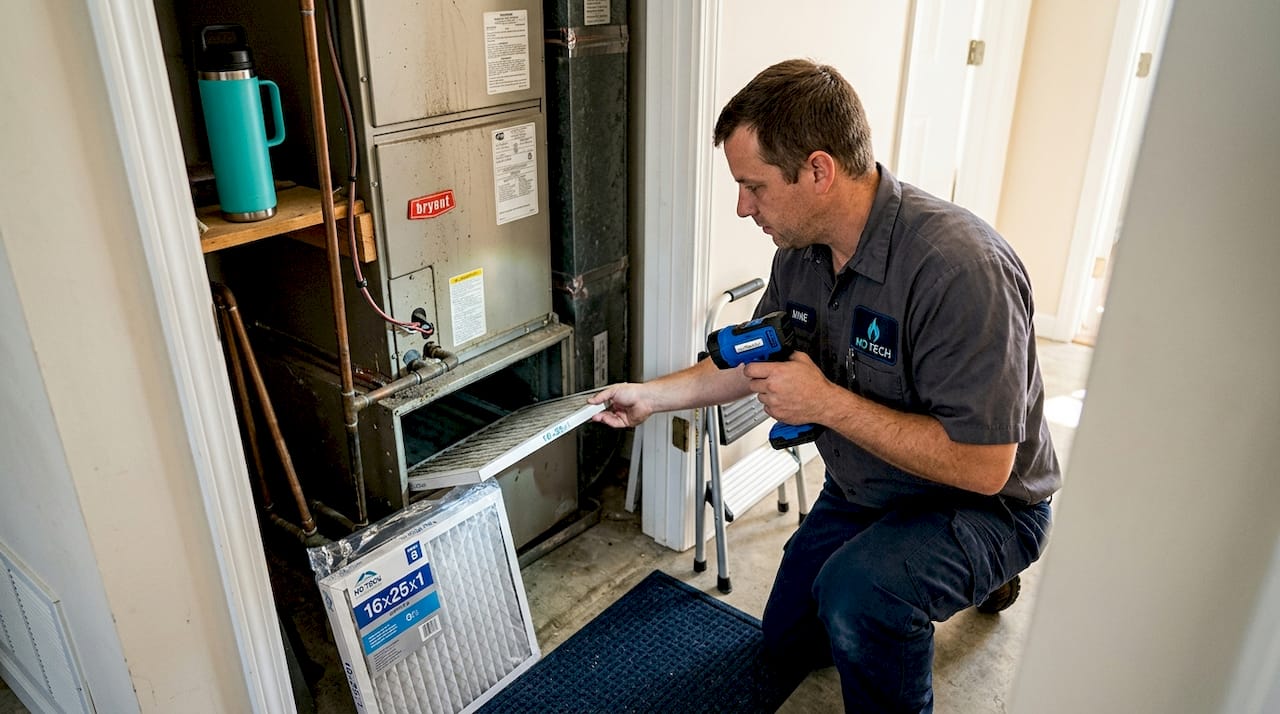
HVAC systems manage humidity levels, filter air pollutants, and keep air moving consistently throughout a building. The air handler sits at the center of all of that. It handles airflow, filtration, and often some level of temperature adjustment before distributing air through your duct system.
Here are the main components you’ll find inside a standard air handler:
- Blower motor and fan: Pulls return air in and pushes conditioned air out through the ducts.
- Evaporator coil: Absorbs heat from indoor air during cooling mode or transfers heat during heating mode when paired with a heat pump.
- Air filter: Traps dust, pollen, and debris before air passes over the coil.
- Dampers: Regulate airflow to different zones or manage fresh air intake.
- Heat strips (in some models): Electric elements that provide backup or supplemental heating.
Pro Tip: Check the location of your air handler first. In Southern California homes, they’re often installed in a closet, garage, or attic. Knowing exactly where yours is makes filter changes and visual inspections much faster.
Air handler vs furnace: what’s actually different
This is where most homeowners get confused, and the confusion is understandable. Both units sit indoors, both connect to ductwork, and both play a role in keeping your home comfortable. But they work in fundamentally different ways.
A furnace generates heat by burning fuel, typically natural gas or propane. It has a combustion chamber, a heat exchanger, and a flue that vents combustion gases outside. A furnace is self-sufficient for heating. It doesn’t need an outdoor unit to produce warmth.
An air handler, on the other hand, does not produce fuel-based heat. It circulates and conditions air but relies on a separate heat source, usually a heat pump, to provide the actual heating or cooling energy. Some air handlers include electric resistance heat strips as a backup, but that’s supplemental, not the primary heat source.
Here’s a side-by-side comparison to make it clear:
| Feature | Air handler | Furnace |
|---|---|---|
| Heat source | Heat pump (electric) | Combustion (gas/propane) |
| Paired equipment | Heat pump or AC unit | Works independently for heat |
| Fuel type | Electricity | Natural gas, propane, or oil |
| Best climate | Mild to moderate (like Southern CA) | Cold climates with extreme winters |
| Includes ductwork connection | Yes | Yes |
| Contains evaporator coil | Yes | Usually separate add-on |
A few situations where an air handler makes more sense than a furnace:
- You live in a moderate climate where temperatures rarely dip below freezing.
- Your home already uses a heat pump as the primary heating and cooling source.
- You want an all-electric system without gas lines.
Air handlers work best with heat pumps in moderate climates where electric heating is practical and efficient. For most homeowners in Orange County and Los Angeles County, an air handler paired with a heat pump is often the right fit.
Pro Tip: If your home uses a heat pump and you’re shopping for an indoor unit, you need an air handler, not a furnace. Pairing a furnace with a heat pump is possible in hybrid systems, but it requires specific equipment and professional setup.
How an air handler works step by step
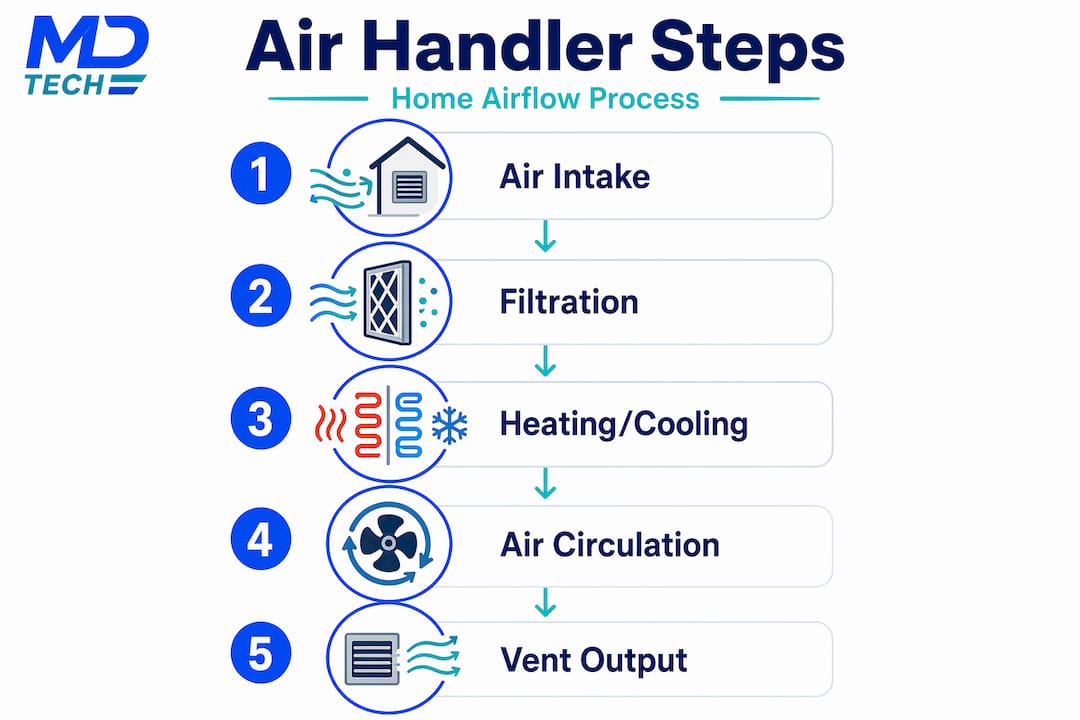
Understanding the process helps you recognize when something is off. Here’s exactly how air moves through your system on a cooling cycle:
- Return air is pulled in. Your thermostat signals the system to cool. The blower motor inside the air handler activates and draws warm indoor air through return vents and into the unit.
- Air passes through the filter. Before anything else happens, air moves through the filter, removing dust, pet dander, and airborne particles.
- Air contacts the evaporator coil. The blower pushes air over the coil for heating or cooling. In cooling mode, refrigerant inside the coil absorbs heat from the air, dropping its temperature significantly.
- Conditioned air enters the ducts. The now-cooled air gets pushed through your supply ducts and out through vents in each room.
- The outdoor unit does its part. The heat absorbed by the refrigerant travels to the outdoor unit, where it’s released outside. The refrigerant cycles back, and the process repeats.
- The thermostat closes the loop. Once your home reaches the set temperature, the thermostat signals the system to shut off. Both the air handler and outdoor unit stop until the next cycle.
In heating mode with a heat pump, the cycle reverses. The outdoor unit extracts heat from outside air (even in cool weather) and transfers it indoors via the refrigerant. The air handler’s blower then distributes that warmed air through your ducts.
The HVAC system as a whole includes heating, cooling, ventilation, and filtration working together to maintain consistent temperatures and indoor air quality. The air handler is the hub where most of that activity happens indoors.
Air handler maintenance tips every homeowner should know
Most air handler problems don’t happen suddenly. They build up over months of neglect. The good news is that a handful of consistent habits can prevent the majority of breakdowns.
- Replace your air filter every 1 to 3 months. A clogged filter restricts airflow, overworks the blower motor, and allows dust to coat the evaporator coil. It’s the single most impactful thing you can do. Regular maintenance improves efficiency and prevents costly repairs.
- Inspect and clean the evaporator coil annually. Dust and grime build up on coils over time, reducing their ability to transfer heat. A dirty coil can cut system efficiency significantly and eventually cause the coil to freeze.
- Check that the condensate drain line is clear. Air handlers produce condensation during cooling. That moisture drains through a small line. If it clogs, you get water damage or the system shuts itself off.
- Listen for unusual sounds. Squealing usually points to a worn blower belt or bearing. Rattling suggests loose panels or debris. Banging can indicate a loose blower wheel.
- Watch for weak airflow or uneven temperatures. If some rooms feel much warmer or cooler than others, you might have a duct issue, a failing blower, or a clogged filter creating airflow restrictions.
You can handle filter changes and basic visual checks yourself. But coil cleaning, refrigerant checks, and electrical component inspections should go to a licensed technician. Knowing about common HVAC repair issues before you call for service helps you describe the problem accurately and avoid being upsold on repairs you don’t need.
Pro Tip: Set a phone reminder on the first of every other month to check your filter. Combine it with another regular task, like paying a bill, so it becomes automatic. Consistency here is worth more than any expensive maintenance contract.
For homeowners who want to go a step further, outdoor unit maintenance paired with regular indoor air handler care can noticeably extend the life of your entire system.
My honest take on why air handlers get overlooked
I’ve been helping homeowners in Southern California with HVAC and appliance issues for years, and the pattern I keep seeing is the same. People call when something breaks. They almost never think about the air handler until they’re sweating in July or shivering in January waiting for a repair appointment.
What I’ve found is that most homeowners genuinely don’t know what role the air handler plays. They know the thermostat and maybe the outdoor unit, but the indoor cabinet? It’s just “that thing in the closet.” That lack of awareness is what leads to skipped filter changes, ignored warning sounds, and deferred maintenance that eventually becomes a $1,500 repair.
The truth I’ve learned through experience is this: the air handler does most of the heavy lifting in your home comfort system. Every breath of conditioned air you feel passed through that unit. If it’s dirty, restricted, or starting to fail, your entire system suffers, even if the outdoor unit is running perfectly.
My advice to any homeowner reading this is to spend 10 minutes this week locating your air handler, checking the filter, and taking a look at the coil if you can access it. That small investment of time is worth more than almost anything else you can do for your HVAC system.
— MDTECH
Keep your air handler running at its best
If your air handler is making noise, struggling to keep up, or hasn’t had a professional look in over a year, it’s time to act before a small issue becomes a full system failure.
At Appliancesrepairmdtech, our licensed technicians serve homeowners across Orange County and Los Angeles County with fast, reliable HVAC diagnostics and repair. We diagnose air handler problems accurately, use quality parts, and don’t recommend work you don’t need. Whether you’re dealing with reduced airflow, a frozen coil, or a blower motor that sounds wrong, we can help. HVAC tune-ups are also available to improve efficiency and catch problems before they become expensive. Book online or give us a call to get your system back in shape before peak season hits.
FAQ
What is an air handler in simple terms?
An air handler is the indoor unit of your HVAC system that circulates and conditions air throughout your home. It contains a blower, filter, and coil, and works alongside an outdoor heat pump or air conditioner.
What’s the difference between an air handler and a furnace?
A furnace burns fuel to generate heat and can operate independently. An air handler moves and conditions air but depends on a heat pump or AC unit for its heating or cooling energy.
How do I know if my air handler needs maintenance?
Signs include weak airflow, unusual noises like squealing or banging, inconsistent temperatures between rooms, or ice forming on the unit. A clogged filter is often the first culprit to check.
Can an air handler work without an outdoor unit?
Not effectively. An air handler requires a paired outdoor unit like a heat pump or air conditioner to provide the conditioned air it distributes. Without it, the system has no heating or cooling source.
How often should I replace my air handler filter?
Most residential filters should be replaced every one to three months depending on usage, pets, and local air quality. NATE-certified technicians recommend checking monthly and replacing when visibly dirty.