
TL;DR:
- Regular HVAC maintenance improves energy efficiency, extends system life, and prevents most breakdowns. It also protects warranty coverage and enhances indoor air quality through proper coil and filter upkeep. Scheduling biannual tune-ups and regular filter changes saves money and ensures system reliability.
Regular HVAC service is the single most effective action a homeowner can take to protect their heating and cooling investment. The U.S. Department of Energy links consistent preventative HVAC maintenance to energy savings of 10–30%, fewer emergency breakdowns, and longer system life. This article covers every major HVAC maintenance advantage, from lower utility bills to cleaner indoor air, so you can make an informed decision about how often to service your HVAC and what each visit actually delivers.
1. Benefits of regular HVAC service: energy savings you can measure
Regular professional maintenance reduces home energy use by 10–30%. That range is not theoretical. It reflects what happens when a technician cleans coils, replaces a clogged filter, and recalibrates system controls during a single visit.
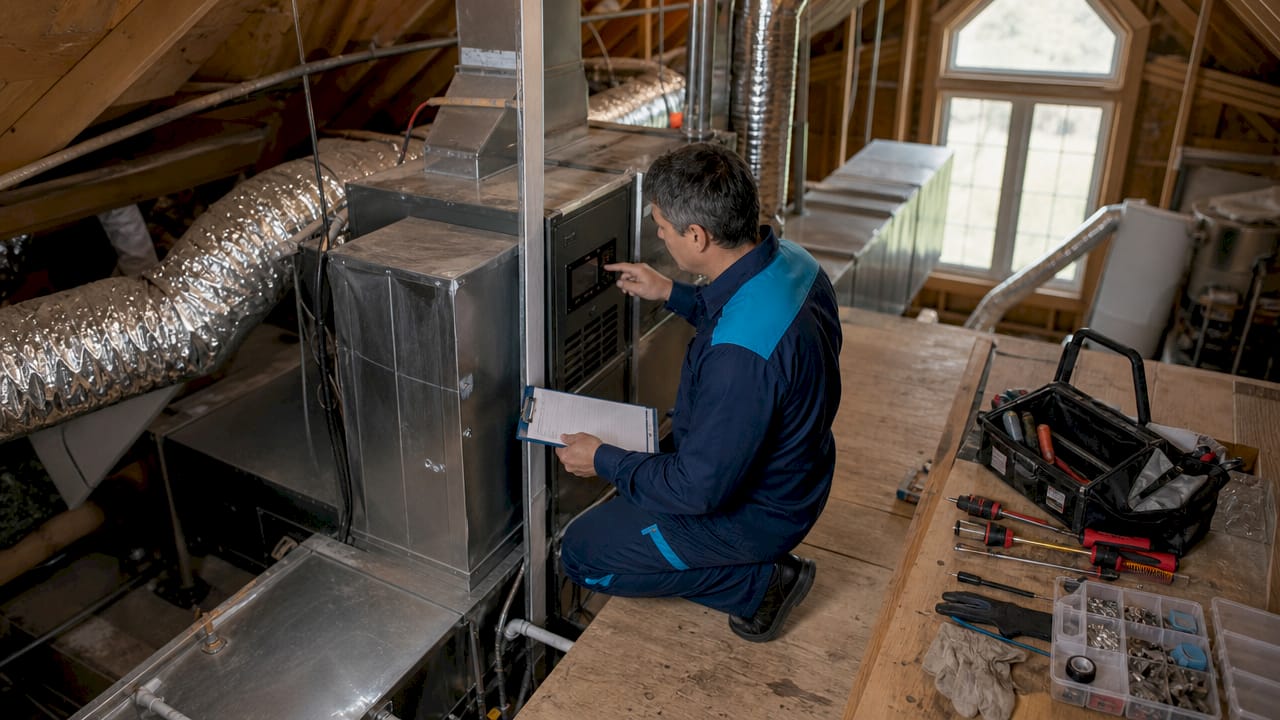
Dirty evaporator and condenser coils force the compressor to work harder to move the same amount of heat. Clean coils alone improve efficiency by 15–25%. That translates directly into lower monthly electricity bills without changing your thermostat settings.
Key maintenance tasks that drive energy savings:
- Air filter replacement: A clogged filter restricts airflow and raises energy draw immediately.
- Coil cleaning: Removes buildup that insulates heat transfer surfaces and cuts efficiency.
- Blower inspection: A dirty or unbalanced blower moves less air per watt consumed.
- Refrigerant check: Low refrigerant forces longer run cycles to reach the set temperature.
- Thermostat calibration: An off-by-two-degree thermostat can add hours of unnecessary runtime per week.
Pro Tip: Schedule filter replacements at the start of spring and fall, right before your system shifts into its heaviest seasonal workload. Doing it after peak season means you ran hard miles on a dirty filter.
2. Extending HVAC system lifespan through routine service
Well-maintained HVAC systems reach a lifespan of 15–20 years. Neglected systems often fail within 8–12 years. That gap represents one full replacement cycle, which typically costs $5,000–$12,000 for a residential system.
The reason neglected systems fail early is mechanical stress. When filters clog, coils ice over, or refrigerant runs low, the compressor compensates by running longer and hotter. Compressors are the most expensive single component in any HVAC system. Protecting them is the core argument for preventative HVAC maintenance.
Maintenance interventions that directly extend system life:
- Lubricate motor bearings to reduce friction and heat buildup in fan motors.
- Tighten electrical connections to prevent arcing that burns out contactors and capacitors.
- Inspect the condensate drain to prevent water backup that corrodes the drain pan and evaporator coil.
- Check refrigerant levels to keep the compressor operating within its designed pressure range.
- Test capacitors and contactors to catch failing start components before they strand the compressor.
- Clean the outdoor unit to maintain airflow across the condenser coil in summer heat.
Neglected systems are up to 40% more likely to suffer a major failure within their first decade. That statistic makes a compelling case for scheduling service before problems appear, not after.
Pro Tip: Keep a folder with every service invoice and technician note. Manufacturer warranty claims for compressors and heat exchangers often require proof of documented annual maintenance. Without that paper trail, a $1,500 compressor claim can be denied.
3. Improving indoor air quality with consistent HVAC maintenance
HVAC systems act as a home’s primary air filtration system. When coils and blowers accumulate dust, pollen, and pet dander, the system recirculates those particles through every room. Regular service removes that buildup before it reaches your living space.
Humidity control is the less obvious benefit. Clean coils remove moisture from the air more effectively during cooling cycles. A system running with dirty coils struggles to dehumidify properly, which raises perceived indoor temperature and creates conditions where mold can grow in ductwork. Preventing buildup on coils and blowers maintains indoor humidity at a comfortable level and makes your home feel cooler without lowering the thermostat.
Air quality benefits from a professional HVAC service visit:
- Reduced allergen load: Clean filters and coils trap pollen, dust mites, and pet dander more effectively.
- Lower mold risk: Proper drainage and clean coils prevent moisture accumulation in the air handler.
- Controlled humidity: A well-functioning system maintains 40–50% relative humidity, the range recommended by the American Society of Heating, Refrigerating and Air-Conditioning Engineers (ASHRAE).
- Odor reduction: Dirty blower wheels and drain pans are common sources of musty smells that circulate through the home.
Pro Tip: Replace filters every 1–2 months during active cooling or heating seasons, not just at tune-up time. A filter rated MERV 8 to MERV 11 captures most common household allergens without restricting airflow on standard residential systems.
4. Reducing repair risks and protecting warranty coverage
Regular maintenance prevents 70–85% of HVAC repairs. That figure reflects the reality that most breakdowns trace back to gradual degradation in components that a technician would catch during a routine visit.
The cost difference between scheduled and emergency service is significant. Scheduled visits cost 3–5 times less than emergency calls. An after-hours service call during a July heat wave in Southern California carries both a premium labor rate and the risk of waiting days for a technician when demand is highest.
| Scenario | Typical Cost | Breakdown Risk | Warranty Status |
|---|---|---|---|
| Regular annual service | Low (scheduled rate) | Low (issues caught early) | Protected (documented) |
| No regular service | Zero upfront | High (gradual failures) | At risk (no proof of care) |
| Emergency repair call | 3–5x scheduled rate | Reactive only | Often already voided |
Manufacturer warranties require documented annual maintenance to honor parts coverage. Failing to provide that proof can lead manufacturers to deny claims for expensive components like compressors and heat exchangers. The warranty protection alone justifies the cost of a yearly tune-up for most homeowners.
Maintenance plans often include priority service during peak seasons. That means faster scheduling when your neighbors are also calling for help in August. For homeowners in Orange County and Los Angeles County, where summer temperatures regularly exceed 90°F, that scheduling advantage is worth real money.
Pro Tip: Ask your HVAC provider about a maintenance plan that includes two annual visits and priority scheduling. The plan fee is almost always less than the cost difference between one scheduled and one emergency call.
5. How maintenance creates a performance history for your system
Tracking system vitals like refrigerant levels, motor amperage, and capacitor readings over multiple visits gives technicians a baseline. When a reading drifts from that baseline, it signals a component heading toward failure before it actually fails.
This predictive approach changes how you budget for home repairs. Instead of a surprise $2,000 repair in the middle of summer, you get a heads-up in spring that a capacitor is weakening. You schedule the $150 replacement at your convenience. That is the practical value of a performance history for your system.
Maintenance also functions as a proactive strategy for the full system. Moving parts wear, electrical connections loosen, and refrigerant migrates over time. A technician who sees your system annually catches these trends. One who only visits during emergencies sees only the result of years of undetected degradation.
6. How often should homeowners schedule HVAC maintenance?
The industry gold standard is two professional tune-ups per year. Schedule one in spring before cooling season and one in fall before heating season. This timing catches problems before the system faces its heaviest workload.
Filter replacement follows a different schedule. The U.S. Department of Energy recommends replacing or cleaning air filters every 1–2 months during active seasons. Homeowners with pets, allergies, or older ductwork should lean toward the one-month interval.
Maintenance schedule best practices:
- Spring tune-up (march to april): Clean coils, check refrigerant, test cooling operation, inspect electrical components.
- Fall tune-up (september to october): Inspect heat exchanger, test ignition system, check gas pressure, verify safety controls.
- Monthly filter check: Replace or clean based on visual inspection, not just the calendar.
- Heat pumps: Service twice annually because they run year-round in both heating and cooling modes.
- Older systems (10+ years): Consider quarterly inspections as components approach end of rated life.
- High-use households: Homes with multiple occupants, pets, or dusty environments need more frequent filter changes and annual duct inspections.
Regional factors matter too. In Southern California, cooling systems run longer into the fall than in northern states. Homeowners in Orange County and Los Angeles County often benefit from a third filter check in october to account for extended summer-like conditions.
Key Takeaways
Regular HVAC service reduces energy costs, extends system life to 15–20 years, protects warranty coverage, and prevents up to 85% of breakdowns before they happen.
| Point | Details |
|---|---|
| Energy savings are measurable | Professional maintenance cuts home energy use by 10–30%, with coil cleaning alone worth 15–25% efficiency gains. |
| Lifespan doubles with care | Maintained systems last 15–20 years; neglected ones fail in 8–12 years, costing one full replacement cycle early. |
| Warranties require documentation | Manufacturers can deny compressor and heat exchanger claims without proof of documented annual service. |
| Emergency calls cost far more | Scheduled visits run 3–5 times less than emergency service calls, making prevention the cheaper path. |
| Twice-yearly is the standard | Spring and fall professional tune-ups, plus monthly filter checks, form the industry-recommended baseline schedule. |
What I’ve learned from years of watching HVAC systems age
The homeowners who call us in a panic in july almost always share one thing: they skipped last year’s tune-up because the system seemed fine. HVAC systems do not announce problems early. They quietly degrade until the hottest day of the year forces the issue.
What I’ve found is that the cost argument for regular service is actually understated. Most articles focus on energy savings, which are real. But the bigger number is the avoided replacement. When a well-maintained system runs 18 years instead of 10, that is one full $8,000–$12,000 replacement a homeowner never has to make. No energy savings calculation comes close to that figure.
Professional technicians also catch things homeowners cannot see. A capacitor reading that is 15% below spec looks normal to the eye. It shows up clearly on a multimeter. That $150 catch prevents a $1,200 compressor failure six months later. The repair vs. replacement decision becomes much easier when you have a service history showing exactly how the system has aged.
My honest recommendation: treat HVAC service the same way you treat oil changes. You do not wait for the engine to knock. You follow the schedule because the cost of prevention is always lower than the cost of failure.
— MDTECH
Professional HVAC maintenance from Appliancesrepairmdtech
Appliancesrepairmdtech serves homeowners across Orange County and Los Angeles County with licensed HVAC technicians who follow a thorough inspection protocol on every visit. Whether you need a seasonal tune-up, a filter replacement program, or a full system diagnostic, the team brings the tools and the service history tracking that protects your warranty and your budget.
Appliancesrepairmdtech offers expert HVAC repair and maintenance with priority scheduling options for homeowners who want faster service during peak seasons. For a full checklist of what a professional visit should cover, the HVAC maintenance checklist walks through every inspection point by season. Book online or call to schedule your next tune-up before the next heat wave arrives.
FAQ
What are the main benefits of regular HVAC service?
Regular HVAC service reduces energy use by 10–30%, extends system lifespan to 15–20 years, improves indoor air quality, and prevents up to 85% of breakdowns before they occur.
How often should I schedule professional HVAC maintenance?
The industry standard is twice per year: once in spring before cooling season and once in fall before heating season. Filters should be replaced every 1–2 months during active use.
Does skipping HVAC service void my warranty?
Most manufacturers require documented annual maintenance to honor warranty claims on major components like compressors and heat exchangers. No service records can result in a denied claim.
Is a maintenance plan worth the cost?
Maintenance plans typically cost less than a single emergency service call, and they include priority scheduling during peak seasons when technician availability is tightest.
How does HVAC maintenance improve indoor air quality?
Clean coils and filters remove dust, pollen, and pet dander from circulating air. Proper drainage and coil condition also prevent mold growth and maintain healthy indoor humidity levels.