
TL;DR:
- Hiring licensed, insured technicians ensures safe, reliable repairs and protects your warranty.
- Verifying licenses through official sources and reading recent honest reviews help identify trustworthy professionals.
- Avoid red flags like cash-only payments and no written estimates to prevent costly, unreliable service.
Hiring the wrong repair technician costs more than just money. A technician without proper credentials can void your appliance warranty, create gas leaks, or leave you liable for accidents on your property. Knowing how to choose a repair technician the right way, before anyone touches your refrigerator, HVAC unit, or washer, is one of the most practical skills a homeowner or property manager in Orange County or Los Angeles County can have. This guide walks you through licensing, verification, red flags, and hiring steps so you can book with confidence every time.
Table of Contents
- Understand technician licensing and insurance requirements
- How to verify a repair technician’s license and reputation
- Recognize red flags and avoid unreliable repair technicians
- Steps to confidently hire and book a repair technician
- Verify completed repairs and maintain long-term appliance health
- Why relying solely on price can backfire when choosing technicians
- Find trusted appliance and HVAC repair services in Orange & LA counties
- Frequently asked questions
Key Takeaways
| Point | Details |
|---|---|
| Verify licenses | Always confirm technician licenses are active, match the work needed, and include necessary bonds and insurance. |
| Check reviews | Use multiple platforms and read recent, middle-rated reviews to gauge real technician reputation. |
| Avoid red flags | Beware cash-only, no written estimates, and unsolicited parts upselling to protect yourself. |
| Look beyond price | Lowest cost often risks quality and safety; prioritize credentials and warranties for long-term value. |
| Keep documentation | Retain estimates, receipts, and warranty info to support future service needs and disputes. |
Understand technician licensing and insurance requirements
The first rule of selecting a repair technician in California: know which repairs legally require a license and which do not. Standard appliance repairs, such as fixing a dryer belt or replacing a dishwasher pump, do not require a California State License Board (CSLB) contractor license. However, the moment work involves gas lines, HVAC systems, or projects valued over $500 in labor and materials, California law requires an active CSLB license, with violations classified as a misdemeanor carrying fines up to $15,000.
For HVAC specifically, the rules are strict. To hold a C-20 HVAC license in California, a technician must complete 4 years of journeyman experience, pass two separate exams with at least a 72% score, post a $25,000 surety bond, and carry workers’ compensation insurance. That process weeds out underqualified operators. When a technician shows up without that license for HVAC or gas work, they are not just bending rules. They are working illegally in your home.
Insurance is just as important as licensing. General liability insurance covers property damage the technician may cause, while workers’ compensation covers injuries to the technician on your property. Without those, you could be held financially responsible. Understanding why licensed technicians matter before hiring protects both your property and your peace of mind.
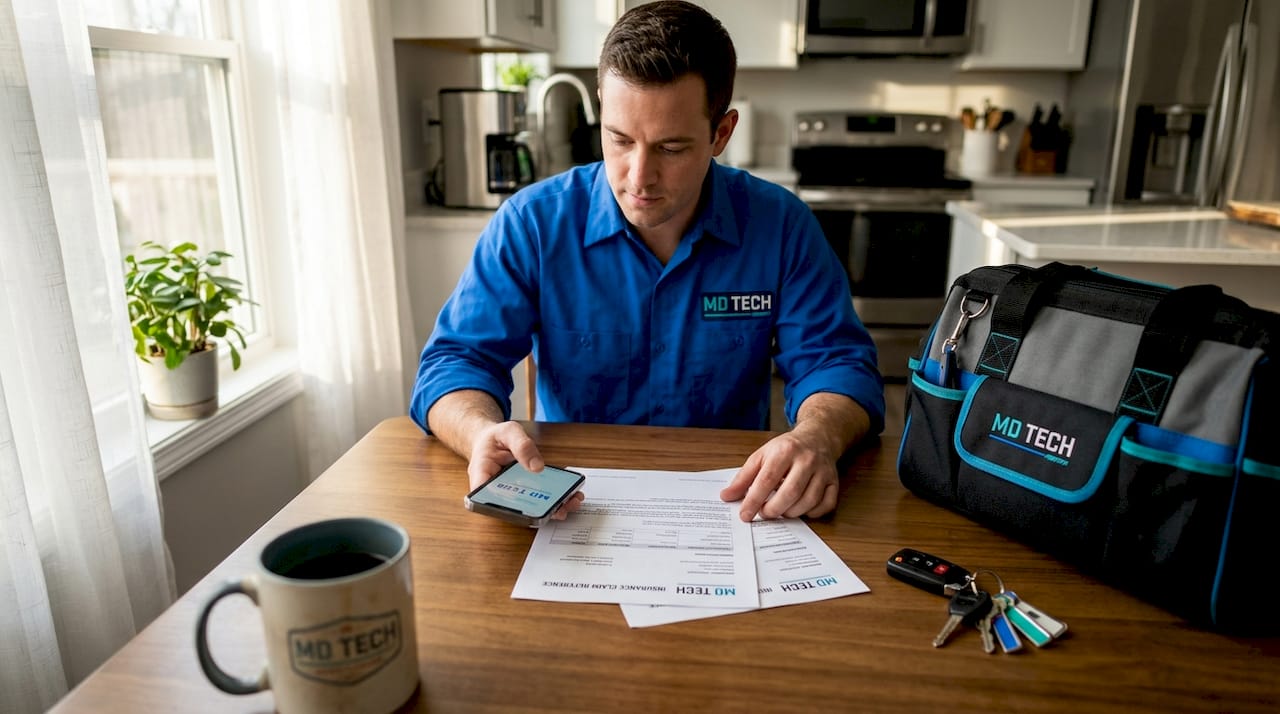
Here is a quick breakdown of the key license types relevant to homeowners in Orange and LA counties:
| License type | Work covered | Required exam | Bond required |
|---|---|---|---|
| C-20 HVAC | Heating, ventilation, AC systems | Law & Business + C-20 Trade | Yes, $25,000 |
| C-36 Plumbing | Gas lines, water connections | Law & Business + C-36 Trade | Yes, $25,000 |
| No license required | Standard appliance repair under $500 | N/A | N/A |
Key points to remember before hiring any technician:
- Always ask if the repair involves gas or HVAC. If yes, a CSLB license is legally required.
- General appliance repairs do not require a CSLB license, but insurance still matters.
- Confirm the technician carries workers’ comp coverage, or you carry the risk.
- Hiring insured technicians can save you significantly on unexpected liability costs.
- Unlicensed work can also void manufacturer warranties on major appliances.
How to verify a repair technician’s license and reputation
Knowing a license should exist is one thing. Confirming it actually does is another. Here is how to do it in five clear steps:
- Go to cslb.ca.gov. This is the official CSLB license lookup tool. No account needed.
- Search by license number. If the technician gives you a number, search it directly. It is the most reliable method.
- Search by business name. If no number is available, use the first 10-15 characters of the business name and try variations for ampersands or spacing.
- Confirm three things. Status must read “Active,” the license classification must match your repair type, and bond and workers’ comp must both be current.
- Demand the number if they stall. A legitimate contractor is required by law to provide their license number on quotes, contracts, and ads. Hesitation is a red flag.
A license that reads “previously licensed” is not sufficient for legal work. Missing workers’ comp coverage exposes you to personal liability. Do not skip this step.
Beyond the license, reputation verification is equally important when choosing the right technician. Check Google reviews, Yelp, and the Better Business Bureau. But here is the move most people miss: ignore the five-star and one-star reviews and read the two and three-star ones first. Those tend to be the most honest, nuanced accounts of what actually happened. Look for patterns, not outliers.
- Focus on reviews from the past 12 months. Technician quality changes over time.
- Check for responses from the business. Companies that respond professionally to criticism tend to be more accountable.
- Cross-check the business name on tips for choosing repair services with the CSLB name to confirm they match.
Pro Tip: Before any technician arrives, ask for their license number and insurance certificates by email or text. A confident, honest technician will send them without hesitation. One who deflects or claims they are “not required for this job” on HVAC or gas work is telling you everything you need to know.
Recognize red flags and avoid unreliable repair technicians
Some technicians prey on homeowners who are already stressed about a broken appliance. Knowing what to watch for is how you stop the situation before it costs you. Red flags for unreliable technicians include cash-only payment demands, no written estimate before inspection, upselling parts without explanation, and no paper receipt after service.
Watch for these specific warning signs:
- Cash-only payment. This eliminates your dispute options entirely and often signals an unregistered operation.
- Phone or online diagnoses. A technician who names the problem and quotes a price before seeing the appliance is guessing, not diagnosing.
- Vague verbal estimates. If it is not in writing with line-item detail, it does not exist in any legally useful way.
- Pressure to approve additional parts on the spot. Any reputable technician will explain what failed, why it failed, and show you the broken component.
- No receipt after service. Your receipt is your only proof of what was done, what was charged, and what warranty applies.
“When multiple red flags appear in a single interaction, do not try to weigh them individually. The combination itself is the signal. Stop the job, pay only for any confirmed diagnostic work already agreed upon in writing, and find another technician.”
Pro Tip: Use a note-taking app to log every detail before and after the technician visit: the quoted price, arrival time, what they said about the problem, and what they actually did. If a dispute arises, this record matters more than you expect.
Licensed technicians you can trust for safety will never pressure you or resist documentation. Transparency is standard practice for professionals.
Steps to confidently hire and book a repair technician
This is where all your preparation pays off. Follow this process and you will rarely, if ever, end up with a bad outcome.
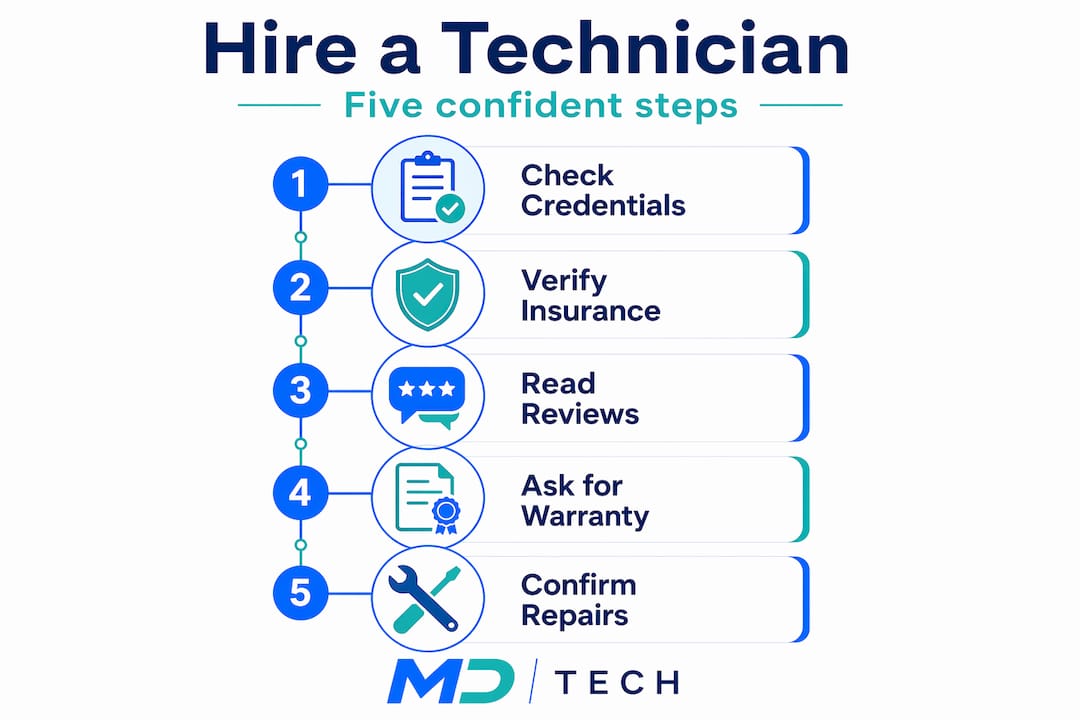
- Contact at least three verified technicians. Get written estimates from each. This is not about finding the cheapest option. It is about seeing what a fair range looks like and how each company communicates.
- Compare estimates carefully. Look beyond the labor rate. Review warranty coverage, whether they use OEM (original equipment manufacturer) parts, and their stated response time. According to 2026 comparison data, top appliance repair providers typically offer 90-day labor warranties, 1-year parts warranties, an average rate of $85/hr, and same-day response.
- Confirm warranty terms in writing before work begins. A verbal warranty is not worth much if the technician stops returning calls after the repair.
- Schedule with clear expectations. Confirm the arrival window, service scope, and payment method in writing, ideally by email so you have a trail.
- Ask your questions directly. Good technicians expect informed customers. Ask about their experience with your specific brand and model.
- Keep records. Store all estimates, license confirmations, and receipts in one folder, physical or digital.
When comparing options, here is what to prioritize:
| Factor | What to look for | Why it matters |
|---|---|---|
| Labor warranty | Minimum 90 days | Covers callbacks on the same issue |
| Parts warranty | 1 year preferred | Protects against early part failure |
| License status | Active, matching classification | Legal and safety compliance |
| Parts used | OEM over aftermarket | Preserves appliance manufacturer warranty |
| Reviews | 4.5 or higher, 100+ reviews | Broad sample reduces bias |
Pro Tip: Learn how to book an appliance technician in your area before something breaks. Having a pre-vetted technician on file means you will not be making rushed decisions when your refrigerator fails at 10 p.m. on a Saturday.
Verify completed repairs and maintain long-term appliance health
The repair is done. Do not pay in full and walk away yet. Take five minutes to verify the work before the technician leaves.
- Test the appliance yourself. Run it through a full cycle or function check while the technician is still present. If something is not right, it is easier to address before they pack up.
- Review the receipt in detail. It should list each part replaced, the labor charge, the problem description, and warranty terms.
- Store documents properly. Keep the receipt, warranty paperwork, and the technician’s license and insurance information together.
- Contact the company promptly if the issue returns. Most warranties require you to report recurring problems within a specific window. Do not wait.
- Schedule follow-up maintenance. Many appliance problems return because the underlying cause was not addressed. Annual maintenance checks catch issues before they become emergencies.
For major or complex repairs, look for ASE-certified master technicians who carry manufacturer authorization. These credentials reduce misdiagnosis and repeat service calls. The role of warranty in repairs matters most when an issue recurs, so understand your coverage before the technician leaves.
Pro Tip: Photograph the appliance before and after the repair. If a technician accidentally causes cosmetic or functional damage, you have visual proof tied to a timestamp.
Additional maintenance habits that extend appliance life:
- Clean HVAC filters every 30 to 90 days depending on use and air quality.
- Check refrigerator door seals annually. A failing seal raises energy costs before it causes a breakdown.
- Run washing machine cleaning cycles monthly to prevent mold and odor buildup.
- Have gas appliances inspected by a C-36 or C-20 licensed technician annually.
Why relying solely on price can backfire when choosing technicians
Here is something most homeowners only learn the hard way: the cheapest estimate is often the most expensive outcome.
Low-price technicians frequently operate without insurance, skip diagnostic steps to save time, or use cheap aftermarket parts that fail within months. A $60 repair that requires three callbacks, causes secondary damage, or voids your appliance warranty ends up costing $300 or more. The math almost never favors the bargain.
Independent shops can offer better service and lower labor rates than large chains by running leaner operations, but the key difference is accountability. A shop offering extremely low rates often cuts corners on warranties, insurance, and documentation. You do not know which type you are dealing with until something goes wrong.
Watch out for “free diagnostic” offers specifically. This is a classic setup where the technician charges nothing upfront, then quotes inflated repair costs because you have no baseline comparison. The free diagnostic is not a favor. It is a sales funnel.
The better approach: balance price with credentials, reviews, warranty terms, and how the technician communicates. A technician who answers your questions clearly, provides a detailed written estimate, and holds an active CSLB license where required is demonstrating their standards before the job even starts. That transparency is worth paying for.
The best approach to choosing appliance repair services consistently shows that homeowners who evaluate five factors, not just price, report fewer callbacks, higher satisfaction, and lower total repair costs over time. Price is one data point. It should never be the deciding one.
Find trusted appliance and HVAC repair services in Orange & LA counties
Now that you know how to choose wisely, you deserve a team that already meets every standard in this guide.
At Appliances Repair MD Tech, we serve homeowners and property managers throughout Orange County and Los Angeles County with licensed, insured technicians who specialize in major appliances and HVAC repair. Every estimate is provided in writing before any work begins. We use OEM parts to protect your manufacturer warranties, and we back our work with clear labor and parts warranties. Whether you need Samsung appliance repair, refrigerator service, washer and dryer repairs, or gas appliance work, our team is ready to respond quickly, communicate clearly, and get the job done right. You can also review our appliance parts replacement guide to understand your repair options before booking.
Frequently asked questions
Do I always need a licensed contractor for appliance repairs in California?
Most standard appliance repairs do not require a CSLB license, but any work involving gas lines or HVAC systems must be performed by a licensed contractor to comply with California law and protect your home from safety risks.
How can I verify if a repair technician’s license is valid?
Use the CSLB website or LicensedCheck.com to search by license number or business name. Confirm the license is “Active”, the classification matches your repair type, and the bond and workers’ comp coverage are both current.
What are common warning signs of unreliable repair technicians?
Key red flags include cash-only payment demands, no written estimate before starting work, phone diagnoses made without inspecting the appliance, pressure to approve additional parts, and no written receipt after service is completed.
Why should I avoid choosing a technician based solely on low price?
Lowest rates often mean reduced or no warranties and less accountability, which increases the risk of poor quality work, repeat failures, or safety issues. Balancing cost with licensing, reviews, and warranty terms consistently leads to better outcomes.