
TL;DR:
- Hard water causes mineral buildup that damages plumbing and reduces appliance efficiency. A water softener uses ion exchange to remove calcium and magnesium, preventing scale formation and extending appliance lifespan. Proper maintenance and water testing are essential for optimal performance and long-term savings.
Hard water isn’t just a taste problem. Beneath the surface, dissolved calcium and magnesium minerals are quietly attacking your plumbing, coating your water heater’s heating elements, and leaving stubborn white crust inside your dishwasher and washing machine. For homeowners in Orange County and Los Angeles County, where municipal water often carries significant mineral loads, this invisible damage adds up fast in repair bills and reduced appliance life. A water softener is a home water-treatment system, typically an ion-exchange unit, that removes those minerals before they can do their worst.
Table of Contents
- What is a water softener and how does it work?
- What a water softener does and what it doesn’t
- A closer look: The regeneration cycle and ongoing maintenance
- Expert tips: Choosing and optimizing water softener use
- What most homeowners overlook about water softeners
- Keep your appliances running with expert help
- Frequently asked questions
Key Takeaways
| Point | Details |
|---|---|
| Removes hard minerals | A water softener swaps calcium and magnesium out of your water, reducing scale problems in your home. |
| Improves appliance life | Softer water helps extend the lifespan and efficiency of water-using appliances and pipes. |
| Not a water filter | A softener does not clean or purify your water—it’s not a replacement for filtration. |
| Requires regular upkeep | Periodic regeneration and salt checks are needed to keep your softener working well. |
| Consider all water issues | Test for more than just hardness if you have stains or odors to choose the right system. |
What is a water softener and how does it work?
Think of a water softener as a mineral traffic controller. Hard water enters your home carrying dissolved calcium and magnesium. Left alone, those minerals deposit as scale on every surface water touches. A water softener intercepts them before they reach your appliances, pipes, and fixtures.
What “hardness” actually means
Water hardness is measured in grains per gallon (gpg). One grain equals roughly 17.1 milligrams of dissolved minerals per liter. Soft water sits below 1 gpg. Moderately hard water runs 3.5 to 7 gpg. Anything above 7 gpg is firmly in the hard water zone, and that threshold matters because water above 7 grains per gallon is very likely to cause visible scaling in pipes and on appliances. Many communities in Southern California exceed that level by a wide margin.
The ion-exchange process, step by step
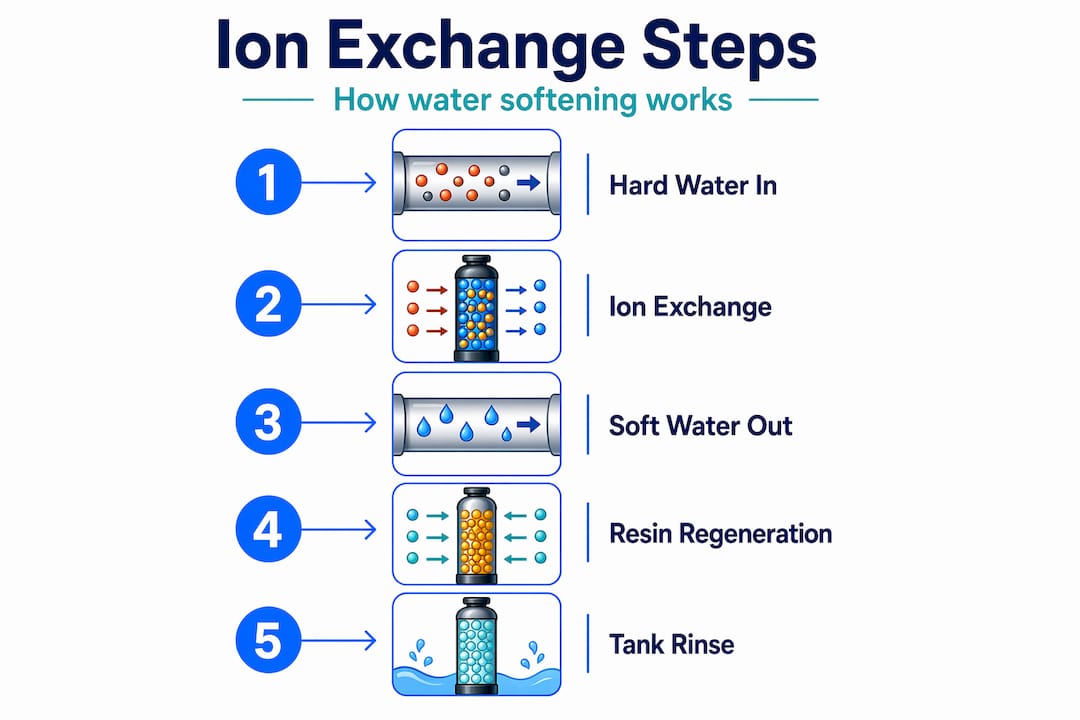
The core technology inside most home water softeners is called ion exchange. The system uses a resin tank packed with tiny, negatively charged plastic beads. As hard water flows through, calcium and magnesium ions, both positively charged, are attracted to the beads and stick to them. In exchange, sodium (or potassium) ions are released into the water. The result is water that still carries dissolved material, but now it’s sodium rather than scale-forming minerals. Ion-exchange softeners swap calcium and magnesium ions for sodium or potassium ions using exactly this resin tank mechanism. During the softening cycle, hard water passes through resin beads and exchanges hardness ions for sodium ions continuously, until the resin becomes saturated.
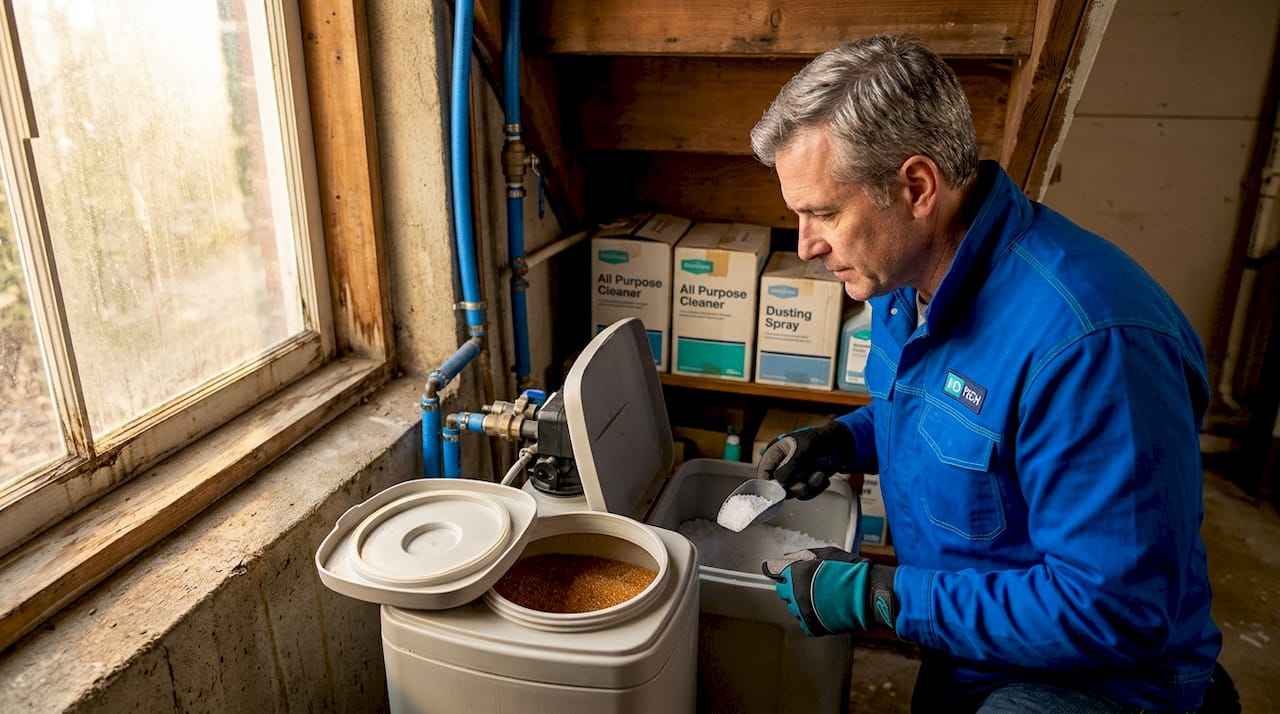
Key components at a glance
| Component | Function |
|---|---|
| Resin tank | Holds ion-exchange beads; removes calcium and magnesium |
| Brine tank | Stores salt or potassium solution for regeneration |
| Control valve | Directs water flow; triggers and manages regeneration cycles |
Pro Tip: If your glassware is coming out of the dishwasher cloudy, or your shower walls have a chalky film that won’t wipe off easily, you likely have hard water above 7 gpg. A simple inexpensive test strip from any hardware store will confirm it in minutes.
What a water softener does and what it doesn’t
Understanding how softeners function brings up the question: what benefits should you actually expect, and what common myths cause confusion?
The real, measurable benefits
The most direct win is scale prevention. Limescale builds up inside water heaters, reducing their efficiency because the heating element has to work harder to push heat through a growing mineral crust. That means higher energy bills month after month. Softened water also dramatically reduces soap scum, meaning your laundry detergent and dishwasher detergent lather more effectively. You often need less detergent to get the same cleaning result. Softened water can reduce scale buildup on hot-water heaters and improve cleaning performance with less soap film and detergent curds forming on dishes and fabrics.
In practical terms, here is what Orange County homeowners typically notice within the first few months of running a softener:
- Fewer white deposits ringing faucets and showerheads
- Cleaner, spot-free dishes after a dishwasher cycle (understanding dishwasher hard water damage makes it clear why this matters)
- Water heaters running more efficiently and costing less to operate, a direct tie to water heater energy efficiency
- Softer laundry with no stiff mineral residue in fabric fibers
- Extended lifespan for washing machines, dishwashers, and coffee makers
What a softener cannot do
Here is where a lot of homeowners get burned by misplaced expectations.
A water softener is not the same as a water filter or purifier. It does not remove bacteria, viruses, chlorine, lead, nitrates, or other chemical and biological contaminants.
A water softener is built for one job: removing hardness minerals. A water softener does not clean water in the sense of making it safe to drink if it contains other hazards. If you have concerns about drinking water safety beyond hardness, you need a separate filtration or purification system working alongside your softener.
Signs you probably need a softener
- Thick white or yellowish mineral deposits around faucets and in toilet tanks
- Appliances breaking down sooner than expected due to clogged valves or corroded elements
- Soap that won’t lather well, leaving a filmy residue on skin and clothes
- A water heater that cycles more frequently or takes longer to heat
- Dishes and glassware emerging from the dishwasher with spots and a dull film
A closer look: The regeneration cycle and ongoing maintenance
Knowing what a softener can and can’t do leads straight to the nitty-gritty: what does it take to keep these systems operating reliably?
The resin beads inside your softener don’t last forever without a reset. Once they’ve captured enough calcium and magnesium to become saturated, they lose their ability to exchange ions. That’s where regeneration comes in. Think of it as rebooting the resin so it can keep working.
How regeneration works, step by step
- Hardness removal: During normal operation, resin beads pull calcium and magnesium from water continuously until the beads are fully loaded with those minerals.
- Resin saturation: The control valve detects (or is programmed to anticipate) that the resin has reached capacity and triggers the regeneration cycle.
- Brine rinse: A concentrated salt solution (brine) from the brine tank is flushed through the resin tank. The high sodium concentration forces the calcium and magnesium off the beads and flushes them down the drain. During regeneration, the resin is cleaned with a salt brine, which flushes the captured calcium and magnesium from the resin and restores its ability to soften water.
- Restored resin: The resin beads are now loaded with sodium ions again and ready to start the ion-exchange process over. The cycle is complete.
Manual vs. automatic regeneration
Older or budget softeners use a timed schedule, regenerating on a set clock regardless of actual water usage. This can waste salt and water if your usage is lower some weeks. Demand-initiated regeneration systems are smarter. They track actual water volume and only regenerate when the resin genuinely needs it. For most households in LA and Orange County, demand-initiated units pay for themselves through lower salt and water consumption within a couple of years.
Pro Tip: Check your brine tank’s salt level at least once a month. Running low on salt means your softener is regenerating with diluted brine, which doesn’t fully recharge the resin. The result is partially hard water sneaking through to your appliances without you realizing it.
Neglected regeneration has a real cost. Over time, a softener running on depleted resin allows scale to accumulate in pipes and appliances just as if you had no softener at all. Keeping up with routine maintenance, including inspecting the brine tank for salt bridges (a crust that forms and blocks salt from dissolving), is critical. Pairing good washing machine care tips with a well-maintained softener is one of the most effective ways to extend your washer’s life. A solid washer maintenance guide will also tell you how scale contributes to component wear inside the drum and pump. And for the bigger picture, a preventive maintenance guide can help you build all of this into a regular schedule so nothing slips through the cracks.
Expert tips: Choosing and optimizing water softener use
With a handle on maintenance, it’s time to ensure you choose the right unit and the right settings for your household’s water and appliances.
Start with a water test, not a guess
Before spending anywhere from $400 to $2,500 on a water softener system, test your water. A basic water hardness test costs under $20 at most hardware stores. A more detailed laboratory test runs $50 to $100 and will tell you exactly what you’re working with. Levels below about 7.0 gpg may not cause major scaling or soap film issues, which means a softener may not deliver enough benefit to justify the cost. Above that threshold, treatment with an ion-exchange softener typically makes strong economic sense.
When a softener alone isn’t enough
Here’s a situation that surprises many homeowners: if your water has elevated iron levels alongside hardness, a standard water softener will struggle. Iron fouls the resin beads and reduces their capacity over time. If you have additional water quality issues beyond hardness, such as iron or sulfur, a water softener alone may not be sufficient and may require pre-treatment before the water even reaches the softener. In those cases, an iron filter or an oxidation system upstream of the softener is the right call.
Key questions to answer before buying
- What is your home’s actual water hardness in gpg? (Test it first.)
- Does your water have iron, sulfur, or other contaminants that need separate treatment?
- How many people live in the home, and what is your average daily water usage?
- How old are your major water-using appliances, and how much scale have they already accumulated?
- What is your realistic monthly budget for salt and maintenance?
Pro Tip: Always test your water quality before investing in a softener. And once the softener is installed, retest every 12 to 18 months. Water sources and municipal treatment can shift over time, especially after drought seasons or infrastructure changes common in Southern California.
Sizing matters more than most people realize
An undersized softener regenerates too frequently, using more salt and wearing out faster. An oversized unit regenerates too rarely, allowing the resin to sit without being properly flushed. Your installer should calculate unit size based on your household water consumption (gallons per day) and your incoming water hardness level. Pairing this with smart home plumbing upgrades can give you real-time data on water usage to fine-tune your softener’s settings and track performance over time.
What most homeowners overlook about water softeners
Even with all the technical know-how, some of the most important lessons come from real-world experience working with homeowners across Orange County and Los Angeles County. And here’s the uncomfortable truth: most people install a water softener and immediately stop thinking about it.
That mindset is exactly what leads to a $1,200 dishwasher repair six years in.
A water softener is not a plug-and-forget appliance. It is a system that requires monthly attention and annual inspection, minimum. The salt needs refilling. The brine tank needs occasional cleaning to prevent salt bridges and mushing, where the salt compacts into a sludge that blocks regeneration. The resin itself has a lifespan, typically 10 to 15 years, after which it needs to be replaced or the unit upgraded.
We’ve also noticed that homeowners tend to install a softener and then skip other appliance maintenance because they assume the softener is handling everything. It isn’t. Softened water reduces one category of damage, mineral buildup. But your dishwasher still needs its filter cleaned regularly. Your washing machine still needs its door gasket wiped down. Understanding dishwasher performance and hard water goes hand in hand with understanding that a softener is one layer of protection, not a complete maintenance strategy.
The smartest homeowners treat a water softener as the foundation of a broader home water and appliance care plan, not the ceiling of it. Test your water. Maintain your softener. Service your appliances on schedule. That combination is what actually delivers the long-term savings and reliability you invested in when you bought the system.
Keep your appliances running with expert help
If you want to put these water softening lessons into action and protect your appliances, here’s how our team can help.
A well-maintained water softener dramatically reduces the mineral damage your appliances face every day. But even the best softener can’t undo wear that’s already set in, or replace professional servicing for appliances that already show signs of scale damage or mechanical stress.
Our licensed technicians in Orange County and Los Angeles County are ready to help you assess whether it’s time to repair vs. replace an appliance that hard water has already affected. We handle local plumbing repairs including issues directly tied to scale buildup in pipes and fixtures. And if your appliances need component work, our team can help you replace appliance parts efficiently and affordably. Book an appointment online or call us directly to get started.
Frequently asked questions
Does softened water taste salty or feel different to drink?
Properly softened water may taste slightly different but is usually not noticeably salty unless the softener is misconfigured or using excessive sodium. Ion-exchange softeners add only a small amount of sodium in exchange for the calcium and magnesium removed.
Is a water softener the same as a water filter or purifier?
No. A water softener removes hardness minerals but leaves chemical and biological contaminants untreated. A softener does not clean water in the safety sense, so households with drinking water concerns need a separate filtration system.
How often does a water softener need to regenerate?
Most modern units with demand-initiated controls regenerate every two to seven days depending on household water usage. Always consult your owner’s manual since regeneration frequency varies by model, with some units automatic and others requiring manual switching.
Will softened water damage my pipes or appliances?
No. Softened water reduces scale buildup on water heaters and improves cleaning performance, which means your pipes and appliances are generally better protected, not harmed, by properly softened water as long as settings are correctly maintained.