
TL;DR:
- OEM parts provide exact compatibility, high quality, and warranty protection for safety-critical repairs. They cost more but help maintain long-term reliability, warranty validity, and resale value, especially for essential components. Reputable aftermarket parts can be suitable for routine maintenance on older units, but OEM remains essential for safety and warranty-sensitive repairs.
OEM parts are original equipment manufacturer components built to the exact specifications of your vehicle or appliance. They are the same parts installed at the factory, and they remain the most reliable choice when you need a repair to hold up long term. Whether you’re replacing a washing machine control board or a brake sensor on your car, the case for using OEM parts comes down to three things: fit, quality, and protection. This guide breaks down the real advantages, the honest cost tradeoffs, and the practical rules for knowing when OEM is worth every extra dollar.
Why use OEM parts for repairs and replacements
OEM parts deliver a level of compatibility that aftermarket alternatives rarely match. Because they are manufactured to factory tolerances, they install without modification and perform exactly as the original component did.
The core benefits of OEM parts fall into four clear categories:
- Exact fit. OEM parts are plug-and-play with no trimming, drilling, or shimming required. That precision saves installation time and protects surrounding components from stress caused by poor alignment.
- Consistent quality. OEM parts are produced under the same manufacturing standards as the original. You are not guessing about material grade or tolerances.
- Durability. Because the materials and geometry match the original design, OEM parts tend to last as long as the first component did. Aftermarket parts made from cheaper materials often fail sooner.
- Warranty compliance. Many manufacturers require OEM parts to keep your warranty valid. Using an incompatible aftermarket part can give the manufacturer grounds to deny a claim.
One detail that trips up a lot of DIYers is the difference between OEM and OE parts. OE parts meet factory requirements and may be sold without the vehicle or appliance manufacturer’s branding, often at a lower price but with equivalent quality. Knowing this distinction helps you shop smarter without sacrificing reliability.
Pro Tip: When ordering a replacement part, search by your appliance or vehicle’s model number rather than a generic description. OEM and OE parts are cataloged by model, so you get the exact match every time.
OEM vs aftermarket parts: cost, quality, and compatibility
The price difference between OEM and aftermarket parts is real, and it deserves an honest look. OEM parts commonly cost 20–100 percent more than aftermarket equivalents. That premium reflects tighter quality control, factory-matched materials, and the manufacturer’s warranty support behind the part.
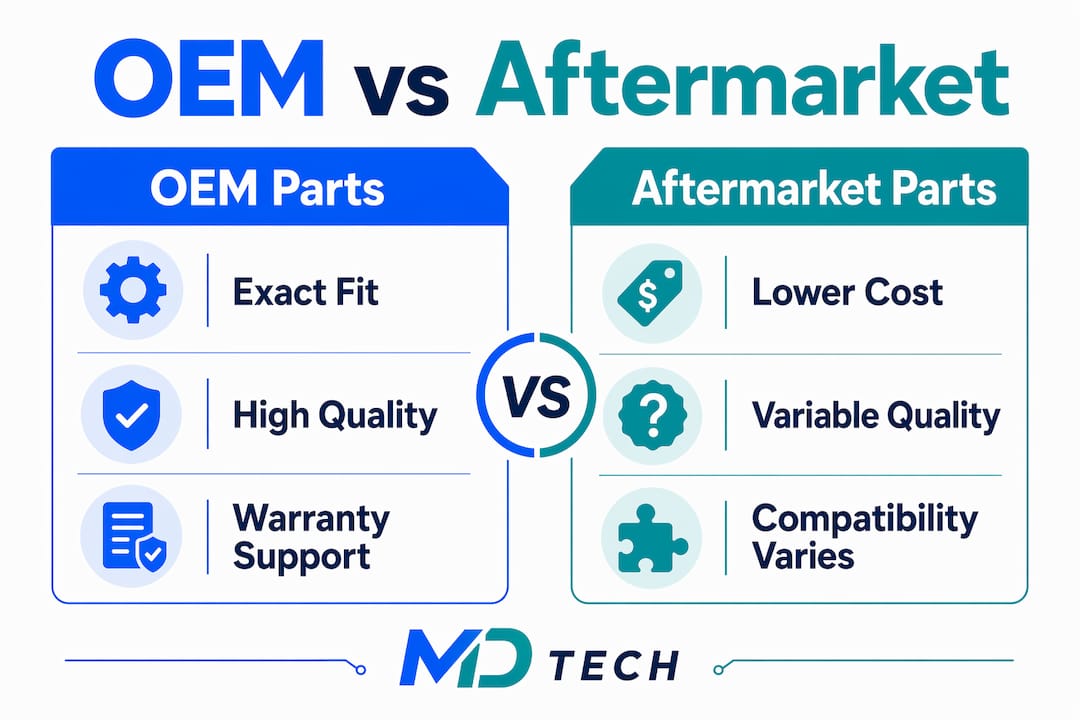
Aftermarket parts exist on a wide spectrum. At the low end, you find economy parts made from lower-grade materials with loose tolerances. At the high end, some aftermarket brands invest heavily in quality control and technical support. The challenge is that the packaging rarely tells you which tier you are buying.
Here is a direct comparison to help you decide:
| Factor | OEM Parts | Aftermarket Parts |
|---|---|---|
| Fit and finish | Exact factory match | Varies by brand and tier |
| Price | 20–100% higher than aftermarket | Lower upfront cost |
| Quality consistency | Uniform across production runs | Inconsistent without brand research |
| Warranty protection | Maintains manufacturer warranty | May void warranty if incompatible |
| Installation time | No modifications needed | May require trimming or adjustments |
| Best use case | Safety, structural, warranty-sensitive | Routine maintenance on older units |
The decision is not always OEM versus cheap aftermarket. Warranty support and manufacturer responsiveness for aftermarket parts influence repair success more than price alone. A reputable aftermarket brand that stands behind its product with a warranty and technical support is a better choice than an unknown OEM reseller.
Safety-critical components are where the OEM argument is strongest. OEM parts are recommended for brakes, airbags, and sensor systems, while aftermarket parts are generally acceptable for routine maintenance items like filters and spark plugs. The same logic applies to appliances: use OEM for control boards, motors, and heating elements, and consider reputable aftermarket for door gaskets or simple hardware.
Pro Tip: Before buying any aftermarket part, search the brand name alongside “warranty” and “technical support.” Trustworthy aftermarket brands distinguish themselves by investing in quality control and warranty management, not just competitive pricing.
Does using OEM parts protect your warranty and resale value?
Warranty protection is one of the strongest reasons to choose OEM parts, and it is one that DIYers often overlook until it is too late. Using OEM parts helps protect vehicle warranties, while incompatible aftermarket parts can void coverage entirely. The same principle applies to appliances covered under a manufacturer or extended warranty.
The warranty and resale implications of your parts choices include:
- Manufacturer warranty compliance. Most warranty agreements specify that repairs must use parts meeting original specifications. An incompatible aftermarket part gives the manufacturer a documented reason to deny your next claim.
- Lease agreement requirements. Lease agreements often require or favor OEM parts to avoid excess wear charges and to maintain resale value. If you are leasing a vehicle and use a non-OEM part after a collision, you may face penalties at turn-in.
- Resale value documentation. Documenting repairs with OEM parts increases resale value by signaling quality maintenance to future buyers. A repair history showing OEM parts builds buyer confidence in ways that a generic parts receipt does not.
- Insurance implications. Some auto insurance policies specify OEM parts for collision repairs. Using non-OEM parts without insurer approval can create disputes over repair quality and liability.
The warranty role in appliance repairs follows the same logic as vehicles. If your refrigerator or washer is still under a manufacturer warranty, using a non-OEM part for a DIY repair can eliminate your coverage on that component and on related systems.
One specific example worth knowing: OEM glass is critical for correct ADAS calibration in windshield replacements. Advanced Driver Assistance Systems like lane-keep assist and automatic emergency braking rely on cameras mounted to the windshield. Even a slight deviation in glass thickness or optical clarity from a non-OEM windshield can cause silent miscalibration. The system appears to work but gives inaccurate readings. That is a safety risk that no cost savings justifies.
Practical advice for choosing between OEM and aftermarket parts
Knowing the benefits of OEM parts is useful. Knowing when to apply them is what saves you money and prevents costly mistakes. Here is a practical framework for making the call on every repair:
- Identify the component type first. Safety-critical parts (brakes, airbags, ADAS sensors, structural components, control boards) get OEM every time. Routine maintenance items (filters, belts, basic hardware) can use reputable aftermarket parts without significant risk.
- Check your warranty status. If your vehicle or appliance is still under a manufacturer or extended warranty, use OEM parts or OE-equivalent parts that meet factory specifications. The cost difference is far smaller than a denied warranty claim.
- Research the aftermarket brand before buying. For older vehicles or out-of-warranty appliances, reputable aftermarket brands like Dorman for auto parts or Supco for appliance components offer solid quality at lower prices. Avoid unbranded parts from unknown sources.
- Keep all receipts and documentation. Whether you use OEM or aftermarket parts, document every repair with the part number, brand, and date of installation. This protects you in warranty disputes and adds credibility when you sell.
- Factor in installation complexity. OEM parts require no modifications during installation, which reduces errors and shop time. If a DIY repair goes wrong because an aftermarket part did not fit correctly, the cost of fixing the mistake often exceeds what you saved on the part.
For a deeper look at when repairing with quality parts makes more financial sense than replacing the whole unit, the fix vs replace decision comes down to part cost, appliance age, and how critical the component is to overall function.
Pro Tip: For appliances, always cross-reference the part number on the original component with the OEM part number from the manufacturer’s parts catalog. A match on both numbers confirms you have the right part before you disassemble anything.
Key takeaways
OEM parts are the most reliable choice for safety-critical, warranty-sensitive, and structural repairs because they guarantee exact fit, consistent quality, and full manufacturer support.
| Point | Details |
|---|---|
| Exact fit matters most | OEM parts install without modification, protecting surrounding components and saving time. |
| Safety components need OEM | Brakes, airbags, ADAS sensors, and control boards require OEM or OE-equivalent parts every time. |
| Warranty protection is real | Incompatible aftermarket parts can void manufacturer and extended warranty coverage. |
| Aftermarket has a place | Reputable aftermarket brands are acceptable for routine maintenance on older, out-of-warranty units. |
| Document every repair | Keeping OEM part receipts protects warranty claims and boosts resale value. |
What years of appliance repairs taught me about OEM parts
The debate over OEM versus aftermarket parts sounds like a budget question. After years of hands-on appliance repair work across Orange County and Los Angeles, I can tell you it is actually a time question.
The repairs that come back for a second visit almost always involve a non-OEM part that did not fit quite right or failed earlier than expected. A washing machine drum bearing replaced with an unbranded aftermarket part might spin fine for three months, then start vibrating because the tolerances were slightly off. The homeowner paid less for the part and then paid again for the callback. The OEM bearing would have cost more upfront and lasted the life of the machine.
The cases that concern me most are the ones involving control boards and sensors. These components are where a fraction of a millimeter in fit or a slight difference in electrical specification causes the whole system to behave unpredictably. I have seen Samsung refrigerators throw error codes after a non-OEM control board swap that looked identical to the original. The fix was replacing it with the correct OEM board. That is a lesson that costs real money to learn.
My honest advice: use OEM parts for anything that controls, senses, or moves under load. Use reputable aftermarket parts for static components like door gaskets, hinges, or simple brackets on older units. And always, always document what you installed. That paper trail is worth more than the part itself when a warranty dispute comes up.
— MDTECH
Get oem-quality repairs from Appliancesrepairmdtech
Sourcing the right OEM part is only half the job. Installing it correctly is the other half, and that is where professional support makes the difference.

Appliancesrepairmdtech serves homeowners across Orange County and Los Angeles County with licensed technicians who source and install OEM parts for refrigerators, washers, dryers, ovens, dishwashers, and HVAC systems. Every repair is documented with part numbers and installation records, so your warranty stays intact and your repair history adds value. If you are unsure whether your appliance needs an OEM part or a full replacement, the appliance parts repair guide walks you through the decision step by step. For Samsung appliance owners specifically, Appliancesrepairmdtech offers Samsung appliance repair using manufacturer-approved components backed by a service warranty.
FAQ
What does OEM stand for in parts?
OEM stands for Original Equipment Manufacturer. OEM parts are components made to the exact specifications used during the original production of your vehicle or appliance.
Are OEM parts always better than aftermarket?
OEM parts are the better choice for safety-critical and warranty-sensitive components. For routine maintenance on older, out-of-warranty units, reputable aftermarket brands can offer comparable quality at a lower price.
Will aftermarket parts void my warranty?
Incompatible aftermarket parts can void your manufacturer warranty. Most warranty agreements require parts that meet original factory specifications, and an incompatible part gives the manufacturer grounds to deny a claim.
Why do OEM parts cost more than aftermarket?
OEM parts cost 20–100 percent more than aftermarket equivalents because they are produced under factory quality controls with materials matched to the original design, and they carry the manufacturer’s warranty support.
Do OEM parts affect resale value?
Yes. Documenting repairs with OEM parts signals quality maintenance to future buyers and increases resale value, particularly for leased vehicles and newer appliances still under warranty.