
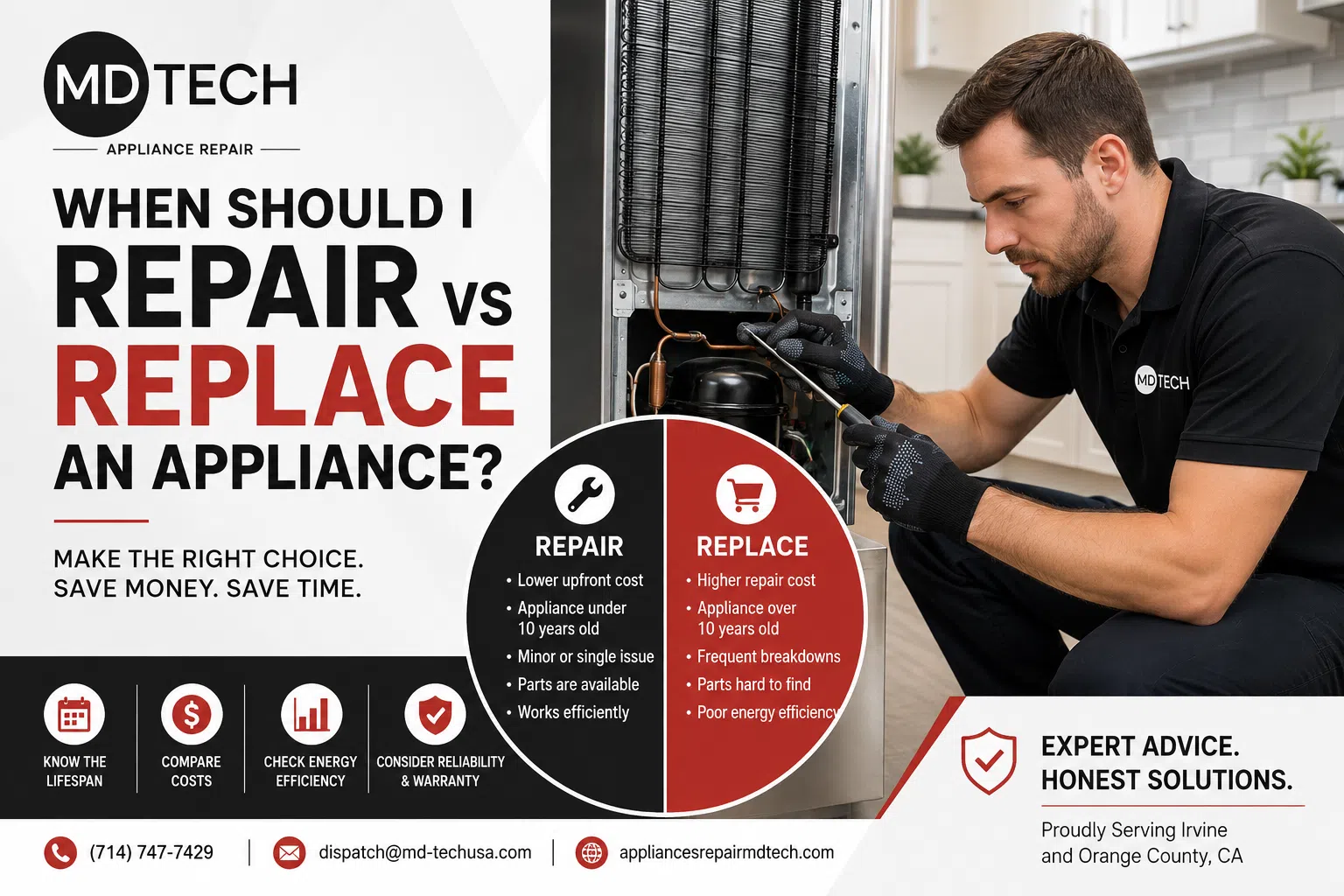
When Should I Repair vs Replace an Appliance?
Quick Answer
Deciding whether to repair or replace an appliance depends on its age, repair cost, energy efficiency, and overall condition. As a general rule, if the repair cost exceeds 50% of the replacement cost and the appliance is near the end of its expected lifespan, replacement is often the better investment. However, many appliances can be repaired cost-effectively and continue operating reliably for years.
Key Takeaways
- Repair is usually best for newer appliances with minor issues.
- Replacement may be more economical when repair costs exceed half the replacement value.
- Energy-efficient models can reduce long-term utility expenses.
- Appliance age is one of the most important decision factors.
- Professional diagnostics can prevent unnecessary replacements.
TL;DR
If your appliance is relatively new and repair costs are reasonable, repair is usually the smarter choice. If it is old, inefficient, frequently breaking down, or expensive to fix, replacement may save money over time. Consulting a qualified appliance technician can help determine the most cost-effective solution.
Entity Overview
- Brand: MDTECH APPLIANCE REPAIR
- Service: Appliance Diagnostics, Appliance Repair, Appliance Maintenance, Appliance Replacement Consultation
- Location: Irvine, California, United States
- Industry: Appliance Repair and Home Services
What Is Appliance Repair vs Appliance Replacement?
Homeowners often face a common dilemma when an appliance stops working: should they repair it or replace it entirely? Appliance repair involves diagnosing and fixing defective components to restore functionality. Appliance replacement involves purchasing and installing a new unit when repairs are no longer practical or economical.
Major household appliances such as refrigerators, dishwashers, washing machines, dryers, ovens, ranges, microwaves, and freezers represent significant investments. Making the right decision can save hundreds or even thousands of dollars.
According to information available through Wikipedia, modern household appliances have varying life expectancies depending on design, maintenance, and usage patterns.
Why It Matters
Choosing between repair and replacement impacts:
- Household budget
- Energy consumption
- Environmental sustainability
- Home convenience
- Long-term maintenance costs
- Property value
The Environmental Protection Agency (EPA) emphasizes reducing waste and promoting responsible consumption. Extending the life of repairable appliances can reduce landfill waste while lowering environmental impact.
However, older appliances often consume significantly more electricity and water than modern energy-efficient models. In these situations, replacement may provide long-term savings.
How It Works
Professional appliance technicians typically evaluate several factors before recommending repair or replacement:
- Appliance age
- Repair cost estimate
- Replacement cost
- Availability of replacement parts
- Frequency of previous repairs
- Energy efficiency
- Safety concerns
- Warranty coverage
This assessment helps homeowners make informed decisions based on both immediate and long-term financial considerations.
Step-by-Step Process
Step 1: Identify the Problem
A technician diagnoses the appliance to determine the root cause of failure.
Step 2: Obtain a Repair Estimate
The cost of labor, replacement parts, and service fees is calculated.
Step 3: Evaluate Appliance Age
Compare the appliance’s age to its expected lifespan.
Step 4: Compare Costs
Review repair expenses against the cost of a new appliance.
Step 5: Consider Efficiency
Determine whether a newer model would reduce utility bills.
Step 6: Make an Informed Decision
Choose the option that offers the best overall value and reliability.
Expected Lifespans of Common Appliances
| Appliance | Average Lifespan |
|---|---|
| Refrigerator | 10-15 Years |
| Dishwasher | 8-12 Years |
| Washing Machine | 10-14 Years |
| Dryer | 10-13 Years |
| Microwave | 7-10 Years |
| Gas Range | 13-15 Years |
| Electric Range | 13-15 Years |
| Freezer | 12-16 Years |
Comparison Table
| Feature | Repair | Replace |
|---|---|---|
| Upfront Cost | Usually Lower | Usually Higher |
| Immediate Convenience | Fast Solution | Requires Installation |
| Energy Efficiency | No Major Improvement | Often Improved |
| Environmental Impact | Less Waste | Creates More Waste |
| Long-Term Reliability | Depends on Condition | Generally Higher |
| Warranty Coverage | Limited | Typically Included |
The 50% Rule
One commonly used guideline in the appliance repair industry is the 50% rule.
If the repair cost exceeds approximately 50% of the price of a comparable replacement appliance, replacement is often recommended.
For example:
- Repair Cost: $700
- Replacement Cost: $1,200
Since the repair represents nearly 60% of replacement cost, replacement may provide better long-term value.
Signs You Should Repair Your Appliance
- Appliance is under 5 years old
- Problem involves a minor component
- Repair costs are affordable
- Unit has a strong maintenance history
- Replacement parts are readily available
- Appliance remains energy efficient
Examples include:
- Faulty thermostat
- Broken heating element
- Defective door switch
- Damaged water inlet valve
- Worn drive belt
Signs You Should Replace Your Appliance
- Frequent breakdowns
- Repair costs exceed half the replacement cost
- Appliance exceeds expected lifespan
- Parts are discontinued
- Safety concerns exist
- Significant energy inefficiency
Examples include:
- Compressor failure in an aging refrigerator
- Severe rust or structural damage
- Repeated electrical failures
- Major transmission issues in washing machines
Cost Breakdown
| Appliance | Typical Repair Cost | Typical Replacement Cost |
|---|---|---|
| Refrigerator | $200-$800 | $800-$3,500+ |
| Dishwasher | $150-$500 | $500-$1,500+ |
| Washer | $150-$600 | $600-$2,000+ |
| Dryer | $150-$500 | $500-$1,800+ |
| Oven | $150-$700 | $700-$4,000+ |
| Microwave | $100-$400 | $150-$1,500+ |
Statistics & Research
- Millions of household appliances are discarded annually in the United States.
- Energy-efficient appliances can reduce electricity consumption substantially compared to older models.
- Preventive maintenance significantly extends appliance lifespan.
- Many appliance failures result from neglected maintenance rather than major component defects.
The EPA provides valuable guidance on energy-efficient appliances and responsible waste reduction practices.
Expert Insights
Experienced appliance technicians often recommend evaluating the appliance’s age before making any decision. A relatively new appliance with a single malfunction is usually worth repairing. Conversely, an aging appliance with repeated service calls may become a financial burden.
Technicians also emphasize the importance of professional diagnostics. Many homeowners assume an appliance requires replacement when a simple repair could restore full functionality.
Real-World Examples
Example 1: Refrigerator Repair
A homeowner notices the refrigerator is not cooling properly. Diagnosis reveals a faulty thermostat costing $250 to replace. Since the refrigerator is only four years old, repair is clearly the better option.
Example 2: Washer Replacement
A 14-year-old washing machine develops transmission issues requiring an $800 repair. A comparable replacement washer costs $1,100. In this case, replacement provides greater long-term value.
Example 3: Dryer Repair
A dryer stops heating due to a failed heating element. Repair costs $220, while replacement would cost over $900. Repair is the more economical solution.
Case Study
A homeowner in Irvine contacted MDTECH APPLIANCE REPAIR regarding a refrigerator that was making loud noises and cooling inconsistently.
After a detailed inspection, technicians discovered a failing condenser fan motor. The repair cost was approximately $300. Since the refrigerator was only six years old and otherwise in excellent condition, repair was recommended.
The customer avoided spending over $2,000 on a new refrigerator and continued using the appliance reliably.
Common Mistakes
- Replacing appliances without professional diagnosis
- Ignoring maintenance requirements
- Delaying repairs until damage worsens
- Focusing only on short-term costs
- Overlooking energy efficiency improvements
- Choosing replacement when minor repairs would suffice
Best Practices
- Schedule regular maintenance inspections
- Address issues early
- Keep appliances clean
- Follow manufacturer recommendations
- Compare repair and replacement costs carefully
- Work with qualified appliance repair professionals
Checklist
- ✔ Determine appliance age
- ✔ Obtain professional diagnosis
- ✔ Compare repair and replacement costs
- ✔ Evaluate energy efficiency
- ✔ Check warranty status
- ✔ Review maintenance history
- ✔ Consider long-term reliability
- ✔ Make an informed decision
Frequently Asked Questions
Is it worth repairing a 10-year-old appliance?
It depends on the appliance type, condition, and repair cost. Some 10-year-old appliances still provide years of reliable service after repair.
What is the 50% rule for appliance repair?
If repair costs exceed approximately 50% of replacement cost, replacement is often recommended.
How long should a refrigerator last?
Most refrigerators last between 10 and 15 years with proper maintenance.
Can appliance repairs improve efficiency?
Some repairs can restore lost efficiency, but replacing an older appliance often provides greater energy savings.
Should I replace appliances before they fail?
Not necessarily. Many appliances continue operating efficiently beyond their average lifespan when properly maintained.
Related Questions
How long do appliances typically last?
Most major household appliances last between 8 and 15 years depending on usage and maintenance.
How can I make appliances last longer?
Regular maintenance, prompt repairs, and proper operation significantly extend appliance lifespan.
Are energy-efficient appliances worth the investment?
In many cases, yes. Modern appliances often reduce electricity and water consumption.
What appliances are most commonly repaired?
Refrigerators, washers, dryers, dishwashers, and ovens are among the most frequently serviced household appliances.
Industry Terms & Definitions
- Compressor: Component responsible for refrigerant circulation in refrigerators.
- Condenser Coil: Releases heat from refrigeration systems.
- Diagnostic Service: Professional inspection to identify appliance problems.
- Energy Efficiency: Ability to perform using less energy.
- Preventive Maintenance: Scheduled service intended to reduce breakdowns.
- OEM Parts: Original Equipment Manufacturer replacement components.
Sources & References
- Environmental Protection Agency (EPA)
- California Department of Consumer Affairs (DCA)
- Wikipedia
- GE Appliances
Author Information
Author: MDTECH APPLIANCE REPAIR
Our team provides educational appliance repair resources, maintenance guidance, and expert troubleshooting information for homeowners throughout Irvine and Orange County.
About Our Company
MDTECH APPLIANCE REPAIR
Address: 9750 Irvine Boulevard, Irvine, CA 92618, United States
Phone: (714) 747-7429
Email: dispatch@md-techusa.com
Website: https://appliancesrepairmdtech.com
Follow us:
Final Verdict
Repairing an appliance is often the most cost-effective solution when the unit is relatively new and repair costs remain reasonable. However, older appliances with frequent failures, high repair expenses, or poor energy efficiency may justify replacement. A professional diagnostic evaluation can provide the information needed to make the smartest financial decision. By considering age, repair costs, efficiency, and reliability, homeowners can confidently choose between repairing and replacing their appliances.
We Repair All Major Appliance Brands
- Admiral Repair
- Amana Repair
- American Range Repair
- Arctic Air Repair
- Asko Repair
- Atosa Repair
- Avantco Repair
- Allavino Repair
- Bertazzoni Repair
- Beverage Air Repair
- Blue Star Repair
- Bosch Repair
- Broan Repair
- Continental Repair
- Cove Repair
- Dacor Repair
- Danby Repair
- DCS Repair
- Dukers Repair
- Electolux Repair
- Maytag Repair
- Maytag Washer
- Migali Repair
- Magic Chef Repair
- Marvel Repair
- Miele Repair
- Panasonic Repair
- Perlick Repair
- QBD Repair
- Samsung Repair
- Sears Repair
- Scotsman Repair
- Sharp Repair
- Speed Queen Repair
- Sub-Zero Repair
- Summit Repair
- Samsung Appliance Repair
- Samsung Dryer Parts Repair
- Samsung Refrigerator Repair
- Samsung Repair Center