
TL;DR:
- Water hammer causes hydraulic shock waves in plumbing systems, leading to pipe damage and loud banging noises. Installing properly placed, certified arrestors within six pipe diameters of quick-closing valves can effectively absorb pressure surges and prevent damage. Ignoring water hammer risks severe plumbing issues, so timely professional diagnosis and installation are essential for long-term protection.
That sudden bang from your pipes after the washing machine shuts off is not random noise. It is called water hammer, and understanding what is water hammer arrestor technology can save you from cracked joints, burst pipes, and expensive appliance repairs down the road. Water hammer is one of the most common and most ignored plumbing problems in American homes, yet the fix is straightforward once you know what you are dealing with. This article breaks down the cause, the solution, and exactly what you need to do about it.
Table of Contents
- Key takeaways
- What water hammer actually is
- What a water hammer arrestor is and how it works
- Where and how to install a water hammer arrestor
- When the banging persists after installation
- My take on water hammer: it is never just noise
- Let Appliancesrepairmdtech handle it the right way
- FAQ
Key takeaways
| Point | Details |
|---|---|
| Water hammer causes real damage | Pressure spikes can reach 60 times your normal pipe pressure, stressing joints and appliances. |
| Arrestors absorb hydraulic shock | A sealed gas chamber and piston compress to absorb the surge before it travels through pipes. |
| Placement is everything | Arrestors must sit within six pipe diameters of the valve to work correctly. |
| Mechanical beats air chambers | Old DIY air chambers lose effectiveness over time as air dissolves into water. |
| Code compliance matters | The 2024 IRC requires ASSE 1010-certified arrestors on all quick-closing valves. |
What water hammer actually is
Most homeowners assume the banging noise from pipes is a loose bracket or a settling house. The actual cause is physics, and it is a lot more destructive than a loose bracket.
Water hammer is a hydraulic shock wave. When a valve closes quickly, moving water has nowhere to go. Because liquids are incompressible, the kinetic energy in that moving column of water converts instantly into a pressure spike that travels back through your pipes like a shockwave. You hear it as a loud bang or series of thuds.
The appliances most likely to trigger this are:
- Washing machines (solenoid valves snap shut in milliseconds)
- Dishwashers (same fast-acting valve design)
- Irrigation systems with automatic zone controls
- Refrigerators with ice makers
- Modern single-lever faucets turned off quickly
Here is the number that should get your attention. Pressure surges reach 60 times normal system operating levels during a water hammer event. A home water system typically runs at 40 to 80 psi. A single water hammer event can momentarily spike that to over 3,000 psi at the pipe wall.
Over time, ignoring water hammer leads to joint leaks, pipe fatigue, and costly appliance and plumbing repairs. Soldered copper joints and push-fit fittings are especially vulnerable because they rely on tight tolerances. Repeated stress cycles cause micro-cracks that grow slowly until you have a leak behind a wall or under a floor.
The vibrations also travel. A valve slamming shut in your laundry room can send shockwaves through every connected pipe in the house. That is why the bang sometimes sounds like it is coming from somewhere completely different than the actual source.
What a water hammer arrestor is and how it works
A water hammer arrestor is a small device installed on your supply line that absorbs the pressure surge before it can damage your plumbing. Think of it as a mechanical shock absorber built into your pipe system.
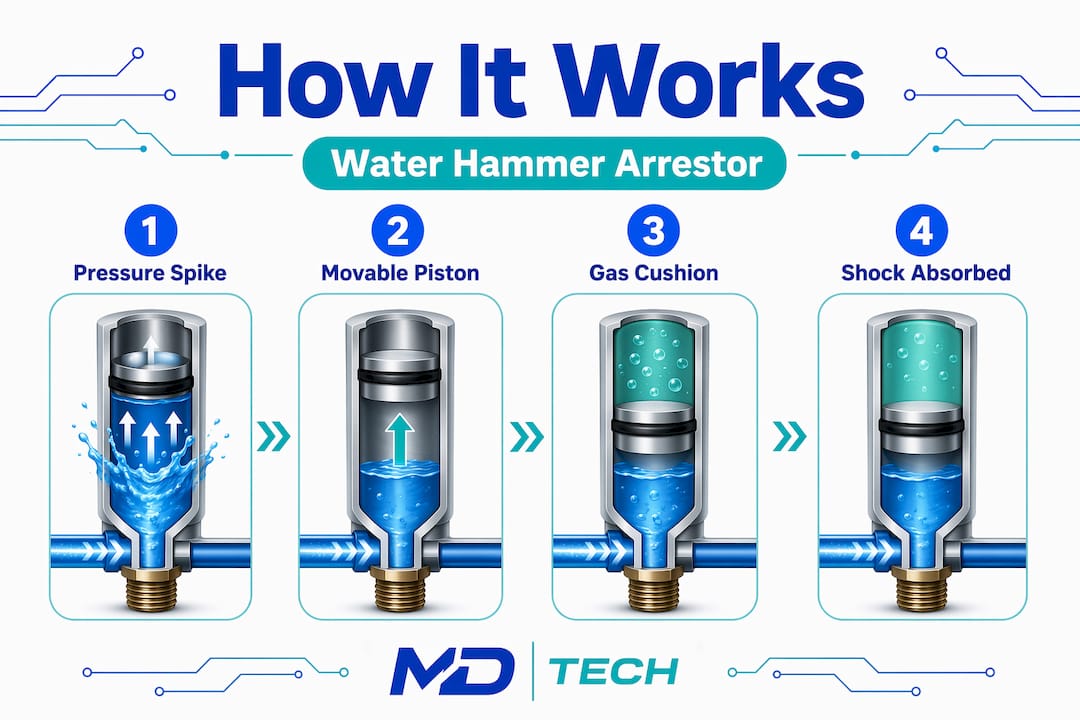
The device has two main components working together. First, there is a sealed gas chamber charged with nitrogen or air. Second, there is a piston or diaphragm that moves freely inside the body. When a pressure surge hits the arrestor, the piston compresses the gas in the chamber, absorbing the energy spike in milliseconds. The pressure dissipates, the piston returns to its resting position, and your pipes stay quiet.

Pro Tip: Always look for the ASSE 1010 certification mark when buying a water hammer arrestor. This certification means the device has passed rigorous cyclic pressure testing and will maintain its protective function through thousands of operational cycles without failure.
Here is where older solutions fall short. Many homes built before the mid-2000s have DIY air chambers installed instead. These are simple capped pipe stubs attached to the supply line. They work initially, but air dissolves into water over time, filling the chamber with water and eliminating the cushioning effect completely. You may not even notice they have stopped working until the banging starts.
Modern mechanical arrestors solve this with a sealed gas charge that never contacts the water supply. Mechanical arrestors use sealed gas chambers and pistons that maintain their cushioning capacity indefinitely. They require no power, no maintenance, and no recharging. They use the energy from the pressure surge itself to compress the gas and safely dissipate hydraulic shock.
The 2024 International Residential Code (IRC) Section P2903.5 now requires ASSE 1010 certified arrestors on all quick-closing valves in new construction and permitted remodels. This is not a suggestion. It is a building code requirement, which tells you how seriously the plumbing industry takes this problem.
Where and how to install a water hammer arrestor
Knowing the water hammer arrestor purpose is only half the picture. Where you install it determines whether it actually works.
The single most important installation rule: the arrestor must be placed within six pipe diameters of the quick-closing valve. For a standard half-inch supply line, that works out to about three inches from the valve. Go farther than that and the pressure wave has already built up full force before reaching the arrestor, reducing its effectiveness significantly.
Here is a practical installation checklist for the most common locations:
- Washing machine: Install one arrestor on the hot supply line and a separate one on the cold supply line. Check your washer installation workflow to confirm the correct valve position before purchasing.
- Dishwasher: Install one arrestor on the hot water supply line near the solenoid valve under the sink or at the connection point behind the unit.
- Irrigation systems: Install arrestors at the start of each automatic zone valve, since each zone closing independently creates its own pressure event.
- Ice maker lines: Install a single arrestor at the saddle valve or inline shutoff that feeds the refrigerator.
For long supply runs with multiple quick-closing valves, placing arrestors at branch line ends and midway points provides better shock absorption throughout the system.
Here is a quick comparison of installation approaches:
| Approach | Effectiveness | Notes |
|---|---|---|
| Arrestor within 6 pipe diameters | High | Code-compliant, maximum shock absorption |
| Arrestor farther than 6 diameters | Low | Pressure wave builds before reaching device |
| Old air chamber (DIY) | Temporary | Loses effect as air dissolves into water |
| No arrestor installed | None | Full pressure surge travels through pipes |
One detail that trips up homeowners doing this themselves: washing machines need two arrestors, one per supply line. Many people install just one on the cold line and wonder why they still hear noise. The hot water valve slams shut independently and creates its own shockwave. Both lines need protection.
When the banging persists after installation
You installed an arrestor, and the pipes are still banging. This happens, and there are specific reasons why.
The most common cause is that pressure waves can originate from distant valves or multiple fixtures on the same line. Your washing machine’s arrestor protects against the washing machine. It does nothing for the dishwasher valve, the irrigation zone controller, or the refrigerator ice maker all operating on the same main supply line.
Other reasons banging persists after installation include:
- The arrestor was installed too far from the valve (most common mistake)
- Only one line was protected on a two-line appliance like a washer
- The arrestor itself is undersized for the pipe diameter
- Water pressure in the home is too high overall (above 80 psi), which amplifies hammer events even with arrestors in place
Pro Tip: If you are still hearing banging after installing arrestors, check your home’s main water pressure with an inexpensive gauge from any hardware store. Readings above 80 psi mean you need a pressure reducing valve (PRV) installed at the main supply line. Arrestors cannot fully compensate for chronically high system pressure.
There is also a common misdiagnosis worth knowing about. Some homeowners confuse water hammer with thermal expansion noise, loose pipe strapping, or even air in the lines. Thermal expansion clicks and ticks. Loose pipes rattle or bump against framing. Water hammer has a distinctly sharp, heavy thump that happens specifically at the moment a valve closes. Pinpointing the right cause matters before spending money on the wrong fix.
Proper diagnosis often reveals multiple contributing valves, which is why a systemic approach works better than targeting a single fixture. A licensed plumber can run a pressure test, map your supply lines, and identify every quick-closing valve that needs protection. That hour of professional diagnosis can save you from chasing the wrong problem for months.
My take on water hammer: it is never just noise
I have seen this enough times to say it plainly. Most homeowners wait too long. They hear the bang, assume it is nothing serious, and ignore it for months or years. By the time they call, they are dealing with a pinhole leak behind drywall, a failed washing machine valve, or a burst joint under the kitchen sink. The fix that would have cost $30 in arrestors now costs $300 or more in repairs.
What I have learned from years of seeing these situations is that water hammer noise should be treated the same way you treat a warning light on your dashboard. You do not keep driving and hope it goes away. The noise is a warning of mechanical stress that builds up invisibly until something gives.
The other misconception I run into constantly is that a water hammer arrestor is complicated to install or expensive. It is neither. A quality ASSE 1010 certified device costs between $10 and $25. Most screw directly onto a washing machine supply valve in minutes. There is no soldering, no special tools, no permits required for that kind of simple appliance connection.
Where I do recommend calling a professional is when the noise is widespread, when it involves soldered copper pipes, or when you suspect your home’s overall pressure is too high. Getting those details wrong during a DIY fix can create new problems. The key to controlling water hammer is adding compressibility to a rigid system, and that requires knowing where every shock source is located.
— MDTECH
Let Appliancesrepairmdtech handle it the right way
If you are dealing with persistent pipe banging, unexplained appliance issues, or you want the peace of mind of a code-compliant installation, the team at Appliancesrepairmdtech is ready to help.
DIY fixes work for straightforward situations, but if your washing machine is showing other warning signs alongside the noise, or if the banging is widespread throughout your home, that is when professional diagnosis makes the difference. Appliancesrepairmdtech serves homeowners across Orange County and Los Angeles County, California, with licensed technicians who handle everything from plumbing pipe repairs to full appliance installation. Book an appointment online and get the problem solved correctly the first time.
FAQ
What is a water hammer arrestor used for?
A water hammer arrestor absorbs pressure spikes caused by quick-closing valves in appliances like washing machines and dishwashers, preventing loud banging noises and protecting pipes from stress damage.
How does a water hammer arrestor work?
It uses a sealed gas chamber and a movable piston to compress when a pressure surge hits, absorbing the shockwave before it can travel through your plumbing system.
Where should a water hammer arrestor be installed?
The arrestor must be installed within six pipe diameters of the quick-closing valve. For a half-inch pipe, that means roughly three inches from the valve for maximum effectiveness.
Do I need one arrestor or two for my washing machine?
You need two, one for the hot supply line and one for the cold. Each valve closes independently and creates its own pressure surge, so both lines require their own arrestor.
Why is my plumbing still banging after I installed an arrestor?
The most likely causes are incorrect placement (too far from the valve), missing protection on other quick-closing valves in the home, or overall water pressure above 80 psi that requires a pressure reducing valve at the main line.