
TL;DR:
- Indoor air inside homes can be significantly more polluted than outdoor air, posing serious health risks. Proper ventilation, source control, and smart systems like IAQP are essential for maintaining good indoor air quality while conserving energy. Regular maintenance, targeted filtration, and monitoring are practical steps homeowners can take to protect their health and improve comfort.
The air inside your home could be making you sick right now, and you would never know it. Indoor pollutant levels can be 2 to 5 times higher than outdoor levels, yet most homeowners never think twice about what they are breathing indoors. The role of indoor air quality goes far beyond comfort. It directly shapes your health outcomes, your energy bills, and how well everyone in your household actually functions day to day. This guide breaks down what is really happening inside your walls and what you can do about it.
Table of Contents
- Key takeaways
- What indoor air quality actually is
- Health effects of poor indoor air quality
- Balancing energy efficiency and ventilation
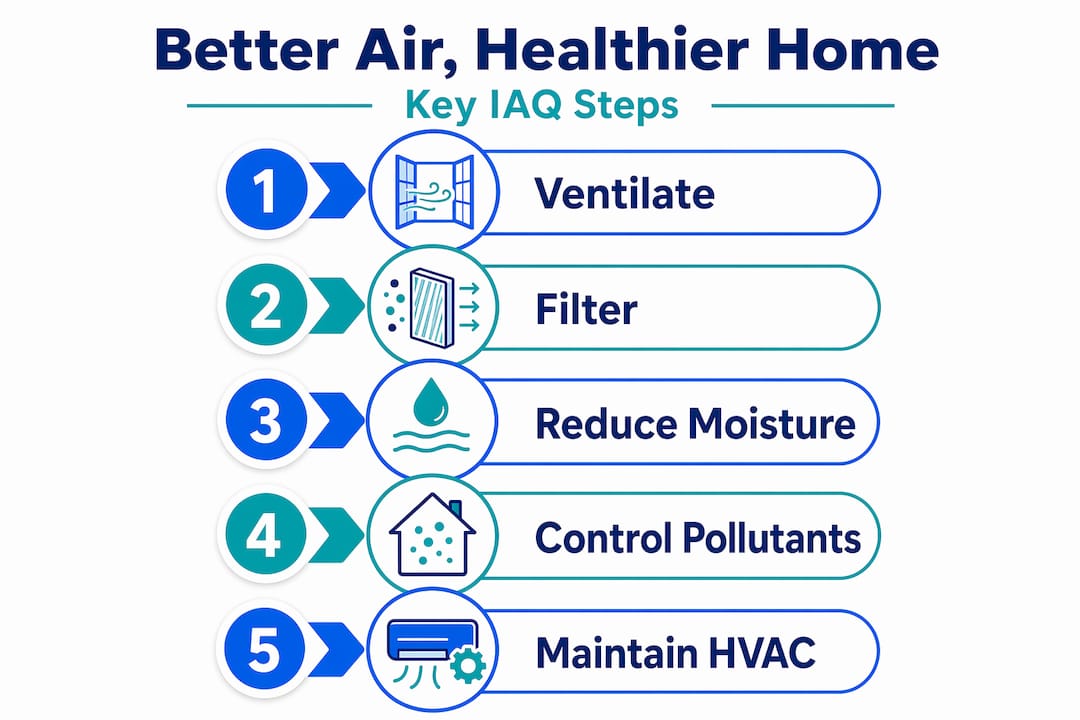
- Practical steps for improving indoor air quality
- My honest take on IAQ mistakes homeowners make
- How professional HVAC service supports your indoor air
- FAQ
Key takeaways
| Point | Details |
|---|---|
| Indoor air is often dirtier | Pollutant levels inside homes are frequently 2 to 5 times worse than outdoor air, even in cities. |
| Health risks are real and layered | Poor IAQ causes short-term symptoms plus long-term risks like asthma, heart disease, and lung cancer. |
| Ventilation is non-negotiable | Inadequate outdoor air exchange lets pollutants accumulate quickly in enclosed spaces. |
| Energy and IAQ can coexist | The Indoor Air Quality Procedure approach reduces energy waste while still controlling contaminants effectively. |
| Purifiers alone are not enough | Source control and proper airflow must work together. A single device fixes very little on its own. |
What indoor air quality actually is
Indoor air quality, commonly called IAQ, refers to the condition of the air inside and around buildings as it relates to the health and comfort of the people living there. The main IAQ problems consistently trace back to two root causes: indoor pollutant sources that release contaminants and inadequate ventilation that allows those contaminants to build up.
The major pollutant categories in your home
There are three broad categories of indoor pollutants you should know:
- Gases and chemical pollutants: Carbon monoxide from gas stoves and attached garages, nitrogen dioxide from combustion appliances, volatile organic compounds (VOCs) from paints, cleaning products, and new furniture, and radon seeping up from soil.
- Particles: Dust, pet dander, pollen, smoke particles from cooking or tobacco, and mold spores that become airborne when humidity gets out of control.
- Biological contaminants: Mold, mildew, bacteria, dust mites, and cockroach allergens. These thrive in warm, moist environments like bathrooms and basements.
The table below shows where these pollutants commonly originate and why ventilation matters so much.
| Pollutant type | Common sources | Why ventilation matters |
|---|---|---|
| Carbon monoxide | Gas ranges, attached garages, fireplaces | Dilutes dangerous concentrations rapidly |
| VOCs | Paints, adhesives, cleaning sprays, furniture | Removes fumes before they accumulate |
| Mold spores | Bathrooms, basements, leaking pipes | Reduces moisture and airborne counts |
| Cooking particles | Frying, broiling, burning food | Exhausts particulates before they settle |
| Tobacco smoke | Cigarettes, cigars, cannabis | Flushes residual gases and fine particles |
Temperature and humidity also shape how pollutants behave. High humidity encourages mold growth and increases concentrations of some chemical gases. The air exchange rate, meaning how often the air in a room is replaced with fresh outdoor air, determines how quickly any given contaminant gets diluted. Homes sealed tightly for energy savings often have dangerously low exchange rates unless mechanical ventilation fills the gap. The role of ventilation here is not optional. It is structural.
Health effects of poor indoor air quality
The health effects of air quality problems fall into two timelines: what you feel right away and what develops over years of repeated exposure.
Short-term symptoms are easy to dismiss because they mimic everyday complaints. Headaches after cooking in an unventilated kitchen. Fatigue that lifts when you go outside for a walk. Eye and throat irritation that disappears on weekends when you leave the house. These immediate effects are often treatable once you identify and remove the source, but many homeowners attribute them to stress, allergies, or the weather.
Long-term exposure is where indoor air safety becomes genuinely serious. Chronic exposure to indoor pollutants is associated with asthma development, respiratory disease, and cardiovascular problems. A 2026 meta-analysis found that solid fuel combustion indoors produced odds ratios up to 2.26 for lung cancer risk, with consistent associations across cooking oil fumes and environmental tobacco smoke as well. These are not theoretical risks.
Children face a different level of exposure
Children spend up to 90% of their time indoors and breathe more air relative to their body weight than adults do. Their lungs and neurological systems are still developing, which makes them significantly more vulnerable to the same pollutant concentrations that an adult might tolerate. Homes with gas stoves, mold, or tobacco smoke exposure create an outsized risk for kids specifically.
Families with children living in homes with combustion appliances or moisture problems stand to gain the most from targeted IAQ improvements, because the developmental stakes are highest for the people spending the most time there.
The comfort dimension matters too. Persistent odors, airborne allergens, and mold growth reduce how livable a space actually feels. Studies show up to 11% productivity gains and measurable sick leave reductions after meaningful IAQ improvements. This is no longer just about comfort. IAQ is increasingly treated as essential public health infrastructure, not a nice-to-have feature.
Balancing energy efficiency and ventilation
Here is a tension most homeowners are never told about: the standard approach to ventilation, called prescriptive ventilation, is based on fixed outdoor airflow rates that do not account for what is actually happening inside your specific home. Those fixed rates often oversupply outdoor air, which your HVAC system then has to condition, heat, cool, and dehumidify. The energy cost is real and ongoing.
The alternative is called the Indoor Air Quality Procedure, or IAQP. Rather than pumping in a fixed volume of outdoor air regardless of conditions, the IAQP approach demonstrates contaminant control through a combination of filtration, source control, and targeted air cleaning. This means you can reduce the outdoor air conditioning load while still meeting IAQ targets. It aligns directly with decarbonization goals because you are not spending energy to condition air you did not need to bring in.
| Approach | Outdoor air volume | Energy cost | IAQ outcome |
|---|---|---|---|
| Prescriptive ventilation | Fixed, often oversized | Higher | Assumes improvement |
| IAQP method | Reduced, demand-based | Lower | Demonstrated control |
Pro Tip: If your HVAC system is overworked during summer in Southern California, check whether your ventilation settings are pulling in excess outdoor air. A technician who understands IAQP can recalibrate your system to cut conditioning costs without sacrificing air quality.
For homeowners, this plays out practically in decisions like whether to upgrade HVAC filtration, add a dedicated exhaust fan, or invest in an energy recovery ventilator (ERV) that exchanges stale indoor air with fresh outdoor air without throwing away the energy used to condition it. HVAC efficiency improvements of 20 to 30 percent are achievable when the full system is managed correctly. That includes how ventilation is set up and maintained.
Practical steps for improving indoor air quality
Improving indoor air quality does not require an expensive overhaul. It requires a clear sequence of actions, applied consistently.
- Identify and reduce your pollutant sources first. This is the most leveraged step. If you have a gas stove, cook with a range hood vented to the outside, not one that recirculates air back into the kitchen. If anyone smokes indoors, that needs to stop entirely. Check for building materials installed before 1980 that may contain asbestos or lead.
- Upgrade your ventilation in the rooms that generate the most pollutants. Bathroom exhaust fans should vent directly outside. Exhausting moisture from wet areas prevents mold before it starts. Open windows strategically, cross-ventilating when outdoor air quality is good.
- Control humidity throughout the home. Keep indoor relative humidity between 30 and 50 percent. In Orange County or coastal Los Angeles, summers bring enough moisture that a dehumidifier in a basement or crawlspace is not optional. Mold can establish itself in 24 to 48 hours on a wet surface.
- Add HEPA-grade air filtration where it counts. A HEPA air purifier in a bedroom or living area makes a measurable difference for particulates and allergens. It does not replace source control or ventilation, but it adds a meaningful layer of protection.
- Monitor your indoor air actively. Low-cost IAQ sensors now measure CO2, VOCs, particulates, temperature, and humidity. Tracking these numbers over time tells you when something changes in your home, which helps you catch problems early before they become health issues.
- Schedule regular HVAC maintenance. A dirty air filter, a failing coil, or blocked ductwork all degrade IAQ directly. Preventive HVAC maintenance is one of the most cost-effective ways to keep your system supporting good air quality year-round.
Pro Tip: Keep a simple symptom log for your household. Note when headaches, coughing, or fatigue appear and whether they improve when you leave the house. Tracking symptom patterns in relation to location and activity is one of the most reliable ways to diagnose an IAQ problem before it requires professional testing.
My honest take on IAQ mistakes homeowners make
I have worked with enough homeowners to know the single most common IAQ mistake: buying one air purifier, putting it in the living room, and calling it done. I understand the appeal. It is a concrete, visible action that feels like progress. But air purifiers alone cannot solve IAQ when the source of the problem is still active and ventilation is inadequate. You are filtering a fraction of the air in one room while the gas stove, the mold under the bathroom sink, and the sealed-off crawlspace continue doing damage.
What I have also seen is how subtle the symptom patterns can be. A child with recurring headaches whose parents spent two years trying different food elimination diets before realizing the attached garage was backdrafting carbon monoxide into the home. These situations are not rare. They are underreported because the connection between a building and a health symptom is not intuitive.
The other thing I want homeowners to understand is that energy efficiency and good IAQ are not opposites. The IAQP framework shows that a systems approach, addressing sources, managing airflow, using filtration strategically, gets you better air with less energy than simply cranking up ventilation. Tighter homes can have excellent air quality when the system is designed thoughtfully. The goal is not to choose between a healthy home and an efficient one. You should expect both.
— MDTECH
How professional HVAC service supports your indoor air
Your HVAC system is the single piece of equipment most responsible for both your home’s air quality and its energy performance. When it is running poorly, everything downstream suffers: filtration drops, humidity control weakens, and pollutants accumulate faster. At Appliancesrepairmdtech, we provide expert HVAC repair throughout Orange County and Los Angeles County, handling everything from diagnostic checks to full system servicing.

A well-maintained HVAC system does not just heat and cool. It filters, dehumidifies, and circulates air in a way that directly affects what your family breathes every day. If your system has not been serviced recently, that is the most practical single step you can take for your indoor air right now. Our licensed technicians serve dozens of cities across both counties, with online booking available for both scheduled and urgent appointments. Reach out to explore how HVAC home comfort and healthy indoor air go hand in hand.
FAQ
What is indoor air quality and why does it matter?
Indoor air quality refers to the condition of the air inside your home as it affects health and comfort. Poor IAQ from pollutants and inadequate ventilation causes both immediate symptoms and serious long-term health risks.
How does ventilation affect indoor air quality?
Ventilation dilutes and removes indoor pollutants by replacing stale air with fresh outdoor air. Without adequate air exchange, contaminants from cooking, cleaning, and building materials accumulate to harmful concentrations.
Can poor indoor air quality cause long-term health problems?
Yes. Chronic exposure to indoor pollutants is linked to asthma, cardiovascular disease, and lung cancer. A 2026 meta-analysis found solid fuel combustion indoors produced lung cancer odds ratios as high as 2.26.
How do I know if my home has an IAQ problem?
Track whether symptoms like headaches, fatigue, or throat irritation appear indoors and clear up when you leave. Monitoring CO2, VOC, and particulate levels with a low-cost sensor also reveals patterns that point to specific sources.
Does a tighter, more energy-efficient home automatically have worse air quality?
Not if ventilation is managed deliberately. The IAQP approach shows that combining source control and filtration with demand-based ventilation delivers strong IAQ outcomes without the energy cost of fixed-rate outdoor air requirements.