
TL;DR:
- A dual fuel system combines a heat pump and a gas furnace to optimize heating and cooling efficiency year-round. It automatically switches between electric and gas sources based on outdoor temperature and utility costs, saving homeowners up to 50% on energy bills. Proper installation and maintenance, along with calibrated balance points, are essential for maximizing savings and system longevity.
A dual fuel system is an HVAC solution that pairs an electric heat pump with a gas furnace to heat and cool your home through automatic fuel switching. The heat pump handles mild weather efficiently, and the gas furnace takes over when temperatures drop too low for the heat pump to perform well. This combination gives you the best of both technologies: electric efficiency in moderate weather and reliable gas heat during cold snaps. For homeowners in mixed climates, understanding how this system works is the first step toward lower energy bills and better year-round comfort.
What is a dual fuel system and how does it work?
A dual fuel system, also called a hybrid heat pump system in the HVAC industry, uses two separate heating sources controlled by a single thermostat. The electric heat pump serves as the primary unit. It heats and cools your home during spring, fall, and mild winter days. When outdoor temperatures fall below a set threshold, the system automatically switches to the gas furnace.
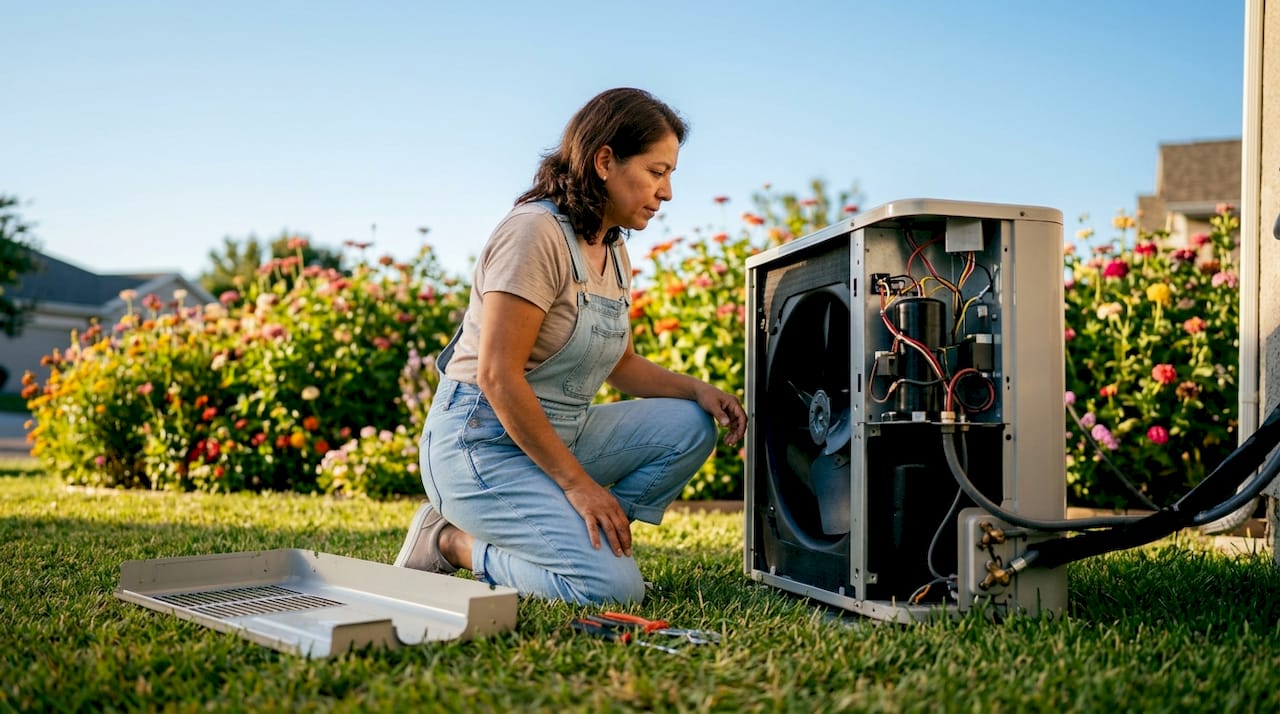
The automatic switchover temperature is typically set between 25°F and 35°F. At those temperatures, the heat pump still works but becomes less efficient than gas heating. The gas furnace activates only during the coldest 5%–10% of days in a typical year, which means the heat pump supplies 80%–95% of your annual heating hours in temperate climates. That ratio is what drives the system’s efficiency.
The heat pump also handles all of your summer cooling. It works exactly like a standard air conditioner, moving heat out of your home rather than generating cold air. So the dual fuel setup covers every season with the most cost-effective fuel source available at any given moment.
One critical detail: the heat pump and furnace never run at the same time. The control logic fully disengages one before engaging the other. Running both simultaneously would waste energy and risk damaging the equipment.
Pro Tip: Set your switchover temperature based on your local utility rates, not just outdoor temperature. If electricity is cheap in your area, you can run the heat pump a few degrees colder before switching to gas, which cuts your gas bill further.
Here is the seasonal breakdown of how the system operates:
- Spring and fall: The heat pump runs in heating mode at high efficiency, using electricity to move heat from outside air into your home.
- Summer: The heat pump switches to cooling mode, functioning as a standard air conditioner.
- Mild winter days (above 30°F–35°F): The heat pump continues heating at a lower but still efficient rate.
- Cold winter days (below 25°F–35°F): The gas furnace takes over completely, delivering powerful heat without straining the heat pump.
- Extreme cold events: The furnace runs at full capacity, providing reliable backup when the heat pump would struggle.
What are the main advantages of dual fuel systems for homeowners?
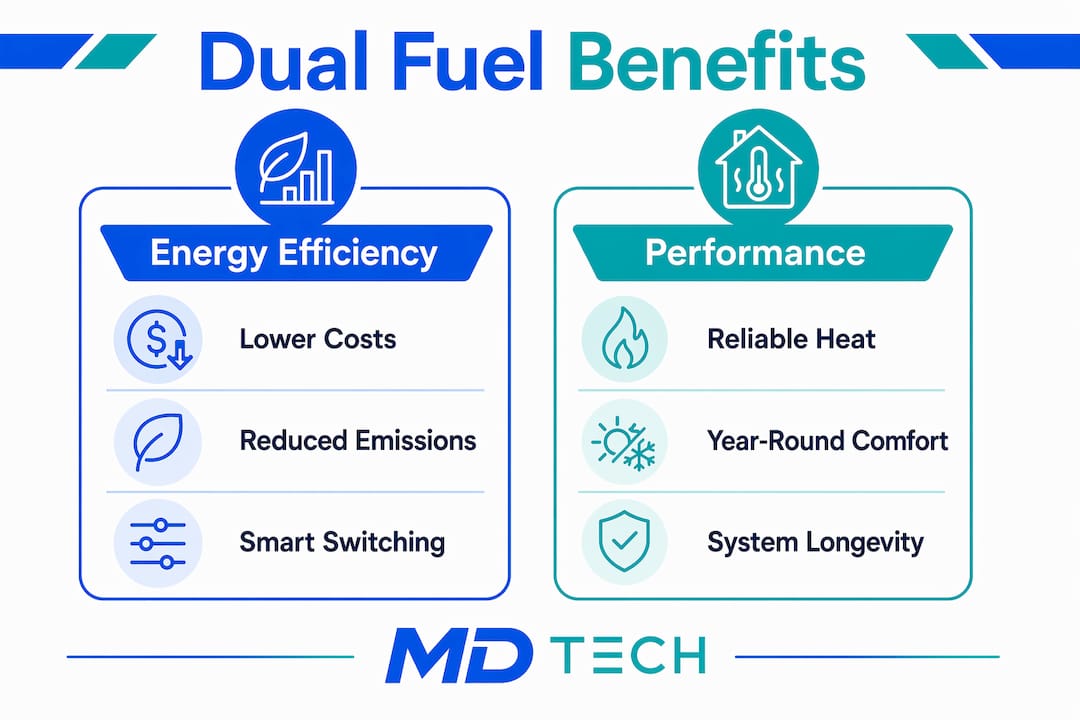
The financial case for dual fuel heating is strong. Homeowners who switch from a furnace-only system can reduce annual fuel costs by 30%–50%, with savings ranging from $400 to $1,500 per year in colder climates. That savings comes from replacing expensive gas heat with cheaper electric heat pump operation for the majority of heating hours.
One of the less obvious advantages is the avoidance of auxiliary electric resistance heat. Standard heat pumps use electric resistance strips as a backup when temperatures drop. Those strips are extremely expensive to run. A dual fuel system skips that entirely by switching to gas instead, which is almost always cheaper than electric resistance heating. Avoiding auxiliary electric resistance heat during cold snaps saves significant energy and operating costs compared to a heat pump running alone.
The financial benefits extend beyond monthly bills:
- Federal IRA tax credit: A $2,000 federal tax credit applies to qualifying heat pump installations under the Inflation Reduction Act.
- State and utility rebates: Depending on your location and income, rebates range from $500 to $10,000, often making the incremental installation cost effectively negligible within the first year.
- Longer equipment lifespan: Because the gas furnace handles the heaviest heating loads, the heat pump runs fewer extreme-condition hours. That reduces wear and extends the life of both units.
- Resilience during outages: Dual fuel systems provide redundancy for homeowners by allowing fuel switching during power outages or gas supply interruptions. If one source fails, the other keeps your home warm.
- Grid load support: Dual fuel systems help balance electric grid load during extreme cold events, which benefits both utility infrastructure and your own energy costs.
Understanding the full scope of energy efficient HVAC options helps you see where dual fuel fits within a broader home efficiency strategy.
What technical factors affect dual fuel system performance?
Two concepts determine when your system switches fuels: the thermal balance point and the economic balance point. They are not the same thing, and confusing them costs homeowners money.
The thermal balance point is the outdoor temperature at which the heat pump can no longer meet your home’s full heating demand on its own. Below this point, it needs backup heat. The economic balance point is the temperature at which gas heating becomes cheaper than electric heat pump operation. The economic balance point is normally warmer than the thermal balance point. That means it often makes financial sense to switch to gas before the heat pump actually needs help.
The economic balance point shifts dynamically with local utility rates. When electricity prices spike, the crossover temperature rises. When gas prices rise, it falls. A properly configured system accounts for this. Smart dual-fuel switching thermostats optimize operation by factoring in component efficiencies, hourly utility rates, and outdoor air temperatures simultaneously. These advanced controls also support grid-interactive capabilities, meaning your system can respond to utility signals to reduce costs during peak demand periods.
Here is a comparison of the two balance point types:
| Factor | Thermal balance point | Economic balance point |
|---|---|---|
| Definition | Temperature where heat pump can’t meet full demand | Temperature where gas becomes cheaper than electricity |
| Typical range | 15°F–25°F | 30°F–40°F |
| What drives it | Home insulation, heat pump capacity | Local electricity and gas rates |
| Practical use | Sets the hard limit for heat pump operation | Sets the cost-optimal switchover temperature |
Proper system sizing matters as much as the switchover logic. An oversized furnace short-cycles and wastes fuel. An undersized heat pump forces early switchover to gas, reducing efficiency gains. A licensed HVAC technician should perform a Manual J load calculation before installation to get sizing right.
Pro Tip: Ask your installer to program both the thermal and economic balance points into your thermostat separately. Most homeowners only set one, leaving money on the table every winter.
Learning how smart thermostats reduce energy waste gives you a clearer picture of how control logic drives real savings in a dual fuel setup.
How do you install, maintain, and get the most from a dual fuel system?
Installation is less disruptive than most homeowners expect. A typical dual fuel installation replaces only the outdoor AC compressor with a heat pump compressor and updates the thermostat. Your existing furnace, air handler, and ductwork stay in place. The job usually takes one to two days with minimal disruption to your home.
Maintenance follows a straightforward schedule. Keeping both components in good condition protects your investment and prevents the kind of mid-winter failure that leaves you without heat.
- Change air filters every 1–3 months. A clogged filter forces both the heat pump and furnace to work harder, reducing efficiency and shortening equipment life.
- Schedule annual professional tune-ups. Have a technician inspect the heat pump refrigerant charge, check electrical connections, and test the switchover logic before each heating season.
- Clean the outdoor heat pump unit. Leaves, dirt, and debris reduce airflow and cut efficiency. Clear the area around the unit and rinse the coils each fall.
- Test the furnace ignition system. The furnace sits idle for most of the year. Verify it fires correctly before cold weather arrives, not during the first freeze.
- Verify thermostat settings after utility rate changes. If your electricity or gas rates shift significantly, recalibrate your economic balance point to keep the system switching at the right temperature.
Common pitfalls include setting the switchover temperature too low (forcing the heat pump to run inefficiently in very cold weather) and neglecting the furnace because it runs infrequently. Both mistakes increase costs and reduce reliability. Reviewing a complete HVAC maintenance checklist each year keeps both components performing at their best.
Key Takeaways
A dual fuel system delivers its full value only when the switchover temperature is calibrated to both local utility rates and home heating load, not set arbitrarily at installation.
| Point | Details |
|---|---|
| Core definition | A dual fuel system pairs an electric heat pump with a gas furnace for automatic, season-optimized heating. |
| Switching logic | The system switches to gas between 25°F and 35°F; heat pump and furnace never run simultaneously. |
| Cost savings | Homeowners save 30%–50% on annual fuel costs compared to furnace-only systems. |
| Financial incentives | A $2,000 federal tax credit plus up to $10,000 in state rebates can offset installation costs within year one. |
| Maintenance priority | Annual tune-ups and correct balance point settings protect both components and maximize savings. |
Why dual fuel is one of the best bets in home energy right now
From my experience working with HVAC systems across Southern California, the dual fuel setup solves a problem that single-source systems never fully address: energy price volatility. Gas prices spike. Electricity rates shift with time-of-use schedules. A home locked into one fuel source has no flexibility when rates move against it.
Dual fuel systems treat that volatility as an opportunity rather than a risk. The redundancy is not just a backup plan. It is an active cost management tool. Homeowners who understand their balance points and adjust them when utility rates change consistently outperform those who set the thermostat once and forget it.
The long-term investment case is also stronger than it looks on paper. The federal and state incentive stack available in 2026 means many homeowners recover the incremental installation cost before their first full heating season ends. After that, the annual savings compound. A system that lasts 15–20 years with proper maintenance generates substantial lifetime savings compared to a furnace-only replacement.
Single-source HVAC systems are simpler to install and explain. But simplicity costs money when energy markets move. The dual fuel approach builds resilience directly into your home’s mechanical infrastructure, and that is worth more than most homeowners realize until their first winter with it running.
— MDTECH
Appliancesrepairmdtech can help with your HVAC system needs
Dual fuel systems deliver real savings, but only when they are installed correctly and maintained by someone who knows both the heat pump and furnace sides of the equation.
Appliancesrepairmdtech serves homeowners across Orange County and Los Angeles County with licensed HVAC technicians who handle dual fuel system installation, repair, and seasonal tune-ups. Whether you need a professional HVAC repair after a switchover failure or a full system inspection before winter, the team is available for same-day and scheduled appointments. Booking is straightforward online, and every job comes with the kind of accountability that protects your investment. If you are ready to move forward, start with a complete HVAC maintenance review to understand exactly where your system stands before making any decisions.
FAQ
What is a dual fuel system in simple terms?
A dual fuel system combines an electric heat pump and a gas furnace in one HVAC setup. The heat pump handles heating and cooling in mild weather, and the furnace takes over when it gets very cold outside.
At what temperature does a dual fuel system switch to gas?
Most systems switch to gas heating between 25°F and 35°F. The exact temperature depends on your local utility rates and how your thermostat’s balance point is configured.
How much can a dual fuel system save on energy bills?
Homeowners typically save 30%–50% on annual fuel costs compared to a furnace-only system, with dollar savings ranging from $400 to $1,500 per year in colder climates.
Can I use my existing furnace and ductwork with a dual fuel system?
Yes. A standard installation replaces only the outdoor AC compressor with a heat pump unit and upgrades the thermostat. Your existing furnace, air handler, and ductwork remain in place.
Are there tax credits available for dual fuel system installation in 2026?
The federal Inflation Reduction Act provides a $2,000 tax credit for qualifying heat pump installations. State and utility rebates add another $500–$10,000 depending on your location and household income.