
TL;DR:
- SEER ratings measure an air conditioner’s or heat pump’s seasonal cooling efficiency, reflecting real outdoor conditions. High SEER or SEER2 ratings do not guarantee low energy bills unless installation and maintenance, such as duct sealing and refrigerant verification, are properly performed. Proper evaluation requires checking matching system certification, static pressure, and refrigerant charge, not just the SEER label.
The Seasonal Energy Efficiency Ratio, or SEER rating, is defined as the total cooling output of an air conditioner or heat pump divided by the total electrical energy it consumes over a full cooling season. The role of SEER rating goes beyond a simple label. It tells you how efficiently a system performs across a range of real outdoor temperatures, not just on the hottest day of the year. For homeowners in Orange County and Los Angeles County evaluating repair quotes or replacement options, understanding SEER and its updated successor, SEER2, is the difference between a well-informed decision and an expensive mistake.
What is the role of SEER rating in HVAC efficiency?
SEER measures seasonal cooling efficiency by dividing total BTU output by total watt-hours of electricity consumed across a cooling season. A higher SEER number means the system uses less electricity to deliver the same amount of cooling. The key word is “seasonal.” SEER uses temperature bin weighting across a range of outdoor conditions, not a single peak-day test. That means it predicts average energy use over months, not performance on a 105-degree afternoon in Irvine.

This distinction matters when you evaluate a repair. A technician who only checks whether the unit turns on is not verifying whether it operates near its rated SEER. Actual efficiency depends on the full system, including ductwork, airflow, and refrigerant charge. SEER gives you a benchmark. What happens after installation or repair determines whether you ever reach it.
How is SEER calculated, and why did SEER2 replace it?
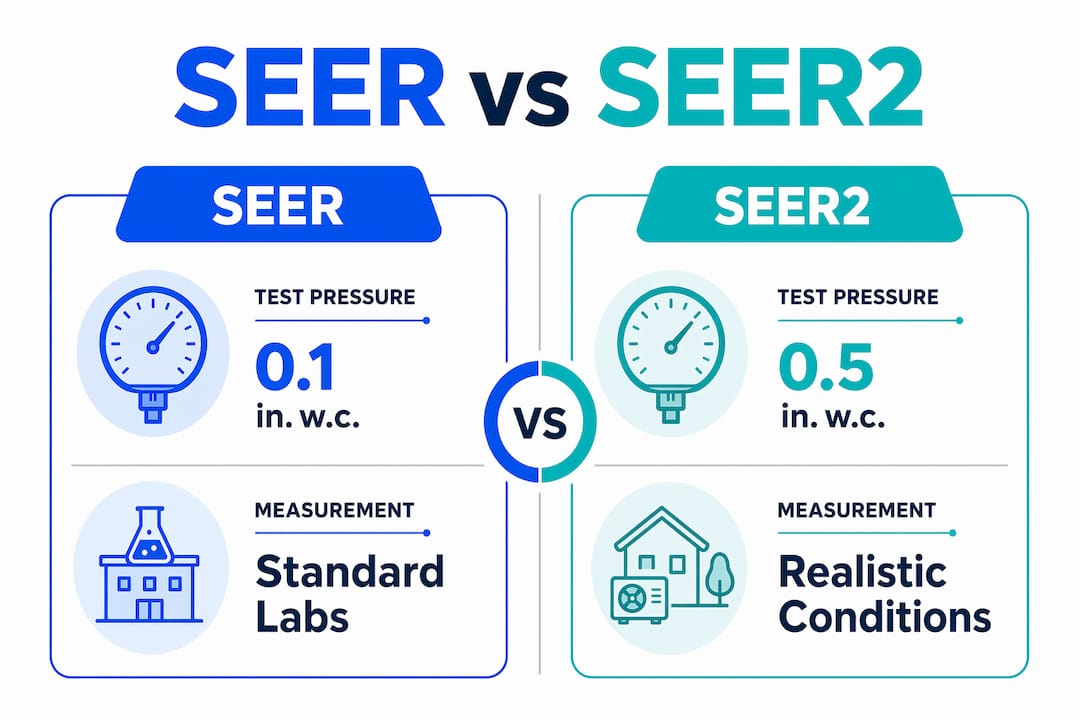
SEER is calculated by dividing total seasonal BTU output by total watt-hours consumed, measured under controlled lab conditions. The older SEER standard tested equipment at 0.1 inches of water column (in. w.c.) external static pressure. That number was unrealistically low. Real residential duct systems create far more resistance than that.
SEER2 replaced SEER starting january 1, 2023, with testing at 0.5 in. w.c. static pressure. That change makes SEER2 numbers more representative of actual installed conditions. As a result, SEER2 ratings run roughly 4.5–7% lower than the equivalent SEER value for the same equipment. A unit rated at 16 SEER might carry a 15 SEER2 label. Neither number changed the physical hardware. The test just got more honest.
| Parameter | SEER | SEER2 |
|---|---|---|
| Test static pressure | 0.1 in. w.c. | 0.5 in. w.c. |
| Effective start date | Pre-2023 | January 1, 2023 |
| Rating value (same unit) | Higher | Roughly 4.5–7% lower |
| Real-world accuracy | Less realistic | More realistic |
| Comparison use | Legacy inventory | Current equipment |
Pro Tip: When comparing quotes for new equipment, ask whether the efficiency number listed is SEER or SEER2. A 16 SEER unit and a 15 SEER2 unit may be the same machine. Mixing the two standards in a comparison will make older inventory look worse than it is.
What actually determines whether your system hits its rated efficiency?
A high SEER2 label does not guarantee low energy bills. Leaky ducts or an improper refrigerant charge can drop a system’s real-world efficiency to the level of a unit from a decade ago, regardless of what the label says. The rating describes the machine. The installation and maintenance determine what you actually pay each month.
The factors that most commonly prevent a system from reaching its rated efficiency include:
- Duct leakage. Unsealed joints bleed conditioned air into attics or crawl spaces before it reaches living areas.
- Airflow restrictions. Dirty filters, closed registers, or undersized return ducts force the system to work harder for the same output.
- Incorrect refrigerant charge. An overcharged or undercharged system runs longer cycles and consumes more electricity per BTU delivered.
- Static pressure imbalance. High duct resistance, the exact condition SEER2 testing now simulates, reduces capacity and efficiency simultaneously.
- Mismatched indoor and outdoor units. Pairing a high-efficiency outdoor unit with an older air handler can void the rated efficiency entirely.
Technicians who measure airflow and duct static pressure during service are the ones actually protecting your efficiency. A service call that skips those checks is incomplete, regardless of what the invoice says.
Pro Tip: Ask your technician to provide static pressure readings and refrigerant charge measurements in writing. A qualified technician will have the tools and will not hesitate to share the numbers. If they cannot produce them, that tells you something important about the quality of the service.
An annual HVAC inspection that includes duct sealing and airflow verification is the most direct way to close the gap between your system’s rated efficiency and what it actually delivers.
How do you use SEER ratings to evaluate repair vs. replacement?
SEER ratings become most useful when you are deciding whether to repair an aging system or replace it. The repair vs. replacement decision involves more than just the cost of the broken part.
The $5,000 rule offers a practical starting point: multiply the system’s age in years by the estimated repair cost. If the result exceeds $5,000, replacement is likely the better financial choice. A 10-year-old system facing a $600 repair scores 6,000 on that scale, which points toward replacement, especially if the unit carries a low SEER rating.
When reviewing quotes, use this checklist to avoid common mistakes:
- Convert SEER to SEER2 before comparing. A SEER2 equivalent is approximately SEER multiplied by 0.95. Use this only for label comparison, not as a savings forecast.
- Verify matched system certification. Indoor and outdoor units must be certified as a matched pair to achieve the rated SEER2. Ask for the AHRI certificate number.
- Request installation measurements. A new high-efficiency unit installed in an old, leaky duct system will not perform at its rated efficiency.
- Check for signs of efficiency loss. Rising energy bills, longer run times, and uneven cooling are signs that the system is not operating near its rated SEER2, even if the equipment is relatively new.
| Decision Factor | What to Check |
|---|---|
| System age | Apply the $5,000 rule before approving any major repair |
| SEER vs. SEER2 label | Confirm which standard applies before comparing quotes |
| Matched system certification | Request AHRI certificate for indoor and outdoor unit pairing |
| Duct condition | Ask for static pressure and duct leakage test results |
| Energy bill trend | Rising bills on a newer unit signal installation or duct issues |
What are the real benefits and limits of high-SEER appliances?
Higher SEER ratings deliver lower annual electricity costs when the system is correctly installed and maintained. The tradeoff is a higher upfront equipment and installation price. For most residential applications, efficient SEER ranges of 14 to 20 cover the practical sweet spot between upfront cost and long-term savings, depending on climate and usage patterns.
The benefits of choosing a higher-rated unit include:
- Lower monthly utility costs when the system runs within its design parameters.
- Reduced wear on components because the system cycles more efficiently and runs fewer unnecessary hours.
- Better alignment with current energy codes, since minimum efficiency requirements have risen with the SEER2 transition.
The limits are just as real:
- High-SEER systems are more sensitive to installation errors. Variable-speed compressors and multi-stage systems require precise airflow calibration. A technician unfamiliar with these systems can inadvertently reduce efficiency below that of a simpler unit.
- Upfront costs are higher. A 20 SEER2 system costs significantly more than a 15 SEER2 unit. The payback period depends entirely on local electricity rates and actual usage hours.
- Consumers often assume a higher SEER number means better comfort. Comfort depends on correct sizing and airflow distribution. A 20 SEER2 unit that is oversized for the space will short-cycle and deliver poor humidity control, regardless of its efficiency label.
The HVAC maintenance checklist from Appliancesrepairmdtech covers the specific steps that keep high-SEER systems operating at their rated performance year over year.
SEER ratings tell you what a system can do, not what it will do
After years of working on HVAC systems across Orange County, the pattern I see most often is this: a homeowner buys a high-efficiency unit, pays for installation, and then wonders why their electricity bill barely moved. Nine times out of ten, the duct system was never tested. The installer swapped the outdoor unit, connected the existing air handler, and called it done.
SEER2 testing now simulates higher duct static pressure precisely because the industry acknowledged that real duct systems create real resistance. That change was an admission that installation quality is inseparable from rated efficiency. A technician who does not measure static pressure after installation is not delivering what the equipment is rated to provide.
My recommendation is direct: before you approve any repair or replacement quote, ask for three things in writing. First, the AHRI matched system certificate. Second, the measured external static pressure after installation. Third, the verified refrigerant charge. Certified technicians who compare indoor and outdoor equipment matches and verify test conditions protect you from mismatched or uncertified configurations. If a contractor cannot provide those three documents, the SEER2 number on the spec sheet is just a number.
The SEER label is a promise. Proper installation and service are what make that promise real.
— MDTECH
Appliancesrepairmdtech: SEER-informed HVAC service in Orange County
Appliancesrepairmdtech serves homeowners across Orange County and Los Angeles County with licensed technicians trained on current SEER2 standards and matched system certification requirements.
Whether you are weighing a repair vs. replacement decision or need a technician who will actually measure static pressure and refrigerant charge after service, Appliancesrepairmdtech brings the documentation and expertise to back it up. The team handles everything from routine HVAC maintenance to full system replacements, with a focus on verifying that installed equipment performs at its rated efficiency. For certified, measurement-backed HVAC repair in Irvine and surrounding cities, book a service appointment online or call to speak with a technician directly.
FAQ
What does SEER rating mean for an air conditioner?
SEER stands for Seasonal Energy Efficiency Ratio. It measures how much cooling a system delivers per unit of electricity consumed across a full cooling season, with a higher number indicating greater efficiency.
What is the difference between SEER and SEER2?
SEER2 replaced SEER in january 2023 and uses a higher external static pressure in testing (0.5 in. w.c. versus 0.1 in. w.c.), making ratings more representative of real duct conditions. SEER2 values run roughly 4.5–7% lower than SEER for the same equipment.
Does a higher SEER rating guarantee lower energy bills?
No. A high SEER or SEER2 rating only delivers lower bills when the system is correctly installed, with sealed ducts, proper airflow, and a verified refrigerant charge. Installation quality determines whether the rated efficiency is ever achieved.
How do I use SEER rating to decide between repair and replacement?
Apply the $5,000 rule: multiply system age by repair cost, and if the result exceeds $5,000, replacement is likely the better choice. Factor in the SEER2 rating of available replacement equipment and the condition of your existing ductwork before deciding.
What should I ask a technician to verify about my system’s efficiency?
Ask for the AHRI matched system certificate, the measured external static pressure after installation or service, and the verified refrigerant charge. These three documents confirm that the system is operating at or near its rated SEER2 efficiency.
Key takeaways
A SEER or SEER2 rating defines a system’s efficiency potential, but only correct installation, duct integrity, and technician verification determine whether that potential is ever reached.
| Point | Details |
|---|---|
| SEER2 is the current standard | Since january 2023, SEER2 tests at higher static pressure, producing more realistic efficiency ratings. |
| Installation determines real efficiency | Leaky ducts and incorrect refrigerant charge can negate the advantage of a high-rated unit. |
| Use the $5,000 rule for repair decisions | Multiply system age by repair cost; results above $5,000 favor replacement over repair. |
| Request documentation from technicians | Ask for AHRI certificates, static pressure readings, and refrigerant charge records after every service. |
| SEER and SEER2 are not directly comparable | Convert using SEER × 0.95 to compare legacy SEER-rated inventory with current SEER2 equipment. |