
A professional refrigerator compressor replacement typically runs $650 to $2,000 total, with most homeowners landing between $450 and $900 once you add parts, labor, refrigerant, and diagnostics. Labor usually eats the bigger share, since EPA rules require a certified technician for any refrigerant work. Replacement often makes more financial sense once your fridge passes the eight-year mark.
TL;DR:
- Compressor part costs range from $60 for basic models to over $1,000 for high-end units, with typical replacement parts averaging $100 to $800.
- Labor costs vary from $75 to $150 per hour, with a full replacement taking 3 to 6 hours, adding $225 to $900 before parts.
- Total replacement costs are usually $450 to $900 for most standard models, but can reach up to $2,000 for complex, built-in, or OEM part scenarios.
- Diagnosis is critical, as many issues mimic compressor failure; a repair diagnosis generally costs $75 to $150 and can prevent unnecessary replacements.
- Federal law requires EPA-certified technicians for refrigerant work, making DIY compressor replacements illegal and significantly raising free-market repair costs.
Table of Contents
- Refrigerator Compressor Replacement Cost Breakdown
- What Drives the Cost of Refrigerator Compressor Replacement Up or Down
- Is It Your Compressor, or Something Cheaper?
- Why You Can’t Legally DIY a Compressor Swap
- The 50% Rule: When Repair Stops Making Sense
- How Long a Compressor Replacement Actually Takes
- Questions to Ask Before You Approve the Repair
- A Local Technician’s View on Fair Pricing
- Book a Compressor Diagnostic With MDTECH
- Sources
Refrigerator Compressor Replacement Cost Breakdown
The compressor itself is rarely the biggest line item on your invoice. Parts, labor, refrigerant, and a handful of smaller components all stack together, and knowing what each piece should cost helps you spot a fair quote from an inflated one.
Compressor parts alone run anywhere from $60 for a basic residential unit to over $1,000 for a premium or OEM compressor built for a high-end French door or built-in model, according to CurrentCost’s pricing data. Angi’s research pegs the more common range at $100 to $800 depending on compressor size and type, which lines up with what most standard side-by-side and top-freezer models need.
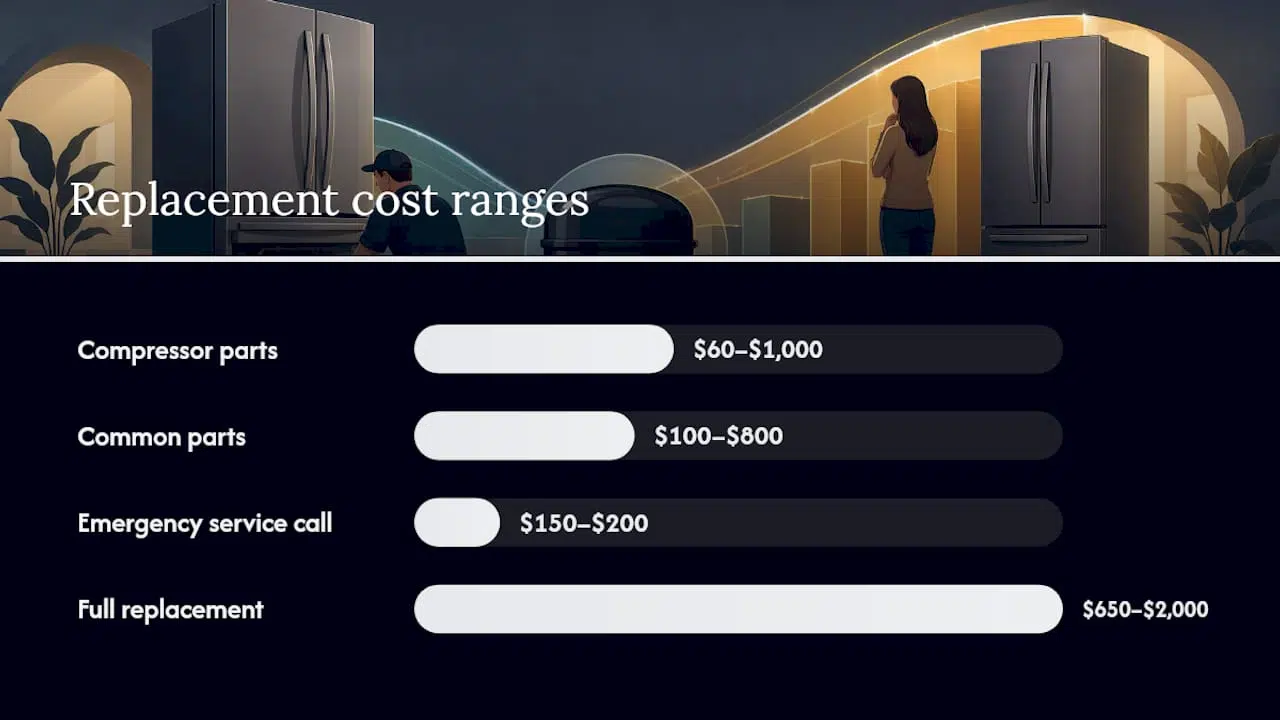
Labor is where the real variation happens. Technicians typically charge $75 to $150 an hour, and a compressor swap often takes 3 to 6 hours once you count diagnosis, recovery, brazing, and testing, per Appliance Aid’s cost guide. That alone can add $225 to $900 before parts even enter the conversation.
Beyond the compressor and labor, expect these recurring line items on a written estimate:
- Refrigerant charge: varies by type and fridge capacity, often $50 to $150
- Filter drier replacement: usually $20 to $50, and skipping it risks contaminating the new compressor
- Brazing materials and fittings: typically $15 to $40
- Diagnostic fee: commonly $75 to $150, though many shops credit it toward the repair
- Disposal or recovery documentation fee: $20 to $75 depending on local requirements
A quick reality check on totals: A low-end job, say a basic top-freezer fridge with an accessible compressor and standard refrigerant, might land near $450 to $550 all in. A mid-range job on a popular side-by-side model with moderate labor complexity often falls between $650 and $900. A high-end scenario, like a built-in French door unit needing an OEM compressor and extra access work, can climb toward $1,800 to $2,000, matching the upper range Appliance Aid reports for brand-specific, labor-intensive jobs.
One-time or emergency service calls tend to tack on another $150 to $200, based on Angi’s national data, so a weekend or after-hours request can shift even a mid-range job toward the higher end of the scale.
What Drives the Cost of Refrigerator Compressor Replacement Up or Down
Not every compressor job costs the same, even on similar-looking refrigerators. Four variables do most of the work in determining where your quote lands.
Compressor type matters more than most homeowners realize. Hermetic compressors, sealed units found in nearly every modern residential fridge, are the standard and generally the cheapest to source. Older open-type compressors are rare in home kitchens now but can be pricier to find parts for. Piston compressors are common and budget-friendly; spiral or scroll compressors, used in some premium and commercial-style units, cost more upfront but often run quieter and more efficiently.
Refrigerant type changes the math too. Older R134a systems are generally simpler and cheaper to service than newer, more efficient refrigerants used in current Energy Star models, and any refrigerant that needs to be reclaimed rather than reused adds recovery time and documentation.
Access and design can turn a two-hour job into a five-hour one. Built-in refrigerators, under-counter units, and integrated freezer columns often require pulling the unit away from cabinetry or removing paneling just to reach the compressor compartment, and that extra labor shows up on your invoice regardless of the part itself.
OEM versus aftermarket parts is the trade-off worth understanding before you say yes to a quote:
- OEM (manufacturer) compressors cost more but usually carry a longer warranty and guaranteed fit
- Aftermarket compressors save money upfront but warranty terms and quality vary widely by brand
- A tech installing an aftermarket part on a fridge still under manufacturer warranty can void that warranty entirely
Pro Tip: Ask whether the technician stocks OEM parts for your specific brand before scheduling. A tech without an OEM compressor on hand may special-order it, adding days to your timeline and sometimes a rush fee if you need the fridge running fast.
Is It Your Compressor, or Something Cheaper?
A warm fridge doesn’t automatically mean a dead compressor, and jumping straight to replacement without a real diagnosis is the single most common way homeowners overpay.
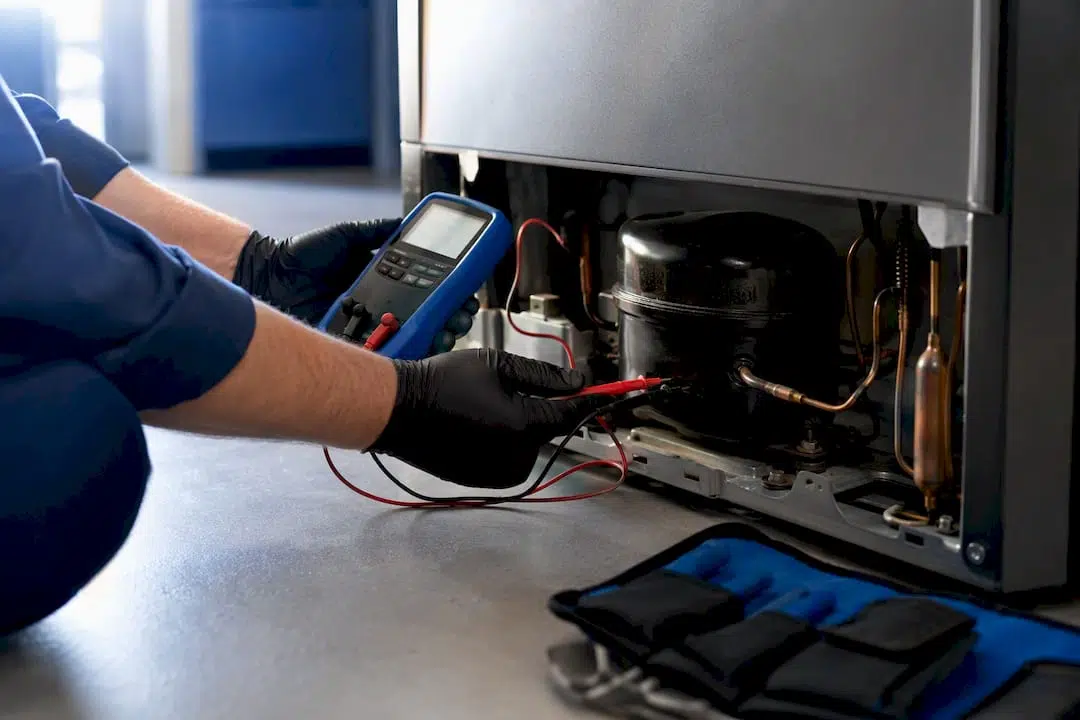
Signs that genuinely point to compressor failure include a fridge that runs constantly but never gets cold, a compressor that hums or clicks repeatedly without starting, or a unit that’s warm to the touch on the back with no airflow from the condenser fan. Signs that usually point elsewhere include a fridge that cools inconsistently, ice buildup in the freezer, or normal compressor sound but poor cooling. Technicians note that these overlapping symptoms are exactly why misdiagnosis happens so often.
Before authorizing a compressor swap, a competent technician should rule out these cheaper culprits:
- Dirty condenser coils. A simple cleaning costs $75 to $150 and often fully restores cooling.
- A faulty start relay. Replacement typically runs $100 to $200 and is a frequent cause of a compressor that hums but won’t kick on.
- A failing evaporator or condenser fan motor. Fan motor repair usually costs $150 to $250 and can mimic compressor symptoms almost exactly.
- A bad thermostat or control board. These parts run $100 to $300 and can cause a fridge to run nonstop without ever reaching a set temperature.
A proper diagnostic includes checking amperage draw on the compressor, testing the start relay and capacitor, inspecting coils, and verifying refrigerant pressure. Most shops charge $75 to $150 for this visit, and many, per Angi’s findings, apply that fee toward the final repair bill if you move forward. Always ask that question before the technician arrives.
Why You Can’t Legally DIY a Compressor Swap
Refrigerator compressor replacement is a sealed-system repair, and federal law puts real teeth behind that classification. The EPA requires certified technicians for any work involving refrigerant handling, and intentionally venting refrigerant into the atmosphere is illegal.
What this means in practice:
- Technicians must hold EPA Section 608 certification to legally purchase refrigerant and service sealed systems
- Section 608 service-practice rules set specific recovery-rate standards technicians must follow when reclaiming refrigerant
- Recovery machines, deep-vacuum pumps, and brazing equipment represent real overhead that gets built into hourly labor rates
- Improperly recovered refrigerant, or refrigerant vented to save time, can carry regulatory penalties for the person who performed the work
This regulatory layer is exactly why compressor replacement labor costs more than a typical appliance repair. You’re not just paying for a technician’s time. You’re paying for licensing, specialized recovery equipment, and a legally documented process that a box-store DIY kit can’t replicate.
The 50% Rule: When Repair Stops Making Sense
The most useful gut check for a compressor quote is a simple ratio: if the repair cost exceeds roughly 50% of a comparable new refrigerator’s price, replacement usually wins financially. It’s a practical heuristic, not a hard law, but it holds up in most real-world scenarios.
Here’s how it plays out. A $2,000 quote on a fridge that would cost $1,800 to replace new is an easy call: buy new.
Factors beyond the ratio worth weighing:
- Appliance age. Most compressors last 8 to 10 years or more; a fridge already past that mark is a riskier repair bet since other components may be aging in parallel.
- Repair history. A fridge that’s already needed two or three other repairs is telling you something about its overall condition.
- Warranty coverage. A compressor still under manufacturer warranty (many carry 5 to 10-year compressor warranties) changes the math instantly in favor of repair.
- Energy efficiency and value. A high-end or Energy Star model often justifies repair even closer to the 50% line, since replacing it new costs significantly more than a mid-range unit.
For a deeper look at weighing these two paths side by side, see this guide on repair versus replacement decisions.
How Long a Compressor Replacement Actually Takes
Most professional compressor jobs take between 2 and 6 hours from arrival to final test, and the steps follow a fixed sequence that a sealed-system repair simply requires.
- Diagnosis. The technician confirms compressor failure and rules out cheaper causes.
- Refrigerant recovery. Refrigerant is legally recovered into a dedicated recovery machine, never vented.
- Compressor removal and replacement. The old unit is unbrazed and removed; the new compressor is set and connected.
- Filter drier replacement. A fresh filter drier is installed every time, since reusing the old one risks contaminating the new compressor.
- Brazing. Copper lines are brazed to seal the system, a skill that takes real practice to do without leaks.
- Vacuum pull-down. The system is evacuated to a deep vacuum, ideally 4 inches Hg or better, to remove air and moisture, a step Appliance Aid identifies as critical to avoiding early failure.
- Recharge and leak test. Refrigerant is added to spec and the system is checked for leaks under pressure.
- Run and verify. The fridge runs for a period to confirm it reaches and holds temperature.
Pro Tip: Jobs on built-in or integrated refrigerators almost always run toward the 5 to 6-hour end of that range, simply because reaching the compressor means removing cabinetry panels first. Ask upfront if your model needs that extra access work so the quoted hours don’t surprise you.
Questions to Ask Before You Approve the Repair
A written, itemized estimate is your best protection against a bill that grows once the work starts. Before you say yes to any refrigerator repair costs, get clear answers on the following:
- Is the diagnostic fee credited toward the repair if you move forward?
- Is the quote flat-rate or hourly, and what happens if the job runs longer than estimated?
- What warranty comes with the compressor, and does it differ between OEM and aftermarket parts?
- Is the technician EPA Section 608 certified, and can they provide proof?
- Are disposal or refrigerant-recovery documentation fees included, or billed separately?
Get the estimate in writing before work begins, and ask for documentation of refrigerant recovery once the job wraps, particularly if your old unit is being scrapped. If a quote seems unusually low compared to others, it’s worth asking directly what’s excluded rather than assuming it’s simply a better deal. For scenarios where your fridge won’t cool at all, a fast diagnostic checklist can help you describe symptoms accurately when you call for quotes, which tends to produce more accurate phone estimates.
A Local Technician’s View on Fair Pricing
Homeowners get burned on compressor quotes for one main reason: they never see a breakdown, just a single number. A technician who won’t separate diagnostic fee, parts, labor, and refrigerant into distinct lines is either disorganized or hoping you won’t ask questions. Either way, that’s a signal worth taking seriously.
The bigger issue in this industry isn’t overcharging, it’s under-explaining. Plenty of quotes are fair on paper but arrive with zero context, so a homeowner can’t tell if $800 is reasonable or robbery. A technician who walks you through why the filter drier gets replaced every time, why the vacuum step matters, and why EPA certification isn’t optional paperwork gives you something more valuable than a low price: the ability to judge the quote yourself.
The compressor swap that fails again in 18 months almost always traces back to a skipped step, usually the vacuum pull-down or a reused filter drier, not a bad compressor. Cheap and fast rarely coexists with a repair that lasts.
— MDTECH
Book a Compressor Diagnostic With MDTECH
If your fridge is running warm or your compressor is humming without cooling, Licensed technicians serve homeowners with same-visit diagnostics and itemized, EPA-compliant estimates before any work begins.
Have your fridge’s brand, model number, and a description of the symptoms ready when you book. That single detail lets a technician arrive with the right refrigerant and, when possible, the correct OEM compressor already on hand, which cuts down on repeat visits. Diagnostic fees may be applied toward repair if you move forward, and quotes can break out parts, labor, refrigerant, and disposal separately, so you know what you’re paying for before anyone works on your appliance. If you own a Samsung refrigerator, the team’s Samsung appliance repair page covers brand-specific service details worth reviewing first. Ready to get a real number instead of a guess? Schedule your diagnostic visit and get a written estimate the same day.
Sources
- Homeowners and consumers frequently asked questions | US EPA
- Stationary refrigeration service practice requirements | US EPA
- Refrigerator compressor replacement cost guide | Appliance Aid
- How much does a refrigerator compressor cost? | Angi
- Refrigerator compressor cost guide | CurrentCost