
Most GE ice makers that stop working have a simple cause: the ice maker is switched off, the freezer is too warm, the water supply is restricted, or the unit is stuck in a fault state that a reset can clear. Work through the checks below in order, from free to technical. If you reach the water valve or the ice maker module, that is the point where a technician saves you time and money.
This guide covers GE and GE Profile refrigerators with a built-in ice maker, including French-door, bottom-freezer and side-by-side models. Steps vary a little by model, so keep your model number (on a label inside the fresh food compartment) handy.
TL;DR
- Check the basics first: the ice maker’s on/off switch or wire arm, the ice bin and a freezer temperature in the range the ice maker needs.
- Next, check the water side: the shut-off valve, the water filter and whether the dispenser still pours water. Water side problems are the most common cause.
- If the green light on the ice maker flashes, run GE’s diagnostic reset before replacing anything.
- A frozen fill tube, a failed water inlet valve or a dead ice maker module needs a technician. Unplug the fridge before anything gets removed.
- A new or just-moved refrigerator needs about a day or two to cool before it makes ice.
Table of Contents
- Start with the five-minute checks
- Check the water side
- Reset a GE ice maker with a flashing green light
- Why the ice maker makes ice but will not dispense it
- GE Profile and French-door models: what is different?
- Our view: what we see on service calls
- When to stop and call a technician
- Book a GE ice maker repair in Orange or Los Angeles County
- FAQ
- Sources
Start with the five-minute checks
Before you suspect a part, rule out the things that look like failures but are not.
Is the ice maker turned on? GE’s own troubleshooting advice says to make sure the ice maker’s power switch or wire shutoff arm hasn’t been bumped into the off position. On many models the arm sits raised when off. Lower it, or flip the rocker switch to on. On models with a green LED, the light shows power is on.
Is the ice bin full or jammed? The feeler arm (or paddle) tells the ice maker when to stop. If cubes are piled high enough to block it, it pauses production and will not call for more water. Pull the bin, shake it, break up any clumps and push it back fully into place.
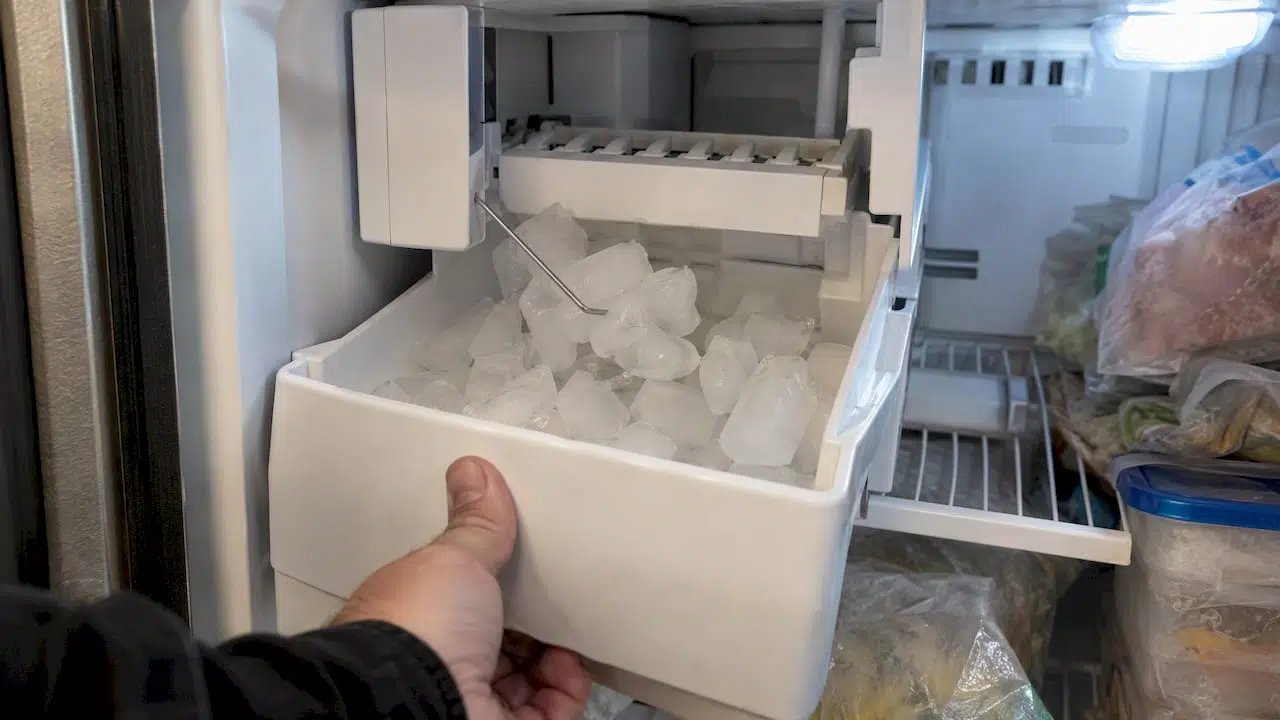
Is the freezer cold enough? Technician guidance in GE’s support content puts the freezer in a range of 0°F to 16°F for ice production. GE’s FAQ describes a freezer that needs to reach about 15°F. Put a thermometer in the freezer for a few hours instead of trusting the dial. If the freezer runs warm everywhere, ice is a symptom, not the problem. Our guide to a fridge icing up and the one on a door that will not seal cover the usual culprits.
Is the fridge new or recently moved? A new installation needs time to cool, usually 24 to 48 hours, and the ice maker will not signal for water until it is well below freezing. It can take a day or two before the first fill.
Check the water side
If the ice maker is on and the freezer is cold, water is the next suspect. The first test is simple: does the water dispenser pour at a normal rate?
| What you see | Likely cause | What to do |
|---|---|---|
| Dispenser works normally, no ice | Frozen fill tube, ice maker module, or a fault state | Run the diagnostic reset below, then call for service |
| Dispenser weak or slow, ice cubes small or hollow | Clogged filter or restricted supply | Replace the filter, check the shut-off valve |
| No water from the dispenser or the ice maker | Closed valve, kinked line or failed water inlet valve | Check the valve, then call a technician |
| Ice clumped into one block | Melt and refreeze, infrequent use, warm freezer | Clear the bin, check temperature |
The shut-off valve and supply line
There is a shut-off valve on the supply line to the refrigerator. GE notes it is usually behind the refrigerator, under the sink, or in a basement or crawl space. Make sure it is fully open. Then pull the fridge out gently and look for a pinched or kinked line. In many Southern California homes the valve sits in a cabinet or at the wall behind the unit, so measure before you pull the fridge out and protect the floor.
The water filter
A clogged filter is a very common reason for slow or no ice. GE says a clogged or partly clogged filter can cause no water or slow flow from the dispenser, and filters should be changed every 6 months. To confirm, GE suggests removing the filter and installing the bypass plug. If the dispenser flow improves, the filter was the problem. If you have not done it before, this walkthrough on changing the water filter in a refrigerator shows the steps.
The frozen fill tube
The small tube that carries water into the ice maker can freeze shut. GE says that if so, the dispenser will still work, and that the ice maker has to be removed to verify it and should be checked by a service technician. This is a classic pattern: water from the door, no ice in the bin. Often something upstream is the real cause, such as a door gasket leak, a warm freezer or a weak water valve, so thawing the tube alone can bring the problem back in days.
The water inlet valve
The valve behind the fridge opens when the ice maker asks for water. If it fails, the ice maker can be perfectly healthy and still never fill. Symptoms include no water to the ice maker, a buzzing sound at the valve, or very small cubes. We explain the part in more detail in our piece on how the ice maker valve works and fails. Testing it involves a multimeter and access to the back panel, so most homeowners should leave this one to a technician.
Reset a GE ice maker with a flashing green light
Many GE units have a green LED on the ice maker. GE’s support page says that when the green light is flashing and the ice maker will not harvest ice, a diagnostic can often reset it. The general sequence from the guidance on file:
- Turn the ice maker off.
- Wait about 15 seconds, then turn it back on.
- Push the paddle three times within 15 seconds to start a harvest test.
- Watch the green light and the ice maker’s motion.
Model steps differ, so follow the exact wording on GE’s diagnostic page for your refrigerator. GE’s technical service guide for these ice makers also notes that the on/off rocker switch controls power and the LED reports certain fault conditions, so a steady light and a flashing light mean different things.
A general power reset (unplugging the fridge for a few minutes) is a common tip from owners after a power surge or outage. It is harmless if you do it correctly: unplug, wait, plug back in and give the freezer time to recover. It does not repair a failed part.
Why the ice maker makes ice but will not dispense it
If the bin is full and ice will not come out of the door, the ice maker may be fine. GE explains that clumped ice cubes can block the dispenser. Empty the bin, break up the clump, wipe the bin dry and check that the door seal and the freezer temperature are not letting moisture in. If the dispenser still jams with fresh, loose ice, the auger, the chute or the door flap may be at fault.
GE Profile and French-door models: what is different?
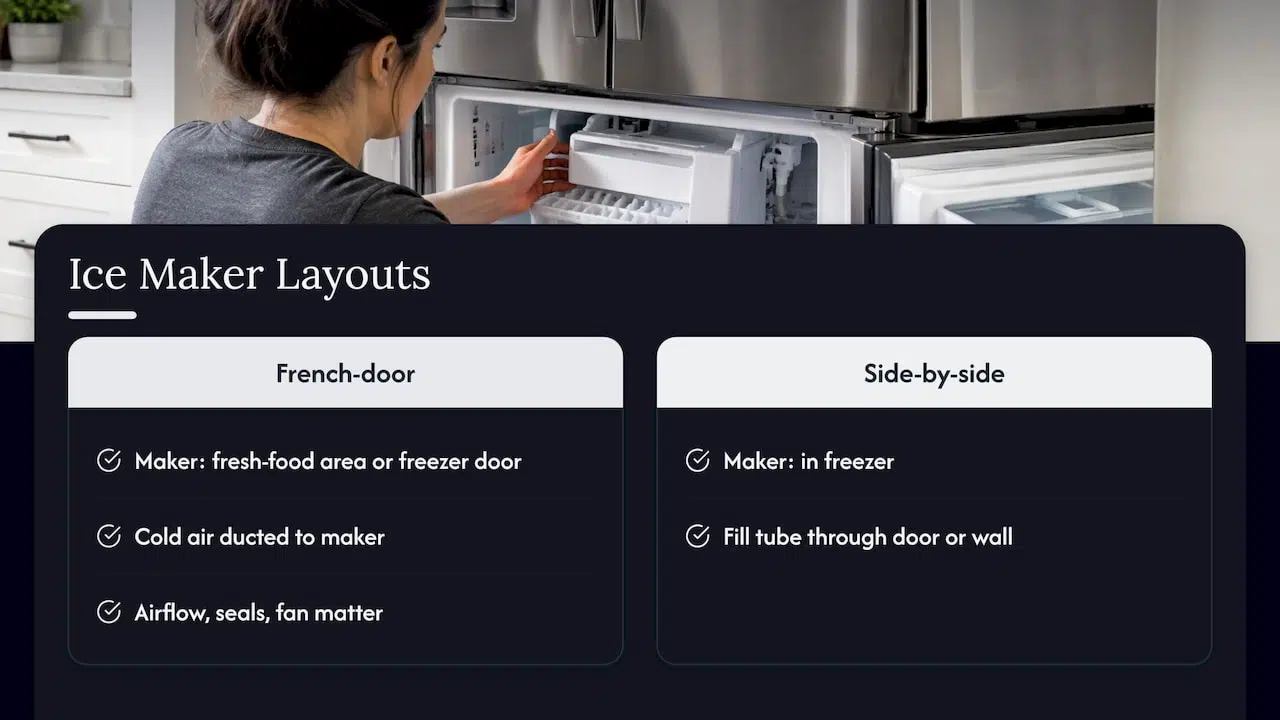
The troubleshooting logic is the same across GE and GE Profile, but the layout changes where the failure shows up. In French-door and bottom-freezer models the ice maker often sits in the fresh food compartment or in the freezer door area, and the cold air has to be ducted to it. That makes air flow, door seals and the ice maker’s own small fan important. In side-by-side units, the ice maker sits in the freezer and the fill tube runs through the door or wall.
French-door models also show up in reliability data. ServiceMag, citing Consumer Reports member surveys, reports that about 31% of refrigerators with ice makers have a problem by the end of year five, especially complex French-door designs. So an ice maker failure in a fridge that is a few years old is common, not a sign you did something wrong.
Our view: what we see on service calls
We repair refrigerators across Orange County and Los Angeles County, and ice maker complaints follow a predictable path. Owners usually try a reset, pull the bin, and replace the filter before calling, which is the right order. Where we step in is the part of the chain you cannot see: the inlet valve, the fill tube, the ice maker module and the control board.
Our advice is practical:
- Do the free checks first. A switched-off ice maker or a blocked arm should never turn into a paid visit.
- Do not keep resetting a unit that keeps faulting. Repeated flashing after a clean reset points to a part, and every extra week of leaking or freezing can add water damage to the problem. Our guide to an ice maker leak shows what to watch for.
- Ask what the diagnosis covers. Before you book anyone, read how surprise fees on refrigerator repairs usually appear, so you can ask for the diagnostic terms upfront.
- Compare repair with replacement honestly. An ice maker problem alone rarely justifies a new refrigerator. If the compressor or sealed system is also failing, the answer can change. We lay out the trade-offs in repair vs replacement.
Our technicians are licensed and we aim to be clear about what is wrong and what it takes to fix it before work begins.
— MDTECH
When to stop and call a technician
Stop the DIY steps and book a repair when any of these apply:
- The green light keeps flashing after a clean reset and harvest test.
- The dispenser works but the ice maker never fills (a likely frozen fill tube).
- You hear the water valve buzz but no water arrives.
- There is water on the floor, ice build-up around the ice maker or frost on the back wall.
- The freezer will not hold a safe temperature at all.
Safety notes where you act: unplug the refrigerator before removing the ice maker, covers or rear panels, and shut off the water supply before disconnecting any line. Do not chip frozen parts with a knife or screwdriver, since that can puncture lines or damage the ice maker housing. If the refrigerator is still under warranty, filing a manufacturer claim first is the usual advice before paying out of pocket, so check your purchase date and any extended plan before booking a paid visit.
Book a GE ice maker repair in Orange or Los Angeles County
If the checks above did not bring the ice back, our technicians can diagnose the ice maker, the inlet valve and the fill tube on site. You can see what we handle on our appliance repair services page, read about our refrigeration repair in Orange County, or book an appointment online. For a quick home checklist to run before the visit, see our five quick fixes for an ice maker that stops working.
FAQ
Why is my GE ice maker not making ice but the water dispenser works?
That pattern usually points to a frozen fill tube, a freezer that is too warm for ice making, or a fault in the ice maker itself. GE notes that a frozen fill tube leaves the dispenser working and needs a technician to confirm. Check the freezer temperature and the ice maker switch first.
How long does a new GE refrigerator take to start making ice?
Plan on a day or two. GE says a new installation needs roughly 24 to 48 hours to cool before the ice maker signals for water. If there is still no ice after that, check the shut-off valve and the filter.
How do I reset a GE ice maker?
Turn the ice maker off, wait about 15 seconds, turn it back on and push the paddle three times within 15 seconds to start a harvest test, as described on GE’s diagnostic page. Exact steps differ by model, so confirm yours. If the light keeps flashing, the cause is likely a part.
Why is my GE ice maker not dispensing ice?
Clumped cubes are a frequent cause. Empty the bin, break up the clumps and let the freezer stabilize at a proper temperature. If loose ice still will not dispense, the dispenser mechanism may need service.
Should I replace the refrigerator because the ice maker failed?
Usually not. An ice maker, valve or fill tube is a contained repair. Replacement makes more sense when the sealed system or compressor is failing, as in our guide to refrigerator compressor replacement costs.
Sources
- GE Appliances: Refrigerator FAQs
- GE Appliances: Green Light on Icemaker Flashing (Icemaker Diagnostic)
- GE Appliances: Bottom Freezer Refrigerator, Not Making Ice
- GE Appliances: Icemaker Does Not Fill With Water
- GE Appliances: Icemaker Doesn’t Fill With Water
- GE Appliances: Icemaker Not Dispensing Due To Clumping Ice
- GE icemaker technical service guide (PDF)
- ServiceMag: Extended Appliance Warranties, Are They Worth It?