
Most furnace repairs in the United States typically cost a few hundred dollars once you add the diagnostic fee, parts, and labor together, according to Thumbtack’s cost data. A simple flame sensor or ignitor swap often lands under $250. A cracked heat exchanger is the outlier that pushes you toward replacement instead of repair.
Before you call anyone, do two things. Check your air filter. A clogged filter causes a surprising share of “furnace not turning on” calls and costs nothing to fix. Then decide if it’s a genuine emergency (no heat, gas smell, carbon monoxide alarm) or something that can wait for a daytime diagnostic appointment, which avoids after-hours surcharges entirely.
- Typical range: a broad range with many repairs clustered near the median cost
- Cheap fixes: flame sensors, ignitors, thermostats, capacitors
- Expensive fixes: blower motors, control boards, gas valves
- Replacement trigger: cracked heat exchanger or a repair bill that approaches half the cost of a new unit
Diagnostic visits often have a fee that may be credited toward the repair if you move forward the same day, per Thumbtack.
Key Takeaways
Furnace repair costs in the U.S.
| Point | Details |
|---|---|
| Know the baseline | Budget $170 to $735 for most repairs, with a median near $352 nationally. |
| Cheap parts vs. expensive parts | Flame sensors and ignitors run under $450; blower motors and control boards can top $1,200. |
| Apply the two rules | Use the 50% rule and the age-times-cost $5,000 rule before approving major repairs. |
| Avoid emergency premiums | Schedule during business hours to skip the after-hours labor multiplier. |
| Book with a documented process | MDTECH provides licensed diagnostics, written estimates, and warranty checks across Orange and Los Angeles Counties. |
Table of Contents
- Furnace Repair Cost by Part: What Each Fix Typically Runs
- What Actually Drives Your Final Bill Up or Down
- Repair or Replace? The Math Homeowners Should Actually Use
- Cutting Your Repair Bill Before It Happens
- Inside a Typical Furnace Repair Appointment
- How MDTECH Handles Furnace Repair Calls
- What Most Cost Guides Get Wrong About Furnace Repairs
- Book a Furnace Diagnostic With MDTECH
- Frequently Asked Questions
- Sources
Furnace Repair Cost by Part: What Each Fix Typically Runs
Once a technician tells you what’s broken, the price should make sense. Here’s how the most common failures break down, all-in, once you add the service call and labor.
- Flame sensor replacement: typically a low-cost repair as one of the most common calls technicians get, with the part itself often inexpensive.
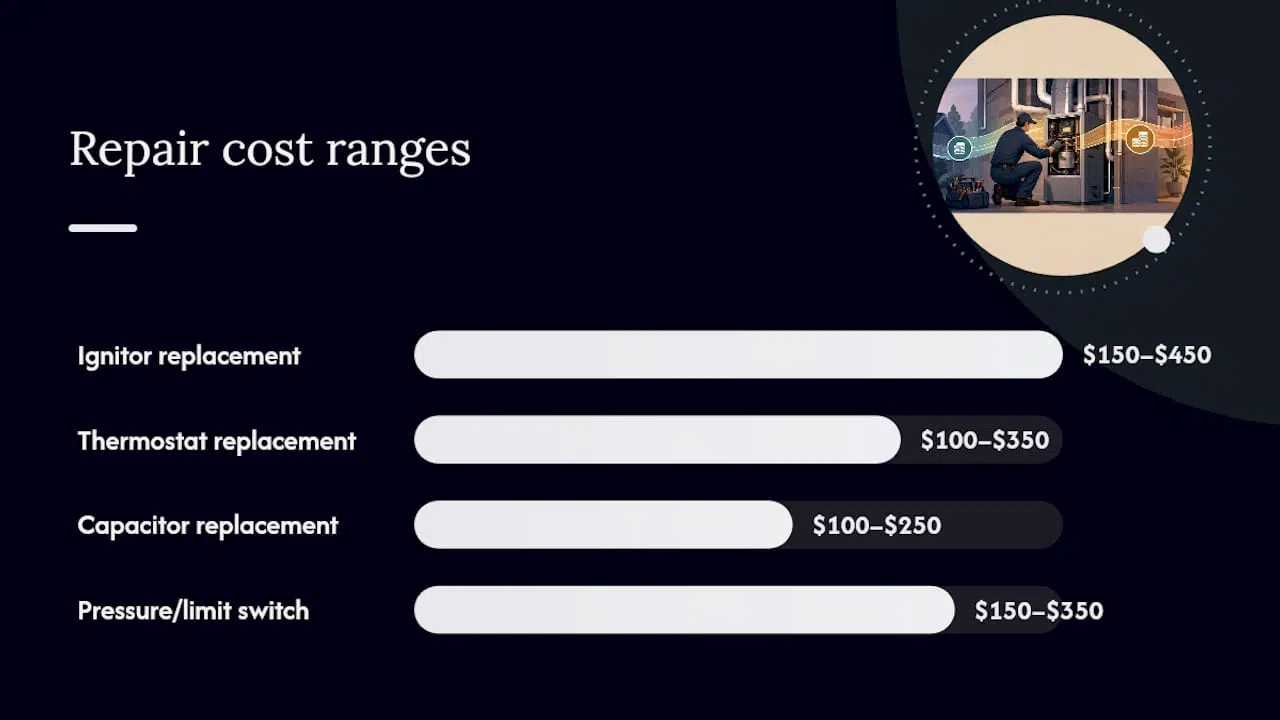
- Ignitor replacement (furnace ignitor replacement cost): $150 to $450, depending on whether it’s a standard hot-surface ignitor or a proprietary part tied to a specific brand.
- Thermostat replacement: $100 to $350, more if you’re upgrading to a smart thermostat with zoning.
- Capacitor replacement: $100 to $250. Cheap part, but skipping this check is how a $150 fix turns into an $800 motor swap.
- Pressure switch or limit switch: $150 to $350.
Angi’s cost data reports a wide range for furnace repairs, with most single-component jobs tending toward the lower end of costs. That spread tells you something important: most furnace repairs are cheap, but the tail end (motors, boards, exchangers) can be brutal.
Blower motor replacement cost furnace: varies widely depending on motor type and complexity, with PSC motors generally less expensive than ECM variable-speed motors. The cost to replace a furnace blower motor varies this much because ECM motors are essentially small computers, not just spinning coils, and they’re often proprietary to the furnace manufacturer.
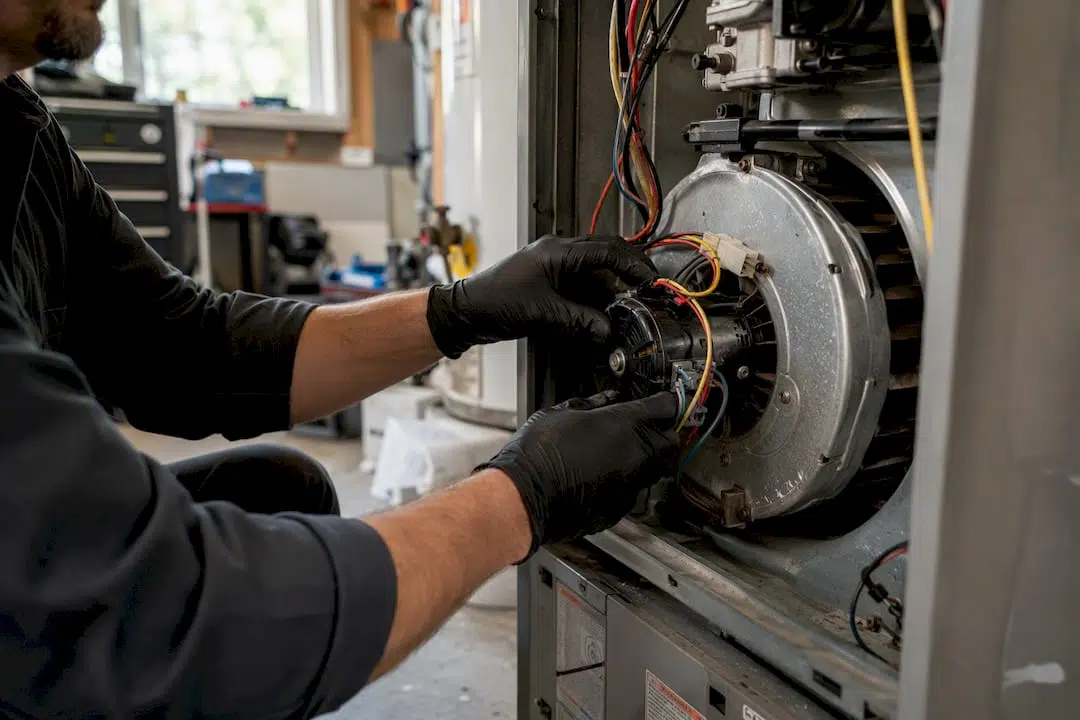
Before anyone quotes you a new blower motor, ask if they checked the capacitor and belt first. A failed capacitor mimics a dead motor, and swapping it costs a fraction of a full motor replacement. This is one of the most avoidable overcharges in furnace repair.
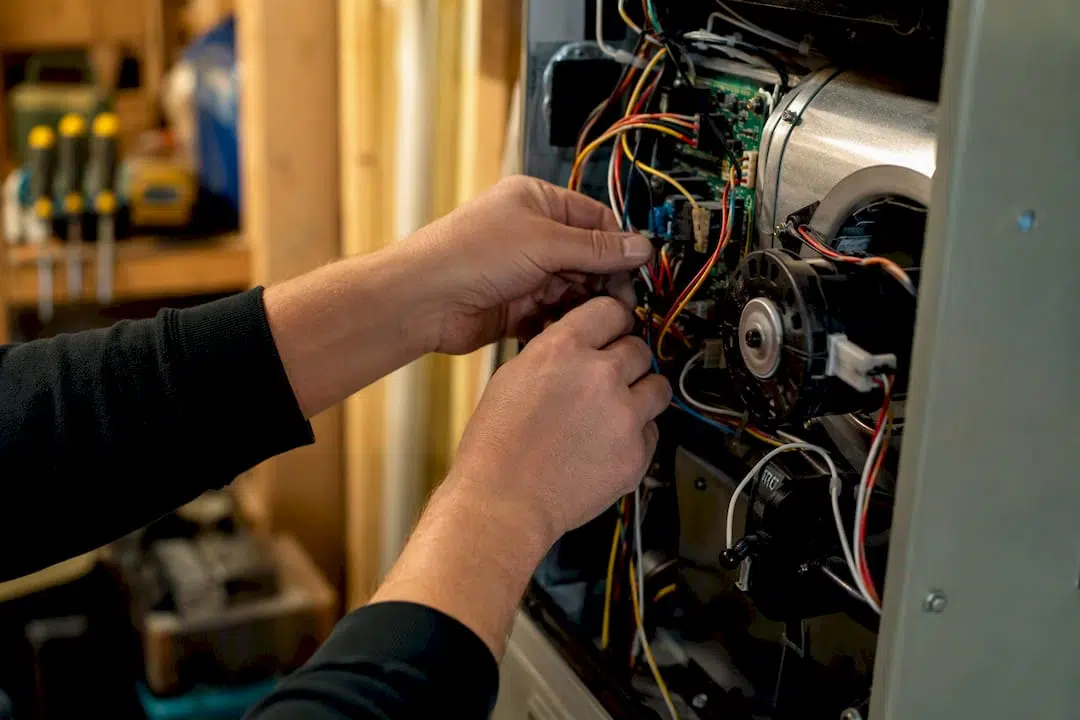
Furnace control board replacement cost: typically moderate to high, with diagnostic uncertainty sometimes influencing quotes. Gas valves tend to be in a similar cost range.
Heat exchanger replacement: this is the one repair that isn’t really a repair. A cracked heat exchanger lets combustion gases, including carbon monoxide, leak into your air supply, so it’s treated as a safety issue rather than a maintenance item, according to UseCalcPro’s estimator data. The replacement cost frequently runs close enough to a new furnace that most technicians will simply recommend replacing the whole unit instead of swapping the exchanger alone.
What Actually Drives Your Final Bill Up or Down
Your invoice is really three numbers stacked together: the diagnostic or service-call fee, labor hours, and parts. UseCalcPro reports typical service-call fees of $70 to $200, with business-hour labor running $75 to $150 per hour. That’s the baseline. Everything else is a multiplier on top of it.
- After-hours or emergency calls: labor rates can increase substantially along with additional dispatch fees for service outside normal hours.
- Access and installation complexity: difficult-to-reach furnace locations can significantly increase labor time and overall repair cost.
- Regional labor rates: vary, with coastal metropolitan areas frequently having higher labor costs than other regions.
- Warranty status: active manufacturer parts warranty can reduce repair costs to labor fees only; otherwise, parts and labor are typically paid by the homeowner.
Pro Tip: Ask upfront whether the diagnostic fee gets applied to the repair cost if you approve the work on the spot. Most companies do this, but not all, and it can shift your total by $70 to $200.
Also worth knowing: if your AC unit has been short cycling in the shoulder seasons, that’s often the same blower or control board hardware that runs your furnace, so a technician diagnosing one system may catch the other issue early.
Repair or Replace? The Math Homeowners Should Actually Use
Two heuristics cut through most of the guesswork, and both are simple enough to do on your phone while the technician is still standing in your living room.
- The 50% rule. If the repair estimate is 50% or more of what a new furnace would cost, replacement is usually the better financial move. A $1,200 quote on a furnace that would cost $2,800 to replace is a borderline call; a $1,600 quote on that same furnace tips clearly toward replacing.
- The $5,000 rule. Multiply the furnace’s age in years by the repair cost in dollars. If the result tops $5,000, lean toward replacement. A 12-year-old furnace with a $500 repair quote scores 6,000, which pushes toward a new unit. A 4-year-old furnace with the same $500 quote scores 2,000, which says repair it.
- Age bands as a shortcut. Under 10 years old: repair almost every time. Between 10 and 15 years: run the math above before committing. Past 15 years: replacement usually wins even for moderate repair costs, since you’re also buying efficiency gains.
There’s one exception that overrides both rules: a cracked heat exchanger or any carbon monoxide risk forces replacement regardless of the furnace’s age or the dollar figures, because you’re weighing safety, not cost. It’s also worth checking Energy before you decide, since a 15-year-old furnace is likely running 10 to 15 percentage points less efficient than a new one, and that gap shows up in your utility bill every single month, not just at repair time.
If you want a deeper walkthrough of this decision, our repair-vs-replacement guide covers how MDTECH technicians evaluate each case on-site.
Cutting Your Repair Bill Before It Happens
Prevention is genuinely the cheapest line item in this entire article. A fall tune-up typically runs $75 to $200 for basic service, or $138 to $178 for a more thorough visit, and it catches the exact parts that fail most often: flame sensors, ignitors, and dirty burners.
- Replace your filter monthly during heating season. A dirty filter restricts airflow, which overheats the system and triggers safety shutoffs.
- Schedule service during business hours whenever the issue isn’t urgent. Skipping the after-hours surcharge alone can save you $100 to $400.
- Get a written, line-item quote before approving work, and ask specifically whether the diagnostic fee rolls into the total.
- Weigh a maintenance plan if you’re on an older furnace. Most plans pay for themselves in one avoided emergency call.
Pro Tip: Keep your furnace’s model and serial number on your phone. Technicians need it instantly to check warranty status, and it can save you from paying for a part that’s still covered. Our furnace maintenance checklist walks through exactly what to inspect before the cold months hit.
Inside a Typical Furnace Repair Appointment
A repair visit follows a predictable sequence, and knowing it ahead of time keeps you from getting rushed into a decision.
- Diagnostic first. The technician runs the service call, tests the system, and identifies the failed component before quoting anything.
- Written estimate. You should see the diagnostic fee, labor hours, and parts cost broken out separately, not lumped into one number.
- Same-visit repair or scheduled follow-up. Simple parts like flame sensors and ignitors usually get fixed on the spot within an hour. Blower motors or control boards sometimes require a special order, pushing the job to a second visit.
- Warranty check. Before you approve any part replacement, ask the tech to confirm whether it’s still covered under a manufacturer or parts warranty.
Ask for the actual reading or test result that led to the diagnosis, not just the conclusion. A technician who can show you a failed capacitor test or an error code on the control board is diagnosing your furnace. One who jumps straight to “you need a new blower motor” without evidence is guessing, and guesses get expensive fast.
If a technician pressures you to approve a major repair before offering any alternative or explanation, that’s a red flag worth pausing on.
How MDTECH Handles Furnace Repair Calls
MDTECH’s licensed technicians handle furnace diagnostics and repairs across Orange and Los Angeles Counties, backed by the same documented, line-item approach described above.
- Licensed HVAC technicians perform on-site diagnostics rather than phone-quoting a repair sight unseen.
- Booking runs through an online scheduling system, so you’re not stuck waiting on hold during a cold snap.
- Service covers common failures (ignitors, flame sensors, blower motors, control boards) as well as full HVAC and gas conversion work.
- Every visit includes a documented diagnosis before any part gets ordered or replaced.
What Most Cost Guides Get Wrong About Furnace Repairs
Most cost guides hand you a number and call it a day. The real skill isn’t finding the average, it’s knowing which average applies to your specific failure. A $69 diagnostic fee and a $312 flame sensor repair are not the same conversation as a $900 blower motor quote, and treating them the same way is how homeowners either overpay for a simple fix or underestimate what a motor or control board job actually costs.
The bigger blind spot is the capacitor check. Homeowners get quoted for a full blower motor replacement more often than they should, because a failed capacitor produces nearly identical symptoms and costs a fraction as much to fix. Any technician who quotes a motor replacement without first testing the capacitor and belt is skipping a step that could save you hundreds.
Prioritize the fall tune-up over almost everything else in this article. It’s the one action that shrinks your odds of an emergency call, and it costs less than most single-component repairs.
Book a Furnace Diagnostic With MDTECH
Between coastal labor multipliers and after-hours dispatch fees, a furnace quote can swing by hundreds of dollars depending on who shows up and when. MDTECH keeps that variable in your favor: licensed technicians, a documented diagnosis before any part gets ordered, and online booking that lets you schedule during business hours instead of paying an emergency premium.
When you book through the HVAC repair page, you get a technician who checks the actual failure (capacitor before motor, sensor before board) rather than defaulting to the most expensive part on the truck. Expect a written estimate broken into diagnostic, labor, and parts, plus a warranty check before you approve anything out-of-pocket. If your furnace is closer to 10 to 15 years old, MDTECH can also walk you through the repair-versus-replacement math on-site. If you’re weighing efficiency upgrades alongside the repair, homeowners in the region sometimes compare notes with Texas Comfort Crew on typical service-area practices, though your local quote will still come down to your specific furnace and access conditions.
Book your furnace diagnostic now through MDTECH’s HVAC repair booking page and get a licensed technician on-site before the next cold front hits.
Frequently Asked Questions
What is the average cost to fix a furnace?
Most repairs cost between $170 and $735, with a median around $352 once you include the diagnostic fee, parts, and labor, according to Thumbtack.
Why is my furnace not turning on?
The most common causes are a dead thermostat battery, a tripped breaker, a clogged filter restricting airflow, or a failed ignitor or flame sensor. A diagnostic visit usually identifies the cause within the first 30 to 60 minutes.
What causes furnace short cycling?
Short cycling (turning on and off rapidly) is often caused by a dirty filter, a failing flame sensor, an oversized furnace for the space, or a faulty thermostat sending inconsistent signals.
How much does it cost to replace a furnace blower motor?
A PSC motor typically costs $300 to $600 installed, while an ECM variable-speed motor runs $600 to $1,200 or more, since ECM units are more complex and often proprietary to the furnace brand.
Does furnace warranty coverage lower my repair cost?
Yes. If your furnace is still under a manufacturer’s parts warranty, you typically only pay for labor. Once that coverage lapses, you’re responsible for both parts and labor.
Does fuel type change repair cost?
Gas furnace repairs often involve ignitors, flame sensors, and gas valves. Electric furnace repairs tend to focus on heating elements and blower components, and generally skip gas-valve related costs. Oil furnace repairs can run higher due to burner and nozzle maintenance requirements.
Sources
- 2026 Furnace Repair Cost | Get Estimates
- How Much Does the Average Furnace Repair Cost? 2026 Data
- Furnace Repair Cost Near Me Calculator — 2026 Estimator | UseCalcPro