
Homeowners across the country are paying a national midpoint near $1,600 for AC compressor replacement in 2026, with most jobs landing somewhere between $850 and $2,400 depending on system size and warranty status. Out-of-warranty jobs on larger systems can climb past $3,000.
The number that actually matters to your wallet is warranty status. If your compressor still carries a manufacturer part warranty, you’re often paying labor only, which usually runs $400 to $1,200. Lose that warranty and you’re covering the compressor itself too, and that’s where the bill jumps.
Here’s the quick verdict:
- Under 8 years old with an active warranty: replacing the compressor almost always makes sense.
- 8 to 12 years old, out of warranty, otherwise healthy system: get quotes, but weigh it against a new system.
- Over 12 years old, or on R-22 refrigerant: full system replacement is usually the smarter money move.
Quick stat: The 2026 national midpoint for compressor replacement sits around $1,600, with a typical range of $850 to $2,400 for most residential jobs.
Key Takeaways
Compressor replacement costs hinge on three variables: warranty status, refrigerant type, and system tonnage, more than any other factor in the quote.
| Point | Details |
|---|---|
| National 2026 midpoint | Expect roughly $1,600, with most jobs falling between $850 and $2,400. |
| Warranty changes everything | Confirm part warranty status with model and serial number before approving any parts charge. |
| R-22 systems cost more | Legacy refrigerant systems face inflated recharge costs and usually justify full replacement. |
| Use the times-two rule | If a repair quote exceeds half the cost of a new system, replacement is usually the better value. |
| Get it in writing | Appliancesrepairmdtech provides EPA-certified diagnostics and line-item estimates across Orange and Los Angeles counties. |
Table of Contents
- What Drives the Cost to Replace an AC Compressor?
- How Much Does AC Compressor Replacement Cost by System Size?
- Why Do Two Quotes for the Same Job Differ by Thousands?
- Does Warranty Coverage Change What You Actually Pay?
- Should You Repair the Compressor or Replace the Whole System?
- What Happens During a Proper Compressor Swap?
- How Can You Lower Your AC Compressor Replacement Cost?
- What Else Gets Replaced Along With the Compressor?
- What Do Technicians Check First on a Failing Compressor?
- Ready to Get an Honest Compressor Quote?
- Sources
What Drives the Cost to Replace an AC Compressor?
A compressor replacement quote isn’t one number. It’s four or five separate charges stacked together, and knowing what belongs on that list is how you catch a contractor padding the bill.
The compressor itself. Part costs vary widely by tonnage and technology. A single-stage compressor for a smaller residential unit might run a few hundred dollars wholesale, while a variable-speed compressor for a larger system can cost well over $1,000 before labor touches it. Professional installation typically falls between $800 and $2,300 once labor is folded in, and that range tells you the part alone rarely explains a high quote.
Labor. This is often the biggest line item, not the smallest. Swapping a compressor isn’t a bolt-on job. It requires refrigerant recovery, unsweating old joints, brazing new connections, pulling a vacuum, leak testing, and recharging the system to spec. Labor frequently equals or exceeds the part cost for exactly that reason, and a technician who quotes a low flat fee without breaking out hours is worth a second look.
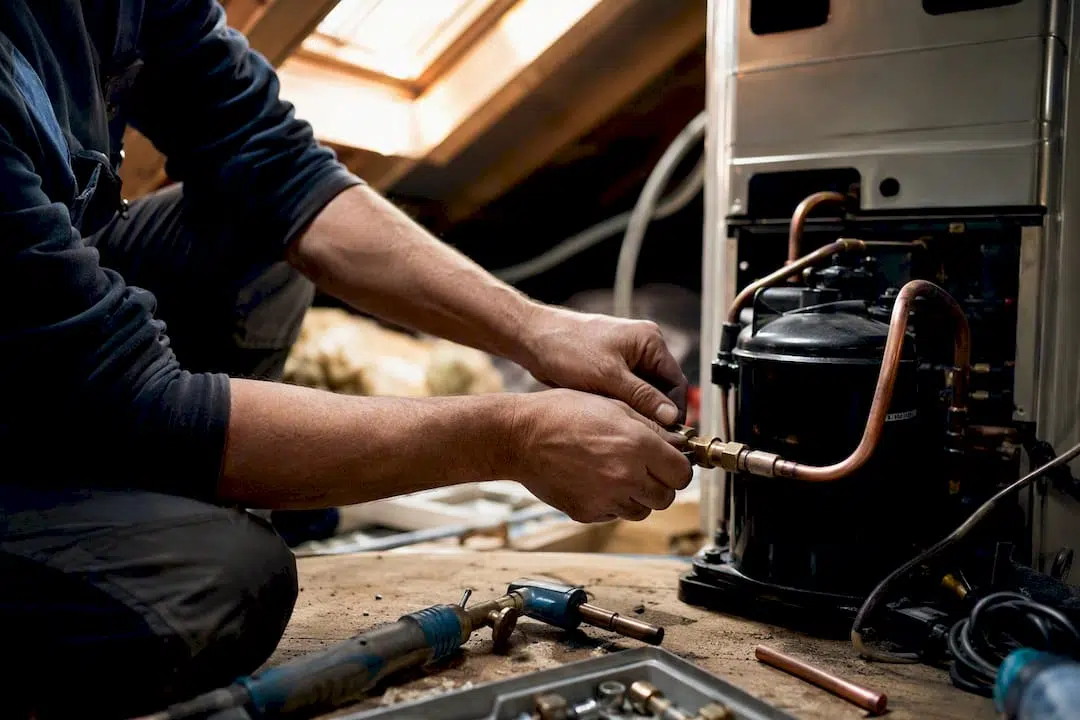
Refrigerant recovery and recharge. You’re paying for both removing the old refrigerant safely and recharging the system afterward, and refrigerant itself isn’t cheap right now (more on that below).
Incidentals that add up fast:
- Filter-drier replacement (almost always required with a compressor swap)
- Brazing rod, nitrogen for pressure testing, and other consumables
- Electrical components like a new contactor or hard-start kit if the old ones are worn
- Legal disposal of the failed compressor and recovered refrigerant
A quote missing any of these isn’t necessarily cheaper. It’s usually incomplete, and you’ll see the missing charge appear later as a surprise add-on.
How Much Does AC Compressor Replacement Cost by System Size?
Tonnage and system type change the math significantly. A 1.5 ton mini-split compressor swap and a 5 ton packaged rooftop unit are not the same job, and pricing them the same way is how homeowners end up either overpaying or getting an unrealistic lowball quote.
Heat pump compressors tend to price higher than straight AC compressors because they’re built to run in both heating and cooling modes and often use more sophisticated valve systems, a distinction the Department of Energy’s consumer guidance on central AC and heat pumps lays out clearly.
One category deserves its own callout: legacy R-22 systems. If your unit still runs on R-22, you’re not just paying for a compressor. You’re paying inflated refrigerant prices on a substance that’s been phased out of production for years, and that alone can push a “simple” swap north of $4,650 out of warranty, according to industry pricing aggregators tracking 2026 rates. On an R-22 system, replacement almost always beats repair.
Why Do Two Quotes for the Same Job Differ by Thousands?
Two homeowners with nearly identical systems can get wildly different quotes, and it’s rarely because one contractor is ripping the other off. Usually it comes down to four variables.
Access and site complexity. A ground-level condenser in an open side yard is a straightforward job. A rooftop unit that needs scaffolding, or a packed mechanical closet with barely enough room to swing a wrench, adds labor hours and sometimes requires a bigger crew. Access complications get their own line item on a properly written quote, and if yours doesn’t have one, ask why.
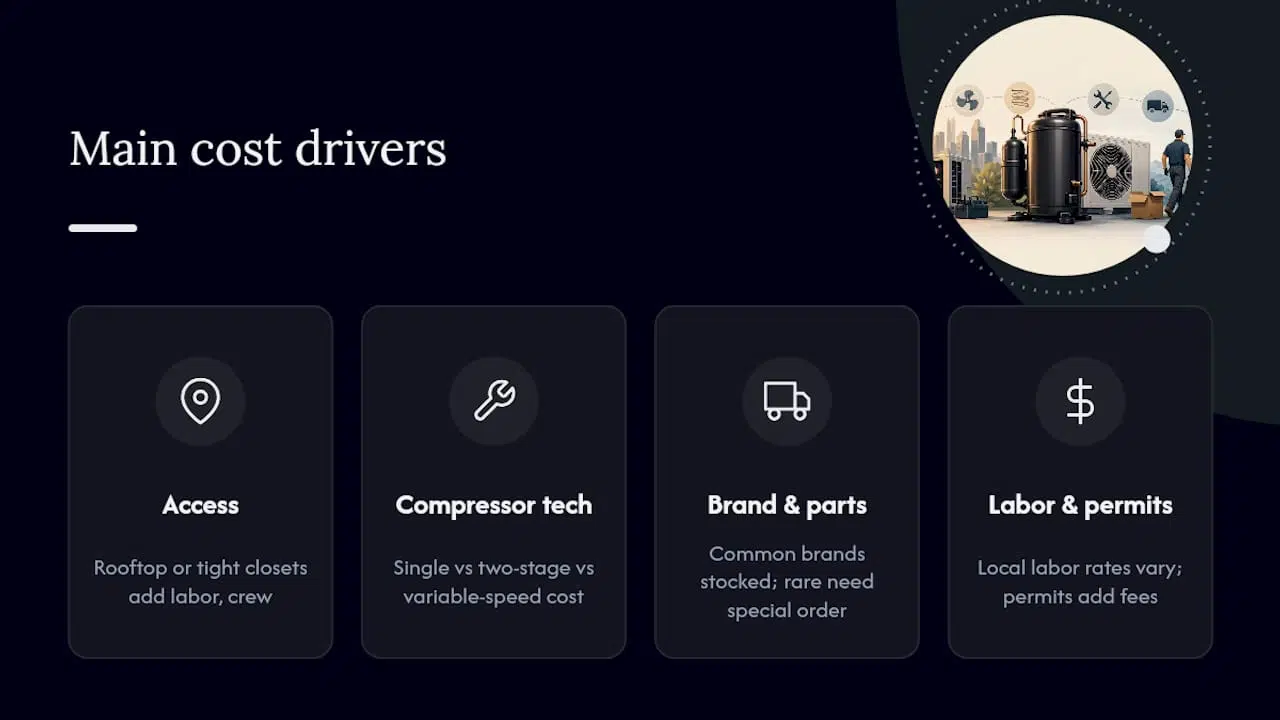
Compressor technology. Single-stage compressors are the cheapest and simplest to source. Two-stage units cost more. Variable-speed compressors, the kind found in higher-efficiency modern systems, are the most expensive to replace and often have longer lead times.
Brand and parts availability. A common residential brand with local distributor stock gets you a same-week repair. A less common or older brand might mean a special order, and that wait sometimes gets billed as a rush fee once the part finally lands.
Local labor rates and permits. HVAC labor rates vary by metro area, and some jurisdictions require permits and inspections for compressor work involving refrigerant, adding a modest but real fee to the total.
Pro Tip: Ask every contractor for a written quote that separates part cost, labor hours, refrigerant charge, and any access or permit fees. If a quote is a single lump number, you have no way to compare it against a competing bid.
Does Warranty Coverage Change What You Actually Pay?
Warranty status is the single biggest lever on your final bill, bigger than tonnage, bigger than brand. Most compressor manufacturers offer part warranties running 5 to 10 years, sometimes longer on premium lines, but that warranty typically covers the part only, not the labor to install it. Confirming warranty status before authorizing work, using the model and serial number on the unit, can save homeowners hundreds to thousands of dollars on a single visit.
Refrigerant is the other cost pressure reshaping 2026 quotes. The EPA’s phasedown of HFC refrigerants under the AIM Act is steadily reducing allowed production volumes of common refrigerants, R-410A included, and tighter supply is pushing prices up year over year. That cost gets passed straight through to your recharge line item.
Quick stat: Homeowners on legacy R-22 systems face significantly increased refrigerant costs, since production of that refrigerant has been banned in the U.S. for years and remaining supply comes mostly from reclaimed stock.
- Ask for the warranty confirmation in writing before you approve any parts charge.
- Request the refrigerant type and current per-pound cost as its own quote line.
- If your system runs R-22, price a full system replacement alongside any repair quote.
Should You Repair the Compressor or Replace the Whole System?
Here’s a rule contractors use informally, and it’s worth adopting yourself: if a compressor repair quote runs more than half of what a full new outdoor unit would cost, replacement usually wins on value. Some techs call it the “times two” rule. Double your repair quote. If that number gets close to or exceeds a new condenser installed, don’t repair.
- Get both numbers before deciding anything. A compressor-only quote in isolation tells you nothing. Get a comparable quote for a new condenser or full system swap.
- Weigh system age against the threshold. Under roughly 8 years old, repair almost always makes sense, especially with warranty coverage. Past 10 to 12 years, replacement usually pencils out better, particularly with the added refrigerant cost pressure on older systems.
- Watch for compounding red flags. A second compressor failure in under five years, a system still running R-22, or a coil and fan motor already showing wear all push the math toward replacement even on a system that isn’t that old.
Pro Tip: If your contractor recommends replacement, ask them to write out both quotes side by side. A tech confident in their repair-versus-replace math will show you the comparison without hesitation.
What Happens During a Proper Compressor Swap?
A rushed compressor job is how homeowners end up calling back within a year. A properly done one follows a specific sequence, and knowing that sequence lets you ask the right questions before work starts.
Diagnosis comes first: measured amp draw compared against the compressor’s nameplate rating, refrigerant pressure readings on both the suction and discharge sides, and a leak check to rule out a slow leak masquerading as compressor failure. Then the actual swap: EPA-certified refrigerant recovery, removal of the failed unit, brazing in the new compressor with nitrogen flowing through the lines to prevent internal contamination, pulling a deep vacuum to the correct micron level, and a precise recharge to manufacturer spec.
The job isn’t finished when the new compressor is bolted in and running. A complete verification means checking amp draw against nameplate again, confirming suction and discharge pressures sit within spec, and measuring the temperature split across the evaporator coil before the technician packs up.
You should walk away with written documentation of every one of those numbers. If a technician can’t hand you that, they likely didn’t check it. EPA Section 608 also requires certified handling for every step involving refrigerant, and asking for a technician’s certification number is a fair question, not an insult.
How Can You Lower Your AC Compressor Replacement Cost?
You have more control over the final number than most homeowners assume, and most of the savings happen before a technician ever touches your system.
- Check the warranty first. Find your model and serial number, call the manufacturer or check their registration portal, and confirm coverage status before any technician quotes parts.
- Collect at least two or three written, line-item quotes. Compare labor hours, refrigerant charge, and incidentals side by side, not just the bottom-line total.
- Request a documented performance test after the work. This protects you if something fails again within weeks.
- Rule out cheaper fixes first, but only with a real diagnosis. A failed capacitor or contactor can mimic compressor failure and costs a fraction to replace, so insist on amp and pressure readings before agreeing to a full compressor swap.
Pro Tip: Off-season scheduling, generally late fall through early spring, often gets you faster availability and occasionally better pricing, since HVAC crews aren’t buried in peak-summer emergency calls.
What Else Gets Replaced Along With the Compressor?
A compressor rarely fails in isolation, and a technician who swaps it without checking the rest of the refrigerant circuit is setting you up for a repeat failure. When a compressor burns out, it often sends metal debris and acid-contaminated oil through the entire line set, which means the system usually needs a flush, not just a new part dropped in.
The expansion valve or fixed orifice metering device is a common casualty, especially if the original failure involved a refrigerant leak or overheating. If that component shows contamination or wear, replacing it alongside the compressor prevents a second failure a few months later. The filter-drier gets swapped as standard practice on nearly every compressor job, since its job is to catch moisture and debris, and an old one is already saturated.
Technicians also inspect the line set for contamination and may recommend a full acid flush if the burnout was severe. Skipping this step to save money is one of the more common ways a “successful” compressor swap fails again within a year. Ask your technician directly whether a flush or expansion valve replacement is part of the scope, and get it written into the quote rather than discovered as a mid-job upcharge.
What Do Technicians Check First on a Failing Compressor?
We start every compressor call the same way: amp draw against nameplate rating, capacitor health, refrigerant pressures on both sides, and warranty status before a single tool touches the unit. That sequence catches the cases where a $30 capacitor gets mistaken for a $1,500 compressor job. Every job leaves you with a written, line-item estimate and documented performance numbers after the work, not a verbal promise.
— MDTECH
Ready to Get an Honest Compressor Quote?
Everything above assumes you’re comparing multiple written quotes, but getting those quotes from a contractor who actually documents amps, pressures, and refrigerant charge before you commit is where most homeowners get stuck. Appliancesrepairmdtech sends EPA-certified technicians to your home in Orange County or Los Angeles County who diagnose the actual failure first, capacitor, contactor, or compressor, and hand you a written, line-item estimate before any work starts, not a verbal guess.
On-site visits include amp and pressure testing, a warranty status check against your unit’s model and serial number, and a full breakdown of part, labor, refrigerant, and incidental costs so you can compare it against any other bid you’ve collected. If your system needs more than a compressor swap, the same visit covers a repair versus replacement conversation grounded in your system’s actual age and condition, not a sales script. Book your AC repair appointment online, or start with our Orange County AC repair service page to see current availability in your city.
Sources
For homeowners who want to verify the regulatory and pricing details behind this guide: the EPA’s Section 608 certification requirements cover refrigerant handling rules, the HFC phasedown FAQ explains refrigerant price pressure, and the Department of Energy’s central AC and heat pump guidance breaks down system-type differences. Industry pricing context comes from ACHR News and consumer-facing checklists like Tru Comfort’s AC maintenance signs.
- Consumer central air conditioners and heat pumps (U.S. Department of Energy)
- Frequent questions about the HFC phasedown (EPA)