
Fluctuating water pressure usually traces back to one of six culprits: a well pressure switch or pump problem, municipal supply swings, a hidden leak, a failing pressure-reducing valve (PRV), trapped air, or clogged pipes. The fastest way to narrow it down is to check whether the issue affects one fixture or the whole house, then attach a pressure gauge to an outdoor hose bib for a baseline reading. If pressure drops suddenly or you see visible leaking, treat it as urgent and call a plumber right away.
TL;DR:
- Check hot and cold taps upstairs and downstairs; if only one fixture has weak flow, clean its aerator or inspect its filter.
- A hose bib gauge should read roughly 45–60 psi; readings that swing over several minutes point toward a supply or pressure reducing valve problem.
- Turn off every fixture and appliance, then compare the meter after 30 minutes; movement indicates a leak somewhere in the system.
- On a well, a pump cycle shorter than 60 seconds usually points to a waterlogged pressure tank bladder, not a failing pump.
- Pressure reducing valve adjustments, pressure tank service, and well pump electrical work should be left to licensed professionals because they involve safety and code concerns.
Table of Contents
- Common Causes Grouped by Your Water Source
- How to Diagnose the Problem Step by Step
- Fixes You Can Try Before Calling a Pro
- What a Technician Checks During a Service Visit
- Local Water Supply Factors in Orange and Los Angeles Counties
- Why Early Diagnosis Saves Homeowners Money
- How We Help You Stop the Guesswork
- FAQ
- Sources
Common Causes Grouped by Your Water Source
Where your water comes from shapes which cause is most likely, so it helps to sort the possibilities by source before you start testing anything.
If you’re on a private well, the problem often sits inside the pump system itself. A faulty pressure switch can cause the pump to cycle erratically, while a waterlogged pressure tank bladder leads to rapid on-off cycling that feels like surging. Groundwater levels also drop seasonally, and well yield can decline enough during late summer or drought to cause intermittent flow, a pattern Penn State Extension documents as a normal seasonal effect on wells. Sediment or sand pulled into the well screen adds another layer of restriction over time.
If you’re on municipal water, the causes usually sit outside your property line. Water main breaks, scheduled maintenance, hydrant flushing, and peak demand in your neighborhood all cause temporary pressure dips. Pressure-regulating equipment at the meter or a shared service line with neighbors can also create swings you have no direct control over.
Inside the home, several issues can mimic a supply problem:
- Trapped air in the pipes after repairs or shutoffs, which causes sputtering before pressure stabilizes
- Clogged aerators, showerheads, or inline filters that restrict flow at individual fixtures
- Corroded or mineral-scaled pipes that narrow the usable diameter over years
- A failing PRV that no longer holds a steady output pressure
- A main shutoff valve that is only partially open
- Sediment buildup in the water heater, which mainly affects hot-side pressure
- A hidden leak somewhere in the supply line, slowly bleeding off pressure
Matching your symptom to the right group keeps you from replacing a part that was never the problem.
How to Diagnose the Problem Step by Step
Before calling anyone, a short sequence of checks will tell you whether you’re dealing with a fixture issue, a whole-house issue, a well problem, or a municipal one.
- Test the scope. Run water at multiple fixtures, hot and cold, upstairs and downstairs. If only one fixture is affected, the problem is local to that fixture’s filter, cartridge, or aerator.
- Take a baseline pressure reading. Attach a pressure gauge to an outdoor hose bib. Normal household pressure runs roughly 45 to 60 psi, with many states setting 20 psi as an absolute minimum for safe service, according to EPA pressure management guidance. A reading that swings widely over a few minutes points to a supply or PRV issue rather than a fixture.
- Run the pressure-loss test. Shut off every fixture and appliance, note the water meter reading, and wait 30 minutes without using any water. If the meter has moved, you have a leak somewhere in the system, a method BobVila’s low-pressure guide recommends as a reliable baseline check.
- Run the 60-second well test. Turn on a faucet and time how long the pump runs before shutting off. A cycle under 60 seconds usually signals a waterlogged pressure tank bladder rather than a failing pump, a distinction explained in InspectAPedia’s pump troubleshooting reference.
- Call your water utility if you’re on municipal supply. Ask whether there’s known main work, flushing, or outages in your area before assuming the problem is inside your home.
Pro Tip: Write down your hose-bib reading at two different times of day. A pressure gauge costs little and turns a guessing game into a measurement.
Fixes You Can Try Before Calling a Pro
Several fixes are safe for most homeowners to attempt, and they solve a surprising share of fluctuation complaints:
- Open the main shutoff valve all the way; a partially closed valve restricts flow more than people expect.
- Unscrew and clean aerators and showerheads, which trap mineral scale over time.
- Replace cheap cartridges or inline filter screens that have clogged with sediment.
- Flush the water heater if the problem shows up mainly on the hot side; our water heater maintenance guide walks through the process.
- Visually check the PRV and pressure tank gauge for obvious signs of failure, like constant dripping or a stuck needle.
Pro Tip: If cleaning an aerator restores full pressure at just that one fixture, you’ve solved it. If the whole house stays inconsistent afterward, the cause is upstream.
Some repairs cross the line into licensed-trade territory: replacing or recalibrating a PRV, servicing a pressure tank bladder, or doing electrical work on a well pump control box. These carry real safety and code implications, and a step-by-step plumbing repair guide is useful for sorting which tasks are reasonable to attempt yourself. Well-specific repairs such as pump replacement, sand pumping, or well rehabilitation need a licensed well contractor, especially when yield has dropped noticeably during dry months. Simple fixes take minutes to an hour; professional diagnostics and part replacement typically run from the same day to about a week depending on parts and any required permits.
What a Technician Checks During a Service Visit
Before any hands-on work, a few safety basics matter: shut off sensitive appliances like dishwashers and washing machines during testing, stay away from pump electrical panels, and note the location of any visible leaks so they can be pointed out quickly.
On a typical visit, a technician works through a consistent sequence:
- Confirm the pressure gauge reading at an outdoor spigot or hose bib
- Inspect the main shutoff valve and water meter for restriction or wear
- Test the PRV for consistent output under varying flow
- Check the pressure tank and pressure switch on well systems
- Observe pump cycling time to rule out short cycling
- Look for sand or sediment pumping, a sign of well screen wear
A sudden, total loss of pressure with visible leaking calls for same-day service; if this is caused by water damage, you might consider options to sell a house with water damage for cash. A gradual seasonal decline on a well system, by contrast, usually allows time to schedule a proper inspection rather than treating it as an emergency.
Local Water Supply Factors in Orange and Los Angeles Counties
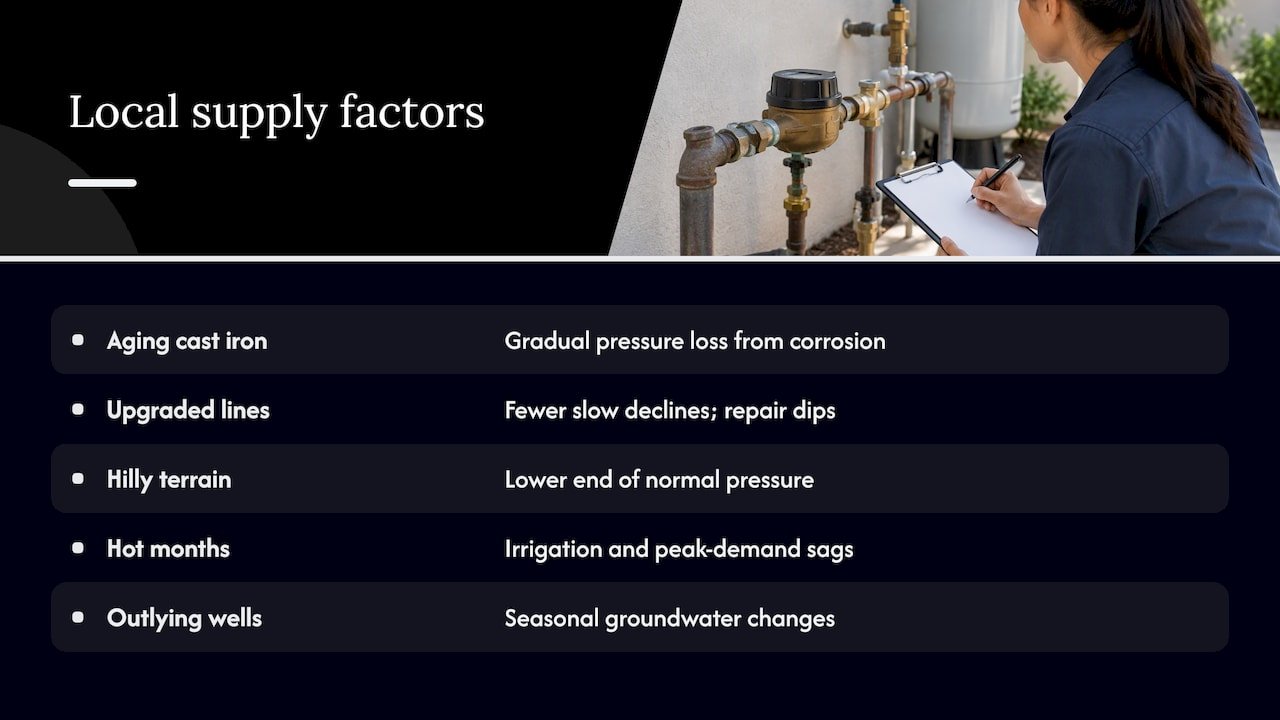
Homeowners across Orange County and Los Angeles County deal with a mix of municipal systems, each drawing from different combinations of imported and local groundwater supplies, which means pressure behavior varies block by block depending on the local utility’s infrastructure and demand patterns. Older neighborhoods with aging cast iron mains are more prone to gradual pressure loss from internal corrosion, while newer developments on upgraded lines tend to see fewer slow declines but can still experience temporary dips during main repairs or flushing.
Hilly terrain in parts of both counties also means some properties sit at elevations that naturally run on the lower end of the normal pressure range, even when the system itself is functioning correctly. Hotter months bring heavier irrigation and peak demand in the early morning and evening, which can create short-term pressure sags in neighborhoods with shared mains. Wells are less common in these urbanized counties but still exist in some outlying areas, where seasonal groundwater changes follow the same patterns seen in rural well systems elsewhere. If your pressure issues track closely with time of day or season rather than a specific fixture, the cause is more likely tied to local supply conditions than anything inside your home.
Why Early Diagnosis Saves Homeowners Money
The most common mistake we see in the field is delay: a homeowner notices pressure surging for weeks, assumes it will pass, and by the time we arrive a waterlogged tank has already pushed a pump into constant short cycling. Early diagnosis catches a $20 part before it becomes a $600 pump replacement, protects water quality, and reduces the odds of a small leak turning into a burst line. When symptoms point past a simple aerator cleaning, calling a licensed professional early is the cheaper path, not the more cautious one.
— MDTECH
How We Help You Stop the Guesswork

Once you’ve narrowed down whether your fluctuating pressure points to a leak, a worn PRV, a tired pressure tank, or a well-pump issue, we handle the rest. We bring a diagnostic checklist including gauge readings, shutoff and meter inspection, PRV testing, and pressure tank evaluation to provide a clear answer instead of another guess. Booking is straightforward through our plumbing repair services page, and we coordinate directly with well contractors when a problem goes beyond standard household plumbing.
FAQ
What would cause intermittent water pressure?
Intermittent pressure most often comes from a well pressure switch malfunction, a waterlogged pressure tank, trapped air after recent plumbing work, or municipal supply changes during peak demand hours. Running the scope test and a hose-bib pressure reading, as described above, quickly separates a fixture-level cause from a system-wide one.
Is it normal for boiler pressure to fluctuate slightly?
Small fluctuations in a closed heating system can occur with normal temperature changes, since heated water expands and contracts the system pressure slightly. A larger or sudden swing, however, points to a leak or a failing expansion component and is worth having checked rather than assumed normal.
What are the signs that my house water pump is going bad?
Classic warning signs include rapid on-off cycling under a minute, a pump that runs but never reaches its normal cut-out pressure, unusual noise, or sand appearing in your water, a pattern InspectAPedia’s troubleshooting reference ties to tank or pump wear. A noticeable, sustained drop in yield, especially during dry months, is also a signal worth having assessed by a well contractor.
Why is my well water pump pulsing?
Pulsing or surging from a well pump is typically caused by a waterlogged pressure tank bladder that can no longer hold air correctly, forcing the pump to cycle on and off rapidly. Penn State Extension’s well maintenance guidance notes that seasonal groundwater drops can compound this, especially in late summer.
Sources
- Distribution System Water Quality – Protecting Water Quality Through Distribution System Pressure Management (EPA)
- Managing your well during drought (Penn State Extension)
- InspectAPedia: Water pressure diagnosis and well pump/pump-run troubleshooting
- Low water pressure in the home: causes and solutions (BobVila)