
If your freezer feels cold but won’t actually freeze food, check the door seal, clear any blocked vents, and confirm the setting with a real thermometer before assuming the worst. Most cases trace back to airflow problems: overpacked shelves, frost buildup, or a loose gasket, and those are fixable at home in under an hour. If the compressor is humming loudly or the evaporator fan is silent, you’re likely looking at a sealed-system issue that needs a licensed technician.
TL;DR:
- Overpacking shelves or blocked vents cause airflow issues, making the back stay cold while the front warms up, and require reorganization.
- A silent evaporator fan or humming compressor suggests a more serious electrical fault, often needing professional diagnosis and repair.
- Food that has stayed above 40°F for more than two hours should be discarded, unless it remains icy or cold to the touch, in which case it can be safely refrozen.
- Regular maintenance, such as cleaning coils and inspecting gaskets, reduces the likelihood of future freezing issues and prolongs freezer lifespan.
Table of Contents
- Run this checklist before you do anything else
- Work through the problem in this order
- Why freezers stop freezing: the usual suspects
- Fixes you can do yourself, and when to stop
- What to do with food that started to thaw
- Keep it from happening again
- What we see on service calls
- Get your freezer checked without the guesswork
- Sources
- FAQ
Run this checklist before you do anything else
Start with the basics. These checks take 10 to 15 minutes and will tell you whether you’re dealing with a simple fix or something more serious.
- Place a standalone appliance thermometer between two frozen items and check it again in a few hours; built-in dial readouts often show the set point, not the real temperature.
- Confirm the thermostat is actually set to 0°F, not accidentally bumped toward a warmer setting.
- Check that the freezer has power. Try a simple unplug-and-replug if the outlet and breaker seem fine.
- Look for blocked vents, overstuffed shelves, or a door that isn’t closing flush.
- Do a paper test on the door gasket: close the door on a strip of paper and see if it slides out easily.
- Scan the back wall and evaporator area for visible frost or ice buildup.
- Listen for the evaporator fan and compressor. Silence or grinding noises both point to a problem.
Whatever you find, don’t panic about the food yet. Frozen items generally hold their cold for several hours even during a short outage, but you’ll want to verify with a thermometer before deciding what’s safe to keep.
Work through the problem in this order
Once you’ve done the quick scan, move through these steps in sequence. Each one rules something out before you move to the next.
- Verify the temperature properly. Place the appliance thermometer between frozen packages, not against the wall, and give it several hours before trusting the reading. A true freezer should hold at 0°F.
- Rule out control issues. Unplug the unit for five minutes, plug it back in, and reset the thermostat to its coldest practical setting. Check the breaker if nothing happens at all.
- Inspect airflow. Clear anything blocking the internal vents, reorganize items so air can circulate, and check whether heavy frost is choking the evaporator fan.
- Check the condenser coils. Unplug the unit first, then locate the coils (usually behind or beneath the unit) and look for a thick layer of dust or pet hair.
- Observe the fan and compressor together. With the door closed and the unit running, listen: a running compressor with a silent fan usually means a bad fan motor, while a compressor that only hums and clicks off often signals a failing start relay or a deeper compressor fault.
Pro Tip: Do the thermometer test twice, morning and evening, before you call anyone. A single reading can be misleading if the door was opened recently.
If you’ve cleared the airflow, coils, and gasket and the temperature still won’t drop, or the compressor is humming without starting, that’s your signal to call a professional rather than keep testing.
Why freezers stop freezing: the usual suspects
Each of these has a distinct signature, which is why the diagnostic steps above matter more than guessing.
- Overpacking and blocked vents choke off cold-air circulation, so the back of the freezer stays cold while the front warms up.
- Frost buildup on the evaporator coils or fan acts like insulation, blocking the very airflow that’s supposed to freeze your food.
- Dirty condenser coils force the compressor to work harder and reject heat poorly, which shows up as a freezer that runs constantly but never gets cold enough.
- A failing evaporator or condenser fan produces weak or absent airflow: a silent fan when the compressor is clearly running is the tell.
- A bad start relay, thermostat, or defrost control can prevent the compressor from starting at all or cause it to cycle incorrectly; these are electrical components and not something to test with the unit open and powered.
- Compressor failure or a coolant leak in the sealed system is the most serious cause and the one DIY tools can’t fix, since it requires refrigerant handling and specialized equipment.
Fixes you can do yourself, and when to stop
A lot of “not freezing” problems disappear with basic maintenance. Here’s what’s safe to handle without a technician.
- Defrost manually if frost is heavy. Unplug the unit, remove food to a cooler, and let the frost melt (a fan speeds this up), then dry the interior completely before restarting.
- Clean the condenser coils. With the unit unplugged, use a coil brush or vacuum attachment to clear dust and debris, ideally every few months.
- Replace a failed gasket. If the paper test shows a loose seal, a replacement gasket is a straightforward swap on most models and inexpensive compared to a repair call.
- Reposition and declutter. Leave clearance around the unit for airflow and avoid stacking items against the vents.
Call a technician when the temperature stays above a safe range after you’ve checked airflow, coils, and the gasket, when the compressor hums without starting, when you smell or suspect a coolant leak, or when you find any sign of an electrical fault. Consumer Reports notes that simple fixes like coils and gaskets are usually cheap, while compressor and sealed-system repairs cost considerably more, and that the case for replacing rather than repairing gets stronger once a unit is roughly 10 to 15 years old. Our guide on compressor failure covers the warning signs in more depth if you suspect that’s the issue.
Pro Tip: Take a photo of your freezer’s model and serial number before calling anyone. It saves time and often gets you a faster, more accurate quote.
What to do with food that started to thaw
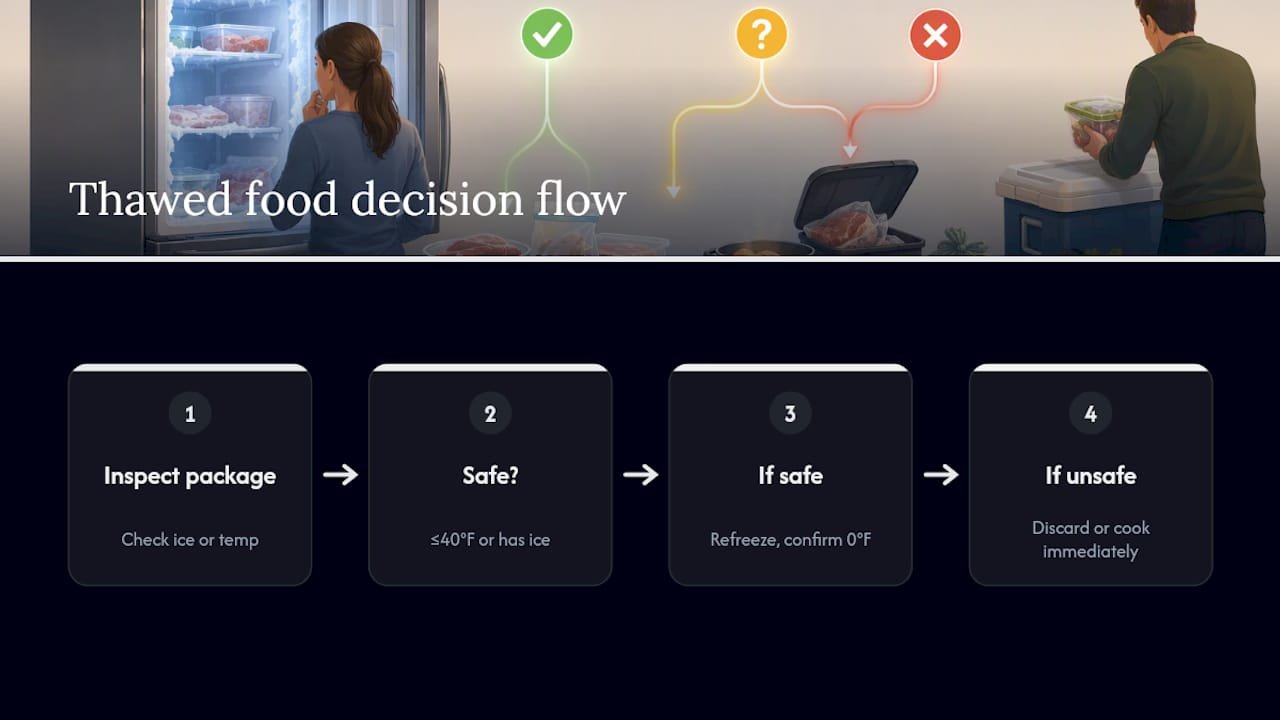
Don’t guess here. The FSIS rule is simple: any perishable food that’s been above 40°F for more than 2 hours should be thrown out, no exceptions for how it looks or smells.
Food safety threshold: according to FSIS, food that still contains ice crystals or has stayed at 40°F or below can safely be refrozen, which is good news if you catch the problem early.
Check each package individually rather than assuming the whole freezer is fine or ruined. Items still icy or cold to the touch are usually safe to refreeze; anything that feels warm or has been sitting for an unknown stretch of time is safer to discard or cook immediately. Before you refreeze anything you care about, confirm with your appliance thermometer that the unit is genuinely back down to 0°F, not just cold to the touch.
Keep it from happening again
A little routine maintenance goes a long way toward avoiding a repeat of this whole situation.
- Clean the condenser coils on a regular schedule, and check the door gasket periodically for gaps or tears.
- Avoid overpacking, keep the internal vents clear, and leave clearance around the unit so air can move freely.
- Defrost manual-defrost units before frost builds past about one-quarter inch, per Energy.
- Keep a standalone appliance thermometer in the freezer permanently so you catch drift early instead of after the fact.
Setting the freezer to 0°F and giving it a bit of breathing room around the back and sides does more for reliability than most people expect.
What we see on service calls
On most freezer calls, our technicians start the same way homeowners should: an independent thermometer, a look at the gasket and vents, then the coils, fans, and start relay in sequence. Most visits end one of two ways. Either it’s a same-day fix (a torn gasket, a dead fan motor, a frost buildup issue) or it turns into a diagnostic estimate for a sealed-system or compressor problem, which takes more specialized parts and time to resolve properly.
— MDTECH
Get your freezer checked without the guesswork
If you’ve worked through the checklist and the freezer still won’t hold 0°F, or the compressor sounds like it’s struggling, it’s time to bring in a technician rather than keep swapping parts on a guess. A local appliance repair service offers freezer diagnosis and repair with online booking across Orange County and Los Angeles County, backed by licensed technicians familiar with these symptoms.
Book a freezer repair appointment and get a technician looking at the actual problem instead of another round of troubleshooting.
Sources
- Should you repair or replace your broken refrigerator? | Consumer Reports
- Consumer guide to kitchen appliances | U.S. Department of Energy
- Appliance thermometers | Food Safety and Inspection Service (FSIS)
FAQ
How can I tell if my freezer is broken?
Check the temperature with a standalone appliance thermometer placed between frozen items and wait a few hours for an accurate reading. If it stays well above 0°F after you’ve cleared vents, checked the gasket, and cleaned the coils, the unit likely has a mechanical or electrical fault.
How do I reset my freezer?
Unplug the unit for about five minutes, then plug it back in and set the thermostat to its coldest practical setting. If nothing changes after a few hours, check the breaker and outlet before assuming a deeper fault.
Why is my freezer running but not cold?
A freezer that runs constantly but stays warm usually points to blocked airflow, frost-covered coils, or a fan that isn’t moving air properly. Dirty condenser coils are a common culprit, since they force the compressor to work without actually cooling the interior efficiently.
Can a freezer stop cooling while the fridge section keeps working?
Yes, since many combo units use separate evaporator fans or dampers for each compartment, so one side can fail while the other keeps running normally. If only the freezer side has stopped freezing, the fault is often isolated to that section’s fan, vent, or damper rather than the compressor itself.