
If your AC hums but won’t start, the condenser fan isn’t spinning, or you’re getting warm air with a slow, sluggish startup, a failing capacitor is the most likely cause. Turn the unit off and call a licensed HVAC technician before the compressor or fan motor takes on damage. These signs overlap with other faults, so a professional test is the only way to confirm it.
TL;DR:
- A failing capacitor can cause the outdoor condenser fan to stay still or produce humming sounds without starting, often leading to warm air and slow system startups.
- Visual signs such as a swollen, domed top or fluid leakage on the capacitor are strong indicators that replacement is needed before further damage occurs.
- Proper testing by a technician involves both visual and under-load measurements to confirm the capacitor’s microfarad rating, ensuring accurate diagnosis and replacement.
- Running the system with a bad capacitor increases the risk of overheating the motor and damaging the compressor, which is significantly more expensive to repair or replace.
- Regular maintenance, including keeping the unit clean and monitored, can extend capacitor lifespan, which typically ranges from 10 to 20 years, depending on environmental conditions.
Table of Contents
- What does an AC capacitor actually do?
- 1. Common symptoms that point to a failing capacitor
- 2. Visual signs and quick checks you can safely do
- 3. How technicians test a capacitor before replacing it
- 4. What happens if you keep running the unit anyway
- 5. How long capacitors last and what replacement costs
- 6. Maintenance that helps capacitors last longer
- 7. What a professional capacitor diagnosis looks like on-site
- What homeowners get wrong about capacitor symptoms
- Get your AC’s capacitor checked before it takes the compressor down with it
- Sources
- FAQ
What does an AC capacitor actually do?
Most residential air conditioners rely on two types of capacitors: a start capacitor, which gives the compressor or fan motor a jolt of torque to get moving, and a run capacitor, which keeps voltage steady while the motor operates. Many outdoor condenser units use a dual capacitor that handles both jobs for the fan motor and compressor in a single cylinder.
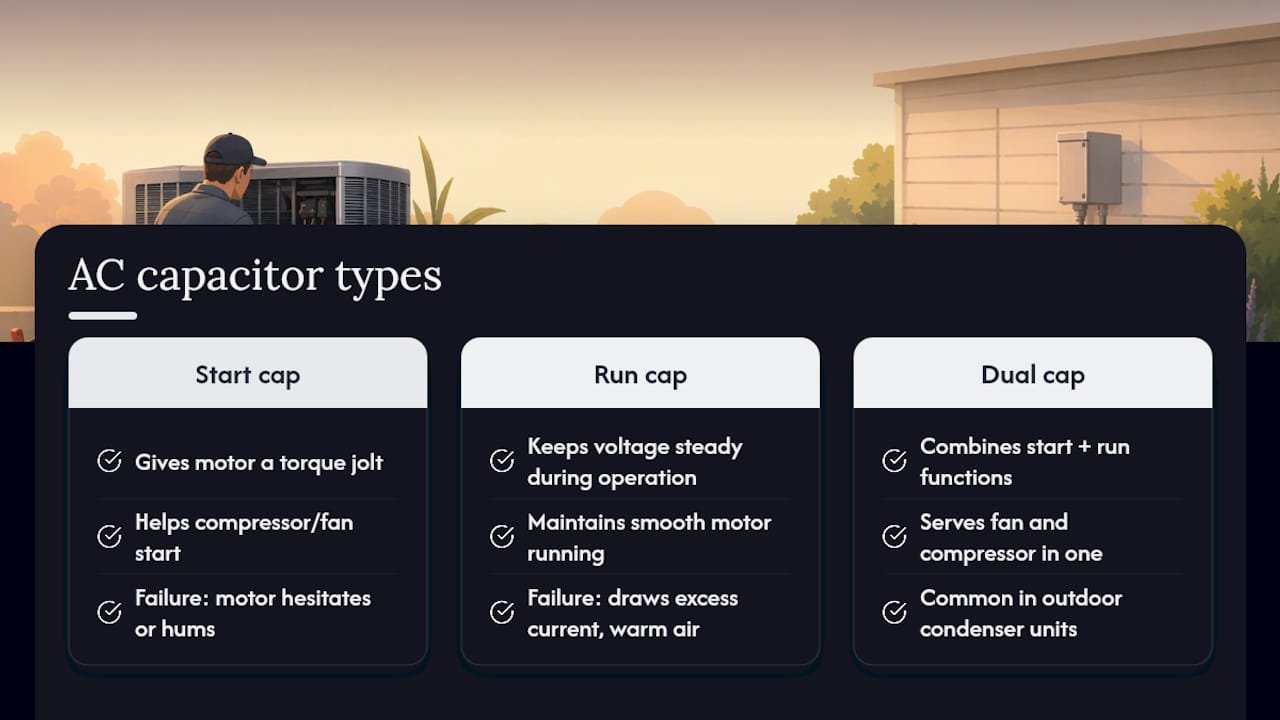
The Carrier technical guide on AC capacitors explains that these components store and release electrical energy to help motors start and run smoothly. When a capacitor weakens, it can’t deliver that torque, so the motor strains to spin. That strain shows up as humming, a fan that hesitates before turning, or a compressor that draws more current than it should. The result is the exact symptom list homeowners search for: no start, warm air, or a system that clicks and hums but goes nowhere. Once you understand this mechanical relationship, the symptoms stop looking random and start looking like clues pointing at one part.
1. Common symptoms that point to a failing capacitor
Not every symptom carries the same weight. Some are near-certain signs of a capacitor problem, while others could point to something else entirely. Here’s how to read them, ranked roughly by confidence.
- Humming but won’t start. The compressor or fan motor buzzes when the thermostat calls for cooling, but nothing spins. This is one of the clearest signs of capacitor failure, since the motor is getting power but not the starting torque it needs. Shut the system off at the thermostat and call a technician. Do not try to jump-start it or touch the outdoor unit’s panel.
- Condenser fan not spinning while the motor hums. Stand a safe distance from the outdoor unit and look for a fan blade that stays still despite the motor sound. According to Carrier’s guidance on a fan that won’t spin, a failed capacitor is a common cause, and running the system this way risks overheating the motor. Turn the unit off immediately rather than nudging the blade by hand.
- Warm or lukewarm air from the vents. This one is moderate confidence because a dirty filter, closed vents, or a low refrigerant charge can produce the same symptom. Check your thermostat setting and replace the filter first. If the air stays warm after that, treat the capacitor as a likely suspect and get it checked.
- Slow or delayed startup. If the system pauses, clicks, or takes several seconds longer than usual to kick on, note the behavior, including how long the delay lasts, so you can describe it to a technician. A weakening capacitor often shows this kind of hesitation before it fails outright.
- Frequent short cycling. A unit that turns on and off in short bursts instead of running a full cooling cycle may have a capacitor that can’t sustain steady voltage. Short cycling can also point to a thermostat or control board issue, so this symptom alone isn’t definitive, but it’s worth mentioning when you call for service.
- Tripping breaker or blown fuses. A struggling motor pulls more current than normal, which can trip a breaker or blow a fuse repeatedly. If this happens more than once, don’t just reset the breaker and move on. Repeated trips are a sign of a real electrical problem, and a bad capacitor is one of the more common culprits.
- Higher energy bills with no other explanation. A weakening capacitor forces the compressor and fan motor to work harder, which quietly drives up energy use before the unit fails outright. If your cooling costs have crept up without a change in habits or weather, it’s worth adding this to the list of clues rather than dismissing it.
None of these symptoms confirms a bad capacitor on its own. Together, though, they build a pattern that a technician can verify quickly with the right tools.
2. Visual signs and quick checks you can safely do
Before calling for service, there are a few things you can rule out yourself without opening any electrical panel.
- Confirm the thermostat is set to cool and the temperature is actually below room temperature.
- Check your breaker panel to see if the AC circuit has tripped, and reset it once, no more.
- Walk around the outdoor unit and clear away leaves, grass clippings, or debris blocking airflow.
- From a few feet away, look at the capacitor’s housing (usually visible through the service panel vents) for a top that looks swollen or domed instead of flat.
- Look for oily residue or seepage near the base of the unit, which can indicate internal leakage.
- Note any burnt smell or unusual discoloration around the electrical compartment.
A bulging or leaking capacitor is a strong physical warning sign. Carrier’s technical resources identify a swollen, domed top and fluid leakage as clear indicators that a capacitor has failed internally and needs replacement.
If you see any of these signs, shut off the outdoor unit at the disconnect switch or breaker and stop troubleshooting. Never touch, probe, or attempt to discharge a capacitor yourself. Even with the power off, a capacitor can hold a dangerous electrical charge, and that job belongs to a trained technician with the right tools.
3. How technicians test a capacitor before replacing it
A visual check tells you something might be wrong. A proper test tells you for sure. Technicians typically use two methods.
- Bench testing: the capacitor is disconnected from the system and measured with a capacitance meter to check its microfarad (MFD) rating against the number printed on its label.
- Under-load testing: the capacitor stays connected while the system runs, and the technician measures amp draw, then applies the formula amps multiplied by 2,652 and divided by volts to estimate real-world capacitance.
According to HVAC School’s breakdown of capacitor testing, under-load readings tend to be more realistic because they reflect how the capacitor performs under actual motor torque demands, not just in isolation. Technicians judge results against a tolerance range, commonly plus or minus 6 to 10 percent of the rated MFD. A reading that drifts outside that window signals a capacitor on its way out, even if the system still limps along.
Matching the replacement matters just as much as the diagnosis. The new capacitor needs the same MFD rating and a voltage rating equal to or higher than the original, never lower.
Pro Tip: If your system shows more than one symptom at once, such as warm air and short cycling, don’t assume it’s the capacitor alone. Airflow and refrigerant charge issues can look similar, which is why a systematic diagnostic check that rules out filters and charge levels first prevents a misdiagnosis.
4. What happens if you keep running the unit anyway
Running an AC system on a failing capacitor doesn’t just risk an inconvenient breakdown. It risks a much more expensive one. When a capacitor can’t deliver stable voltage, the compressor or fan motor pulls higher amperage to compensate, and that extra strain generates heat inside components that were never built to run that hot for long. Carrier’s guidance on a stalled condenser fan points out that a motor forced to run without proper capacitor support can overheat and suffer damage that a simple part swap won’t fix.
A capacitor is one of the least expensive parts in the whole system. A compressor or fan motor is one of the most expensive to replace, in some cases costing more than the rest of the repair combined. Read more on what compressor failure looks like and how it happens if you want the fuller picture of what’s at stake.
The safest move when you suspect a bad capacitor is simple: shut the unit off and stop using it until it’s inspected. A short wait for a technician costs far less than a motor replacement.
5. How long capacitors last and what replacement costs
Most residential AC capacitors last between 10 and 20 years, though that range shrinks fast under the wrong conditions. Heat is the biggest factor: capacitors installed in units that run constantly through hot summers, or that sit in direct sun with poor airflow around the outdoor unit, tend to degrade faster than the same part in a shaded, well-ventilated installation. Age alone also plays a role, since the internal materials break down gradually even in a well-maintained system.
Capacitors are widely treated as a low-cost wear item, cheap enough that many technicians recommend proactive replacement once test readings drift outside tolerance rather than waiting for full failure. Exact pricing depends on your system’s capacitor size, your region, and whether other repairs are needed at the same time, so getting a local quote is the only way to know your real number. If you’re weighing a capacitor swap against a bigger repair decision, this breakdown of repair versus replacement trade-offs can help frame the choice.
6. Maintenance that helps capacitors last longer
A capacitor’s lifespan isn’t fixed. Heat exposure, dust buildup, and electrical strain all shorten it, and most of those factors respond well to routine care.
- Keep the area around your outdoor unit clear of leaves, mulch, and overgrown plants so air can move freely.
- Change or clean your indoor air filter on a regular schedule to keep the system from overworking.
- Where possible, keep the condenser shaded during peak afternoon sun without blocking its airflow.
- Schedule a professional tune-up annually so a technician can clean the coils, check electrical connections, and measure capacitor MFD readings before they drift out of range.
If your system is more than 10 years old, or you’ve noticed any of the moderate-confidence symptoms above more than once, it’s worth scheduling an inspection now rather than waiting for a full breakdown. A full seasonal checklist is covered in this HVAC maintenance guide if you want to build the habit into your yearly routine.
7. What a professional capacitor diagnosis looks like on-site
When a technician arrives for a suspected capacitor issue, the process follows a set order: a visual inspection of the capacitor’s housing, a safe power disconnect at the breaker or service switch, then bench or under-load testing to confirm the actual MFD reading against the nameplate rating. Every step happens with the capacitor properly discharged first, since even a powered-down unit can hold a dangerous charge.
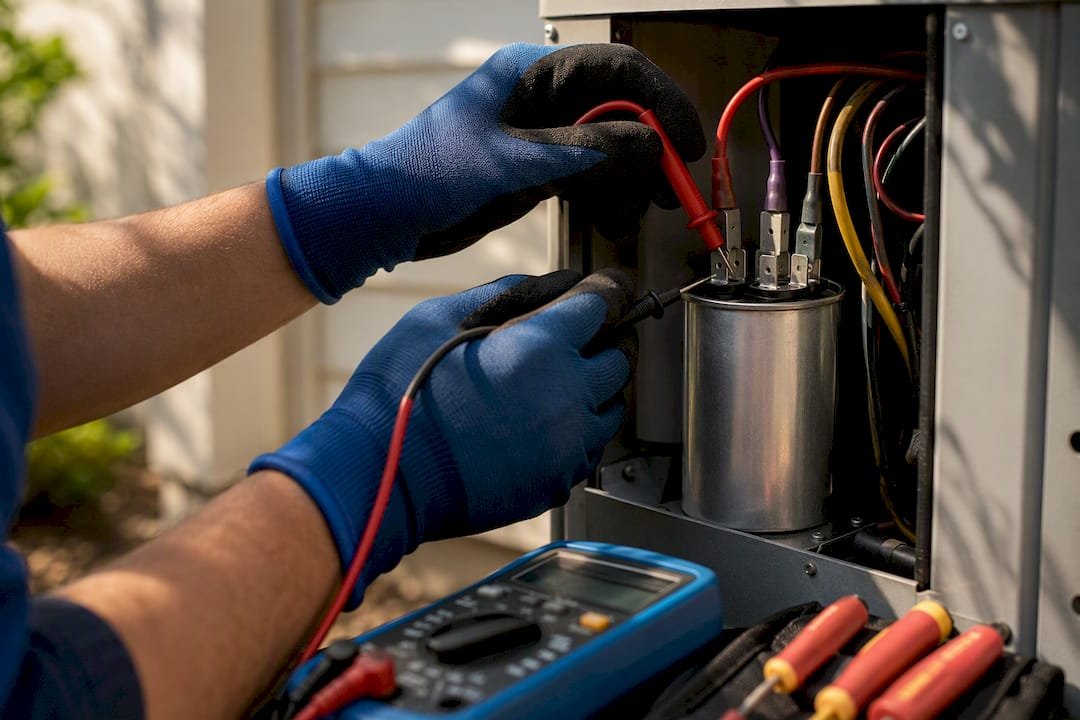
If replacement is needed, the technician matches the new part’s MFD rating exactly and confirms the voltage rating is equal to or higher than the original, never lower. A clear quote should spell out parts and labor separately so you know exactly what you’re paying for and why. That transparency, paired with careful measurement at every step, is what separates a proper repair from a guess.
What homeowners get wrong about capacitor symptoms
The biggest mistake homeowners make isn’t ignoring symptoms. It’s treating any single symptom as proof and skipping the professional test that actually confirms it. Warm air alone gets blamed on the capacitor when the filter is really the culprit. A tripped breaker gets reset over and over without anyone asking why it keeps happening.
The checklist above works best as a pattern, not a single trigger. Humming without a start and a motionless fan are about as close to certain as symptoms get. Warm air, slow starts, and short cycling deserve attention, but they earn a filter check and a thermostat glance before you assume the worst. What matters most is the discipline to stop using the system the moment you suspect a capacitor problem, rather than running it a few more days to see if it clears up on its own. That habit, more than any single symptom, is what keeps a cheap repair from turning into a compressor replacement.
— MDTECH
Get your AC’s capacitor checked before it takes the compressor down with it
A weak capacitor rarely announces itself clearly, and the cost of guessing wrong is a lot higher than the cost of a proper test. Technicians typically follow the same sequence outlined above on every call: safe power disconnect, bench and under-load testing, and a replacement part matched to the exact MFD and voltage rating the system needs, no shortcuts.
If your AC is humming without starting, blowing warm air, or tripping breakers, our air conditioning repair service covers diagnosis and capacitor replacement across Orange County and Los Angeles County. For systems where the capacitor issue turns out to be a symptom of a larger installation problem, our air conditioning installation services team can also walk you through your options. Book a visit and get a clear, itemized quote before any work begins.
Sources
- What is an AC capacitor? | Carrier
- Capacitor testing and replacement – HVAC School
- Measure Guide: Air Conditioning Diagnostics | Building America
FAQ
Will an AC still run with a bad capacitor?
It might limp along briefly, but running it risks overheating the compressor or fan motor. Carrier’s guidance recommends shutting the system off and getting a professional diagnosis rather than continuing to operate it.
What is the average lifespan of an AC capacitor?
Most residential AC capacitors last between 10 and 20 years, though heat exposure and constant use can shorten that range. Regular professional maintenance helps catch a weakening capacitor before it fails outright.
How much does it cost to replace a capacitor in an AC unit?
Pricing depends on your system’s capacitor size, your local market, and labor rates, so there’s no single number that fits every home. Getting a local quote from a licensed technician is the most reliable way to know your actual cost.
How long after replacing an AC capacitor will it work?
A correctly matched replacement typically restores normal startup and cooling immediately once the technician confirms the new part’s readings under load. Technicians re-check the capacitance and amp draw right after installation to verify the fix worked before they leave.