
Energy Star appliances are worth the extra upfront cost for anything you run daily, and especially for anything replacing a unit older than 10 years. The EPA estimates households save around $450 a year by choosing certified models over standard ones. Refrigerators, washers, HVAC systems, and water heaters recover that price gap fastest. Before you buy, check local rebates. They can shrink the payback window by months.
TL;DR:
- Refrigerators, water heaters, and HVAC systems show the fastest payback periods when upgraded to Energy Star models, often recouping costs within a year.
- Local rebates can significantly reduce the purchase price, with some offerings exceeding a few hundred dollars per appliance, boosting overall savings.
- Replacing appliances over 10 years old can reduce energy use by up to 50%, accelerating the return on investment for qualifying units.
- Proper installation and regular maintenance are crucial to ensure appliances perform at their rated efficiency and maximize long-term savings.
- Repairing a young appliance with a single issue is usually more cost-effective than replacing it, unless it has already faced multiple failures or is past its expected lifespan.
Table of Contents
- Energy Star vs Standard: What the Certification Actually Verifies
- What You’ll Actually Save, and How Payback Works
- Which Appliances to Upgrade First
- Finding Rebates and Tax Credits Before You Buy
- Repair or Replace: A Quick Decision Checklist
- Why Installation and Maintenance Decide Whether You Actually See the Savings
- Getting the Full Value Out of an Energy Star Upgrade
- Sources
- FAQ
Energy Star vs Standard: What the Certification Actually Verifies
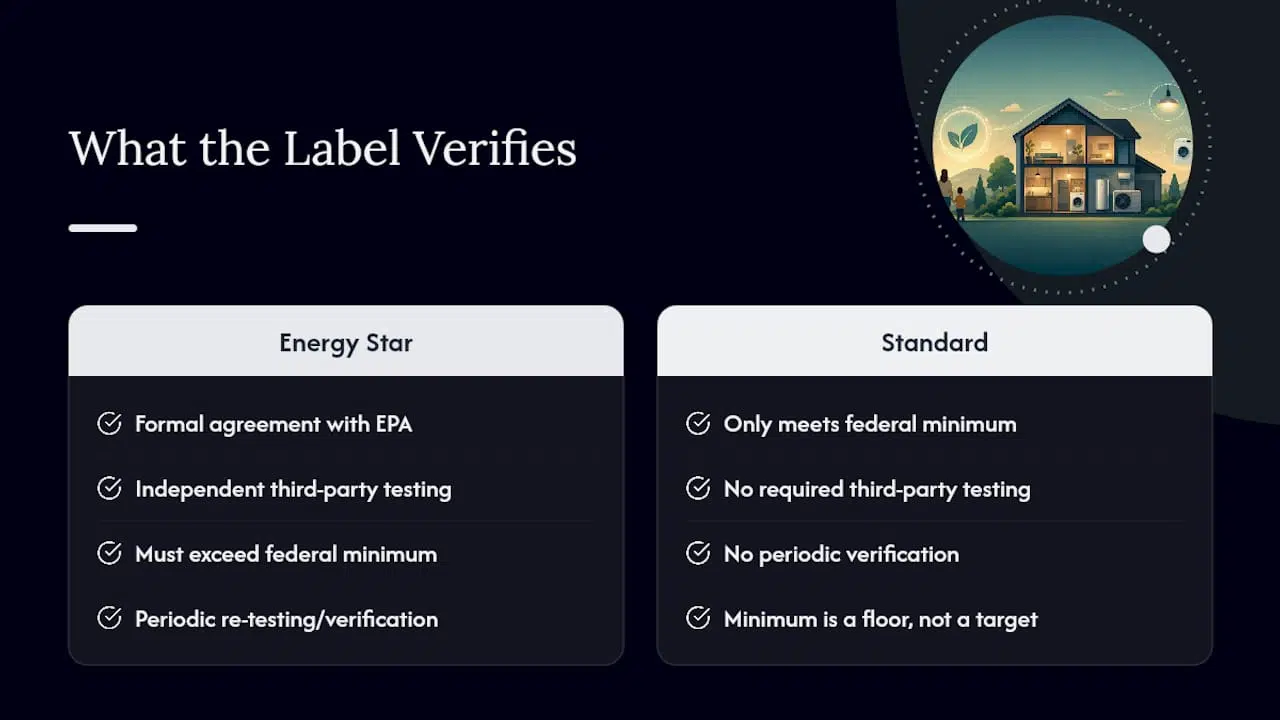
The label on that dishwasher isn’t a marketing sticker. Energy Star is a joint program run by the EPA with support from the Department of Energy, and every certified product has to clear a real bar before it earns the badge. Manufacturers sign a formal agreement with the EPA, then submit models for independent third-party testing and verification before anything gets labeled.
That’s the core difference in the energy star vs standard comparison: standard appliances only have to meet the federal minimum efficiency standard, which is a floor, not a target. Energy Star models have to beat that floor by a set margin, and they get checked again periodically to make sure they still do. Since 1992, the program has helped households and businesses save more than $500 billion in energy costs nationwide.
For a homeowner standing in a Best Buy aisle comparing two washers that look nearly identical, that verification is the whole point. You’re not trusting a brand’s claim about efficiency. You’re trusting a federal testing protocol that doesn’t care which logo is on the machine.
What You’ll Actually Save, and How Payback Works
The EPA’s $450-per-year household figure is an average across a full mix of appliances and habits, not a guarantee for any single purchase. A single retiree replacing one 15-year-old refrigerator won’t see $450. A family of five running the washer, dryer, dishwasher, and AC hard every day might see more.
Pro Tip: Run your own numbers before you shop. Pull your last utility bill, note what you’re paying per kilowatt-hour, and multiply that against the appliance’s estimated annual kWh use listed on its Energy Guide label.
Payback speed depends on a handful of variables that matter more than the sticker price gap:
- Local electricity and gas rates (higher rates mean faster payback)
- How often the appliance runs (a fridge that’s always on pays back faster than a dryer used twice a week)
- The age and condition of the unit being replaced
- Whether a rebate or tax credit knocks down the purchase price
Here’s the number that surprises most homeowners: a heat pump water heater that carries Energy Star certification can use less than half the energy of a standard electric water heater, saving a family of four roughly $320 a year. That’s one appliance category where the upgrade often pays for itself before the warranty even runs out.
Which Appliances to Upgrade First
Not every Energy Star upgrade delivers the same return. Some categories barely move the needle. Others change your bill noticeably within the first year. Here’s how they stack up.
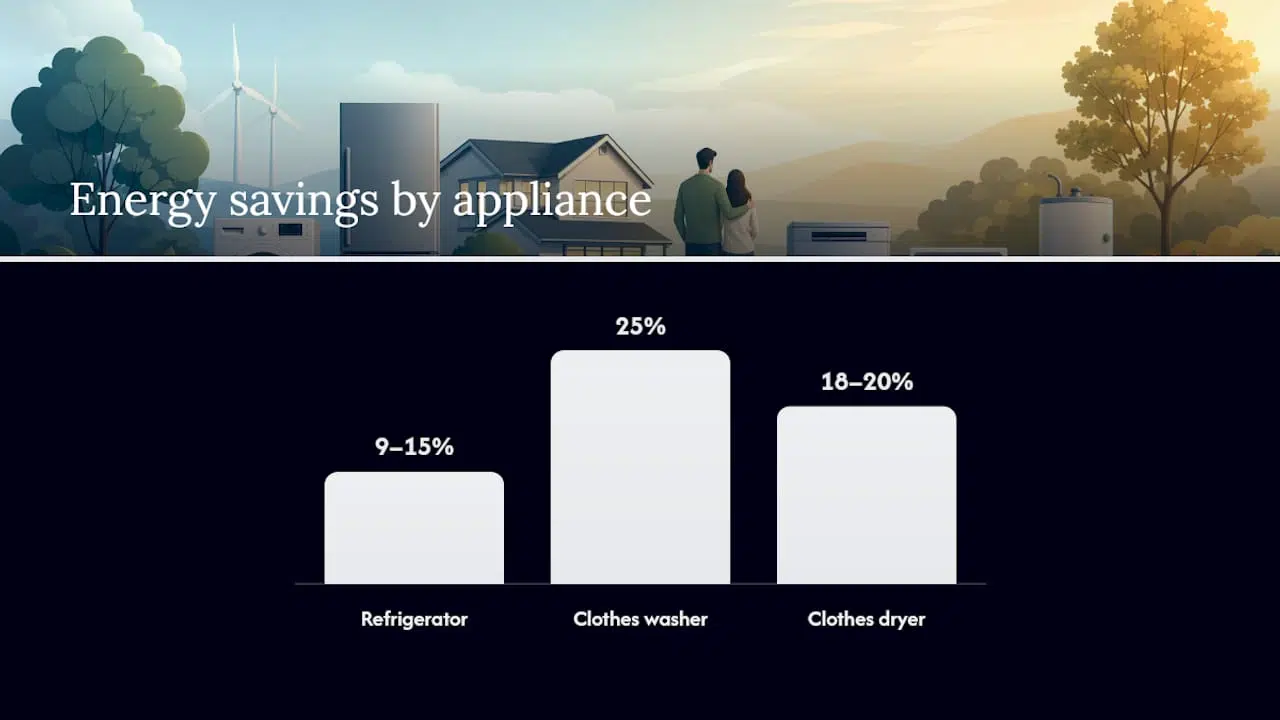
- Refrigerators. Certified models run roughly 9 to 15% more efficient than units that just meet the federal minimum. Since a fridge runs continuously, this is one of the highest-value swaps you can make, especially if yours predates 2010.
- Clothes washers. Certified washers use about 25% less energy and 33% less water than standard machines. Front-load owners tend to see the biggest jump.
- Clothes dryers. Certified dryers use about 18 to 20% less energy than standard models, largely thanks to better moisture sensors that shut off the cycle sooner instead of over-drying.
- Dishwashers. Efficiency gains here are real but smaller than washers or fridges. It’s a fine upgrade during a kitchen remodel, but rarely worth replacing early on its own.
- Heat pump water heaters. As noted above, this category delivers some of the fastest paybacks in the entire appliance lineup.
- Central AC and heat pumps. HVAC savings vary widely by climate and home size, but for anyone in a hot climate running the system most of the day, this is a high-priority replacement.
Pro Tip: If you’re choosing between two aging appliances to replace this year, replace whichever one runs the most hours per week. A unit that’s on constantly, like a fridge or an AC compressor, will always out-earn its purchase price faster than one used a few hours a week.
The general rule: anything over 10 years old is worth replacing first, since older units often use 30 to 50% more energy than a current certified model doing the same job.
Finding Rebates and Tax Credits Before You Buy
The math changes fast once incentives enter the picture. Local utility rebates commonly range from around $50 to several hundred dollars per appliance, and high-impact equipment like heat pump water heaters or HVAC systems sometimes qualifies for larger incentives on top of federal tax credits for qualifying equipment.
Start with the ENERGY STAR rebate finder, which lists active utility programs by zip code. A few practical steps before you commit to a purchase:
- Search your zip code on the rebate finder and note which specific models qualify, not just the appliance category.
- Call the retailer or manufacturer to confirm the exact model number is on the qualifying list. Rebate programs are picky about this.
- Ask whether the utility rebate can be stacked with a federal tax credit. It often can.
- Save your receipt and the Energy Guide label. You’ll need both for tax filing and any rebate paperwork.
Stacking incentives can turn a purchase that looked marginal on paper into a clear financial win, particularly for bigger-ticket equipment like water heaters and HVAC systems.
Repair or Replace: A Quick Decision Checklist
Not every appliance problem means it’s time to shop. Here’s the order to work through it:
- Check the age. Under 8 years and still under warranty? Repair almost always wins.
- Get a repair quote and compare it against the price of a new Energy Star model, factoring in installation.
- Estimate the annual energy savings using your utility rate and the new unit’s Energy Guide label.
- Check the rebate finder and any available tax credits for the replacement model.
- Factor in how many more years you plan to stay in the home. Short timeline, favor the cheaper fix.
Pro Tip: Break-even math needs to include installation and setup costs, not just the sticker price. A water heater that “pays back” in three years on paper can stretch to four or five once delivery, disposal, and professional installation are added in.
Repair makes sense for a young appliance with one isolated issue. Replacement makes sense once you’re facing your second or third repair call in two years on a unit that’s already past its expected lifespan.
Why Installation and Maintenance Decide Whether You Actually See the Savings
A certified appliance only performs at its rated efficiency when it’s installed and maintained correctly. Improper HVAC installation, for example, can quietly erode the efficiency gains you paid for. Routine maintenance preserves that rated performance over time and can push back the date you need to replace anything at all. If you’re planning a major appliance or HVAC swap, it’s worth having a licensed technician confirm the setup before you assume you’re getting the numbers on the label.
— MDTECH
Getting the Full Value Out of an Energy Star Upgrade
Buying the certified model is only half the equation. A refrigerator, water heater, or AC unit hits its rated efficiency numbers only when it’s installed correctly, and that’s where a lot of homeowners quietly lose part of the savings they paid for. Appliancesrepairmdtech works throughout Orange County and Los Angeles County getting new appliances and HVAC systems set up right the first time, so the efficiency you bought on paper shows up on your actual utility bill.
If you’re leaning toward replacing an aging refrigerator, washer, or AC unit, our appliance installation services cover proper setup for major brands, including gas conversions and electrical hookups that DIY installs commonly get wrong. Still on the fence about repair versus replacement? Our appliance repair team can give you a straight read on whether your current unit is worth fixing before you spend money on something new. Check your local rebates first, then reach out to schedule an installation or a repair quote.
Sources
The savings figures throughout this guide come directly from EPA’s ENERGY STAR Impacts page and its product certification standards. For rebate eligibility in your area, the ENERGY STAR rebate finder stays current with local utility programs. Homeowners planning a replacement can also review our guide on energy-saving appliances for 2026.
- ENERGY STAR Impacts | ENERGY STAR
- Consumer Messaging Guide for ENERGY STAR Certified Appliances
- ENERGY STAR rebate finder
FAQ
Are Energy Star Appliances Worth It?
For appliances you run often, like refrigerators, washers, and HVAC systems, yes. The EPA estimates households save about $450 a year on average by choosing certified models, and that gap widens further with a local utility rebate.
How Long Does It Take an Energy Star Appliance to Pay for Itself?
It depends heavily on usage, local electricity rates, and whether you claim a rebate. High-use appliances like refrigerators and heat pump water heaters, which can save a family of four roughly $320 a year over a standard electric water heater, tend to pay back fastest.
Is There a Real Difference Between Energy Star and Non Energy Star Appliances?
Yes. Standard appliances only meet the federal minimum efficiency standard, while Energy Star models have to clear a higher bar confirmed through independent third-party testing. Certified clothes dryers, for instance, use about 18 to 20% less energy than standard models.
Does MDTECH Install Energy Star Appliances?
Yes. Appliancesrepairmdtech offers appliance installation services across Orange County and Los Angeles County, including setup for major and luxury brands. Pricing depends on the appliance and installation complexity, and current details are available on the site.
Should I Repair or Replace an Appliance to Get Energy Star Savings?
If the appliance is under 8 years old with one isolated problem, repair usually makes more financial sense. If it’s over 10 years old or facing repeated failures, replacing it with an Energy Star model typically saves more over time, especially once rebates are factored in.