
Most homeowners will pay a diagnostic fee before a single repair is made. This charge, also called a service-call fee, covers the technician’s trip to your home, the time spent inspecting the appliance, and the testing needed to pinpoint the fault. According to the Appliance Repair Cost Guide, the typical U.S. residential diagnostic fees generally fall within a range from about $60 to $180. That fee exists whether or not you approve the repair.
Before you book, confirm three things:
- Is the diagnostic fee credited toward the repair? Some companies apply the diagnostic fee toward the repair cost if you approve work; others retain the fee regardless.
- Will you receive a written estimate before work begins? Verbal quotes leave you exposed.
- Are there after-hours, travel, or specialty-appliance surcharges? These can push a $120 base fee well past $200.
Companies like MDTECH Appliance Repair (Appliancesrepairmdtech) build these answers into their booking process. HomeGuide’s cost data puts the typical service-call charge at $75–$125 on routine jobs, which is a useful sanity check when comparing quotes.
Key Takeaways
The diagnostic fee for appliance repair typically runs $60–$180, and whether it is credited toward your repair bill is the single most important policy question to ask before booking.
| Point | Details |
|---|---|
| Typical fee range | Most U.S. residential diagnostic fees fall between $60 and $180, with a common midpoint near $120. |
| Credit-toward-repair policy | Ask before booking: many companies credit the fee toward repair if you approve; some retain it regardless. |
| Written estimate required | Demand an itemized written estimate covering parts, labor, travel, and any surcharges before approving work. |
| Specialty appliance surcharges | Built-in, luxury, and sealed-system appliances often push fees toward the high end of the range or beyond. |
| Appliancesrepairmdtech | Credits the diagnostic fee toward repair when approved and provides a written, itemized estimate on every visit. |
Table of Contents
- How companies structure the diagnostic fee for appliance repair
- What a diagnostic fee actually covers, and what it does not
- Typical diagnostic fee ranges by appliance type
- When diagnostic fees are credited, retained, or waived
- What a fair written estimate must show before work begins
- Red flags that a diagnostic fee or estimate may be unfair
- Questions to ask before you book a diagnostic visit
- How Appliancesrepairmdtech handles diagnostic fees and transparency
- Why transparent diagnostics are the only honest way to do this
- Book a diagnostic visit with Appliancesrepairmdtech
- Sources
How companies structure the diagnostic fee for appliance repair
Not every company bills the same way, and the pricing model shapes whether a quoted fee looks cheap or expensive once the invoice arrives.
Four models you will encounter:
- Flat diagnostic fee. A fixed charge for the visit and assessment, regardless of how long it takes. You pay it whether you approve repairs or not.
- Diagnostic fee credited toward repair. The same flat charge applies, but it is deducted from your repair bill if you approve work on the spot. This is the most common model among reputable residential companies.
- Time-and-materials. Labor is billed by the hour (typically $75–$150/hr, per InvoiceZap’s billing guide), plus the cost of parts. The diagnostic visit may be billed at the hourly rate for the first 30–60 minutes.
- Flat-rate repair pricing. The company quotes a fixed price for a defined job (e.g., replacing a washer pump), which bundles diagnosis and labor. This works in your favor when the repair is straightforward; it can be opaque when it is not.
Travel and after-hours charges sit on top of any of these models. A company might charge a $100 base diagnostic fee plus a $25 travel surcharge for locations outside their core service area, or a 20–50% premium for weekend and emergency calls.
Here is where the math gets interesting: a 30-minute diagnosis under a time-and-materials model at $100/hr costs you $50, while a flat diagnostic fee of $120 for the same visit looks more expensive until you realize the flat-rate company is also crediting that $120 toward your repair. The total cost after repair approval can be identical or lower with the higher-looking fee.
Pro Tip: A credited diagnostic fee is a genuine saving only if you were already planning to repair. If you are on the fence, ask whether you can take the written estimate away and decide later without losing the credit. Some companies allow a 24–48 hour window; others require same-day approval.
What a diagnostic fee actually covers, and what it does not
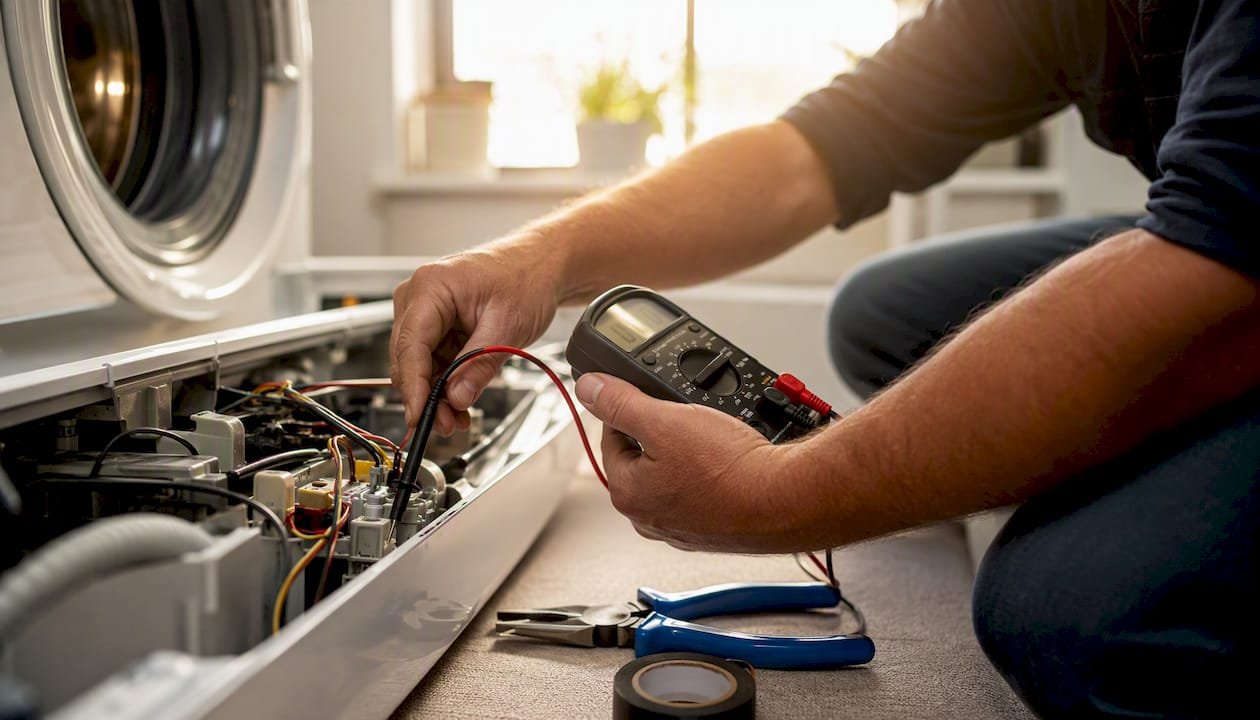
A standard diagnostic visit covers more than a technician glancing at your appliance. A thorough diagnostic typically takes 30–60 minutes and includes inspection, error-code reading, component testing with tools like a multimeter, and a repair estimate.
What is typically included:
- Travel to your home and the technician’s time on-site
- Visual inspection of the appliance and its connections
- Error-code retrieval (for digital appliances)
- Component testing (electrical continuity, motor function, sensor readings)
- A verbal or written repair estimate
What is typically NOT included:
- Parts and materials
- Actual repair labor beyond the diagnostic window
- Disposal or haul-away fees
- Permits (required for some gas-line or HVAC work)
- Disassembly charges for built-in or panel-ready units
A diagnostic visit is skilled labor, not a truck-roll fee. The technician arrives with calibrated tools, brand-specific knowledge, and the ability to distinguish a $40 door gasket failure from a $600 compressor fault. That distinction alone can save you from approving the wrong repair — or from replacing an appliance that only needs a minor fix.
Specialty appliances add a wrinkle. Built-in refrigerators, wine coolers, ice machines, and sealed-system units often require longer diagnostic windows and specialized equipment. Companies commonly charge at the upper end of the $60–$180 range for these, and some add a separate sealed-system testing fee on top. If your appliance is a luxury or built-in model, ask specifically whether the diagnostic fee covers sealed-system testing or whether that is billed separately.
Typical diagnostic fee ranges by appliance type
Fees vary by appliance because complexity, access, and required tools differ. The table below reflects typical U.S. residential ranges drawn from industry cost guides.
| Appliance | Typical Diagnostic Range | Primary Driver of Higher Fees |
|---|---|---|
| Refrigerator (freestanding) | $80–$150 | Sealed-system complexity, refrigerant tools |
| Refrigerator (built-in/panel) | $120–$180 | Access difficulty, longer disassembly time |
| Washer | $60–$180 | Control board diagnostics, drum access |
| Dryer | $60–$180 | Heating element testing, venting inspection |
| Dishwasher | $60–$180 | Water-inlet and pump testing |
| Oven / Range | $60–$180 | Gas-line safety checks, igniter testing |
| Wine cooler / Compactor | $60–$180 | Specialty refrigeration, limited service volume |
| Ice machine | $100–$180 | Water-line, sealed system, scale buildup |
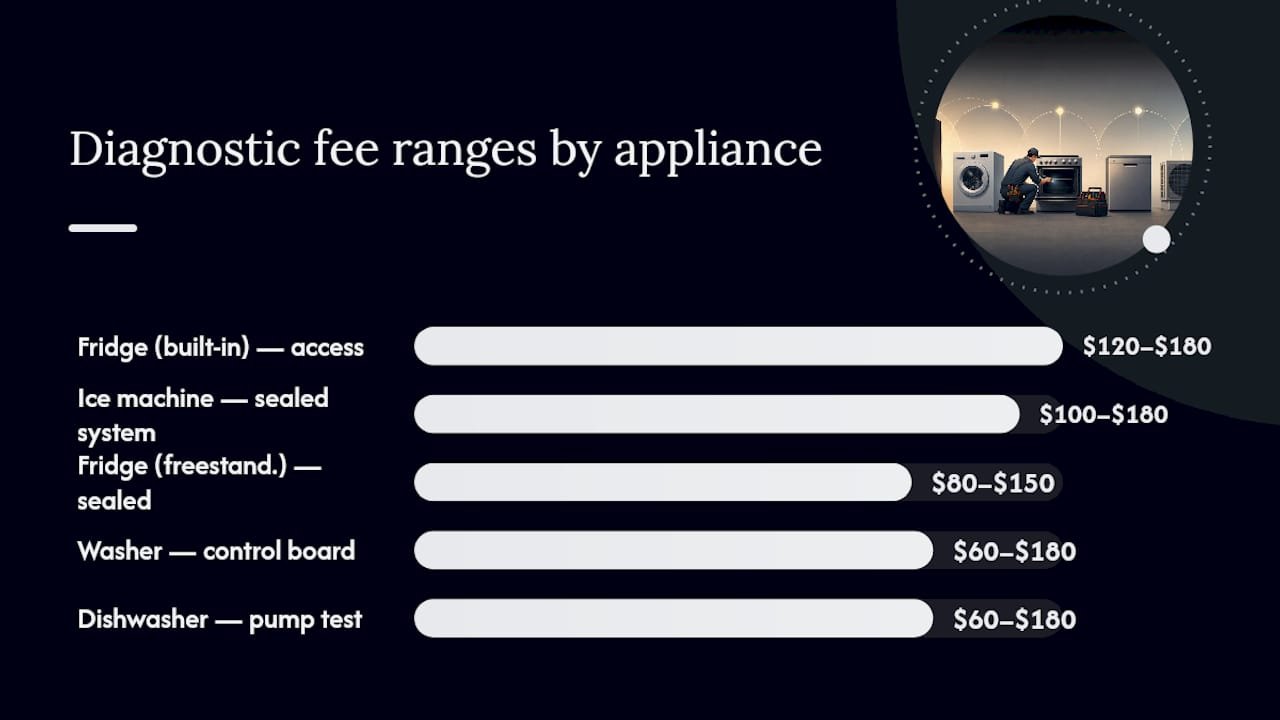
Refrigeration and sealed-system appliances consistently land at the high end. The tools required for refrigerant pressure testing are expensive, and the diagnostic itself takes longer because a leak or compressor fault requires multiple checks before a reliable verdict is possible. Industry trade sources confirm that luxury brands and built-in units further increase fees due to access complexity and brand-specific parts knowledge.
Factors that push any visit toward the high end of its range: after-hours or weekend scheduling, hard-to-reach installation locations (stacked units, tight alcoves), multi-appliance trips where each unit is assessed separately, and luxury brand models with proprietary diagnostic software.
Pro Tip: If a technician needs to order parts and return for a second visit, ask upfront whether a second service-call fee applies. Many companies waive the return-visit charge when the part delay is on their end; others bill a reduced trip fee. Get this in writing before approving the parts order.
When diagnostic fees are credited, retained, or waived
The credit-toward-repair policy is common but not universal, and the difference between a company that credits and one that retains can be $80–$150 on a single job. Here is how the three scenarios typically play out:
- You approve the repair on the spot. The diagnostic fee is credited against your repair bill. You pay only the difference between the diagnostic fee and the total repair cost.
- You decline the repair after diagnosis. The company retains the diagnostic fee. This is fair: the technician performed skilled work, and the fee compensates for that time regardless of your decision.
- Warranty or promotion work. Some manufacturers’ warranty programs cover the diagnostic fee entirely. Promotional offers (first-visit discounts, seasonal specials) may waive or reduce it. Always confirm whether your appliance is still under manufacturer warranty before booking a paid diagnostic.
Three scenarios worth knowing:
- Emergency same-day visit. Expect the full diagnostic fee plus an after-hours surcharge. The credit-toward-repair policy usually still applies, but confirm before the technician arrives.
- Routine non-urgent diagnosis. Standard fee, standard credit policy. The most predictable situation.
- Warranty-covered repair. The manufacturer or extended warranty may cover both the diagnostic and repair. Call your warranty provider first; booking through the wrong channel can void coverage.
To confirm the policy before you commit: ask directly whether the diagnostic fee is credited if you approve repairs, request that the answer appear on the written estimate, and ask what the refund or waiver conditions are if the technician cannot diagnose the problem on the first visit.
What a fair written estimate must show before work begins
A written estimate is not optional. It is the document that protects you from surprise charges and lets you compare quotes from different companies on equal terms. Itemized invoices covering diagnostic, parts, labor, and travel benefit both homeowners and technicians by making the pricing transparent and defensible.
A fair estimate should include all of the following:
- Diagnostic or service-call fee — stated as a dollar amount, with a clear note on whether it is credited toward repair.
- Itemized parts list — each part by name or part number, with its individual cost.
- Labor charge — either an hourly rate with an estimated time, or a flat-rate description for the specific job.
- Trip or travel charge — if applicable, listed separately so you can see it.
- After-hours or specialty surcharges — any premium for timing, appliance type, or access difficulty.
- Warranty on parts and labor — the duration and what it covers, in writing.
- Total estimate including taxes — a bottom-line number so you can make an informed decision.
If any of these lines are missing or vague (“labor: TBD”), ask for clarification before signing. A technician who cannot itemize parts has either not diagnosed the problem yet or is not planning to be transparent about markup. Either way, you need more information before approving work. For context on how repair costs affect broader homeowner decisions, having a clear written estimate also matters when you are weighing repair against replacement or preparing a home for sale.
Red flags that a diagnostic fee or estimate may be unfair
Most appliance repair companies are straightforward. A few are not, and the warning signs tend to cluster around the same practices.
Watch for these:
- Verbal-only estimates. If a technician refuses to put the quote in writing, walk away. No legitimate company should have a problem with a written estimate.
- Refusal to itemize parts and labor. A single lump-sum quote hides markup and makes warranty claims nearly impossible to enforce.
- Pressure to approve repairs immediately. A technician who insists you decide before they leave is not giving you time to think. Legitimate companies give you the estimate and let you call back.
- Unusually low diagnostic fee paired with vague pricing. A $30 diagnostic fee sounds great until the invoice shows $400 in parts at a 300% markup.
- No mention of warranty on parts or labor. Any company confident in its work backs it with a warranty. Silence on this point is a signal.
Pro Tip: Companies that advertise “free diagnostics” sometimes recover that cost inside inflated parts prices or labor rates. Industry analysis confirms that transparent, itemized fees actually reduce the incentive to oversell repairs. A clear $120 diagnostic fee from a company that credits it toward repair is often a better deal than a “free” visit from one that does not.
If you encounter any of these red flags, ask for a written estimate and a 24-hour window to decide. If the company refuses, decline the service and book elsewhere. Getting a second opinion on a diagnosis costs another diagnostic fee, but it is cheaper than an unnecessary $800 repair.
Questions to ask before you book a diagnostic visit
A two-minute phone call before booking can save you from a billing surprise. Use these questions as your script:
- “What is your diagnostic fee, and is it credited toward the repair if I approve work?” This is the single most important question. The answer tells you the pricing model and whether the fee is a sunk cost or an advance on repair.
- “Do you charge a separate travel or trip fee?” Some companies include travel in the diagnostic fee; others add it as a line item.
- “Are there after-hours or weekend surcharges?” If you need same-day service, know the premium upfront.
- “How do you bill labor: hourly or flat rate?” This affects your total cost significantly on longer jobs.
- “What warranty do you provide on parts and labor?” A reputable company will answer this without hesitation. Ninety days on labor and one year on parts is a reasonable baseline.
- “Will I receive a written estimate before any work begins?” The answer should always be yes.
When you call, listen for hesitation on the warranty and written-estimate questions. A company that stumbles on either one is telling you something about how it operates. You can also detect potential appliance issues yourself before calling, which helps you describe the problem clearly and reduces diagnostic time.
How Appliancesrepairmdtech handles diagnostic fees and transparency
Appliancesrepairmdtech serves homeowners across Orange County and Los Angeles County with a straightforward diagnostic-fee policy built around the practices homeowners should expect from any reputable company.
Standard practices:
- The diagnostic fee is credited toward the repair when you approve work.
- If you decline the repair after a thorough diagnosis, the fee is retained to compensate for the technician’s time and expertise.
- A written, itemized estimate is provided before any repair work begins, covering parts, labor, and any applicable surcharges.
- All technicians are licensed and carry brand-specific expertise across major appliance manufacturers.
- Repair work is backed by a warranty on both parts and labor.
What to expect on the day of service:
- The technician arrives within the scheduled window and confirms the diagnostic fee and credit policy before starting.
- The appliance is inspected, error codes are retrieved, and components are tested.
- A written estimate is presented with itemized parts, labor, and the diagnostic credit applied.
- You decide whether to approve repairs. No pressure, no same-day ultimatum.
For homeowners who want to understand the full diagnostic process before a technician arrives, Appliancesrepairmdtech publishes detailed guides on what the visit involves and how to prepare. Choosing insured and licensed technicians also protects you if something goes wrong during the repair.
Why transparent diagnostics are the only honest way to do this
The appliance repair industry has a trust problem, and it is not hard to see why. Homeowners call when something is broken, they are not experts in the equipment, and they often feel pressure to approve a repair they do not fully understand. A vague estimate or a verbal-only quote exploits exactly that dynamic.
At Appliancesrepairmdtech, the position is simple: a diagnostic fee should be a clear, stated charge that reflects real skilled labor, not a foot-in-the-door tactic. When a technician spends 45 minutes testing components, reading error codes, and ruling out secondary faults, that work has value regardless of whether you approve the repair. Charging for it honestly, crediting it when you do approve, and putting everything in writing is not a policy choice. It is the baseline for operating with integrity.
Book a diagnostic visit with Appliancesrepairmdtech
Appliancesrepairmdtech gives Orange County and Los Angeles County homeowners a diagnostic experience built on the exact practices this guide describes: a stated fee, a written itemized estimate, and a credit toward repair when you approve work.
What you get with every diagnostic visit:
- Diagnostic fee credited toward your repair when approved
- Written, itemized estimate before any work starts
- Licensed technicians with brand-specific expertise
- Warranty on parts and labor
- No same-day pressure to approve
Whether your refrigerator stopped cooling, your washer is mid-cycle and stuck, or you are weighing repair versus replacement, the first step is a reliable diagnosis from a technician who will show you exactly what the problem is and what it will cost to fix. Schedule your service visit today and get a written estimate before a single repair begins.
Sources
The following sources informed the pricing benchmarks, policy explanations, and billing guidance in this guide:
- Appliance repair cost guide — HomeGuide
- What Appliance Repair Diagnostics Cost – ITECH APPLIANCES
- Why Appliance Repair Companies Charge a Diagnostic Fee — Tech Angels
- Appliance Repair Invoice Template: Complete Billing Guide for Technicians | InvoiceZap