
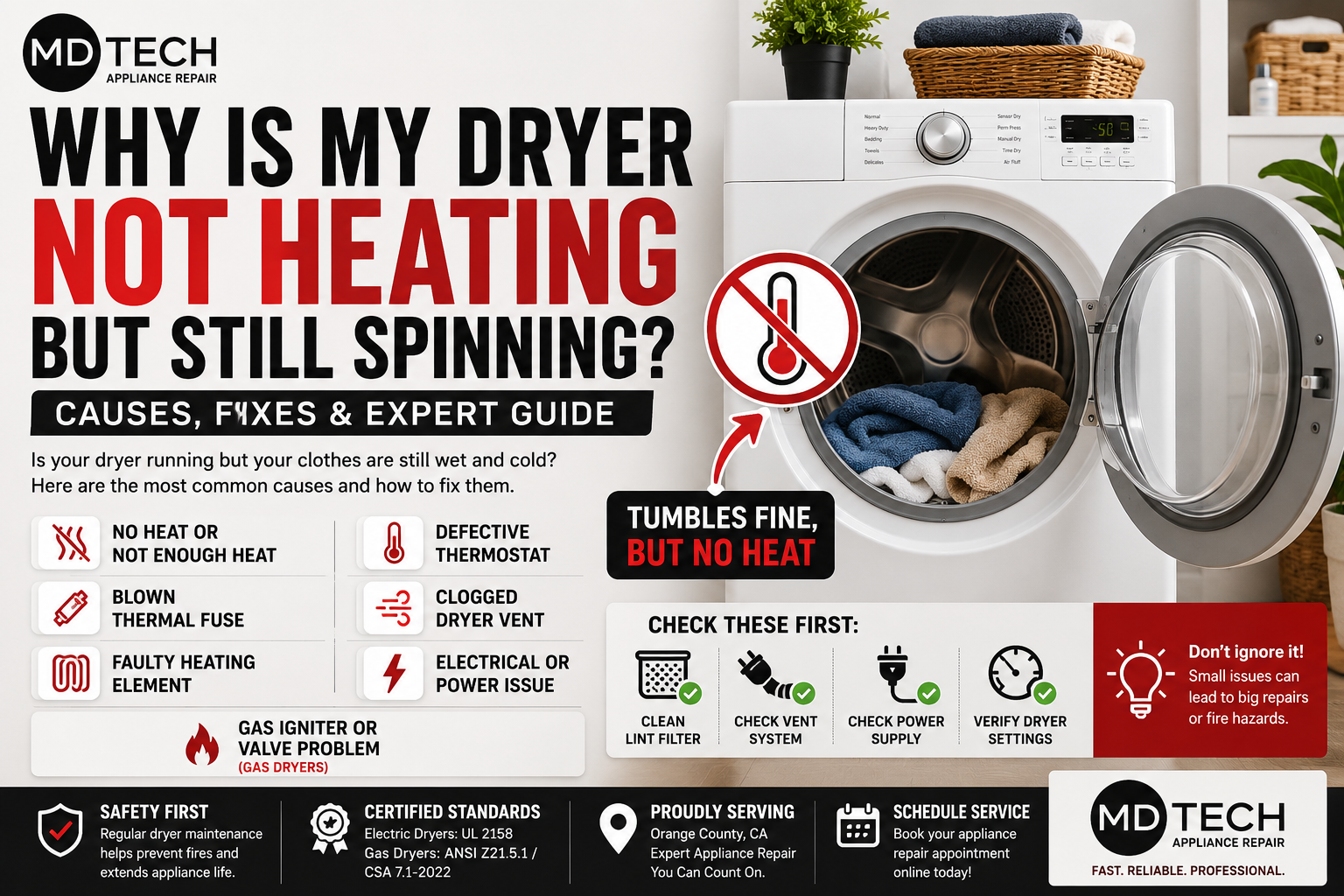
If you are asking, why is my dryer not heating but still spinning?, the most likely problem is with the dryer’s heating system, airflow, electrical supply, temperature controls, or gas ignition system. A dryer can tumble normally because the motor and drum system are working while the component responsible for producing heat has failed.
Common causes include a failed heating element, blown thermal fuse, defective thermostat, clogged dryer vent, restricted airflow, electrical supply problem, faulty igniter, damaged wiring, gas valve coil failure, or electronic control problem. The exact cause depends on whether your dryer is electric or gas.
Before replacing parts, it is important to diagnose the problem correctly. A dryer that spins but does not heat may have a relatively simple repair, but heating and ventilation problems should not be ignored.
If you need professional help, MDTECH provides washer and dryer repair services for homeowners who need help diagnosing appliance problems.
Quick Answer: Why Is My Dryer Not Heating but Still Spinning?
If your dryer is not heating but still spinning, the drum motor, belt, and controls may still be functioning while the heating system has failed.
The most common possibilities include:
- Failed electric dryer heating element
- Blown thermal fuse or thermal cut-off
- Defective operating thermostat
- Failed high-limit thermostat
- Clogged or restricted dryer vent
- Electrical supply problem
- Damaged wiring or connection
- Faulty gas dryer igniter
- Weak gas valve coils
- Flame sensor problem
- Electronic control-board failure
- Incorrect dryer cycle or temperature setting
Start with safe external checks such as the selected cycle, lint filter, visible exhaust duct, and outside vent airflow. If the dryer continues to tumble without producing heat, professional diagnosis can identify the failed component.
Never bypass a thermal fuse, thermal cut-off, or other safety component.
Key Takeaways
- A dryer can spin normally even when the heating system has failed.
- Electric dryers commonly use heating elements, thermostats, thermal fuses, and electrical controls.
- Gas dryers use components such as igniters, flame sensors, gas valve coils, and thermostats.
- A restricted dryer vent can reduce drying performance and contribute to excessive heat buildup.
- A blown thermal fuse can interrupt heating or operation depending on the dryer design.
- A failed heating element is a common cause of an electric dryer producing no heat.
- A gas dryer may tumble normally while its burner fails to ignite.
- An incorrect cycle can make a functioning dryer appear not to heat.
- Safety devices should never be bypassed.
- Regular lint-filter and exhaust maintenance supports proper dryer operation.
What Does It Mean When a Dryer Spins but Does Not Heat?
A clothes dryer contains several systems that work together but perform different jobs.
The motor turns the drum. The belt transfers power to the drum. Rollers and other mechanical components support drum movement. The blower moves air through the dryer. The heating system warms that air, while thermostats and sensors help regulate temperature. The exhaust system then removes warm, moist air.
Because these systems operate together but are not identical, one system can fail while another continues working.
That is why you can have a dryer where:
- The drum spins normally.
- The controls respond.
- The timer operates.
- The cycle starts and completes.
- Clothes remain damp.
- The exhaust air is cold or only slightly warm.
This symptom usually points toward the heating, airflow, electrical, gas ignition, or temperature-control system rather than the drum motor itself.
Common Reasons Your Dryer Is Not Heating but Still Spinning
1. Failed Heating Element
A failed heating element is a common cause of an electric dryer that spins but does not heat.
The heating element converts electrical energy into heat. Air passing through the heating assembly becomes warm before moving into the drum.
Over time, the heating coil can develop an internal break or burn out. When that happens, the dryer can continue tumbling even though no useful heat is being generated.
Typical symptoms include:
- Dryer starts normally.
- Drum spins normally.
- Controls work normally.
- Dryer completes a cycle.
- Clothes remain wet or cold.
- Little or no warm air comes from the exhaust.
A heating element can sometimes show visible damage, but visual inspection alone does not always prove that it is good or bad. Proper electrical testing is more reliable.
For additional reference, established appliance-service resources also identify the heating element as a common cause of a dryer that runs without producing heat. See Sears Home Services’ dryer-not-heating troubleshooting guide.
2. Blown Thermal Fuse
A thermal fuse is a safety component designed to respond to excessive temperature conditions.
Depending on the dryer model, a failed thermal fuse or thermal cut-off can interrupt part of the heating or operating circuit.
Thermal protection may be triggered by excessive heat, restricted airflow, vent problems, component failure, or another underlying issue.
If a thermal fuse fails, simply replacing it without investigating why it failed may allow the original problem to remain.
Never permanently bypass a thermal fuse or thermal cut-off.
3. Clogged Dryer Vent
A clogged or restricted dryer vent can cause poor drying performance and excessive heat buildup.
Dryers need adequate airflow to remove moisture from clothing and move warm air through the exhaust system.
Potential signs of restricted airflow include:
- Clothes require multiple drying cycles.
- Drying times have increased significantly.
- Outside airflow is weak.
- The dryer becomes unusually hot.
- Lint accumulates around the exhaust area.
- The dryer shuts down unexpectedly.
The U.S. Consumer Product Safety Commission’s dryer safety information specifically warns about overheated clothes dryers and recommends periodic cleaning of the dryer vent, exhaust duct, and lint screen or filter.
4. Faulty Operating Thermostat
The operating thermostat helps regulate dryer temperature.
If the thermostat fails, the dryer may heat inconsistently, shut off heating too early, overheat, or fail to maintain the expected temperature.
Because dryer designs differ, thermostat diagnosis should be based on the specific appliance model and manufacturer’s specifications.
5. Failed High-Limit Thermostat
The high-limit thermostat is another temperature-protection component.
If the dryer reaches abnormal temperatures, the high-limit system can interrupt heating to help protect the appliance.
If a high-limit thermostat fails, the cause of abnormal heating should also be investigated. A restricted vent, blower problem, or airflow issue can contribute to excessive temperatures.
Electric Dryer Not Heating but Still Spinning
An electric dryer can spin normally even when its heating circuit has a problem.
This can happen because the motor and heating element use different electrical paths. A dryer may therefore appear to operate normally while the heating circuit is not functioning.
Possible causes include:
- Failed heating element
- Blown thermal fuse
- Thermal cut-off failure
- Defective thermostat
- Damaged wiring
- Electrical connection problem
- Control-board problem
- Power-supply issue
Electrical dryer diagnosis can involve high-voltage circuits. Do not open electrical panels or perform live electrical testing unless you have the necessary training and equipment.
Gas Dryer Not Heating but Still Spinning
Gas dryers use a different heating system from electric models.
The drum can rotate normally while the gas burner fails to ignite.
Possible causes include:
- Failed igniter
- Defective flame sensor
- Weak gas valve coils
- Gas supply problem
- Thermal fuse failure
- Operating thermostat failure
- High-limit thermostat problem
- Ignition-system failure
- Restricted airflow
If you smell gas around the appliance, stop using the dryer and follow appropriate gas-safety procedures. Do not attempt unfamiliar gas-system repairs.
Why Is My Dryer Spinning but Not Heating on an Electric Model?
If an electric dryer spins but produces no heat, check the simple external causes first. Confirm that the dryer is set to a heated cycle and that the lint filter and visible exhaust path are not blocked.
If those checks do not resolve the problem, likely causes include the heating element, thermal protection, thermostat, electrical supply, wiring, or control system.
Professional diagnosis is useful because replacing a heating element when the actual problem is a thermostat, wiring issue, or airflow restriction wastes time and money.
Why Is My Gas Dryer Running but Not Heating?
A gas dryer that runs but does not heat may have an ignition or gas-control problem.
The igniter must operate correctly, the gas valve system must function, and the flame-sensing system must allow proper burner operation.
Weak gas valve coils can also create intermittent symptoms where the dryer heats initially but stops producing heat later in the cycle.
Gas dryer heating problems should be diagnosed carefully because they involve fuel and ignition components.
Check the Dryer Cycle and Temperature Setting
Before assuming that a component has failed, check the selected dryer cycle.
Some cycles intentionally use:
- Low heat
- Air fluff
- No heat
- Delicate temperatures
- Sensor-controlled heating
An air-only cycle can make a perfectly functioning dryer appear to have a heating failure.
Check the manufacturer’s instructions and confirm that an appropriate heated cycle has been selected.
Check the Lint Filter
The lint filter should be cleaned regularly.
ENERGY STAR’s clothes dryer guidance recommends cleaning the lint filter after every load to improve air circulation and dryer efficiency.
If dryer sheets are used, residue can accumulate on some filters and reduce airflow. ENERGY STAR recommends periodically cleaning the filter when necessary.
Remember that cleaning the lint filter does not guarantee that the entire exhaust system is clear. Lint can accumulate deeper inside the vent or exhaust duct.
Check the Outside Dryer Vent
If your dryer is designed to exhaust outdoors, check the exterior vent while the dryer is running.
There should normally be noticeable airflow leaving the exhaust.
Weak airflow can indicate:
- Blocked duct
- Crushed duct
- Kinked duct
- Lint buildup
- Exterior vent obstruction
- Improper installation
The CPSC recommends checking that the exterior vent flap opens while the dryer operates and that exhaust air can escape properly.
Why Dryer Ventilation Matters
Dryers remove moisture by circulating warm air through clothing and exhausting moisture-laden air.
If the exhaust path is restricted, drying times can increase and operating temperatures can become abnormal.
According to the CPSC’s dryer safety guidance, dryer vent, exhaust duct, and lint-screen maintenance is an important part of reducing dryer-fire risk.
For conventional vented dryers, the U.S. Environmental Protection Agency also provides indoor-air-quality guidance that includes outdoor venting requirements for conventional clothes dryers.
What You Can Safely Check Yourself
1. Confirm the Cycle
Make sure the dryer is not operating on an air-only or no-heat setting.
2. Clean the Lint Filter
Remove lint before or after every load according to the manufacturer’s instructions.
3. Check Exterior Airflow
Look at the exterior vent while the dryer is operating and check for obvious airflow problems.
4. Inspect the Visible Duct
Look for obvious crushing, kinks, disconnection, or visible obstruction.
5. Check for Unusual Odors
A burning smell should not be ignored.
6. Inspect the Visible Power Cord
For an electric dryer, look for visible damage to the power cord or plug.
7. Watch for Gas Odors
If you smell gas around a gas dryer, stop using the appliance and address the gas-safety concern immediately.
What You Should Not Do
Do Not Bypass the Thermal Fuse
A thermal fuse is a safety component. Never permanently bypass it simply to make a dryer heat.
Do Not Continue Using an Overheating Dryer
If the dryer becomes extremely hot, repeatedly shuts down, or produces a burning smell, stop operating it until the cause is identified.
Do Not Guess at Gas Repairs
Gas ignition and valve components require appropriate technical knowledge and safety procedures.
Do Not Replace Parts Randomly
Replacing multiple parts without testing can make a simple repair unnecessarily expensive.
Dryer Safety and Industry Standards
Dryer heating problems should not be treated only as a laundry inconvenience. Proper airflow, electrical safety, gas-system operation, and temperature control are important parts of safe appliance operation.
The CPSC provides specific safety information about overheated clothes dryers and recommends maintaining the lint screen, exhaust duct, and vent system.
For electric clothes dryers, UL 2158 is an active standard covering electric clothes dryers.
For Type 1 gas clothes dryers, the CSA/ANSI Z21.5.1-22 / CSA 7.1-2022 standard covers gas clothes dryers designed for applications including natural gas and LP gas.
These standards are references for appliance design and safety requirements. They should not be interpreted as a claim that an individual repair technician or company is certified under those standards.
Dryer Installation Can Affect Heating Performance
Installation can have a significant effect on dryer performance.
The appliance needs appropriate positioning, connections, clearance, and an effective exhaust path where required by the dryer design.
A crushed duct behind the dryer can restrict airflow. Poor vent routing can also increase drying times and affect operating temperatures.
MDTECH provides dryer installation services for homeowners who need professional installation assistance.
You can also review MDTECH’s step-by-step appliance installation guide for general information about appliance positioning, connections, venting, leveling, and testing.
For washer-and-dryer installations, see MDTECH’s washer and dryer installation service.
ENERGY STAR Dryer Efficiency Tips
Proper maintenance can improve dryer performance and help prevent unnecessary drying time.
- Clean the lint filter after every load.
- Clean the filter periodically if residue accumulates.
- Avoid unnecessary over-drying.
- Use moisture-sensor cycles when available.
- Avoid severely overloading the dryer.
- Maintain proper exhaust airflow.
- Follow the manufacturer’s maintenance instructions.
ENERGY STAR provides additional guidance on dryer efficiency, maintenance, and certified clothes dryers.
How Professional Dryer Repair Works
A professional dryer diagnostic should begin with the actual symptom instead of immediately replacing a part.
A technician may:
- Confirm the dryer brand and model.
- Verify the heating complaint.
- Check the selected cycle.
- Evaluate airflow.
- Inspect the exhaust system.
- Test thermal safety components.
- Test the heating element on applicable electric dryers.
- Test thermostats.
- Test ignition components on gas dryers.
- Inspect wiring and electrical connections.
- Evaluate control components.
- Test the dryer after repair.
This approach helps identify the actual failure rather than replacing parts based only on symptoms.
Dryer Repair vs. Dryer Replacement
| Situation | Repair May Make Sense | Replacement May Make Sense |
|---|---|---|
| Appliance age | Relatively newer | Very old |
| Failure | Single replaceable component | Multiple major failures |
| Repair history | Occasional problems | Repeated breakdowns |
| Cabinet condition | Good | Significant damage |
| Efficiency | Acceptable | Very inefficient |
| Repair cost | Reasonable | High relative to replacement |
A professional diagnosis can help you compare the expected repair cost with the dryer’s age, condition, efficiency, and expected remaining service life.
Common Dryer Symptoms and Possible Causes
| Dryer Symptom | Possible Causes |
|---|---|
| Spins but no heat | Heating element, thermal fuse, thermostat, electrical problem |
| Spins but heats intermittently | Thermostat, airflow, gas valve coils, control problem |
| Takes several cycles | Vent restriction, weak heating, airflow problem |
| Gets extremely hot | Restricted vent, thermostat issue, airflow restriction |
| Gas dryer spins but no heat | Igniter, flame sensor, gas valve coils, gas supply |
| Electric dryer spins but no heat | Heating element, thermal fuse, electrical supply |
| Dryer shuts off early | Sensor, airflow, thermostat, control problem |
| Burning smell | Lint, overheating, electrical or mechanical issue |
| Weak exterior airflow | Blocked or restricted exhaust |
Real-World Example: Dryer Spins but Clothes Stay Wet
Imagine an electric dryer that suddenly stops drying clothes.
The drum spins, the controls work, and the timer operates normally, but the clothes remain cold and damp.
A technician checks the dryer and discovers that the heating element has failed.
However, the technician also evaluates the exhaust system and discovers restricted airflow.
This second finding is important because replacing the heating element without addressing the airflow problem could leave the underlying issue unresolved.
The example demonstrates an important diagnostic principle:
Fix the cause, not just the symptom.
How to Prevent Dryer Heating Problems
Clean the Lint Filter
Clean the lint filter after every load and follow the manufacturer’s maintenance recommendations.
Inspect the Exhaust
Make sure the exterior vent opens and that exhaust air can flow properly.
Maintain the Vent System
Have the exhaust duct inspected if drying times increase or airflow becomes weak.
Avoid Overloading
Large loads can interfere with tumbling and airflow.
Do Not Ignore Long Drying Times
Longer drying times can be an early warning sign of restricted airflow or reduced heating performance.
Follow the Manufacturer’s Manual
Maintenance requirements and component access vary by dryer model.
When Should You Call MDTECH Appliance Repair?
If your dryer continues to spin but does not produce heat after basic external checks, professional diagnosis may be appropriate.
MDTECH Appliance Repair provides appliance repair and installation services for homeowners who need help with dryer heating problems, appliance installation, ventilation-related concerns, and other appliance issues.
See our washer and dryer repair services for more information.
If your problem involves a new appliance installation, visit our washer and dryer installation service.
If you need professional assistance, you can also schedule an appliance repair appointment online.
MDTECH Appliance Repair Trust & Business Information
MDTECH Appliance Repair is listed by the Better Business Bureau as a BBB Accredited Business with an A+ rating.
For more information about MDTECH and its appliance services, visit the MDTECH Appliance Repair website.
Frequently Asked Questions
Why is my dryer not heating but still spinning?
The most common possibilities include a failed heating element, thermal fuse, thermostat, restricted vent, electrical supply issue, gas ignition problem, or control-system failure. The exact cause depends on the dryer type and model.
Why is my electric dryer spinning but not heating?
An electric dryer can spin while the heating circuit has failed. Possible causes include a defective heating element, thermal fuse, thermostat, wiring problem, electrical supply issue, or control-board failure.
Why is my gas dryer spinning but not heating?
A gas dryer may tumble normally while its burner fails to ignite. Common causes include a defective igniter, flame sensor, gas valve coils, thermal component, or gas-supply problem.
Can a clogged dryer vent cause a dryer not to heat?
A restricted vent can significantly reduce airflow and cause poor drying performance and excessive heat buildup. The vent and exhaust system should be inspected when drying times increase or airflow becomes weak.
How do I know if my dryer heating element is bad?
A failed heating element may cause the dryer to tumble normally while producing little or no heat. Electrical testing is more reliable than visual inspection alone.
Can a thermal fuse cause a dryer not to heat?
Yes. Depending on the dryer design, a failed thermal fuse or thermal cut-off can interrupt part of the heating or operating circuit. The reason for the fuse failure should also be investigated.
Should I keep using a dryer that is not heating?
If the dryer simply produces no heat without other warning signs, basic external troubleshooting may be appropriate. Stop using the dryer if you notice burning smells, unusual overheating, damaged wiring, repeated shutdowns, or gas odors.
How often should I clean my dryer lint filter?
The lint filter should generally be cleaned after every load. ENERGY STAR recommends cleaning the lint filter after every load to improve air circulation and dryer efficiency.
How often should a dryer vent be cleaned?
The appropriate frequency depends on dryer use, vent configuration, duct length, and airflow. If drying times increase or exterior airflow becomes weak, the exhaust system should be inspected and cleaned as appropriate.
Is it better to repair or replace a dryer?
Repair is often reasonable when a single replaceable component has failed and the dryer is otherwise in good condition. Replacement may make more sense when the appliance is very old, has repeated major failures, or requires an expensive repair.
Dryer Not Heating Checklist
- Is the dryer set to a heated cycle?
- Is the lint filter clean?
- Is the exterior vent opening?
- Is air flowing from the exterior vent?
- Is the vent duct crushed or kinked?
- Is the dryer overheating?
- Is there a burning smell?
- Is the power cord visibly damaged?
- Is the dryer gas or electric?
- Does the dryer produce any heat?
- Does it heat intermittently?
- Has drying time recently increased?
- Does the dryer shut down unexpectedly?
- Is an error code displayed?
Additional Dryer Troubleshooting Resources
Homeowners can compare troubleshooting information from established appliance and home-service resources:
Sears Home Services: Dryer Isn’t Heating
Sears Home Services: Top Reasons Why a Dryer Won’t Heat
Angi: Why Is My Dryer Not Getting Hot?
Final Verdict
If you are asking, why is my dryer not heating but still spinning?, the problem is usually associated with the heating, airflow, electrical, gas ignition, or temperature-control system rather than the drum motor.
For electric dryers, the heating element, thermal fuse, thermostats, wiring, and electrical supply are important areas to investigate. For gas dryers, the igniter, flame sensor, gas valve coils, gas supply, and safety components may be involved.
A blocked vent should also be taken seriously because proper airflow is essential for dryer performance and safe operation.
Start with safe external checks: verify the cycle, clean the lint filter, inspect the visible exhaust path, and check exterior airflow. Do not bypass safety components or attempt unfamiliar gas or high-voltage electrical repairs.
If the dryer still spins but does not heat, professional diagnosis can identify the actual failed component and help determine whether repair or replacement makes the most sense.
Need professional dryer service? Visit MDTECH Appliance Repair for information about washer and dryer repair services.