
TL;DR:
- Proper thermostat setbacks can save up to 10% annually on energy bills.
- Smart thermostats are most effective when paired with consistent habits and correct installation.
- Behavior, such as manual adjustments, significantly impacts HVAC efficiency and savings.
Your thermostat controls far more than temperature. It decides when your HVAC system runs, how hard it works, and ultimately how much you pay every month. Many homeowners in Orange and Los Angeles Counties assume a quick bump of the dial is enough, but proper thermostat setbacks can yield up to 10% in annual energy savings. That gap between what most people do and what actually works is where comfort and money get lost. This guide walks you through how thermostats function, which type fits your home, and the habits that make the biggest difference in Southern California.
Table of Contents
- The thermostat’s central role in your HVAC system
- Types of thermostats: Choosing the right fit
- Getting the most from your thermostat: Settings and behaviors that matter
- Multi-zone, smart features, and advanced HVAC setups
- The overlooked truth: It’s not just the device — it’s the daily habits
- Take the next step: Expert help for your HVAC and home comfort
- Frequently asked questions
Key Takeaways
| Point | Details |
|---|---|
| Thermostat choice matters | Selecting the right thermostat can boost comfort and lower your utility bills through smarter HVAC control. |
| Automation delivers consistent savings | Smart thermostats with occupancy-based automation outperform manual adjustments, especially for busy families. |
| Behavior impacts efficiency most | Consistent schedules and avoiding frequent manual changes maximize the benefits of your HVAC system. |
| Advanced setups need care | Multi-zone and smart features require correct sensor setup and calibration for reliable temperature control. |
The thermostat’s central role in your HVAC system
Think of your thermostat as the brain of your HVAC system. It reads the air temperature, compares it to your target setting, and tells your furnace, air conditioner, or heat pump when to turn on and off. Without accurate signals from the thermostat, even the most powerful HVAC unit wastes energy and struggles to keep your home comfortable.
What surprises most homeowners is how much their own behavior shapes system performance. Research from Carnegie Mellon confirms that manual thermostat management leads to less efficient settings and higher energy use compared to automated control. In other words, how you use the thermostat matters more than the equipment itself.
A few common misconceptions cause real problems:
- Cranking the thermostat higher heats your home faster. It does not. Your HVAC runs at the same speed regardless of how high you set the target temperature. All you do is overshoot your comfort zone and waste energy.
- Leaving the temperature constant all day saves money. Not true. Letting temperatures drift when the home is empty and recovering before you return actually costs less.
- Any thermostat works with any HVAC system. Compatibility matters, especially with heat pumps and multi-stage systems.
| Thermostat behavior | Effect on HVAC | Energy impact |
|---|---|---|
| Constant manual adjustments | Frequent on/off cycling | Higher energy use |
| Scheduled setbacks | Longer efficient run cycles | Lower bills |
| Leaving it at one temp all day | System runs when unnecessary | Moderate waste |
| Smart occupancy automation | Runs only when needed | Maximum savings |
For homeowners already thinking about cutting HVAC energy use, the thermostat is the first place to focus. Understanding the energy efficient HVAC basics helps you see why the control side of the system is just as important as the mechanical side.
Types of thermostats: Choosing the right fit
Not all thermostats are created equal, and the right choice depends on your lifestyle, home layout, and budget. There are three main categories worth knowing.
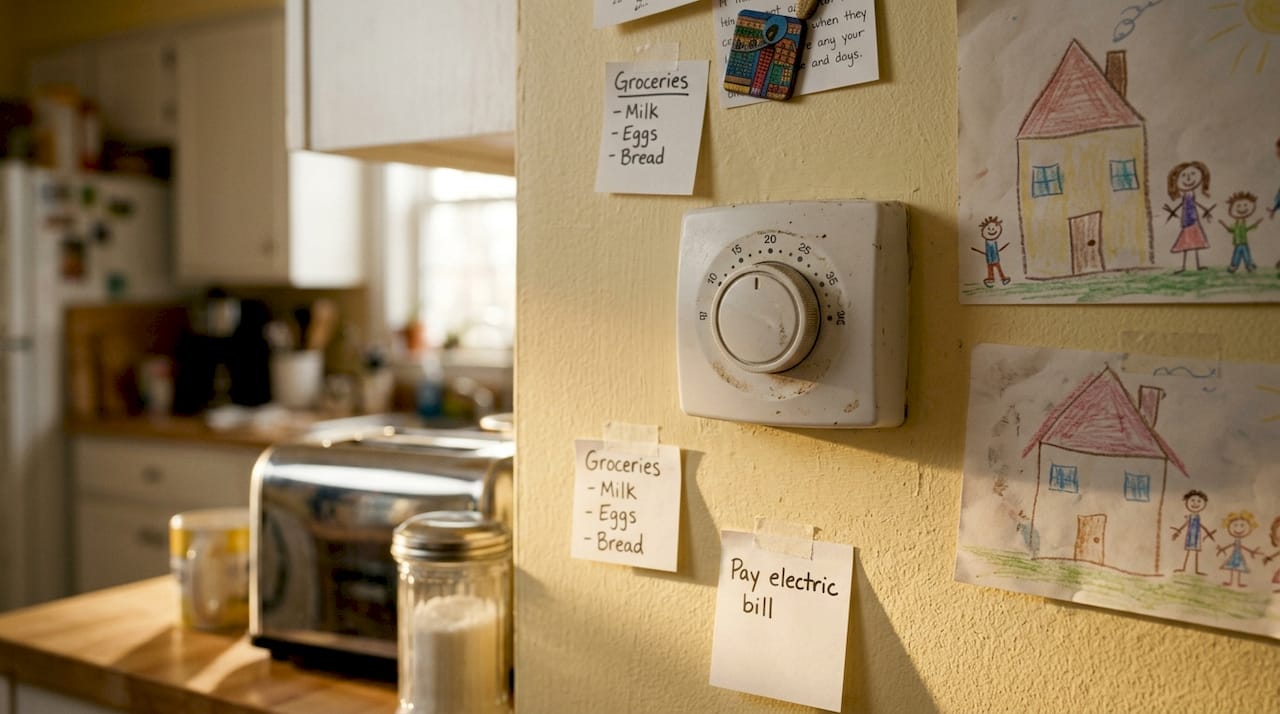
Manual thermostats are simple dial or slider devices. You set a temperature and that is it. They are inexpensive and reliable, but they require you to remember to adjust them every time your schedule changes. For most Orange and LA County homeowners, that inconsistency adds up on the utility bill.
Programmable thermostats let you set schedules in advance, such as lowering the temperature at 8 a.m. when everyone leaves and raising it again at 5 p.m. They are a solid step up from manual control, but they still require you to program them correctly and update settings when your routine changes.
Smart thermostats learn your patterns, use occupancy sensors, and connect to your phone. Occupancy-based smart automation delivers 12.9% heating reductions by avoiding heating empty rooms. That is a meaningful number in a region where heating and cooling run almost year-round.
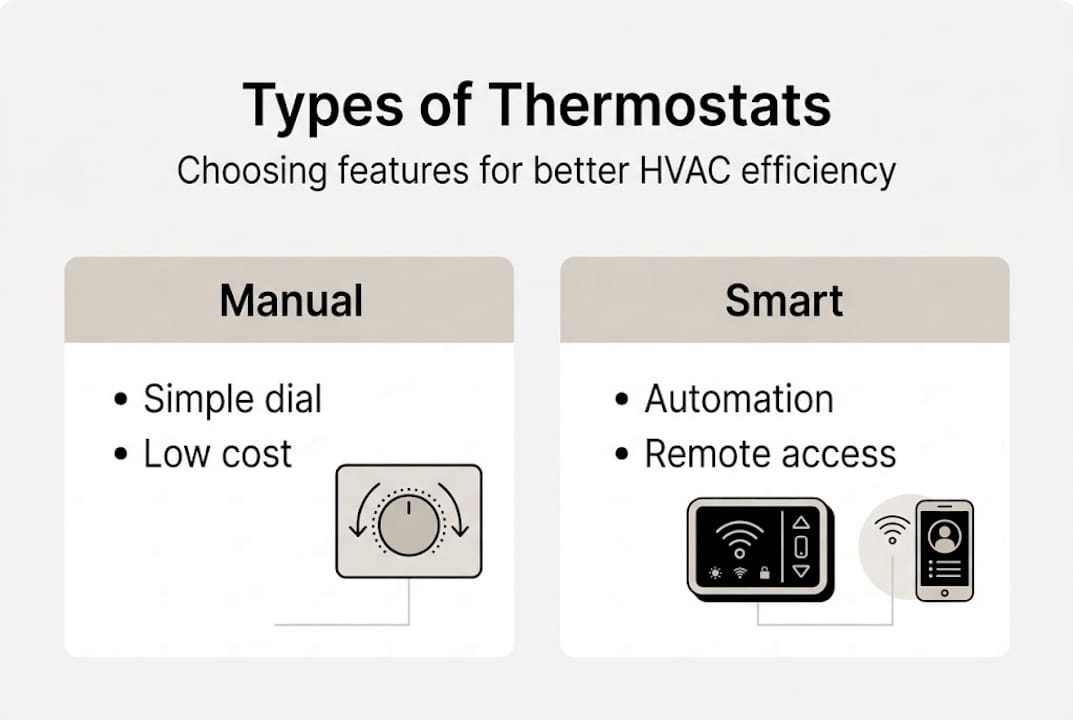
| Type | Cost range | Automation | Compatibility | Estimated savings |
|---|---|---|---|---|
| Manual | $15–$40 | None | Universal | Minimal |
| Programmable | $30–$100 | Schedule-based | Most systems | Moderate |
| Smart | $130–$300 | Occupancy/learning | Check system specs | $131–$250/year |
Smart thermostats save $131–$250 per year, and utility rebates often cover 50 to 100% of the purchase price. Southern California Edison and SoCalGas both offer rebate programs worth checking before you buy.
- Confirm your HVAC system type before purchasing any thermostat.
- Check your utility provider’s rebate portal for current offers.
- Verify C-wire availability in your home for smart thermostat power.
- Read compatibility notes for heat pumps and multi-stage systems.
Pro Tip: Before upgrading, visit your utility provider’s website and search for thermostat rebates. In many cases, a $250 smart thermostat costs you under $50 out of pocket after rebates.
For more on what is trending in home comfort technology, the latest HVAC comfort trends are worth reviewing. You can also explore eco-friendly HVAC options that pair well with smart thermostat upgrades.
Getting the most from your thermostat: Settings and behaviors that matter
Choosing the right thermostat is only half the job. How you use it determines your actual results. Many homeowners upgrade to a smart device and then continue adjusting it manually, which cancels out most of the automation benefits.
Here are the habits that consistently produce better comfort and lower bills:
- Set a schedule and stick to it. Program your thermostat around your real daily routine, not an ideal one.
- Use setback temperatures. Raising the cooling setpoint by 7 to 10°F when you are away or asleep makes a measurable difference.
- Avoid frequent manual overrides. Every time you manually change the setting outside your schedule, you teach the system nothing and waste a cycle.
- Keep windows closed when the system is running. Open windows while the HVAC is active force it to work against outdoor air, burning energy with no benefit.
- Let the system recover gradually. If you return to a warm house, set your target temperature and wait. Do not crank it lower hoping to speed things up.
Proper setbacks yield up to 10% annual savings, but opening windows or frequently adjusting settings reduces that benefit significantly. Automation only works when you let it work.
Pro Tip: Enable occupancy mode on your smart thermostat if it has one. This feature uses motion sensors or your phone’s location to adjust temperatures automatically, so you do not have to think about it.
Pairing good thermostat habits with regular HVAC tune-ups keeps your system running efficiently all year. Understanding the importance of maintenance also helps you catch small issues before they become expensive repairs.
Multi-zone, smart features, and advanced HVAC setups
If your home has multiple floors, additions, or separate living areas, a single thermostat may not give you accurate control. Multi-zone HVAC systems use multiple thermostats or sensors to manage different areas independently. This is especially useful in California homes where one side of the house gets direct afternoon sun while the other stays cool.
Here is what makes multi-zone setups work well:
- Assign a primary sensor per zone. Each zone needs one clear temperature authority. Conflicting sensors cause erratic cycling.
- Use a C-wire for power stability. Smart thermostats need steady power. A C-wire prevents battery drain and communication failures.
- Calibrate sensors regularly. If a sensor reads 2°F or more off from actual room temperature, your system responds to bad data.
- Set heat differential between 1.0 and 1.5°F. This prevents short cycling, where the system turns on and off too frequently.
Multi-zone HVAC systems require clear sensor authority, C-wire stability, and regular calibration to function correctly. Skipping any of these steps leads to hot and cold spots, wasted energy, and premature equipment wear.
| Issue | Likely cause | Fix |
|---|---|---|
| Uneven temperatures | Sensor conflict or poor placement | Reassign primary sensor |
| Short cycling | Heat differential too low | Set to 1.0–1.5°F |
| Thermostat losing power | No C-wire or weak battery | Install C-wire adapter |
| One zone not responding | Wiring fault or dead sensor | Inspect wiring, recalibrate |
“Calibrate sensors if they are off by 2°F or more, and set heat differential between 1.0 and 1.5°F to prevent short cycling and maintain comfort.” — Ecobee troubleshooting guidance
For homeowners exploring residential HVAC options in Orange or LA County, understanding how zoning works helps you make smarter decisions about upgrades and installations.
The overlooked truth: It’s not just the device — it’s the daily habits
Here is something the thermostat marketing world does not want you to focus on: the device is the easy part. We see it regularly in Southern California homes. A homeowner installs a $250 smart thermostat, and within two weeks they are manually overriding it every morning because they feel too warm or too cold. The technology gets blamed, but the real issue is behavior.
Manual management makes homes warmer in winter and cooler in summer than intended, overriding the energy-saving logic built into smart devices. That is not a flaw in the thermostat. That is a human pattern.
Southern California’s climate is mild enough that many homeowners feel they can get away with casual thermostat habits. And they can, until the bill arrives. The homes that consistently save money are not always the ones with the fanciest equipment. They are the ones where someone took 20 minutes to set a realistic schedule and then left it alone.
Smart thermostats are only as smart as the settings you give them. Pairing good hardware with eco strategies for comfort creates lasting results. The gadget is a tool. Consistent, intentional use is what actually moves the needle on your energy bills.
Take the next step: Expert help for your HVAC and home comfort
Ready to put this knowledge into action? Understanding your thermostat options is a great start, but getting the most from your HVAC system often requires professional eyes on the full picture.
Our HVAC repair experts serve homeowners across Orange and Los Angeles Counties, helping with everything from thermostat installation and wiring to full system diagnostics. Whether you are upgrading to a smart thermostat, troubleshooting a multi-zone setup, or just want a system check before summer, we are here to help. Book HVAC tune-up services today and make sure your system is ready to perform efficiently all year long.
Frequently asked questions
How much can a smart thermostat really save on California energy bills?
Smart thermostats typically save $131–$250 yearly for California homeowners, with actual results depending heavily on user habits and proper installation.
What is the best thermostat schedule for comfort and energy savings?
The best schedule mirrors your real occupancy and applies temperature setbacks of 7–10°F when you are away or asleep, which delivers the most consistent savings.
Are smart thermostats worth it in mild Southern California climates?
Yes. While savings are smaller than in colder regions, occupancy-based automation and rebates often cover most of the cost, making the upgrade worthwhile for comfort and convenience.
How do I troubleshoot inconsistent temperatures in multi-zone HVAC systems?
Assign a primary sensor per zone, calibrate all sensors, confirm correct wiring, and make sure only one device controls temperature per zone at a time.
Does frequent manual adjusting of my thermostat hurt efficiency?
Yes. Frequent manual changes and open windows reduce the energy savings that automation is designed to deliver, making scheduled control far more reliable.
Recommended
- What is high efficiency HVAC: A homeowner’s guide
- Key HVAC trends in 2025: boost your home comfort
- Role of HVAC in Homes: Cut Energy Use by Up to 30% in 2026
- HVAC tune-ups: boost efficiency 20% & home comfort
- Energy Efficiency in Roofing: Lower Bills in Houston