
For most households, a front-load washer delivers the best combination of cleaning performance and long-term efficiency. ENERGY STAR data shows front-loaders use roughly 40–50% less water and 50–65% less energy than traditional top-load agitator machines. That gap translates to real savings on utility bills over years of use, and lab testing consistently shows they clean slightly better on typical loads.
- Front-load wins for: efficiency, fabric care, stackability, and cleaning performance on everyday loads
- Top-load wins for: lower upfront cost, simpler maintenance, shorter cycle times, and easier loading without bending
If you have a stacked laundry closet, run multiple loads daily, or want the lowest possible running costs, a front-loader is the clear choice. If you hate bending, want to toss in a forgotten sock mid-cycle, or simply want a machine that’s cheaper to repair when something goes wrong, a top-loader makes more sense. The decision checklist in the “How to choose” section below walks through the full matchup step by step.
Key Takeaways
Front-load washers use 40–50% less water per cycle than traditional top-load agitator machines and clean slightly better on typical loads, but they require consistent gasket maintenance and carry higher average repair costs after the first few years.
| Point | Details |
|---|---|
| Efficiency advantage is real | Front-loaders use ~12–15 gal/cycle vs. ~20–25 gal for traditional top-loaders, per ENERGY STAR. |
| Maintenance is non-negotiable | Front-loaders need monthly gasket cleaning and door-ajar habit to prevent mold and washer odor. |
| Top-loaders cost less to repair | Simpler mechanical designs (especially Speed Queen) mean lower repair bills and fewer failure-prone parts. |
| Space drives the decision | Stacked setups require a front-loader; compact spaces may need a 24-inch model like the Bosch 300 Series. |
| Appliancesrepairmdtech installs and repairs both | Serving Orange County and Los Angeles County for installation, leveling, seal replacement, and drain repair. |
Table of Contents
- How do top-load and front-load washers actually clean clothes?
- Cleaning performance: what lab tests actually show
- Water, energy, and what they cost you per year
- Capacity, space, and stackability: measuring before you buy
- Ergonomics and cycle times: the daily-use reality
- Maintenance, mold risk, and when to call a technician
- Upfront price, lifespan, and total cost of ownership
- Noise, vibration, and where to put the machine
- How to choose: a decision checklist for your household
- What we see from the repair and install side
- Professional washer installation and repair in Orange County and Los Angeles County
- Sources
How do top-load and front-load washers actually clean clothes?
The mechanical difference is straightforward. A front-load washer uses a horizontal drum that tumbles clothes through a small pool of water at the bottom, lifting and dropping them repeatedly. A top-load washer uses a vertical drum where clothes sit in a full tub of water and are moved by either a central agitator post or a low-profile impeller plate at the base.
That distinction drives almost every trade-off in this comparison:
- Front-load (tumble action): Clothes fall through water repeatedly, creating a gentle but effective scrubbing motion. Less water is needed because the drum doesn’t have to fill completely.
- Top-load with agitator: The central post twists clothes back and forth. Effective on heavily soiled items but harder on fabrics and uses more water.
- Top-load with impeller: A low-profile disc spins and creates turbulent water currents. Uses less water than an agitator model and is gentler on clothes, but still fills the tub more than a front-loader.
The spin cycle matters too. Front-loaders typically spin at 1,000–1,400 RPM, extracting more moisture from clothes before they go into the dryer. That means shorter drying times and lower dryer energy use, per LG’s buyer guidance. Top-loaders generally spin at 700–900 RPM.
Pro Tip: If you’re replacing a top-load agitator model with an impeller top-loader, expect gentler handling of clothes but check the cycle time — impeller models often run longer than agitator machines to compensate for the less aggressive wash action.
Cleaning performance: what lab tests actually show
Front-loaders clean slightly better, but the real-world gap is smaller than the marketing suggests. Good Housekeeping’s lab testing finds front-load machines outperform top-loaders overall, though the difference is often small for typical household loads. Where the gap widens is on large, heavily soiled loads — work clothes caked in grease, sports uniforms, or bedding.
The tumbling action gives front-loaders a structural advantage for stain removal. Clothes are repeatedly lifted and dropped, and the mechanical action works with the detergent rather than just diluting it in a full tub. Rinse performance is also better: because the drum uses less water, detergent concentration stays higher during the wash, then rinses more completely.
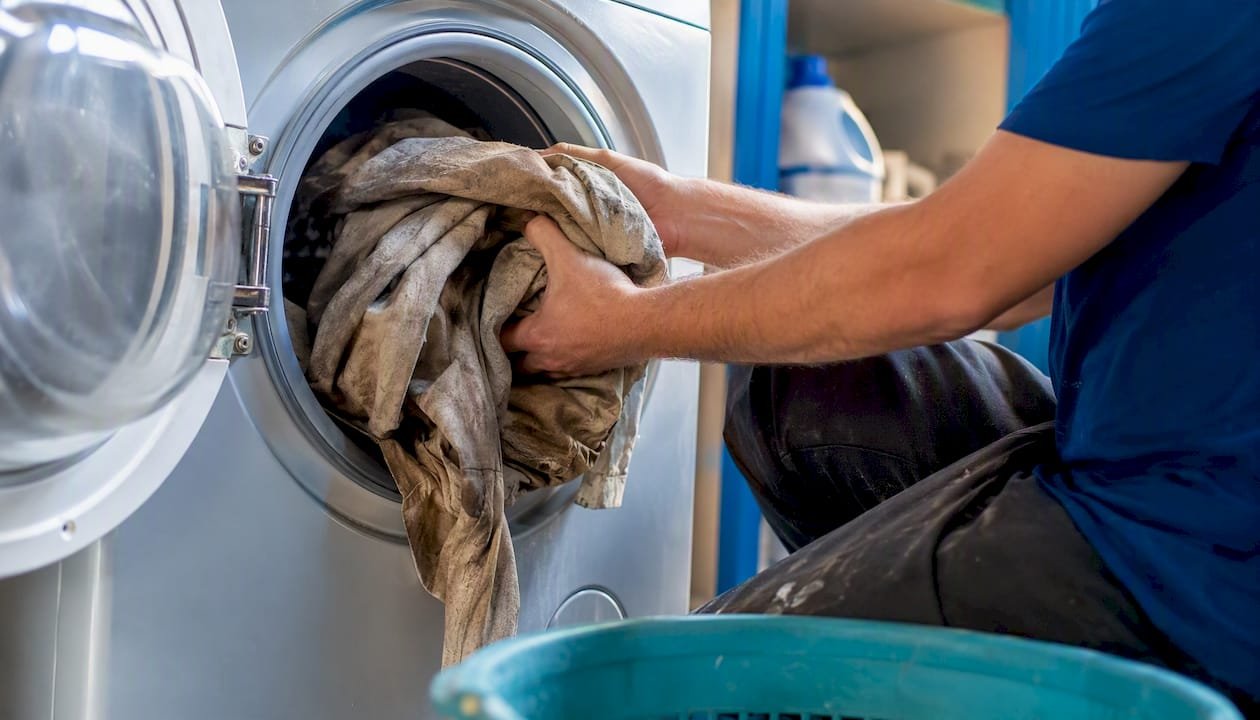
Top-load agitator machines can outperform on one specific scenario: heavily soiled workwear that benefits from extended soaking and aggressive mechanical action. The agitator’s twisting motion works well on thick denim or canvas. For everything else — cotton, synthetics, delicates — a front-loader or a high-efficiency impeller top-loader handles the job with less wear on the fabric.
How independent labs test washers: Reviewers like Good Housekeeping use standardized soil swatches placed in test loads, then measure how much of the stain is removed after a normal cycle. They also measure residual moisture after the spin cycle, since higher spin extraction directly reduces drying time and energy use. That methodology is worth knowing when you read spec sheets — a manufacturer’s “cleaning performance” claim rarely uses the same controlled conditions.
- Front-loaders score higher on stain removal for typical mixed loads
- Top-load agitators hold an edge on heavily soiled, thick-fabric items
- High-efficiency impeller top-loaders sit in the middle on both cleaning and water use
- Spin extraction rate (RPM) is a reliable proxy for drying efficiency
Water, energy, and what they cost you per year
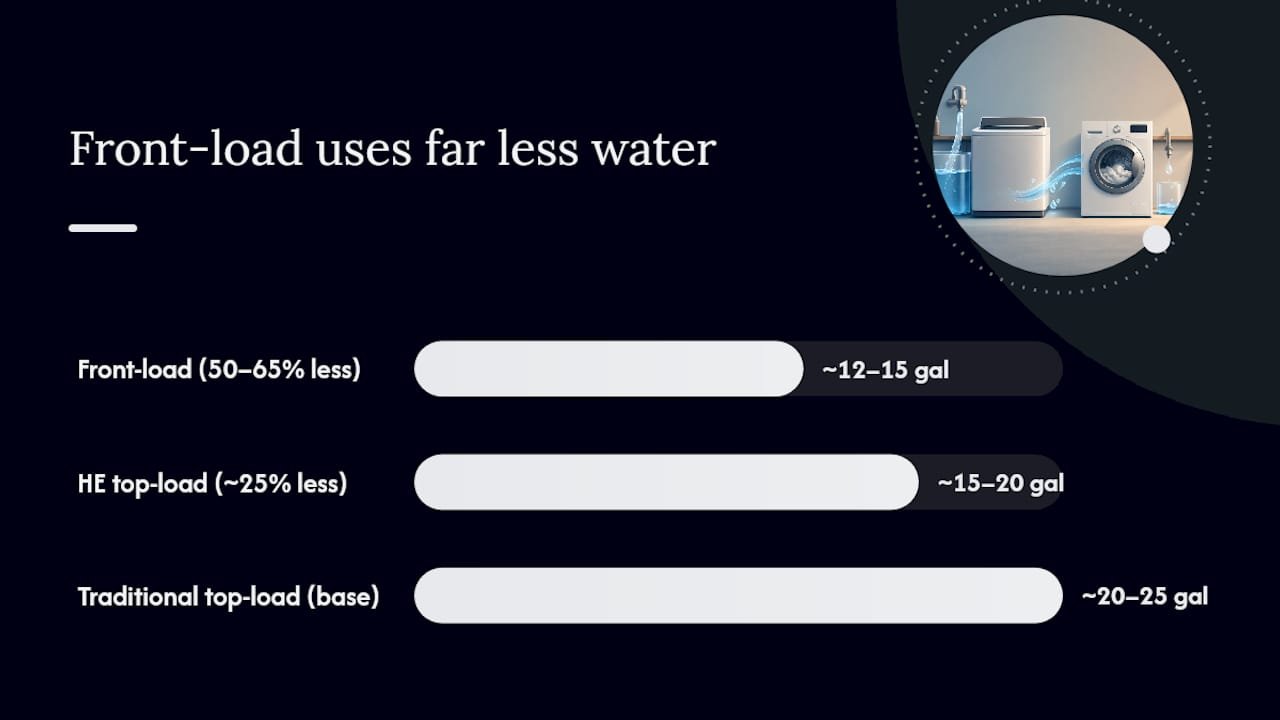
The numbers here are concrete. According to ENERGY STAR, front-load washers use approximately 12–15 gallons per cycle. Traditional top-load agitator machines use roughly 20–25 gallons per cycle. High-efficiency impeller top-loaders fall between the two but still use more water per cycle than front-loaders.
| Type | Water per cycle | Energy vs. traditional top-load | Notes |
|---|---|---|---|
| Front-load | ~12–15 gal | 50–65% less | High spin reduces dryer energy too |
| HE top-load (impeller) | ~15–20 gal | ~25% less than front-load | Larger usable capacity in some models |
| Traditional top-load (agitator) | ~20–25 gal | Baseline | Simpler mechanics, lower repair cost |
For a household running five loads per week, the water savings between a front-loader and a traditional top-loader add up to thousands of gallons annually. Energy savings compound further because front-loaders’ higher spin speeds mean clothes spend less time in the dryer. Whirlpool’s guidance notes that front-loaders use less water and are stackable, while top-loaders tend to offer shorter cycles.
The efficiency advantage is real, but it takes time to recoup in dollar terms. Front-loaders typically cost $200–$600 more upfront than comparable top-loaders. In a high-utility-cost market like Southern California, the payback period is shorter than the national average, but it still takes several years of regular use to offset the price gap through utility savings alone.
Capacity, space, and stackability: measuring before you buy
Drum shape changes how much laundry you can actually fit. A top-load agitator machine loses usable space to the central post — a 4.5 cubic foot drum with an agitator holds meaningfully less laundry than a 4.5 cubic foot front-loader with no post in the way. Impeller top-loaders recover most of that space, and some models offer very large usable capacity as a result, per LG’s buyer guidance.
Stackability is a front-load exclusive. Top-loaders cannot be stacked because the lid opens upward. If your laundry setup is a closet, a hallway alcove, or any space where a side-by-side pair won’t fit, a front-load washer paired with a compatible dryer is often the only practical option.
Key measurements to take before you buy:
- Width and depth: Most full-size front-loaders and top-loaders are 27–28 inches wide. Compact front-loaders (like the Bosch 300 Series WGA12400UC) run 24 inches wide and fit apartments and smaller laundry rooms.
- Door clearance: Front-loaders need 18–20 inches of clearance in front for the door to swing open fully. Measure this before assuming a tight space works.
- Stacked height: A stacked washer-dryer pair typically reaches 74–76 inches. Measure ceiling height and any overhead cabinets.
- Pedestal height: Adding a pedestal to a front-loader raises the door opening by 12–15 inches, which eliminates most of the bending complaint. Factor that into the stacked-height calculation if you’re adding one.
Pro Tip: If you’re buying a front-loader for a stacked setup, confirm the dryer model is explicitly listed as compatible with that washer before purchasing. Not all front-load washers and dryers from the same brand stack with each other.
Ergonomics and cycle times: the daily-use reality
Bending to load a front-loader is the most common complaint, and it’s legitimate. Without a pedestal, the door sits about 12–15 inches off the floor. For anyone with back problems or mobility limitations, that’s a real issue. A pedestal adds $150–$300 to the cost but raises the door to a comfortable standing height.

Top-loaders load from above, which most people find natural. The trade-off is that you can’t stack them, and reaching to the bottom of a deep drum to pull out the last item can be awkward for shorter users.
Adding clothes mid-cycle is a top-load advantage. Most top-loaders let you pause and add a forgotten item at any point before the spin cycle. Front-loaders lock the door once water is present, though some newer models (including certain LG and Electrolux ELFW7637A configurations) include an “add garment” door or a pause-and-add feature that works in the early minutes of a cycle.
Cycle times differ noticeably:
- Traditional top-load agitator: 35–50 minutes for a normal cycle
- High-efficiency top-load impeller (like the GE GTW585B): 45–60 minutes
- Front-load (like the LG WM4000H or GE GFW655): 60–90 minutes for a standard cycle, though quick-wash options run 15–30 minutes
For a household running back-to-back loads on a Saturday morning, that 20–40 minute difference per cycle matters. A front-loader’s efficiency advantage doesn’t help much if the slower cycle time means you’re doing laundry until 4 PM.
Pro Tip: Front-loaders with a “quick wash” or “speed wash” cycle handle lightly soiled loads in 15–30 minutes. If most of your laundry is everyday clothes rather than heavily soiled items, you can use the quick cycle most of the time and reserve the full cycle for sheets and towels.
Maintenance, mold risk, and when to call a technician
Front-loaders have a well-earned reputation for mold and odor problems. The door boot gasket — the rubber seal around the door opening — traps moisture, lint, and detergent residue after every cycle. Clorox’s guidance emphasizes that front-loaders retain moisture in door gaskets and dispensers and recommends routine cleaning plus leaving the door ajar after each use to let the drum dry out. A washing machine that smells musty is almost always a front-loader with a neglected gasket.
Top-loaders are not immune to odor, but the open-top design dries out faster and the gasket problem simply doesn’t exist in the same way.
Monthly maintenance checklist for front-loaders:
- Wipe the door boot gasket with a damp cloth, pulling back the folds to reach trapped residue
- Run a drum-clean cycle with a washer cleaner tablet or a cup of white vinegar
- Clean the detergent dispenser drawer — pull it out and rinse under warm water
- Leave the door ajar for at least two hours after the last cycle of the day
Quarterly tasks for both types:
- Check and clean the drain pump filter (front-loaders have an access panel at the bottom front; top-loaders vary by model)
- Inspect hoses for cracks or bulging
- Wipe down the exterior and control panel
For a full washing machine care routine, consistent upkeep is the single biggest factor in avoiding early repairs.
When to call a technician:
- Washer not draining or draining very slowly (often a clogged pump filter or failed drain pump)
- Washing machine smells persist after cleaning the gasket and running a drum-clean cycle (may indicate mold inside the drum or a failing door seal)
- Washer shaking violently during spin (worn suspension rods, uneven floor, or failed shock absorbers)
- Error codes that don’t clear after a reset
Field-repair data shows front-load washers have more failure-prone components — boot seals, drain pumps, and electronic control boards — and tend to carry higher average repair costs than simpler top-load mechanical designs. Traditional top-loaders with mechanical controls, like the Speed Queen TC5003WN, are among the cheapest machines to repair when something does go wrong.
Know the early warning signs before a small problem becomes a full replacement.
Upfront price, lifespan, and total cost of ownership
Price ranges vary by feature set, but the general tiers hold across brands:
- Budget top-load agitator (GE GTW585B range): $500–$700
- Mid-range front-load (GE GFW655, LG WM4000H): $800–$1,100
- Premium front-load (Electrolux ELFW7637A, Bosch 300 Series WGA12400UC): $1,100–$1,500
- Ultra-premium (Miele WXD160): $1,800–$2,500+
- Commercial-grade top-load (Speed Queen TC5003WN): $900–$1,100
Smart features, steam cycles, and high-spin options add $150–$400 to any base model. A pedestal for a front-loader adds another $150–$300.
Expected lifespan by design class:
- Traditional top-load agitator: 10–14 years with normal use
- High-efficiency top-load impeller: 10–13 years
- Front-load: 10–15 years, but repair frequency tends to increase after year three to five
- Speed Queen mechanical top-load: 15–25 years (commercial-grade components)
- Miele WXD160: rated for 20 years by the manufacturer
Warranty coverage is fairly standard across major brands: one year parts and labor, with some brands offering longer motor or drum warranties. Read the fine print on what voids coverage — using non-HE detergent in a front-loader, for example, can void some warranties and definitely accelerates gasket degradation.
For households planning to keep a machine 10 years or more, repair cost risk is a real factor. A front-loader that needs a boot seal and drain pump replacement in year four can cost $250–$450 in parts and labor. A top-load agitator with a worn transmission is often cheaper to fix, and simpler mechanical designs like Speed Queen’s mean fewer electronic failure points. The repair vs. replacement decision depends heavily on the machine’s age and the repair estimate relative to replacement cost.
Noise, vibration, and where to put the machine
Front-loaders spin faster, and that speed creates more vibration — especially on upper floors, tile, or any surface that isn’t perfectly level. A front-loader running a 1,200 RPM spin cycle on a second-floor laundry room can rattle the whole floor. Top-loaders with lower spin speeds are generally quieter during the spin phase, though agitator models can be noisy during the wash cycle itself.
Practical mitigation steps:
- Level the machine: All washers need all four feet in firm contact with the floor. A washer that rocks even slightly will vibrate dramatically at spin speed. Use a bubble level and adjust the feet before the first load.
- Anti-vibration pads: Rubber pads placed under each foot absorb a significant amount of spin vibration. They cost $15–$30 and are worth it for any front-loader on a hard floor or upper level.
- Floor reinforcement: If the floor itself flexes noticeably when you walk on it, a plywood platform under the machine distributes the load and reduces transmitted vibration.
- Load balance: Uneven loads are the most common cause of violent shaking. A single heavy item like a comforter or a pair of jeans in an otherwise empty drum will throw the machine off balance every time.
Pro Tip: If your front-loader shakes violently even with balanced loads and level feet, the shock absorbers or suspension rods may be worn. This is a common mid-life repair — catching it early prevents damage to the drum bearings, which is a much more expensive fix.
When noise is sudden, new, or accompanied by grinding or banging, that’s a mechanical issue, not a leveling problem. Worn drum bearings, a failing motor coupling, or a broken suspension rod all present as noise before they cause a full breakdown. See the washer repair warning signs guide for a full symptom list.
How to choose: a decision checklist for your household
Work through these questions in order. The first answer that rules out a type ends the decision.
- Do you have a stacked laundry setup or a closet that only fits one column of appliances? If yes, front-load is the only option.
- Is your laundry space under 27 inches wide? If yes, look at compact front-loaders (Bosch 300 Series WGA12400UC at 24 inches).
- Do you or anyone in the household have back or mobility issues and won’t use a pedestal? If yes, top-load is the more practical choice.
- Do you regularly wash heavily soiled workwear or thick canvas items? If yes, a top-load agitator (Speed Queen TC5003WN) may outperform.
- Is low maintenance your top priority? If yes, top-load — specifically a mechanical agitator model — has the simpler upkeep profile.
- Do you run five or more loads per week and care about utility costs? If yes, front-load’s efficiency advantage starts to pay back meaningfully.
Household matchups:
- Busy family (4+ people, 7+ loads/week): Front-load with a large drum (LG WM4000H or GE GFW655). Efficiency savings matter at this volume, and cleaning performance on mixed loads is better.
- Small apartment or laundry closet: Front-load, compact if needed (Bosch 300 Series WGA12400UC). Stackability is often non-negotiable.
- Renter who moves frequently: Top-load. Simpler installation, no pedestal to move, and lower repair risk if something goes wrong in a rental.
- Single person, light loads: Either type works. A budget top-load agitator (GE GTW585B) is the most cost-effective choice.
- Heavy-duty workwear household: Top-load agitator, ideally Speed Queen TC5003WN for durability and simple mechanics.
- Buyer prioritizing long-term quality: Miele WXD160 (front-load, 20-year rated lifespan) or Speed Queen TC5003WN (top-load, commercial-grade durability).
- Delicates and specialty fabrics: Front-load, specifically the Electrolux ELFW7637A for its fabric-care cycle variety.
Red flags that should change your choice:
- Choosing a front-loader without a plan for gasket maintenance is a setup for a washer mold smell problem within two years
- Buying a top-loader for a stacked space because it was on sale — it won’t fit
- Ignoring floor type: a front-loader on a bouncy wood floor without anti-vibration pads will walk across the room
What we see from the repair and install side
From Appliancesrepairmdtech’s perspective, the top-load vs. front-load question looks different once you’ve seen both types fail. Front-loaders come in for boot seal replacements, drain pump failures, and mold remediation far more often than top-loaders do. That’s not a reason to avoid them — they’re genuinely better machines for most households — but buyers who choose a front-loader should go in knowing that maintenance is not optional. The owners who never have problems are the ones who wipe the gasket weekly and leave the door open. The ones who call for a washer not draining or a persistent washing machine smell are almost always the ones who didn’t.
Top-loaders, especially mechanical designs like Speed Queen, rarely come in for anything complicated. When they do need service, the repair is usually straightforward and the parts are inexpensive. For a landlord managing rental units or a household that simply doesn’t want to think about appliance upkeep, that reliability profile is worth more than the efficiency gap.
When Appliancesrepairmdtech handles installations, the front-load jobs almost always include a conversation about pedestal height, door clearance, and leveling. Get those three things right at installation and you avoid the most common early service calls. Stacked setups also need proper dryer venting — a kinked or undersized vent line is one of the most common causes of premature dryer failure in stacked configurations.
Professional washer installation and repair in Orange County and Los Angeles County
Choosing the right washer type is step one. Getting it installed correctly — leveled, balanced, properly vented, and with the pedestal at the right height — is what determines whether it runs well for 12 years or starts shaking and leaking in year two.
Appliancesrepairmdtech handles washer installation, pedestal setup, leveling, boot seal replacement, drain pump repair, and full maintenance visits across Orange County and Los Angeles County. Whether you’ve just bought a Whirlpool or Maytag and need a clean installation, or you’re dealing with a front-loader that smells or won’t drain, the team books online and covers your area. If you’re weighing whether to repair your current machine or replace it, the repair vs. replacement guide is a good starting point, and Appliancesrepairmdtech can give you a straight answer on whether the repair cost makes sense for your machine’s age and condition. Book your appointment online at Appliancesrepairmdtech.
Sources
The figures and testing conclusions in this article draw from the following sources. When manufacturer specs conflict with independent lab results, the independent test data takes priority.
- Front-Load vs. Top-Load Washers: Experts Explain the Differences | GoodHousekeeping
- Front load vs. top load washers: which type is better? | Whirlpool
- Top Load vs Front Load Washer: Which One is for You? | LG US
- Front load vs top load washers | Clorox
- Front Load vs Top Load Washers: Repair Frequency, Cost & Reliability Compared – Home Appliance Fixing Blog
A note on reading manufacturer specs: Water usage figures on spec sheets are measured under standardized test conditions that may not match your household’s typical load size or water temperature settings. Independent lab tests using real soil swatches and measured spin extraction rates give a more accurate picture of real-world performance. When comparing models, cross-reference the manufacturer’s spec with at least one independent review before deciding.
Appliancesrepairmdtech can help you interpret specs for your specific home setup — contact the team through the online booking form to ask questions before you buy.