
TL;DR:
- Thermostat placement influences HVAC accuracy, energy efficiency, and home comfort by ensuring readings reflect actual conditions. Proper installation on a central interior wall at mid-height, away from heat sources, drafts, and direct sunlight, is essential for optimal performance. Smart thermostats improve results but still depend on correct placement and sensor positioning for true effectiveness.
Most homeowners spend hours researching which thermostat to buy and almost no time thinking about where to put it. That oversight is costly. The role of thermostat placement goes far beyond aesthetics or installation convenience. Where your thermostat sits determines what temperature your HVAC system actually responds to, and if that location gives a false reading, your system runs too long, shuts off too early, or cycles constantly. The result is uneven temperatures throughout your home and an energy bill that never seems to make sense.
Table of Contents
- Key takeaways
- The role of thermostat placement in how your HVAC reads temperature
- Where to actually put your thermostat
- Smart thermostats and remote sensors
- Common placement mistakes and how to spot them
- My perspective on why placement gets ignored
- Let Appliancesrepairmdtech get your thermostat placed right
- FAQ
Key takeaways
| Point | Details |
|---|---|
| Location shapes accuracy | A thermostat only reads the air directly around it, so placement determines whether your HVAC responds to real conditions. |
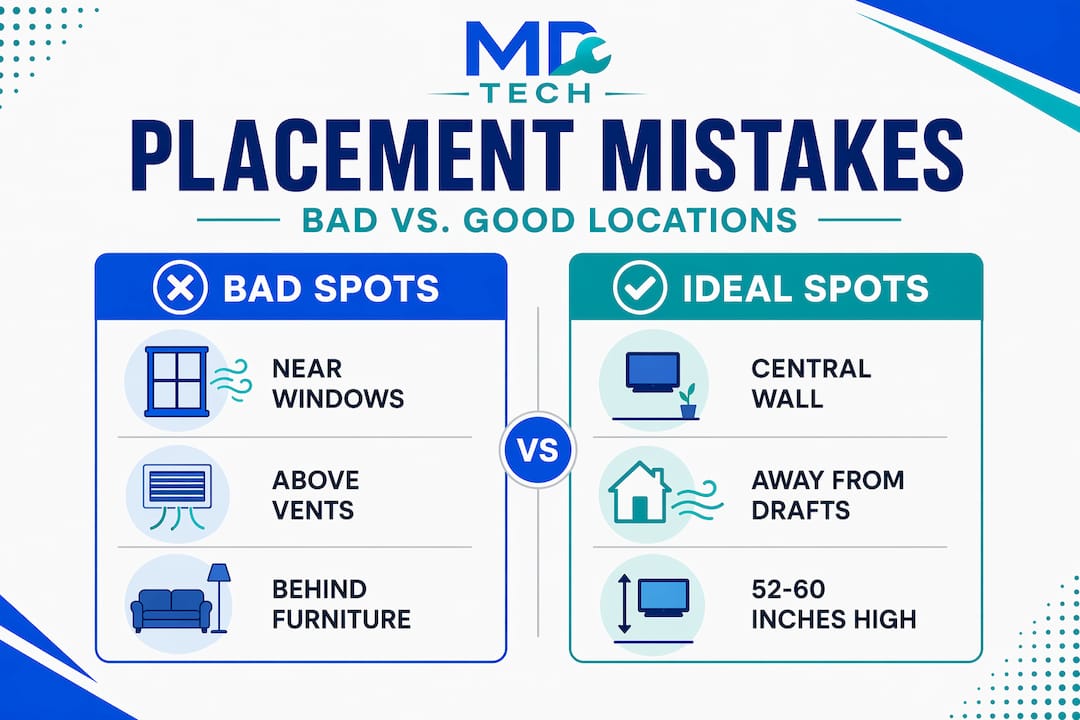
| Avoid heat and draft sources | Kitchens, sunny windows, exterior walls, and air vents all skew readings and cause improper HVAC cycling. |
| Mid-wall height matters | Install at 52 to 60 inches off the floor to capture the most representative air temperature in the room. |
| Smart thermostats help but have limits | Remote sensors improve accuracy only when they are placed correctly away from interference. |
| Diagnosis is straightforward | Uneven rooms, frequent HVAC cycling, and high bills are all signs of a placement problem worth fixing. |
The role of thermostat placement in how your HVAC reads temperature
Your thermostat does not know what temperature your bedroom is. It only knows what temperature the air is at the exact spot where it is mounted. That single-point reading is what triggers your entire HVAC system to run or stop. If that reading is off by even a few degrees because of sunlight hitting the wall, a draft sneaking through a nearby window, or warm air rising from a kitchen below, your system operates on false data.
Thermostats use a single-point reading from their mounted location. When that location introduces temperature bias, the HVAC never gets an accurate signal. It may cut heating short because the thermostat sits in a warm hallway while your bedrooms stay cold. It may run air conditioning for too long because afternoon sun heats the wall where the thermostat is mounted, making it read several degrees higher than the rest of the home.
Common environmental factors that distort thermostat readings include:
- Direct sunlight hitting the wall where the thermostat is mounted, artificially raising the reading
- Nearby air vents blowing conditioned air directly across the sensor, causing it to read target temperature before the room reaches it
- Exterior walls that transfer outdoor cold or heat to the sensor regardless of indoor conditions
- Kitchen appliances generating radiant heat that pushes the reading above actual living temperatures
- Drafty windows or doors creating cold pockets that make the thermostat call for more heat unnecessarily
Blocked airflow from furniture positioned too close to the thermostat compounds the problem further. Even a correctly placed thermostat can misread if a bookshelf or curtain disrupts the natural air circulation around the sensor. Proper sensing requires both the right spot on the wall and clear air movement around the device itself.
Smart thermostats add remote sensors and learning algorithms, but single-point sensing often fails to capture the real variability of room conditions. Upgrading to a smart device without fixing a poor placement problem solves less than homeowners expect.
Where to actually put your thermostat
Understanding why placement matters sets up the real question: where should the thermostat go? There is a clear set of guidelines that most HVAC professionals follow, and getting this right once pays off for years.
-
Choose a central interior wall. This is the single most important guideline. An interior wall is insulated from outdoor temperature swings, and a central position gives the thermostat exposure to air from multiple zones of your home. Optimal thermostat placement targets this central interior wall as the primary criterion.
-
Install at mid-wall height, between 52 and 60 inches off the floor. Air temperature is not uniform from floor to ceiling. Cold air settles low, and warm air rises. Installing at 52 to 60 inches puts the sensor in the band of air that most closely represents what your body feels when sitting or standing in a room.
-
Stay away from air vents and registers. Even a vent several feet away can push conditioned air across the sensor. Give yourself at least six to eight feet of clearance from any supply or return vent.
-
Avoid rooms with heat-generating appliances. The kitchen is the most obvious offender. Stoves, ovens, and even dishwashers produce enough ambient heat to throw off a nearby thermostat significantly.
-
Skip the exterior wall. Mounting on an outside-facing wall exposes the sensor to temperature conductance through the wall material, particularly in older homes with less insulation.
-
Check for windows and doors in the direct vicinity. Openings in the building envelope create drafts and solar gain that distort readings at any time of day.
The hallway question deserves its own attention. Many homes have the thermostat in a central hallway because it feels like the neutral center of the home. Hallway placement can distort temperature sensing because hallways often trap warm air and have poor airflow compared to occupied living spaces. If your hallway is closed off from the rooms where your family actually spends time, it is not the best spot regardless of how central it looks on a floor plan.
Pro Tip: Before finalizing a location, spend an afternoon checking the wall with a handheld thermometer at different heights and times of day. Sunlight patterns and cooking times both shift ambient readings in ways that are easy to catch before you commit to drilling.
Smart thermostats and remote sensors
Smart thermostats genuinely improve HVAC performance for most homes, but they do not completely eliminate the thermostat location impact. What they add is the ability to pull temperature data from multiple spots and prioritize readings from rooms where people actually spend time. That is a real advantage, but placement still governs the quality of each data point.
Remote sensors placed in frequently used rooms away from direct sunlight or vents deliver better comfort and energy savings. The sensor location rules mirror the thermostat rules: interior walls, mid-height, away from interference. When you add a remote sensor in your main bedroom or living room, it tells the thermostat what conditions feel like where people actually are, not just where the main device happens to be mounted.
Specific best practices for remote sensor placement:
- Mount sensors at 4 to 6 feet high on interior walls to capture the most representative occupied-room temperature. Proper sensor height prevents the reading from being skewed by floor drafts or ceiling heat.
- Place sensors in rooms you use most, such as the living room at night or a home office during the day, not just wherever feels convenient.
- Keep sensors away from electronics, televisions, lamps, and any device that generates heat. Even a laptop sitting near a sensor can shift its reading.
- Do not cluster multiple sensors in one room. Redundant sensors in the same space do not improve accuracy and can create conflicting data.
Pro Tip: If your smart thermostat allows you to schedule which sensor is prioritized by time of day, use it. Prioritize bedroom sensors overnight and living room sensors in the evening. That one setting change is worth more than any algorithm the device runs on its own.
Smart thermostats can compensate somewhat for poor placement, but the core logic still depends on accurate input. Think of sensors like microphones in a recording studio. Better placement always beats trying to fix a bad signal in post-production. The technology assists good placement; it does not replace it. You can learn more about how sensor strategies fit into modern systems in this overview of HVAC trends in 2025.
Common placement mistakes and how to spot them
The most frustrating thing about thermostat placement errors is that they often go undiagnosed for years. Homeowners adjust their set temperatures, argue about what feels comfortable, and assume the HVAC system is just aging. More often, the problem is the spot on the wall.
False temperature signals cause HVAC to cycle inaccurately, stressing equipment and increasing operating costs. Here are the most common mistakes and the symptoms they create:
- Thermostat near a supply vent: The system reads target temperature almost immediately after turning on and shuts off before the rest of the home is conditioned. You get short cycling, increased wear on the compressor, and rooms that never quite reach comfort.
- Thermostat in direct sunlight: Heating seasons become inefficient because the thermostat reads artificially high in the afternoon and lets the home cool before calling for heat again.
- Thermostat near the kitchen: Every cooking session pushes the reading up. In winter, this means heating shuts off early while other rooms stay cold.
- Thermostat on an exterior wall: The wall temperature influences the sensor year-round. In Orange County and Los Angeles summers, this is particularly acute.
| Symptom | Likely placement cause |
|---|---|
| Some rooms always too hot or cold | Thermostat not in a representative central location |
| HVAC turns on and off frequently | Sensor near a vent or heat source causing short cycling |
| High energy bills despite normal use | Inaccurate readings driving unnecessary runtime |
| System runs at night but house stays cold | Thermostat in a warm spot; actual rooms are underserved |
| Comfort improves on cloudy days | Direct sunlight is skewing the thermostat reading |
Testing whether your placement is the problem is straightforward. Set a digital thermometer next to your thermostat and compare readings over 24 hours. Then do the same in the rooms where you feel uncomfortable. If the thermostat reads significantly different from those occupied spaces, the placement is the problem. Understanding how the thermostat location impacts HVAC accuracy is the first step toward fixing what you find.
My perspective on why placement gets ignored
I have been on enough service calls to know that thermostat placement is almost always the last thing a homeowner thinks about and often the first thing causing their discomfort. What I keep seeing is a version of the same pattern. Someone buys a new smart thermostat, installs it themselves in the same spot as the old one, and then wonders why the fancy device is not delivering the comfort they expected.
The honest answer is that convenience drives most placement decisions. The old thermostat was near the living room entrance, so the new one goes there too. The wire was already run to that wall, so drilling somewhere better feels like too much extra work. I get it. But that convenience decision can silently add ten to fifteen percent to energy costs every month, and it is the reason one side of the house is always arguing about the temperature while the other side insists it feels fine.
What I have found actually works is treating thermostat placement as part of the initial HVAC commissioning conversation. When I work with homeowners on a new installation or a smart thermostat upgrade, we walk the home first. We check where the sun hits walls at different times of day, where the kitchen heat flows, and where the family actually spends most of their time. That conversation takes fifteen minutes and solves problems that a thousand dollars of new equipment cannot fix. Placement is not a footnote to HVAC efficiency. It is one of the core inputs the entire system runs on.
— MDTECH
Let Appliancesrepairmdtech get your thermostat placed right
If you have read this far and recognized your home in more than one of those symptoms, a professional evaluation is worth more than another round of guessing. Appliancesrepairmdtech serves homeowners across Orange County and Los Angeles County with expert HVAC repair and installation including smart thermostat upgrades and placement assessments. Our licensed technicians do not just swap out devices. They evaluate your home’s layout, airflow, and sun exposure to recommend where your thermostat and remote sensors will perform best.
Getting the placement right the first time saves you money every month and eliminates the comfort complaints that no amount of set-point adjusting ever fully solves. If you are in Irvine, Santa Ana, or anywhere across the county, book an appointment online and let us take a look. It is one of the highest-return improvements you can make to your home’s comfort without replacing any major equipment.
FAQ
Where is the best place to install a thermostat?
The best location is a central interior wall at a height of 52 to 60 inches, away from windows, vents, kitchens, and direct sunlight. This position gives the sensor access to representative air that reflects what occupants actually feel throughout the home.
Why does thermostat placement affect energy bills?
When a thermostat reads an inaccurate temperature because of nearby heat sources or drafts, the HVAC system either runs too long or shuts off too early. That improper cycling wastes energy and can raise monthly bills noticeably.
Can a smart thermostat fix a bad placement?
Smart thermostats with remote sensors reduce the impact of poor main unit placement, but sensor placement still matters for accurate readings. The technology improves comfort, yet it does not eliminate the need for correct positioning.
How do I know if my thermostat is poorly placed?
Common signs include rooms that never reach the set temperature, HVAC systems that cycle on and off frequently, and energy bills that seem high for your usage level. Comparing a handheld thermometer reading next to the thermostat against other rooms is a reliable self-test.
Does thermostat height really make a difference?
Yes. Air temperature varies from floor to ceiling due to natural heat stratification. Installing at mid-wall height of 52 to 60 inches captures the most accurate representation of the air temperature your body experiences, which leads to better system response and comfort.