
For most homes, MERV 11 is the right default. It captures pollen, pet dander, mold spores, and finer dust particles in the 1–3 micron range, delivers a meaningful indoor air quality upgrade over a basic MERV 8, and rarely stresses a modern HVAC blower. MERV 13 goes further, pulling in particles as small as 0.3–1 microns, including tobacco smoke, wildfire fine particulates, and some bacteria-sized droplets. This extra filtration is genuinely valuable, but only if your system can handle the added resistance.
Before you upgrade, three things matter most:
- Blower type: PSC (permanent split capacitor) motors, common in older systems, are more vulnerable to airflow restriction than ECM (electronically commutated motor) variable-speed blowers. Knowing your blower type is step one.
- Filter slot depth: A 1" slot limits your surface area and pushes pressure drop higher. A 2" or 4" cabinet gives you more pleat area, which softens the resistance penalty of a higher MERV rating.
- Household needs: The AAFA (Asthma and Allergy Foundation of America) certifies products in the MERV 11–13 range as effective for allergy and asthma management. If someone in your home is immunocompromised, deals with wildfire smoke, or lives with a smoker, MERV 13 is worth the compatibility check. If it’s seasonal allergies and a dog, MERV 11 usually covers it.
When in doubt, schedule a static-pressure check before swapping filters. Appliancesrepairmdtech serves Orange County and Los Angeles County homeowners who need exactly that diagnostic.
Key Takeaways
MERV 11 is the right default for most homes; MERV 13 delivers finer particle capture for smoke and bacteria but requires careful compatibility assessment before swapping.
| Point | Details |
|---|---|
| MERV 11 is the safe default | Captures 1–3 µm particles (pollen, dander, mold spores) with low pressure-drop risk on most systems. |
| MERV 13 targets finer threats | Captures 0.3–1 µm particles including smoke and bacteria, but needs ECM blower or deeper filter cabinet. |
| Loading matters as much as rating | A loaded filter can dramatically increase pressure drop; replace 1" filters every 1–3 months. |
| Check before you upgrade | Confirm blower type (PSC vs ECM) and filter slot depth before buying a higher-MERV filter. |
| Appliancesrepairmdtech | Serves Orange County and Los Angeles County with static-pressure testing and HVAC diagnostics to confirm filter compatibility. |
Table of Contents
- How do MERV 11 and MERV 13 compare side by side?
- What MERV ratings actually mean for your home
- What MERV 11 actually removes and who it’s right for
- What MERV 13 removes and when it’s worth the upgrade
- Can your HVAC handle MERV 13? How to check before you upgrade
- How to decide: a step-by-step checklist for homeowners
- What filters actually cost and how to manage replacement frequency
- Which filter fits your household situation?
- What field studies say about real-world MERV upgrades
- The filter upgrade advice most homeowners never hear
- When Appliancesrepairmdtech can help you get this right
- Sources
How do MERV 11 and MERV 13 compare side by side?
| Feature | MERV 11 | MERV 13 |
|---|---|---|
| Particle sizes captured | 1–3 µm (pollen, mold spores, pet dander, finer dust) | 0.3–1 µm (bacteria, tobacco smoke, wildfire PM2.5, viral droplet nuclei) |
| Filtration efficiency | Moderate-high for particles ≥1 µm | High for particles ≥0.3 µm |
| Pressure drop / airflow impact | Low to moderate; compatible with most modern systems | Moderate to higher; requires blower and duct headroom |
| Typical residential uses | Pets, seasonal allergies, moderate outdoor pollution | Smokers, wildfire zones, immunocompromised occupants |
| Filter thickness options | 1", 2", 4" pleated | 1", 2", 4" pleated (deeper = lower loaded pressure rise) |
| Typical retail cost (1") | Lower | Slightly higher |
| Replacement interval (1") | Every 1–3 months | Every 1–3 months; more often under heavy load |
Quick verdict: Choose MERV 11 if your system is older or you’re unsure about compatibility. Choose MERV 13 if your household has smoke exposure or respiratory sensitivities and your blower can sustain the extra resistance.
Watch for these immediate incompatibility signals before upgrading to MERV 13:
- Narrow 1" filter slot with no room for a deeper cabinet
- Older PSC blower (check the unit label or owner’s manual)
- Audible whistling or hissing around the filter after installation
- Noticeably reduced airflow from registers within a day of swapping
What MERV ratings actually mean for your home
MERV stands for Minimum Efficiency Reporting Value. It measures a filter’s ability to capture particles of specified sizes under standardized test conditions defined by ASHRAE 52.2, the laboratory protocol that manufacturers like Trane and 3M Filtrete use when publishing their filter ratings.
The number tells you the smallest particle size a filter reliably captures. Here’s how the tiers break down in practical terms:
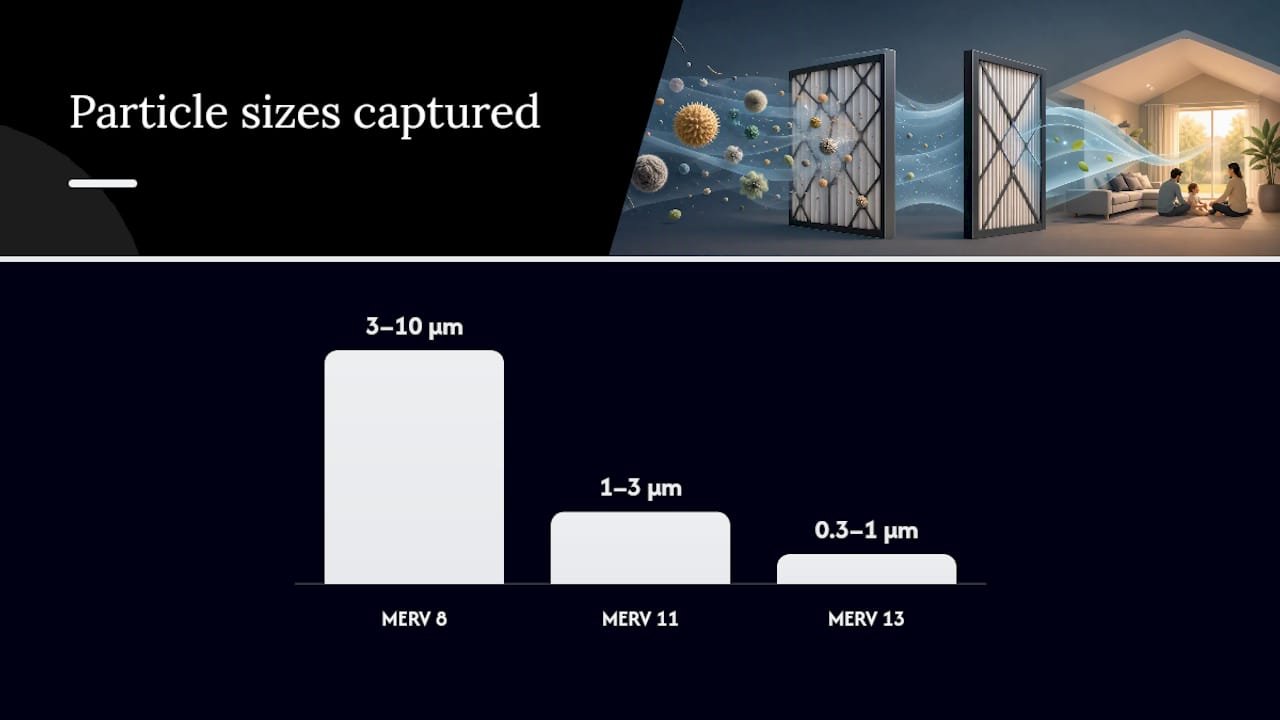
- MERV 8: Captures particles in the 3–10 µm range. Catches lint, dust mites, and larger pollen. The baseline for most builder-grade homes.
- MERV 11: Captures particles in the 1–3 µm range. Adds mold spores, pet dander, finer dust, and most pollen types. A meaningful upgrade over MERV 8 without the compatibility risk of going higher.
- MERV 13: Captures particles down to 0.3–1 µm. Adds tobacco smoke, cooking smoke, wildfire fine particulates, many bacteria, and some viral droplet nuclei to the list.
One thing worth knowing: MERV ratings are assigned under specific lab conditions, including a set face velocity (how fast air moves through the filter) and a defined filter depth. Real-world performance can vary by brand and pleat depth. A 1" MERV 13 filter from one manufacturer may have a meaningfully different pressure drop than a 2" MERV 13 from another, even at the same rating.
Key insight: The ASHRAE 52.2 standard gives you a consistent comparison baseline, but it doesn’t guarantee identical performance across brands. Trane and 3M Filtrete both publish MERV guidance that accounts for filter depth and system type — check their product pages before buying, not just the MERV number on the box.
For a broader look at how filtration fits into your home’s overall air quality, the role of indoor air quality in your home’s health is worth reading alongside this comparison.
What MERV 11 actually removes and who it’s right for
MERV 11 captures particles in the 1–3 µm range, which covers the particles most homeowners are actually trying to filter out: pollen, mold spores, pet dander, and finer household dust. For the majority of American homes, that’s the practical sweet spot.
What MERV 11 does well:
- Removes most pollen types and mold spores that trigger seasonal allergies
- Captures pet dander effectively, which matters for the roughly two-thirds of U.S. households with pets
- Handles finer dust and some lint that MERV 8 misses
- Works with nearly all modern HVAC systems, including those with PSC blowers
- Available in 1", 2", and 4" depths; deeper pleats extend filter life and reduce loaded pressure rise
Where MERV 11 falls short:
- Won’t reliably capture fine smoke particles (tobacco, wildfire PM2.5) in the sub-1 µm range
- Misses many bacteria-sized particles and viral droplet nuclei
- Not the right choice for households with serious respiratory conditions or heavy smoke exposure
Trane and 3M Filtrete both describe MERV 11 as a practical “sweet spot” for most residential systems. It delivers real IAQ improvement over a basic MERV 8 without the pressure-drop risk that comes with jumping straight to MERV 13. For a home with pets and seasonal allergies, a 2" MERV 11 pleated filter changed every 60–90 days is a straightforward, low-risk upgrade.
What MERV 13 removes and when it’s worth the upgrade
MERV 13 extends filtration into the 0.3–1 µm range, which is where the particles most dangerous to respiratory health live. Tobacco smoke, wildfire fine particulates, cooking smoke, many bacteria, and some viral droplet nuclei all fall in this size band. That’s a genuinely different category of protection.
What MERV 13 adds over MERV 11:
- Captures fine smoke particles from tobacco, cooking, and wildfire events
- Removes many bacteria and some viral droplet nuclei that MERV 11 passes through
- Provides meaningful protection for immunocompromised occupants or those with severe asthma
- Recommended by Wirecutter for home use when low-resistance MERV 13 models are available
The real caveats:
- Higher initial pressure drop, especially in 1" filters, can strain PSC blowers
- A loaded 1" MERV 13 filter can see pressure drop climb significantly faster than a 2" or 4" version
- Some brands produce MERV 13 filters with notably higher resistance than others at the same rating
The practical fix for most of the pressure-drop concern is filter selection. Wirecutter notes that California regulations now require manufacturers to publish air resistance values, which gives shoppers an objective way to compare MERV 13 models before buying. Look for a low-resistance MERV 13 in a 2" or 4" depth if your cabinet allows it. Trane and Carrier both advise choosing the highest MERV rating your system can sustain rather than simply reaching for the highest number available.
Can your HVAC handle MERV 13? How to check before you upgrade
This is where most homeowners skip a step they shouldn’t. Swapping a MERV 11 for a MERV 13 in an older system with a PSC blower and a 1" filter slot can reduce airflow enough to cause short-cycling, frozen coils, or premature blower wear. The static pressure in your HVAC system is the number that tells you how much headroom you have.
Step-by-step compatibility check:
- Measure your filter slot. Pull the existing filter and note the depth: 1", 2", or 4". A 1" slot limits your options; a 4" cabinet gives you the most surface area and the lowest pressure rise.
- Identify your blower type. Check the unit label or owner’s manual. ECM (variable-speed) blowers compensate for increased resistance by ramping up speed. PSC blowers cannot, so they’re more vulnerable to airflow loss.
- Check manufacturer guidance. Trane, Carrier, and other major brands publish maximum recommended MERV ratings for specific equipment models. That number is your ceiling.
- Inspect your ductwork. If your system already shows signs of high static pressure (noisy blower, uneven room temperatures), adding a higher-MERV filter will make it worse.
- Install and observe. After swapping filters, run the system for 24 hours and check airflow from registers, listen for new sounds, and note whether the system cycles more frequently than usual.
Pro Tip: If you have a PSC blower or a 1" filter slot, prioritize a deeper pleated filter (2" or 4") over jumping to MERV 13. A 2" MERV 11 in a PSC system often outperforms a 1" MERV 13 in both air quality and system longevity.
Call a technician if you notice any of these after upgrading:
- Sudden temperature swings or rooms that won’t reach setpoint
- Louder blower noise or vibration
- Reduced airflow from supply registers
- System cycling on and off more frequently than normal
How to decide: a step-by-step checklist for homeowners
Use this before you buy your next filter or talk to an HVAC technician.
- Assess your household’s health needs. Seasonal allergies or pets? MERV 11 is likely sufficient. Wildfire smoke exposure, a smoker in the home, or an immunocompromised occupant? MERV 13 is worth pursuing.
- Check your filter slot depth. A 1" slot with a PSC blower is a compatibility risk for MERV 13. A 2" or 4" cabinet with an ECM blower is a green light.
- Choose filter depth before choosing MERV rating. A deeper pleat reduces pressure rise as the filter loads. If you can only fit a 1" filter, look for a low-resistance MERV 13 model and replace it every 4–6 weeks under heavy use.
- Evaluate replacement cadence and cost. A 2" or 4" MERV 13 filter costs more upfront but typically lasts longer and maintains lower pressure drop as it loads. Factor that into your annual cost, not just the sticker price.
- Test after upgrading. Run the system for a full day, check airflow, listen for new sounds, and monitor your thermostat’s cycle frequency.
Questions worth asking your HVAC technician before upgrading:
- What’s the maximum static pressure my blower can sustain?
- Do you recommend a 2" or 4" filter cabinet for this unit?
- Is there a low-resistance MERV 13 model you’d use in this system?
- When was the last time the blower motor and coil were serviced?
If you’re unsure, the safest path is to install a MERV 11 now, schedule a static-pressure test, and upgrade to MERV 13 once you have a confirmed pressure reading. The HVAC maintenance checklist is a useful companion for that process.
What filters actually cost and how to manage replacement frequency
A standard 1" MERV 11 filter typically runs less than a comparable 1" MERV 13, though the gap narrows when you move to 2" or 4" pleated versions. The more important cost variable is how often you replace it.
Replacement frequency guidelines:
- 1" pleated filters (MERV 11 or 13): every 1–3 months, depending on household dust load, pets, and occupancy
- 2" pleated filters: every 3–4 months under normal conditions
- 4" pleated filters: every 6 months or longer, depending on load
The catch with high-MERV filters is that loading accelerates pressure drop. Field research from Lawrence Berkeley National Laboratory found that loading rates varied more by house than by MERV rating, and that a loaded filter can dramatically increase pressure drop regardless of its initial rating. That means a MERV 13 filter left in place too long can cause more system stress than a fresh MERV 13 filter ever would.
Deeper pleated filters help here. InterNACHI and Home Energy Magazine testing showed that deeper filters often maintain lower pressure rise as they load, though some high-MERV 2" filters still showed high initial pressure drops in certain tests. The takeaway: filter depth helps, but brand selection matters too.
Practical cost-saving habits:
- Buy filters in multi-packs to reduce per-unit cost
- Set a recurring calendar reminder for replacement (not just when you remember)
- Use a subscription delivery service to keep replacements on hand
- Record the installation date on the filter frame with a marker
For more on why timely filter replacement matters, the reasoning goes beyond air quality to blower longevity and energy use.
Which filter fits your household situation?
Different homes have different needs. Here’s how to map your situation to the right MERV choice.
Seasonal allergies (no pets, no smoke): MERV 11 covers pollen, mold spores, and most allergens in the 1–3 µm range. The AAFA certifies products in the MERV 11–13 range as effective for allergy management. If your system is older, MERV 11 is the lower-risk path. Fallback if incompatible with MERV 13: stay at MERV 11 in a 2" pleat for longer life.
Pets: MERV 11 handles pet dander well. If you have multiple pets or a heavy shedder, a 2" MERV 11 or a low-resistance MERV 13 (if your system allows) both work. Replace more frequently during heavy shedding seasons.
Wildfire smoke or household smokers: MERV 13 is the right call. Wildfire PM2.5 and tobacco smoke particles fall in the 0.3–1 µm range that MERV 11 misses. If your blower can’t handle MERV 13, add a portable HEPA air cleaner in the rooms where smoke exposure is highest. MERV 13 and HEPA are not the same standard, but a portable HEPA unit fills the gap when your central system can’t go higher.
Immunocompromised occupants: MERV 13 plus additional IAQ steps. Filtration alone isn’t enough. MERV 13 handles the particulate side; the rest of the IAQ picture requires a broader approach.
Urban smog or heavy outdoor pollution: MERV 13 captures many of the fine particles in urban smog. If you’re in a high-traffic area or near industrial zones, the upgrade is worth the compatibility check.
One consistent caveat across all scenarios: MERV rating alone doesn’t substitute for ventilation, humidity management, and source control. It’s one layer of a complete IAQ strategy.
What field studies say about real-world MERV upgrades
The energy impact of upgrading from MERV 11 to MERV 13 is smaller than most homeowners expect. LBL field research found that moving to MERV 10–13 typically causes less than 1% change in energy use for many systems. The mechanical effects, specifically reduced airflow and blower strain, are the real concern, not the electricity bill.
Measured finding: Airflow reductions of 3–11% have been recorded in some tests depending on motor type and MERV rating, with PSC motors showing larger drops than ECM motors under the same filter conditions.
Pressure drop increases with MERV tier, and filter depth affects how that pressure rise behaves over time. InterNACHI and Home Energy Magazine testing confirmed that deeper filters often show lower pressure rise as they load, but noted that some high-MERV 2" filters had high initial pressure drops in specific test conditions. The practical implication: don’t assume a 2" filter automatically solves the pressure problem. Check the manufacturer’s published air resistance value before buying.
The LBL research also found that loading rates varied more by house than by MERV rating. A home with heavy dust, pets, or construction nearby will load a MERV 13 filter much faster than a clean, low-occupancy home. That variability is why replacement cadence matters as much as filter selection.
For most homeowners with modern ECM blowers and 2" or 4" filter cabinets, upgrading to MERV 13 is low-risk. For those with PSC blowers and 1" slots, the risk is real and worth a professional assessment before committing.
The filter upgrade advice most homeowners never hear
The standard guidance on MERV filters is “go as high as your system allows.” That’s technically correct, but it misses the more useful question: what does your household actually need to filter?
Most homes don’t have wildfire smoke, tobacco smoke, or immunocompromised occupants. For those homes, MERV 11 isn’t a compromise. It’s the right answer. The particles that drive most allergy and asthma symptoms in a typical American home, pollen, mold spores, pet dander, sit squarely in the 1–3 µm range that MERV 11 handles well. Chasing MERV 13 for a home with seasonal allergies and a golden retriever adds pressure-drop risk without a proportional IAQ benefit.
The other thing most guides understate is the loading problem. A MERV 13 filter that’s been in place for four months in a dusty home isn’t protecting your air quality. It’s restricting your airflow. The filter rating on the box only matters when the filter is fresh. After that, replacement frequency determines whether you’re actually getting the filtration you paid for.
The honest hierarchy is: right filter depth first, right MERV rating second, right replacement cadence third. Get those three in order and the MERV 11 vs MERV 13 decision becomes straightforward.
When Appliancesrepairmdtech can help you get this right
Choosing the right filter is one decision. Making sure your HVAC system can actually support it is another, and that’s where a professional diagnostic makes the difference.
Appliancesrepairmdtech provides HVAC repair and diagnostic services across Orange County and Los Angeles County, including static-pressure testing with a manometer or Magnehelic gauge, blower identification, and installation of 2" or 4" filter cabinets for homeowners upgrading from a 1" slot. If your system needs a tune-up before it can safely run a MERV 13 filter, that’s part of the service too.

A static-pressure test takes one visit and gives you a concrete number: either your system has headroom for MERV 13, or it doesn’t. No guesswork, no risk of a frozen coil or a burned-out blower motor. Book a diagnostic appointment online at Appliancesrepairmdtech and get a clear answer before your next filter purchase.
Sources
The claims in this article draw on the following sources. Each is worth reading if you want to go deeper on a specific point.
- System Effects of High Efficiency Filters in Homes | LBL ETA Publications
- The Furnace and Air Conditioner Filters We Would Buy for 2026 | Reviews by Wirecutter
- Home Energy Magazine :: Is There a Downside to High-MERV Filters?