
For most budget-conscious homeowners and freeze-prone climates, PEX is the smarter buy. For owners who want maximum longevity, high-heat tolerance, and full recyclability, copper still wins. PEX runs about $0.50 to $2 per foot installed, versus $2 to $8 for copper, and copper’s 50 to 70 year lifespan beats PEX’s typical 25 to 50 years.
- Retrofit, tight budget, or freeze-prone area? Choose PEX.
- Long-term ownership, UV-exposed runs, or high-heat systems? Choose copper.
- Mixed conditions in one house? A hybrid setup, copper on the main line and PEX on the branches, often makes the most sense.
Key Takeaways
The right pipe choice depends on your water chemistry, freeze exposure, and how long you plan to own the home, not on which material sounds more premium.
| Point | Details |
|---|---|
| Cost gap is real | PEX runs $0.50 to $2 per foot installed versus $2 to $8 for copper, mainly due to labor. |
| Copper lasts longer, generally | Copper’s 50 to 70 year lifespan beats PEX’s 25 to 50 years under normal water conditions. |
| Freeze risk favors PEX | PEX expands under freezing and rarely bursts, while copper can crack. |
| Water chemistry decides corrosion risk | Acidic or soft water shortens copper’s life; test your water before choosing. |
| Hybrid systems solve mixed conditions | Appliancesrepairmdtech installs copper-PEX hybrid repipes tailored to each home’s exposure and budget. |
Table of Contents
- Copper vs PEX at a Glance
- What Does Copper vs PEX Cost to Install?
- How Long Do Copper and PEX Pipes Last?
- Does PEX or Copper Affect Water Quality?
- Can You Install PEX or Copper Yourself?
- How Do You Decide Between PEX and Copper?
- Which Pipe Material Is Better for the Environment?
- Common Myths About PEX and Copper Plumbing
- What Do Experienced Plumbers Check Before Choosing Pipe Material?
- Get a Professional Opinion Before You Repipe
- Sources
Copper vs PEX at a Glance
| Factor | PEX | Copper |
|---|---|---|
| Material cost | $0.50–$2/ft | $2–$8/ft |
| Typical whole-house repipe | Lower total, less labor | Higher total, more labor |
| Lifespan | 25–50 years | 50–70 years |
| Freeze resistance | Expands, rarely bursts | Can crack when frozen |
| Corrosion/water quality | Resists corrosion and mineral buildup | Vulnerable to acidic water pitting |
| Installation | DIY-friendly, fast | Skilled labor, soldering |
| Temperature tolerance | Lower ceiling | Handles higher heat |
| Recyclability | Harder to recycle | 100% recyclable |
| Best for | Retrofits, cold climates | Mains, high-heat, long-term ownership |
A few exceptions matter. Well water with low pH accelerates copper pitting regardless of the pipe’s age. Runs exposed to direct sunlight or attic heat favor copper, since PEX degrades faster under UV. And homes with a rodent problem should skip PEX in exposed crawlspaces, since it doesn’t stand up to gnawing the way rigid copper does.
What Does Copper vs PEX Cost to Install?
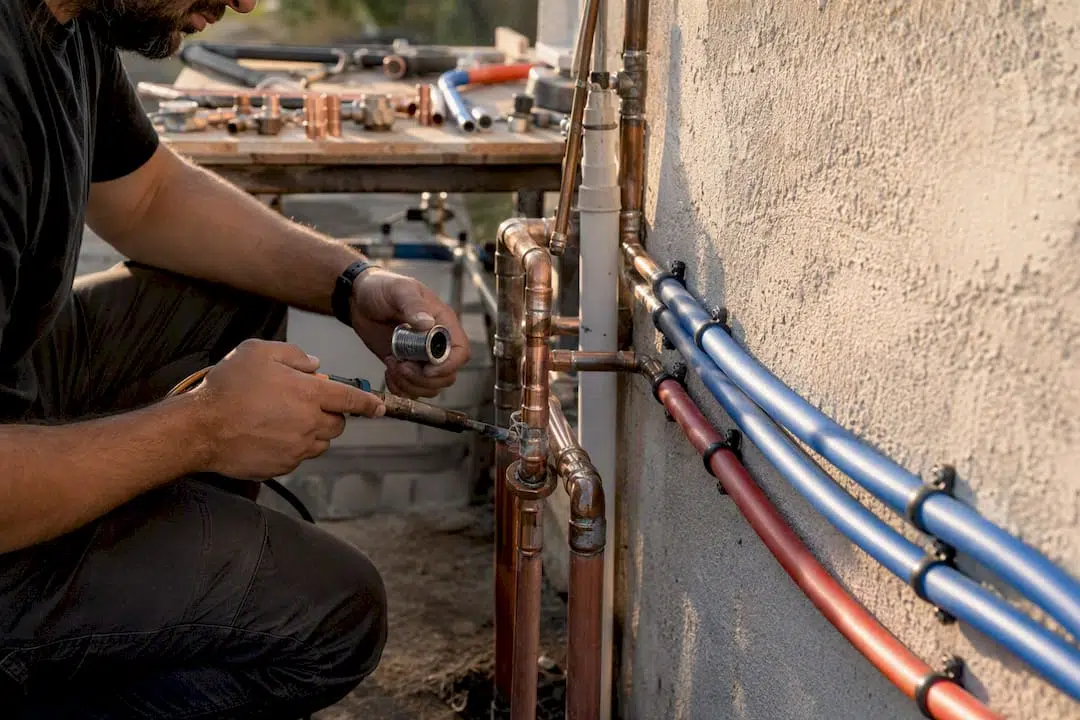
Material is only part of the bill. PEX’s $0.50 to $2 per foot reflects not just cheaper tubing but fewer fittings, since a single coil can snake through walls without the joints copper needs at every turn. Copper’s $2 to $8 per foot includes the copper itself plus the extra labor hours for cutting, fluxing, and soldering each joint.
That labor gap is where whole-house numbers diverge, making it important to consider interior basement waterproofing cost when repiping in moist or wet areas. A typical repipe with PEX often saves thousands of dollars over copper once you add wall repair and finish work, since fewer access points mean less drywall to open and patch.
Permits complicate the picture. Most jurisdictions require an inspection for a full repipe regardless of material, and some local codes still restrict where PEX fittings can be used, so confirming acceptance before you buy materials avoids a failed inspection.
- Get at least two written estimates that separate material and labor costs.
- Ask whether the quote includes drywall patching and paint touch-up.
- Confirm your city’s current code stance on PEX manifolds and fittings.
Pro Tip: Ask your plumber for the permit fee up front. A licensed pro folds it into the estimate, while a handshake deal often leaves you to pull the permit yourself, a common way DIY repipes stall out. Homeowners weighing a full gas line replacement alongside a repipe can find similar cost breakdowns for gas line installation useful for comparison.
How Long Do Copper and PEX Pipes Last?
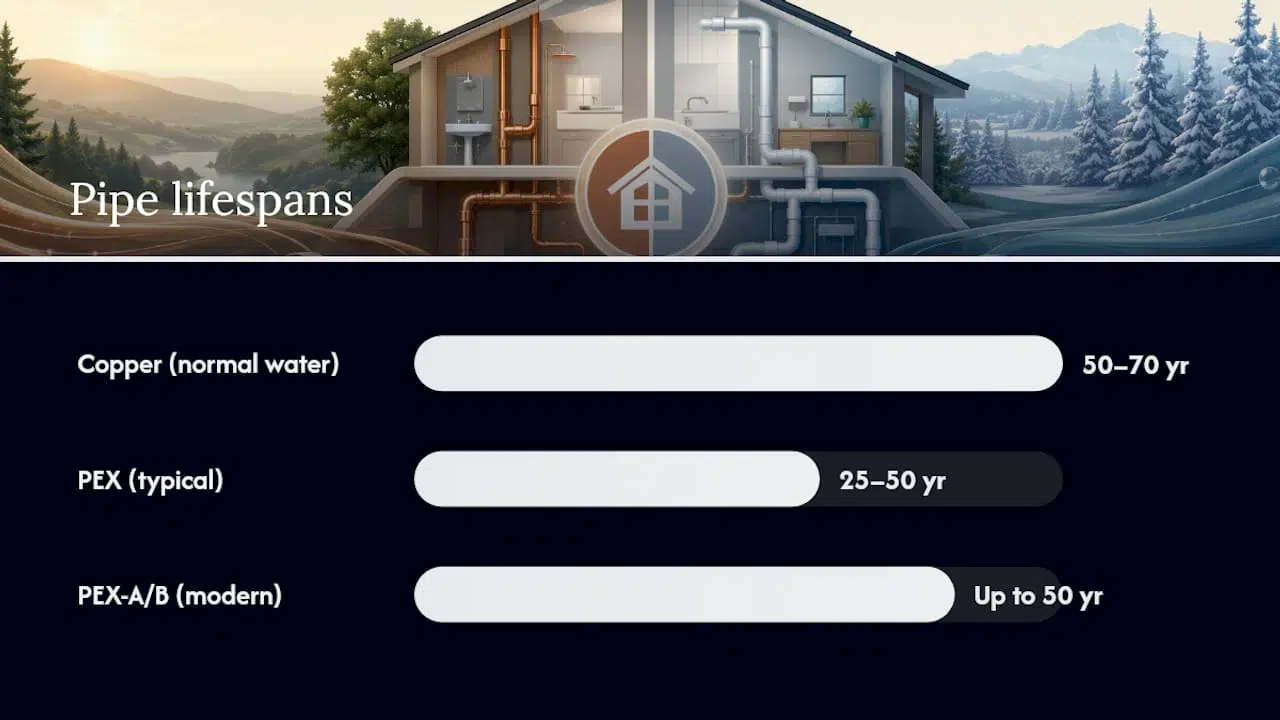
Copper’s reputation rests on longevity: 50 to 70 years is the commonly cited range under normal water conditions. PEX typically lands at 25 to 50 years, with the higher end reserved for modern PEX-A and PEX-B formulations installed correctly and kept out of direct sunlight.
Freezing conditions flip the usual durability story. PEX expands slightly when the water inside it freezes and rarely bursts, while rigid copper often cracks under the same stress. That’s why vacation cabins and unheated crawlspaces in cold regions lean PEX almost by default.
Heat tolerance runs the other direction. Copper handles higher continuous temperatures without softening or deforming, which matters for hot-water recirculation loops and solar thermal systems where copper remains the standard.
- Acidic or heavily chlorinated water can shorten copper’s lifespan well below 50 years.
- UV exposure degrades PEX faster than any other single factor.
- Recirculating hot-water systems favor copper’s higher heat ceiling.
Does PEX or Copper Affect Water Quality?
Acidic or soft water is copper’s biggest enemy. Low pH slowly dissolves the pipe wall from the inside, producing the pinhole leaks that show up as damp drywall years after installation. PEX sidesteps that failure mode entirely since it’s resistant to corrosion and mineral buildup, making it the better call in corrosive well water.
New PEX can release trace amounts of compounds into the first few fills, but that leaching typically dissipates within weeks and stays within NSF/ANSI 61 limits, the standard both materials are certified against for potable water use. Copper, meanwhile, carries natural antimicrobial properties.
- Test your water’s pH and hardness before choosing a material, especially on well systems.
- Check your local water report for chlorine levels, which accelerate copper corrosion over time.
- Flush new PEX lines thoroughly for the first several uses.
Can You Install PEX or Copper Yourself?
- PEX push-to-connect and crimp fittings are DIY-friendly with a basic crimp tool, a set of crimp rings, and a tubing cutter.
- Copper soldering demands a torch, flux, and enough practice to avoid a leaky joint behind a finished wall, which is why most homeowners hire it out.
- Full repipes, gas-adjacent lines, and main shutoff work should go to a licensed plumber regardless of material, since a mistake there risks code violations or water damage.
Pro Tip: A failed DIY solder joint often hides behind drywall for months before it leaks. If you’re not confident with a torch, PEX’s crimp connections are far more forgiving for a first-timer. Our plumbing repair guide walks through which repairs are reasonable to tackle yourself.
How Do You Decide Between PEX and Copper?
- How long will you own this home? Short-term owners rarely recoup copper’s added cost.
- Does the area freeze? If pipes run through an unheated garage or crawlspace, PEX’s flexibility matters more than copper’s prestige.
- Is your water acidic or heavily softened? That alone can shorten copper’s life dramatically.
- Are any runs exposed to sunlight or rodents? Both push toward copper for those specific sections.
- What’s your budget and timeline? PEX’s lower material and labor cost matters most on a full repipe.
Watch for red flags: a history of pinhole leaks in an older copper system signals corrosive water, not bad luck, and some insurers scrutinize PEX installations with a documented claim history.
- A small condo repipe with tight wall access: PEX, for speed and lower disruption.
- A 1950s whole-house repipe with old galvanized lines: hybrid, copper at the main, PEX for branches.
- A vacation home left unheated in winter: PEX, for freeze tolerance alone.
Which Pipe Material Is Better for the Environment?
Copper is 100% recyclable at the end of its life, but producing it takes more energy than manufacturing PEX. PEX has a lighter production footprint but is genuinely harder to recycle once it’s pulled out of a wall.
- Removed copper often has real salvage value, which can offset repipe costs.
- PEX’s coil shipping and fewer fittings also cut transport waste during installation.
Homeowners focused on sustainability beyond piping material might also look at our guide to cutting water waste at home.
Common Myths About PEX and Copper Plumbing
“PEX isn’t safe for drinking water” doesn’t hold up. Both materials meet NSF/ANSI 61 standards when installed correctly, and any trace leaching from new PEX dissipates quickly. “Copper is always the better material” is equally oversimplified. It corrodes fast in acidic water, where PEX is the more reliable pick.
- Some insurers flag PEX due to older installation-quality claims, not the material itself. Keep your invoice and permit documentation on hand.
- Inspectors on a repipe typically check solder joint quality on copper and manifold labeling on PEX systems.
- Confirm local code before mixing materials. Some jurisdictions still restrict PEX in specific applications.
What Do Experienced Plumbers Check Before Choosing Pipe Material?
On-site pros run through a short mental checklist before recommending anything: water hardness and pH, pipe accessibility, sun or heat exposure, freeze risk, and how the new material will tie into existing connections.
- Water test results (pH, hardness, chlorine)
- Accessibility of the run and wall condition
- UV or thermal exposure along the route
- Freeze risk in unheated spaces
- Homeowner’s timeline and budget
Copper still gets the nod for main lines and high-heat recirculation loops, while PEX handles most branch runs and retrofits where speed and flexibility matter more. Many pros land on a hybrid system precisely because it lets each material do the job it’s best at.
Pro Tip: If your plumber suggests copper at the water heater and PEX everywhere else, that’s not indecision. It’s the standard hybrid approach most experienced installers reach for.
A Practical Take on Picking Between Copper and PEX
Most homeowners overthink this decision when a simple water test and a look at their freeze risk would settle it fast. In practice, a hybrid setup solves more real homes than a pure either-or choice ever does.
Get a Professional Opinion Before You Repipe
Choosing between copper and PEX gets easier with someone on-site who can actually test your water and inspect your walls, rather than guessing from a comparison chart. Appliancesrepairmdtech’s licensed plumbers serve Orange County and Los Angeles County homeowners with water testing, full repipe estimates, and hybrid installations that mix copper and PEX where each performs best.

Whether you’re staring down a 1950s galvanized system or planning a new build, an on-site estimate beats guesswork every time. Our plumbing pipe repair team can walk your property, test your water chemistry, and give you a written quote before any wall gets opened. Book an on-site estimate today and get a straight answer for your specific home.
Sources
- Pex vs. Copper: Which Is Better for Your Home’s Plumbing? | Angi
- PEX vs Copper Pipes — Which is Better for Your Home? — BobVila
- EPA sustainability primer (construction/material lifecycle guidance)
- PEX vs Copper Pipes — Which is Better for Your Home? (2026) – PlumbingToolsReview