
If your mini split is not heating, the cause is usually one of five things: the wrong mode or setpoint, a dirty filter, a normal defrost cycle, a tripped breaker, or a real fault such as a stuck reversing valve or a refrigerant leak. The first three you can check in about 15 minutes. The last two need a licensed technician, and this guide shows you where the line sits.
We repair and install HVAC equipment for homeowners in Orange County and Los Angeles County, so we see the same pattern every cool season. The unit ran all summer in cooling mode, then the first chilly evening arrives and nothing warm comes out. Sometimes it is a ten-second fix. Sometimes the system has been quietly failing for months.
TL;DR
- Start with the remote: confirm the unit is in Heat mode (not Fan or Dry) and the setpoint is well above room temperature.
- Clean the filter, then do a hard reset: power off at the remote, cut power for at least 5 minutes, restart.
- Cool air for 5 to 15 minutes during a defrost cycle is normal. Cool air that never turns warm is not.
- Low refrigerant means a leak. Store-bought recharge kits are not the answer, and an EPA-certified technician has to find and fix it.
- Book a repair if the outdoor unit is dead, iced over repeatedly, or the unit stays cold after the basic checks.
Table of Contents
- Quick checks that fix most “no heat” calls
- Is it a defrost cycle or a real fault?
- Why a mini split blows cold air in heat mode
- What not to do
- A five-minute troubleshooting routine
- Our perspective: what we see in Southern California
- When to book a technician
- Need it fixed? Book an HVAC visit
- FAQ
- Sources
Quick checks that fix most “no heat” calls
Work through these in order. They cost nothing and take no tools.
1. Confirm the mode and setpoint
A mini split in Fan or Dry mode will not heat or cool, a point manufacturer support guidance lists among the first things to verify. Press the mode button until the sun symbol shows, then set the temperature at least 5 degrees above the current room temperature. If the setpoint is at or below the room temperature, the unit has no reason to run the heating cycle and will sit idle or blow room-temperature air.
Also check for a timer, sleep mode or an eco setting. Those can lower the setpoint overnight without you noticing. If you have more than one remote, make sure you are using the one that belongs to that indoor unit.
2. Clean the air filter
A clogged filter restricts airflow across the indoor coil. That hurts heat delivery and, in heating mode, can leave you with weak, lukewarm air from the vents. Checking the filters is part of the ENERGY STAR maintenance checklist, and it is the simplest item on it.
Most mini split filters slide out behind the front panel. Rinse them with lukewarm water, let them dry fully and put them back. If the unit runs most of the day, check them more often than you would on a seasonal unit. Our guide on ductless mini split maintenance, DIY or call a tech shows which maintenance jobs are safe for a homeowner and which are not.
3. Do a hard reset
Control boards occasionally get stuck in a mode or misread the thermostat input. The reset steps in manufacturer guidance are simple: turn the system off at the remote, cut power to the unit at the plug or breaker for at least 5 minutes, then restore power and start it again in Heat mode.
There is no universal reset button on a mini split. The breaker is the reset. Wait the full five minutes so the board can clear.
4. Check the breaker and the disconnect
Most systems have a dedicated breaker, and many have a small outdoor disconnect box near the condenser. If the indoor unit lights up but the outdoor fan never spins, a tripped breaker or pulled disconnect is a common reason. Reset a tripped breaker once. If it trips again straight away, stop. Repeated tripping points to a short or a failing compressor or fan motor, and that is an electrician or HVAC tech job.
Is it a defrost cycle or a real fault?
This is the question behind most “my mini split is blowing cold air in heat mode” searches, and the honest answer is: it depends on how long it lasts.
A heat pump in heating mode pulls heat from outdoor air. When the outdoor coil gets cold enough, frost builds up on it. To melt it off, the system briefly reverses the refrigeration cycle. According to a U.S. Department of Energy research report on inverter-driven heat pumps, this is normal operation, usually lasting 5 to 15 minutes. During it the indoor fan may slow, stop, or push out cooler air, and you may see steam rising from the outdoor unit.
| What you notice | Likely meaning | What to do |
|---|---|---|
| Cool or no air for up to about 15 minutes, then warm air returns | Normal defrost cycle | Nothing. Wait it out. |
| Indoor unit stays cool or silent past 15 to 20 minutes | Possible stuck reversing valve or failed defrost sensor | Book a diagnosis |
| Heavy ice on outdoor coil that does not clear | Defrost failure, blocked airflow or water dripping onto the unit | Turn off, check surroundings, call a tech |
| Warm air once, then it only blows cold afterward | Reversing valve or refrigerant problem | Book a diagnosis |
The 15 to 20 minute threshold comes from the same DOE report: if the unit stays in that state longer, or never produces heat again, a mechanical fault is likely. We also wrote a short piece on what to ask your technician about heat pump defrost problems.
Where defrost trouble often starts: the installation
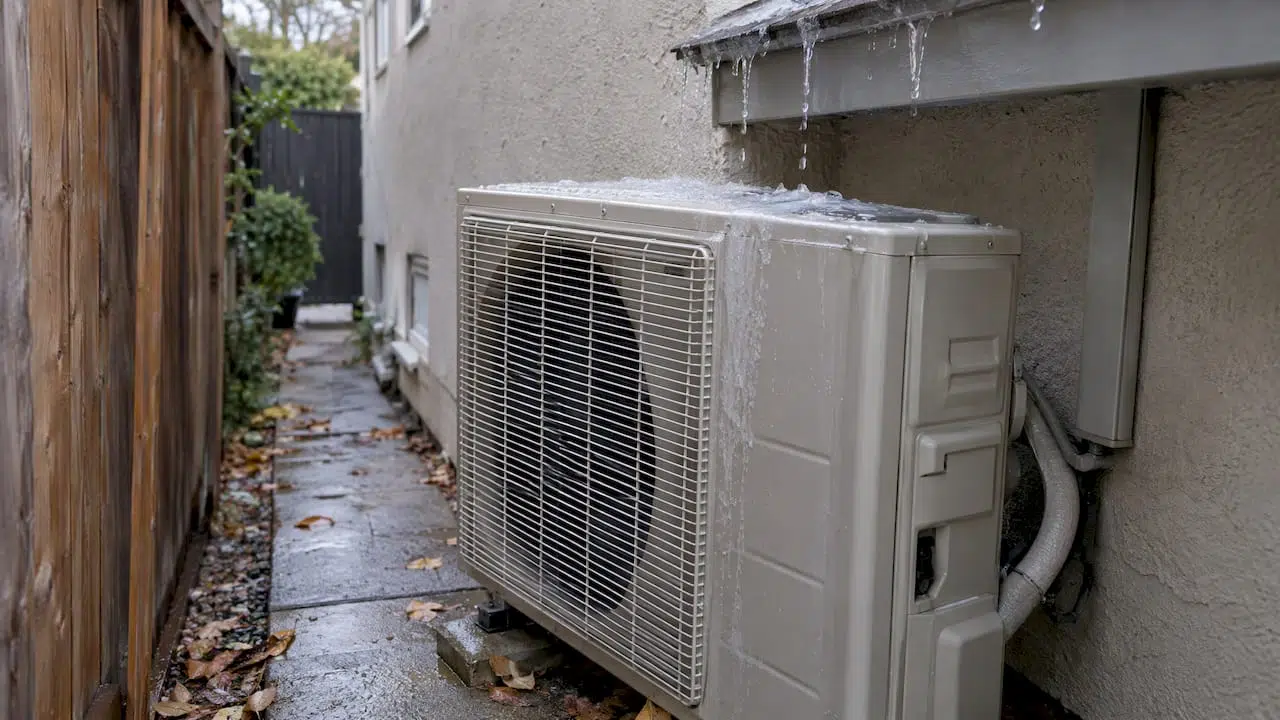
An outdoor unit mounted directly under a roof edge or under another unit that drips onto it can be coated in meltwater that refreezes. A U.S. Department of Energy-hosted guide for homeowners with heat pumps notes that a unit placed beneath a drip line can run defrost far more than it should, which limits heating output. In coastal Southern California you will see this less from snow and more from roof drainage, sprinklers and a unit squeezed against a side-yard wall. Look at what is above and beside the condenser. Leaves, debris and anything blocking airflow make it worse.
Why a mini split blows cold air in heat mode
If you have ruled out settings, filters and defrost, these are the usual faults.
Stuck reversing valve
The reversing valve is what switches the system between cooling and heating. If a unit cooled perfectly all summer and will not switch over for heat, the valve is a prime suspect. You will hear the compressor run and feel cool air at the indoor unit while the thermostat calls for heat. Replacing it is a refrigerant-handling job, so it belongs with a licensed technician.
Failed defrost sensor or control board
A bad sensor can make the unit think it is permanently frosted, or never frosted at all. Either way you get reduced heat, repeated defrosting or ice buildup. Diagnosing it means reading sensor resistance and board output, not guessing.
Low refrigerant from a leak
Low refrigerant is one of the most misunderstood problems. Trane’s troubleshooting guidance is clear that a mini split does not consume refrigerant like fuel. If the charge is low, there is a leak. Left alone, it keeps pushing your energy bill up and can lead to compressor failure, one of the costliest repairs in HVAC.
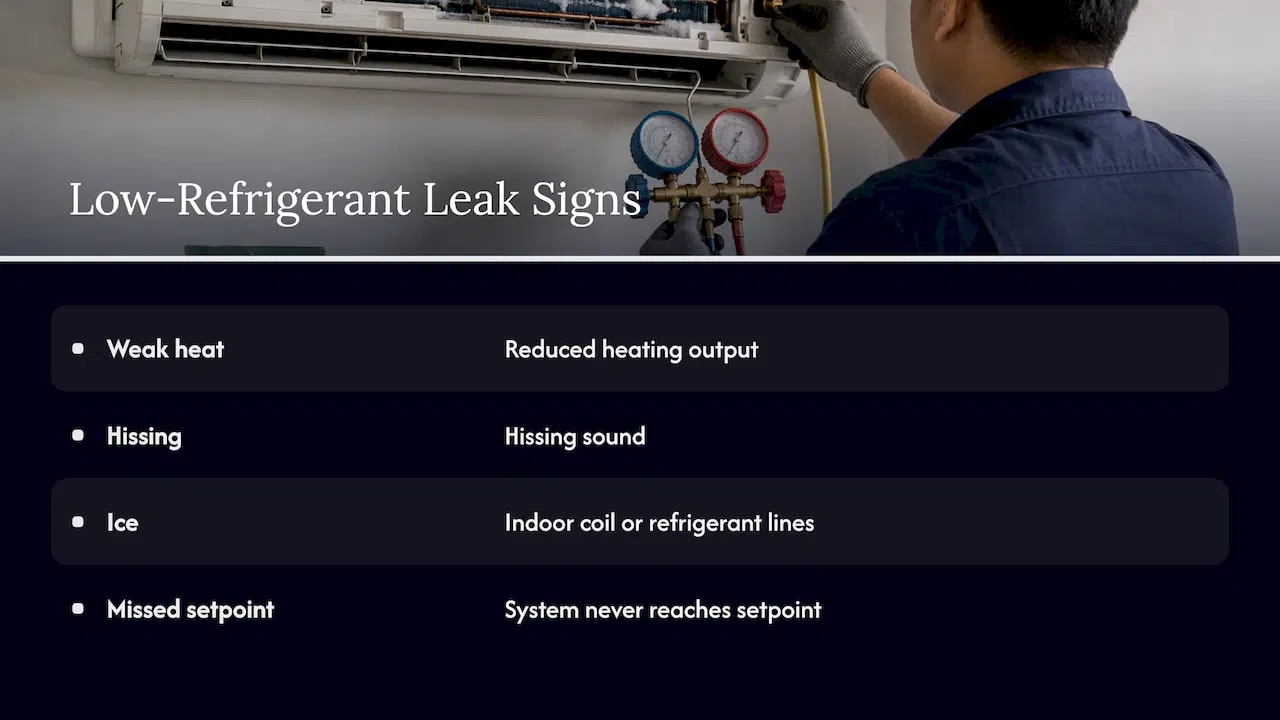
Symptoms include weak heat, a hissing sound, ice on the indoor coil or on the refrigerant lines, and a system that never reaches setpoint. A California refrigerant management training manual notes that mini splits rely on flare fittings, which need careful installation to prevent leaks and ensure proper evacuation. That is why the connections are a common place for technicians to look.
Failed compressor, capacitor or fan motor
If the outdoor fan runs but the compressor does not, or the outdoor unit hums and does nothing, electrical components such as the capacitor may be at fault. A failing compressor is serious. Our article on compressor failure causes, signs and fixes explains what to expect and how to avoid it.
Undersized unit or poor placement
Sometimes nothing is broken. The same DOE report found a wide range in heating performance among field-tested units, with causes including low indoor airflow, poor outdoor placement and thermostat setback. A unit sized for a bedroom will not warm an open living area. If heat has always been underwhelming in one room, ask a technician to check the load, the airflow and the unit’s position, rather than replacing parts.
What not to do
- Do not buy a recharge kit. Mini splits are high-pressure, factory-sensitive systems where the charge depends on line length and the manufacturer’s spec. The Trane guide explains why topping off often leads to overcharging, which hurts compressor efficiency and lifespan. A proper repair means an EPA-certified technician locating the leak, recovering the remaining refrigerant, repairing the breach, pulling a vacuum and recharging to spec.
- Do not chip ice off the coil or lines. You can puncture a refrigerant line. Turn the system off and let it thaw, then find out why it iced.
- Do not keep resetting the breaker. One reset is fine. A repeat trip is a warning.
- Do not open the outdoor unit. Capacitors can hold a charge after the power is off.
A five-minute troubleshooting routine
- Set the remote to Heat and the setpoint 5 degrees or more above room temperature.
- Pull and clean the filters. Look at the indoor coil for dust or ice.
- Check the breaker and the outdoor disconnect.
- Walk outside. Is the fan turning? Is there ice, debris, or dripping water above the unit?
- Hard reset: off at the remote, power off for at least 5 minutes, then restart.
- Give it 20 minutes in Heat mode. Allow for a defrost cycle.
- Still no warm air? Stop and book a technician.
For other symptoms around the house, our HVAC troubleshooting tips for homeowners cover thermostats, airflow and when to stop.
Our perspective: what we see in Southern California
In Orange County and Los Angeles County, mini splits tend to work hard in cooling season and then sit mostly idle until a cold snap. That gap creates a predictable pattern. A filter that was never cleaned, a condenser boxed in by plants or a fence, a flare connection that has slowly weeped for a couple of seasons: none of it matters until you ask the system for heat on a cold night.
Our advice is simple. Do the free checks first, because they are free. But the moment the symptoms point at refrigerant, the reversing valve or the compressor, stop DIY and have the system diagnosed properly. A technician who finds a small flare leak early saves you from a compressor replacement later. Overcharging a system with a kit does the opposite, and we would rather explain that over the phone than repair the damage afterward.
We also encourage a pre-season test. Run heat mode on a mild afternoon in early fall, not on the first cold night. If something is wrong, you get to schedule the visit instead of waiting in a cold house.
— MDTECH
When to book a technician
Call for service if any of these apply:
- The outdoor unit does not start, or hums without the fan or compressor running.
- Warm air never returns after 20 minutes in Heat mode.
- You see repeated or heavy ice on the outdoor coil, indoor coil or refrigerant lines.
- You hear hissing or notice oily residue at the line connections, which can point to a leak.
- The breaker trips again after a single reset.
- The unit worked in cooling mode but never switches to heating.
A diagnostic visit should check the electrical supply, airflow, sensor readings, the reversing valve operation and the refrigerant circuit, and should explain the findings before any repair is done. Our guide to the HVAC repair process for homeowners explains what to expect from the visit, and the HVAC system repair checklist helps you prepare the details a technician will ask for: make, model, symptoms, and what you already tried.
If the system is old and repairs are stacking up, our page on repair versus replacement lays out how to decide. If you are considering a new unit, ENERGY STAR’s ductless heating and cooling page is a useful place to see what efficient equipment looks like.
Need it fixed? Book an HVAC visit
MDTECH Appliance Repair serves homeowners and property managers across Orange County and Los Angeles County, with licensed technicians, online booking and clear communication about what is wrong before work begins. Our HVAC repair page covers diagnostics and repair, and our air conditioning and installation services cover new or replacement equipment. Tell us what the unit is doing, and what you have already checked, when you book.
FAQ
Why is my mini split blowing cold air when it is in heat mode?
The most common harmless reason is a defrost cycle, which usually lasts 5 to 15 minutes. If the air stays cool longer than 15 to 20 minutes, suspect a stuck reversing valve, a failed defrost sensor or low refrigerant. Check mode, setpoint and filters first, then call a technician.
Why won’t my mini split go into heat mode?
Check that the remote is set to Heat and not Fan or Dry, and that the setpoint is above room temperature. If the settings are right and the unit still will not switch, the reversing valve or control board is a likely cause. Both need a technician.
Is there a reset button on a mini split?
Not usually. A reset means turning the unit off at the remote, cutting power at the plug or breaker for at least 5 minutes, then restoring power. That clears many minor control glitches, but it will not fix a mechanical or refrigerant fault.
Can I add refrigerant myself if my mini split is low?
No. Low refrigerant indicates a leak, and recharge kits risk overcharging, which damages compressor efficiency and lifespan. An EPA-certified technician should locate and repair the leak, evacuate the system and recharge it to the manufacturer’s specification.
Why is the fan running but I get no heat?
The indoor fan can run while the outdoor unit is off, in defrost, or not working. Look outside: if the outdoor fan is not turning, check the breaker and disconnect. If power is fine and there is still no heat, the compressor, capacitor or refrigerant circuit needs professional diagnosis.
Sources
- Senville Support: My mini split is not cooling or heating properly
- ENERGY STAR: Maintenance checklist
- U.S. DOE Building America: Field performance of inverter-driven heat pumps in cold climates
- Building Science Education: You installed an air source heat pump. Now what?
- Trane: How to identify and fix mini-split refrigerant issues
- California Lifecycle Refrigerant Management training manual
- ENERGY STAR: Ductless heating and cooling