
Most AC repairs in the U.S. land between $300 and $1,200, with a typical diagnostic fee of $75 to $250 rolled into the final bill. Minor fixes, like a capacitor swap, can run under $200; a failed compressor or major refrigerant leak can push past $2,000. Before you approve any quote, run it against the $5,000 rule and the 50% rule to check whether the repair still makes financial sense.
TL;DR:
- Labor costs can account for up to half of the repair bill, varying significantly based on location, type of unit, and whether flat-rate or hourly billing is used.
- Replacing a compressor typically costs between $1,500 and $2,800, making it the most expensive common repair short of full system replacement.
- Repairs on older systems that use R-22 refrigerant can be several times more costly due to refrigerant scarcity and phaseout, often favoring system replacement.
- Applying the $5,000 and 50% rules can help determine whether repair costs justify replacing a system, especially for units over 10 to 15 years old.
- Scheduling regular maintenance in spring or fall and verifying written quotes before work begins can significantly reduce overall repair expenses.
Table of Contents
- How Much Does AC Repair Cost by Part?
- What Changes the Price of Your AC Repair?
- Repair or Replace: How Do You Decide?
- What Happens During an AC Service Call?
- How Can You Lower Your AC Repair Bill?
- How Does MDTECH Handle AC Repair Estimates?
- Why Transparency Matters More Than the Price Tag
- Get a Written AC Repair Quote from MDTECH
- Primary Sources and Further Reading
- Sources
How Much Does AC Repair Cost by Part?
The price swing in AC repair comes down to one thing: which part failed. A stuck contactor is a $150 fix. A dead compressor is a different conversation entirely, one that can cost as much as a down payment on a new system.
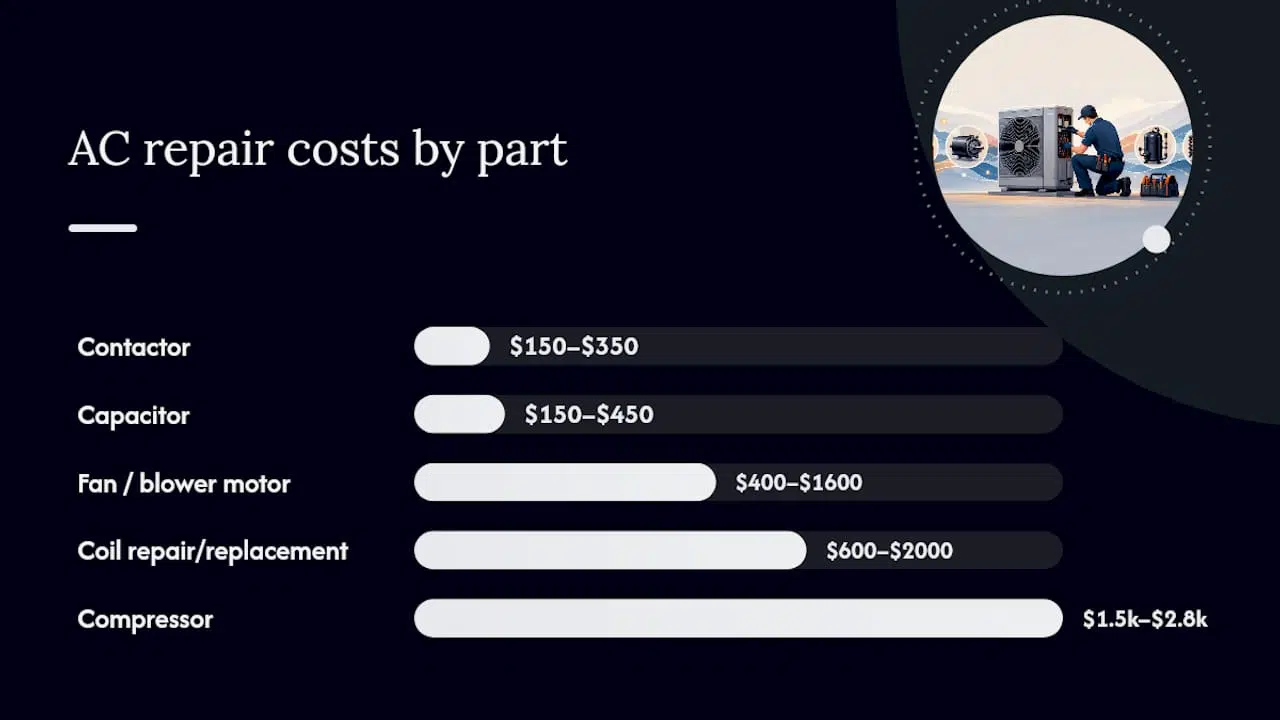
Angi’s 2026 pricing data puts the average HVAC repair around $350, with the full range spanning roughly $130 to $2,000 depending on the system and the failed part. Trane’s cost guide widens that range further, noting that central AC repairs can run anywhere from $100 to $5,000 or more once you factor in labor, warranty status, and regional pricing.
Here’s how the most common repairs typically break down:
- Capacitor replacement: $150 to $450, including the part and about 30 minutes of labor.
- Contactor replacement: $150 to $350, one of the cheaper electrical fixes.
- Fan or blower motor: $400 to $1,600, depending on whether it’s a standard blower or a variable-speed unit.
- Evaporator or condenser coil repair: $600 to $2,000; full coil replacement climbs toward the top of that range.
- Compressor replacement: $1,500 to $2,800, plus labor, often the single costliest common repair short of full system replacement.
- Refrigerant leak detection and recharge: $200 to $1,500, with the wide spread driven almost entirely by refrigerant type.
- Control board replacement: $150 to $600, depending on the board’s complexity and whether it’s a smart/communicating model.
A sample invoice makes this concrete. A small repair, say a bad capacitor, might read: $89 service call, $180 part and labor, $269 total. A medium repair, a fan motor swap, might land at $95 diagnostic, $850 part and labor, $945 total. A large repair, compressor replacement on an out-of-warranty unit, could hit $150 diagnostic, $2,400 part and labor, $2,550 total.
| Repair type | Typical cost range | Labor share |
|---|---|---|
| Capacitor | $150–$450 | Low |
| Contactor | $150–$350 | Low |
| Fan/blower motor | $400–$1,600 | Moderate |
| Coil repair/replacement | $600–$2,000 | Moderate to high |
| Compressor | $1,500–$2,800 | High |
| Refrigerant leak + recharge | $200–$1,500 | Varies by refrigerant |
| Control board | $150–$600 | Low to moderate |
Labor eats up a bigger share of the bill than most homeowners expect. On smaller jobs, labor alone can account for roughly half of what you pay, which explains why the same capacitor swap can cost $180 in one city and $350 in another. State averages vary quite a bit too. Coastal metro markets with higher wage floors and permit requirements tend to sit at the top of every range above; rural regions with lower overhead often land closer to the bottom.
What Changes the Price of Your AC Repair?
Four variables explain almost every dollar of difference between two quotes for the “same” repair.
Location and labor model. A technician in a high cost of living metro charges more per hour than one in a smaller market, and the billing structure itself matters. Flat-rate pricing (a fixed price for the job) tends to protect you from a slow afternoon; hourly billing can work against you if diagnosis drags on.
Unit type. Central split systems, packaged rooftop units, and ductless mini-splits all use different parts and access points. A mini-split’s compact air handler can actually make some repairs faster and cheaper, while packaged units on a roof often carry an access surcharge.
Age and refrigerant type. This is where costs jump the most.
Older systems that still run on R-22 face a hard math problem: production of that refrigerant was phased out years ago, so remaining supply is reclaimed and priced accordingly. A leak repair plus recharge on an R-22 system can cost several times more per pound than the same job on a system using R-410A.
That scarcity alone tips plenty of 12-to-15-year-old systems into replace territory, refrigerant cost aside.
- Permit and inspection fees, when required, typically add $50 to $200 to larger jobs involving refrigerant lines or electrical work.
- After-hours, weekend, or holiday emergency calls commonly add a premium, often in the $40 to $80 per hour range or a flat surcharge on top of the standard rate.
- Warranty status can eliminate parts cost entirely if the compressor or coil failure falls within a manufacturer’s coverage window.
Repair or Replace: How Do You Decide?
Two heuristics settle most of these decisions faster than an hour of research ever will, and they work best used together.
- Run the $5,000 rule. Multiply the age of your unit by the estimated repair cost. If that number exceeds $5,000, replacement usually wins. A 12-year-old system needing a $500 repair scores 6,000, which leans toward replacement even though $500 sounds cheap in isolation.
- Check the 50% rule. Compare the repair estimate to the cost of a full replacement. If the repair exceeds roughly half of what a new comparable system would cost, replacing outright usually delivers better long-term value, since you’re not funding an aging system’s next failure a year later.
- Weigh age thresholds. Central AC and heat pump systems typically last 10 to 15 years. A $1,200 repair on a 4-year-old unit is an easy yes; the same repair on a 14-year-old unit deserves a second quote for full replacement.
Pro Tip: Get the replacement quote before you approve the repair, not after. A same-day comparison keeps you from anchoring on the smaller number and missing the bigger picture.
Some situations override the math entirely. A cracked heat exchanger is a carbon monoxide risk and gets replaced regardless of cost. A major refrigerant leak on an R-22 system, similarly, often makes more sense to replace than to keep feeding reclaimed refrigerant into a dying loop. Compressor failure on a unit already past 12 years frequently falls into this same category, since a new compressor often represents 40% or more of full replacement cost anyway.
What Happens During an AC Service Call?
A technician’s first visit follows a predictable sequence: check the thermostat call, inspect electrical components, test refrigerant pressure, and inspect the condensate line before touching anything expensive. Simple fixes, capacitors, contactors, clogged drains, usually get resolved same day. Compressor, coil, or control board issues often require ordering a part, which can push completion out a few days.
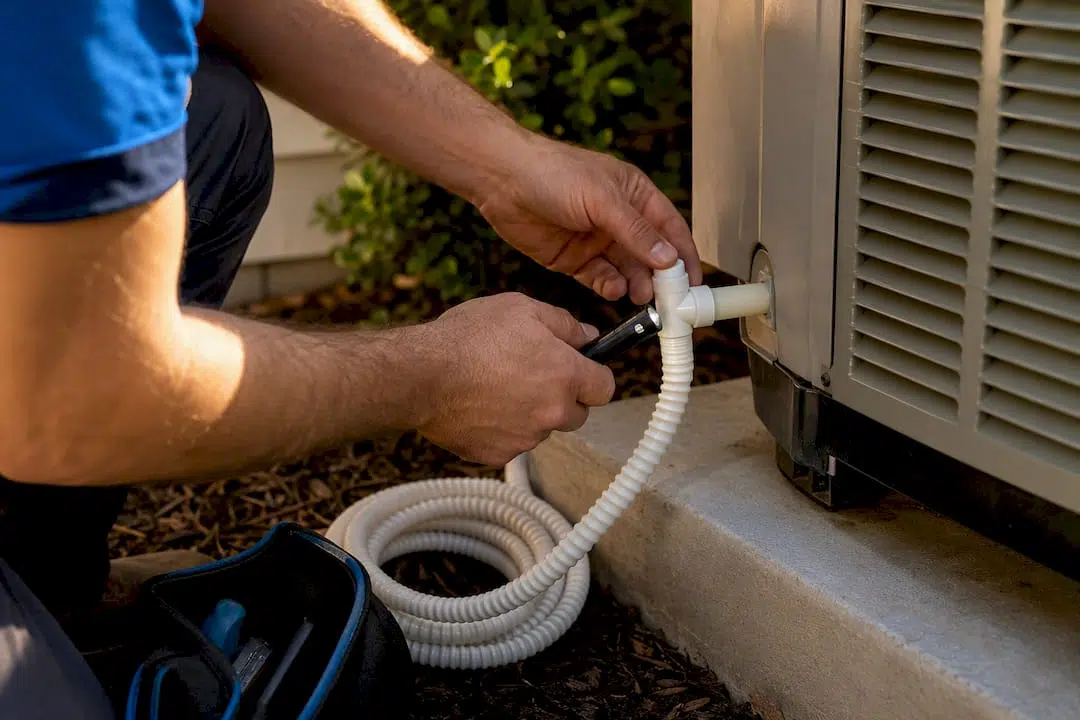
Expect the invoice to separate into three lines: the diagnostic fee, the quoted parts-and-labor cost, and any emergency or after-hours adder if it applies. A written quote before work begins protects you from surprise charges once the panel is already open.
Before you sign off, get these answers in writing:
- Parts warranty length and whether labor is covered separately.
- Exact refrigerant type and quantity charged, plus whether it’s new or reclaimed stock.
- Who’s responsible for pulling any required permit.
- A realistic completion timeline if parts need ordering.
How Can You Lower Your AC Repair Bill?
A handful of five-minute checks before you call anyone can save a wasted service call. Check the air filter first; a clogged filter mimics compressor and airflow problems constantly. Confirm the thermostat has power and is set to cool. Check the breaker panel for a tripped switch. Stop there. Anything past that involves refrigerant, electrical panels, or sealed components and needs a licensed technician.
Annual maintenance pays for itself in avoided emergency calls. A standard tune-up runs roughly $75 to $200, while a full-year service contract typically costs $150 to $500 and can keep manufacturer warranties intact. Scheduling non-urgent repairs in spring or fall, rather than during a July heat wave, also sidesteps the after-hours premiums most companies charge in peak season.
Pro Tip: Book your tune-up in March or April. Techs have open calendars, and catching a weak capacitor then costs a fraction of what an emergency August failure will.
How Does MDTECH Handle AC Repair Estimates?
MDTECH’s licensed technicians serve homeowners and property managers throughout Orange County and Los Angeles County, handling everything from a stuck contactor to a full AC compressor replacement. Every visit starts with a diagnostic and ends with a written quote that lists the failed part, labor hours, and any applicable parts warranty, no verbal estimates that shift once the panel comes off.
Online booking means you can schedule a diagnostic without a phone tag marathon, and the same team that handles HVAC repair can flag when a system is a better candidate for the maintenance checklist than for another round of patch repairs.
Why Transparency Matters More Than the Price Tag
Homeowners get burned less often by high prices than by vague ones. A quote that lists the exact refrigerant type, the part number, and labor hours protects you if something fails again in six months. If you smell gas, hear grinding metal, or notice scorch marks near the unit, skip the quote comparison and call for service immediately. That’s not a repair-cost question anymore, it’s a safety one.
— MDTECH
Get a Written AC Repair Quote from MDTECH
Comparing three verbal estimates over the phone tells you nothing useful, since none of them are pinned to an actual part number or labor hour count. Technicians are sent to homes to diagnose the failure on-site and provide an itemized written quote before any work starts, with parts listed, labor broken out, and warranty terms attached where they apply.
Have your system’s age, model number, and any error codes from the thermostat ready before the visit; it speeds up diagnosis considerably. If the numbers point toward replacement instead of repair, the same visit can walk you through that math using the repair versus replacement guidance MDTECH applies to every borderline case. Schedule your AC repair appointment online and get a same-visit written estimate before any part gets replaced.
Primary Sources and Further Reading
- Energy Saver 101: Home Cooling (U.S. Department of Energy)
- Homeowners and Consumers FAQ on Refrigerant Phaseout (U.S. EPA)
- 2026 HVAC Repairs Cost Guide (Angi)
- Average Central Air Conditioner Repair Cost (Trane)
- AC Installation Cost Budgeting Guide
Sources
- 2026 HVAC Repairs Cost: A Comprehensive Price Guide (Angi)
- Energy Saver 101: Home cooling (U.S. Department of Energy)
- Homeowners and consumers FAQ — ODS phaseout (U.S. EPA)
- Repair or Replace HVAC in 2026: The $5,000 Rule and a Calmer Decision Framework (Home Energy Decisions)
- What Is the Average Central Air Conditioner Repair Cost? (Trane)