
If your AC is running but not cooling, the blower is doing its job while the actual cooling cycle, the compressor, condenser, and refrigerant working together, has stalled somewhere. A running fan just moves air. It doesn’t prove the system is cooling that air. The likely culprits, roughly in order of how often they show up: a thermostat set wrong, a clogged filter choking airflow, a blocked outdoor condenser, a frozen coil, or an electrical failure like a bad capacitor.
Start with safety. If you see ice on the indoor coil or refrigerant lines, smell anything burning, or hear hissing near the unit, shut the system off now and skip straight to calling a licensed technician. Otherwise, work through these checks in order:
- Confirm the thermostat is set to “Cool” with a target below room temperature
- Check the breaker and outdoor disconnect for power
- Pull the filter and hold it to the light
- Walk outside and look at the condenser for debris or a dead fan
- Feel the vents for weak or warm airflow
Pro Tip: Write down what you find at each step before calling for repair. Technicians diagnose faster when they know what’s already been ruled out, which often shortens the visit and the bill.
TL;DR:
- Most AC failures originate from thermostat errors, dirty filters, blocked outdoor condensers, frozen coils, or electrical component failures like capacitors.
- Regularly replacing filters every one to three months and clearing debris around the outdoor unit prevent the majority of system breakdowns.
- When coil or refrigerant issues cause ice buildup or warm indoor air, turning off the system and allowing it to thaw is essential before diagnosing further.
- A failed capacitor accounts for roughly a quarter of “running but not cooling” complaints, often requiring professional replacement.
- Quick DIY checks and professional HVAC services can resolve most issues and prevent emergency situations by addressing airflow, electrical, and refrigerant problems early.
Table of Contents
- Why an AC Not Cooling Doesn’t Mean It’s Broken Everywhere
- Could Duct Problems Be Blocking Your Airflow?
- What Does a Blocked or Dirty Condenser Look Like?
- When Is It a Refrigerant Leak or a Failed Part?
- Is Your AC Problem an Emergency or Just Urgent?
- Simple Habits That Keep Your AC From Failing Again
- What Technicians Wish Every Homeowner Knew
- Get Your AC Fixed Without the Guesswork
- Key Takeaways
- Sources
Why an AC Not Cooling Doesn’t Mean It’s Broken Everywhere
A central air system has two separate jobs happening at once: moving air and cooling air. The blower motor pushes air through the ducts no matter what, so you’ll hear the system running and feel air coming out of the vents even when the compressor outside has quit entirely. That’s why “ac not cooling” and “ac not blowing cold air” are really the same complaint described two different ways. Technicians see this constantly: a homeowner assumes the unit is “half working” because air is moving, when really the whole cooling side of the system has failed and the blower is just circulating room-temperature or even warm air.
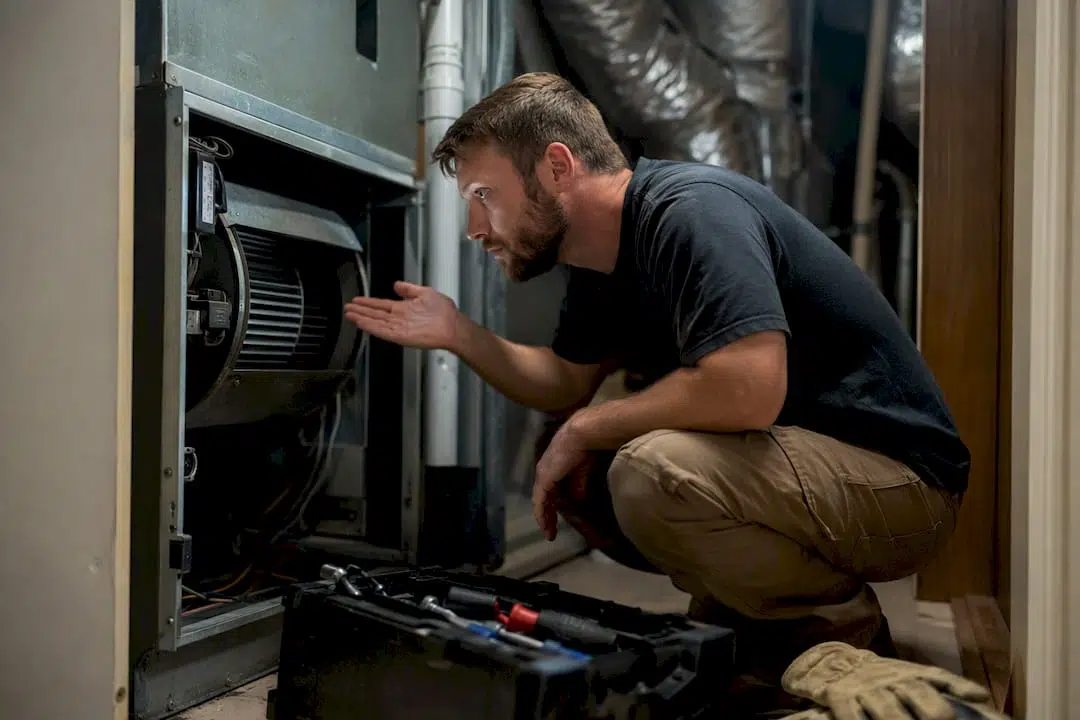
Thermostat and power checks come first
Before touching anything mechanical, rule out the simplest explanations.
- Check the mode. Confirm it’s set to “Cool,” not “Fan” or “Auto Heat/Cool” confusion, and that the fan setting is “Auto” rather than “On” (running the fan continuously without the compressor cycling can make the house feel warmer, not cooler).
- Lower the setpoint at least 5 degrees below the current room temperature and wait 10 minutes to see if the compressor kicks on outside.
- Replace the thermostat batteries if it uses them; a dying battery can cause erratic readings or a blank screen that still allows the fan to run.
- Check the indoor power switch (often near the furnace or air handler, it looks like a regular light switch), the outdoor disconnect box next to the condenser, and the breaker panel.
- If the system has a condensate overflow safety switch, a full drain pan can trip it and shut the whole unit down as a precaution against water damage.
Filters and vents matter more than most homeowners think
A dirty filter is one of the most common homeowner-solvable causes of poor cooling, right alongside thermostat mistakes and a blocked condenser. Standard 1 inch filters should be replaced every 1 to 3 months, sooner if you have pets or run the system constantly during a heat wave. A clogged filter starves the evaporator coil of airflow, and that restriction is one of the two main reasons coils freeze over in the first place.
- Pull the filter and check if you can see light through it; if not, replace it
- Note the size printed on the frame so you buy the right replacement
- Walk the house and confirm every supply and return vent is open and unblocked by furniture or rugs
- Check for uneven cooling between rooms, which often points to a duct or airflow problem rather than the unit itself
Could Duct Problems Be Blocking Your Airflow?
Weak airflow at some vents but not others, rooms that never quite reach the setpoint, or a house that feels humid even when the air is running are all signs of a duct or blower issue rather than a refrigerant problem. Restricted airflow anywhere in the system forces the evaporator coil to run colder than it should, which circles right back to the freezing problem covered next.
A few checks are safe to do yourself:
- Stand near the main trunk line by the air handler and feel for weak or hot airflow, which suggests a blower struggling against resistance
- Visually inspect any accessible flex duct in the attic or crawlspace for kinks, crushed sections, or disconnected joints
- Locate accessible dampers (small levers on duct branches) and confirm they’re open, not accidentally closed from a past heating/cooling zone adjustment
Anything beyond visible ducts, like a failing blower motor, a torn duct buried in a wall, or a zoning system malfunction, is a job for a technician. Guessing at blower motor problems can damage the motor further or trip electrical protections you can’t safely reset.
What Does a Blocked or Dirty Condenser Look Like?
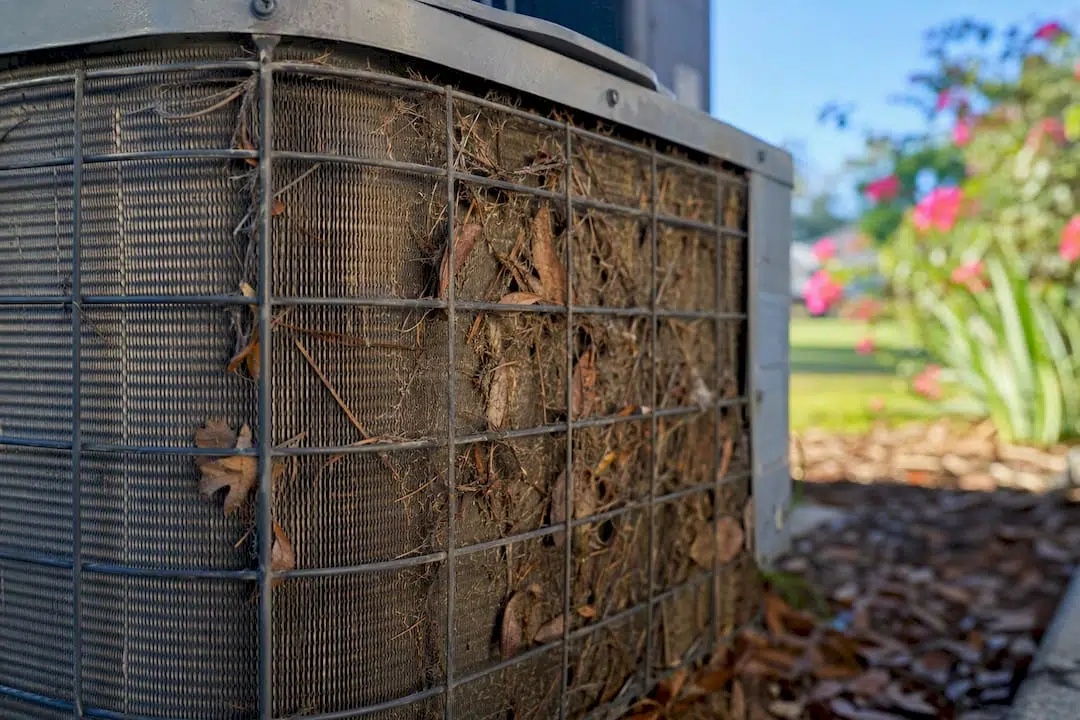
The outdoor condenser’s job is to dump the heat your indoor coil absorbed. When it’s coated in dirt, wrapped in overgrown shrubs, or missing airflow because the fan quit, that heat has nowhere to go, and the whole system loses its ability to cool. Signs include the unit running louder than usual, warm air blowing indoors despite the compressor sounding active, or the outdoor fan visibly not spinning at all.
Here’s how to clean it safely:
- Shut off power at the outdoor disconnect box before touching anything.
- Clear leaves, grass clippings, and debris from around and inside the unit’s cage.
- Gently hose down the fins from the inside out to avoid bending them; a straightforward rinse resolves many performance complaints on its own.
- Trim back vegetation to maintain roughly 2 feet of clearance on all sides for proper airflow.
Pro Tip: If the outdoor fan isn’t spinning at all even with power confirmed at the disconnect, don’t try to spin it by hand or bypass anything. A seized fan motor or failed capacitor is an electrical issue, and poking around it risks a shock even with the unit “off.” For a deeper look at coil maintenance, see this guide to cleaning condenser coils.
When Is It a Refrigerant Leak or a Failed Part?
This is where DIY needs to stop. If you spot ice building up on the copper refrigerant lines or on the indoor coil itself, hear hissing near the lines, or notice the system running for hours without ever bringing the house down to temperature, you’re likely looking at either a refrigerant leak or a frozen evaporator coil. The two are closely linked: restricted airflow or low refrigerant charge are the two main causes of a frozen coil, and running the system in that state can push liquid refrigerant back into the compressor and damage it.
If you see ice:
- Turn the thermostat off from cooling mode entirely
- Set the fan to “On” so it keeps circulating air and helps the coil thaw, which usually takes several hours
- Do not chip at the ice or use direct heat to speed things up
- Once it’s thawed and dry, note whether cooling returns before calling for service
Refrigerant work is not a homeowner task. Handling refrigerant requires EPA certification, and topping off a system without finding and fixing the leak first just delays the real repair while the leak keeps growing. Freon recharging always needs a licensed technician with the right gauges and recovery equipment.
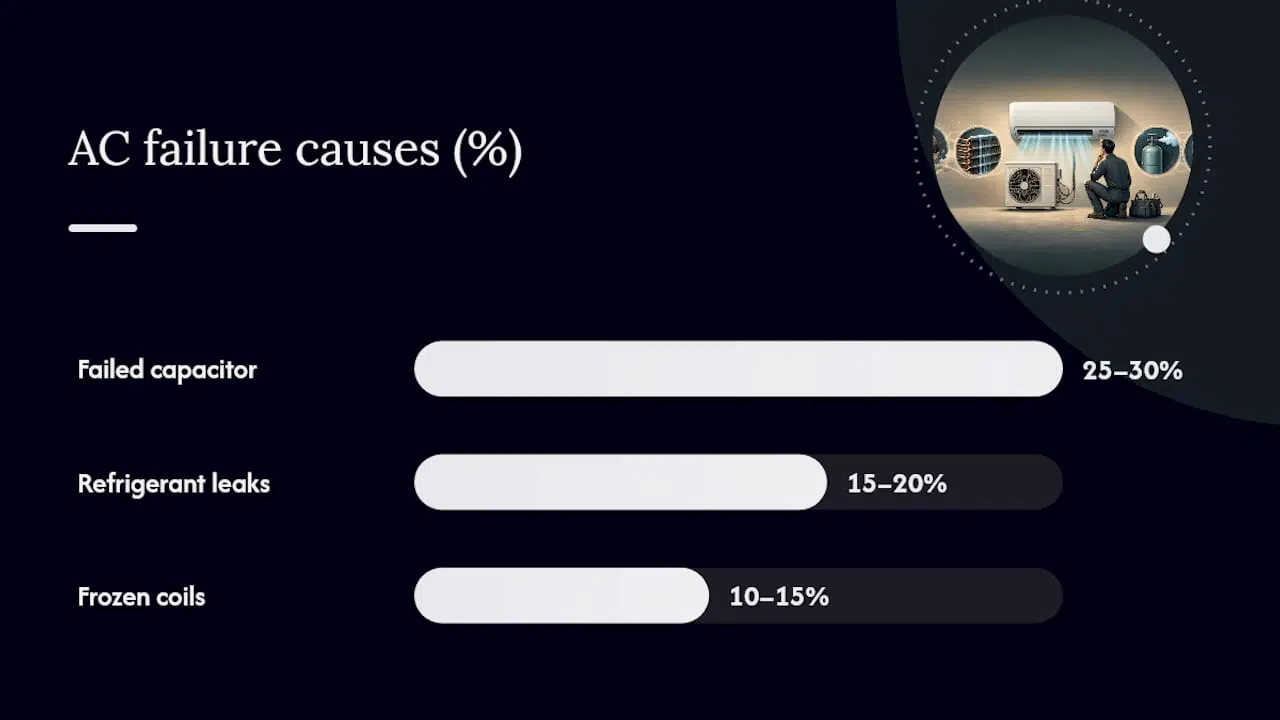
Electrical component failures are just as common as refrigerant problems, and in some cases more so. A failed capacitor is the single most frequent cause of “running but not cooling” service calls, showing up in roughly 25 to 30 percent of them, while refrigerant leaks account for about 15 to 20 percent and frozen coils another 10 to 15 percent. A bad capacitor often shows up as a compressor or fan that hums but won’t start, or a unit that clicks and then shuts back off. A failed contactor can leave the outdoor unit completely silent even though the indoor blower runs fine. Compressor failure, the most expensive of these to fix, usually follows months of ignored smaller problems like low refrigerant or restricted airflow. None of these parts should be handled with the power on; capacitors in particular can hold a dangerous charge even after the unit is switched off.
Is Your AC Problem an Emergency or Just Urgent?
Not every cooling failure needs an emergency call, but some genuinely do. Sorting them correctly saves money and, in a few cases, protects someone’s health.
Call immediately if you notice:
- A burning smell or visible sparking anywhere near the unit
- Hissing or a visible oily residue on refrigerant lines
- Indoor temperature above 85°F with young children, elderly residents, or anyone with a health condition in the home
Schedule service soon, but it’s not a middle-of-the-night emergency, if you’re dealing with:
- Ice on the coil or lines that keeps coming back after thawing
- A breaker that trips repeatedly when the AC starts
- No improvement in cooling after you’ve worked through every DIY check above
Before the technician arrives, jot down the system’s age, when the problem started, and any sounds or smells you noticed. A few photos of the outdoor unit or any visible ice speed up diagnosis considerably.
Simple Habits That Keep Your AC From Failing Again
Most of the failures covered above share one root cause: neglected airflow or ignored small warning signs. A short maintenance routine heads off the majority of them.
- Replace filters every 1 to 3 months, more often with pets or heavy use
- Rinse the outdoor coil and clear debris at the start and end of each cooling season
- Keep at least 2 feet of clearance around the condenser from plants and mulch buildup
- Book a professional tune-up twice a year, which typically covers electrical connections, refrigerant pressure checks, and airflow measurement
Pro Tip: Biannual tune-ups paired with regular filter changes catch a weakening capacitor or a slow refrigerant leak months before they turn into a full breakdown on the hottest day of the year.
What Technicians Wish Every Homeowner Knew
The pattern MDTECH sees most often isn’t dramatic. It’s a filter that hasn’t been changed in eight months, or a homeowner who bought a can of refrigerant online to “top it off” without knowing there’s a leak feeding refrigerant loss in the first place. Before your visit, jot down the indoor temperature, when the problem started, and a photo of the outdoor unit. That handful of details routinely cuts diagnostic time in half.
— MDTECH
Get Your AC Fixed Without the Guesswork
Working through thermostat settings and filter checks yourself is worth the ten minutes it takes, but a hissing line or a compressor that won’t start needs hands that do this every day. Appliancesrepairmdtech sends licensed HVAC technicians across Orange County and Los Angeles County with same or next-day appointment options, so a hot house doesn’t turn into a multi-day wait.
Every visit starts with the same diagnostic order covered in this article: electrical components, refrigerant pressure, airflow, and coil condition, confirmed with gauges and testing equipment rather than guesswork. Technicians carry proper EPA-certified recovery equipment for any refrigerant work, and they’ll walk you through exactly what failed and why before starting a repair. If your system is running but not cooling and the quick checks above haven’t fixed it, book an HVAC repair appointment and get a technician on the way today.
Key Takeaways
A running AC that isn’t cooling almost always traces back to one of five causes: thermostat error, dirty filter, blocked condenser, frozen coil, or a failed electrical component like a capacitor.
| Point | Details |
|---|---|
| Airflow isn’t cooling | A running blower only moves air; the compressor and refrigerant cycle can fail while the fan keeps working. |
| Check filters first | Replace filters every 1 to 3 months since a clogged filter is a leading cause of frozen evaporator coils. |
| Capacitors fail often | Failed capacitors cause roughly 25 to 30 percent of running but not cooling service calls, more than any other part. |
| Ice means shut it off | Turn off cooling and run the fan to thaw a frozen coil before attempting any further diagnosis. |
| Call a licensed pro | Appliancesrepairmdtech provides same or next-day HVAC repair across Orange and Los Angeles counties for refrigerant and electrical failures. |
Sources
These references back the troubleshooting steps and failure statistics throughout this guide:
- Trane: Frozen evaporator coil causes
- Carrier: Why is my AC not blowing cold air?
- Inspectapedia: Air conditioner diagnosis