
A standard tank water heater installed by a professional typically costs between $700 and $2,200 in most U.S. markets, while a tankless system usually costs between $2,500 and $6,500 once labor, venting, and permits are included. Heat pump water heaters generally have a higher upfront cost but may qualify for federal tax credits or utility rebates that reduce the expense.
Labor is a major variable that surprises most homeowners. It often constitutes a significant portion of the total invoice, varying based on access, code upgrades, and whether the job is a straightforward swap or a fuel type conversion.
- Standard 40 to 50 gallon tank, like-for-like swap: $700 to $2,200 installed
- Tankless (gas or electric), including venting: $2,500 to $6,500 installed
- Heat pump hybrid: $2,000 to $4,500 installed, before incentives
Key Takeaways
Water heater installation cost in the U.S. typically runs $700 to $2,200 for a standard tank and $2,500 to $6,500 for tankless, with labor accounting for 30% to 60% of the total.
| Point | Details |
|---|---|
| Tank installs cost less upfront | Standard 50-gallon tank swaps run $1,400 to $2,200 installed for most homes. |
| Tankless costs more but saves space | Gas tankless systems run $2,500 to $6,500 installed, often due to venting and gas-line work. |
| Labor is the biggest variable | Labor commonly makes up 30% to 60% of the invoice depending on access and code upgrades. |
| Permits aren’t optional | Permit fees range $50 to $300 and vary by city; skipping one risks insurance and resale issues. |
| Get a licensed installer | Appliancesrepairmdtech provides line-item estimates, permit handling, and post-install testing across Orange and Los Angeles counties. |
Where to check local labor and permit numbers
- BLS occupational wage data for regional installer rates
- EERI seismic bracing guidance for retrofit requirements
- Your municipal building department’s website for exact permit fees and inspection steps
Table of Contents
- What Drives Water Heater Installation Cost: A Quick Comparison
- What’s Actually on the Invoice: Labor, Materials, and Add-Ons
- Cost by Tank Size and System Type: Which Fits Your Household
- Why Your Quote Might Be Higher (or Lower) Than the Average
- How Long Installation Takes and When Inspections Happen
- Is DIY Worth It, or Should You Hire a Pro?
- Getting Quotes You Can Actually Compare
- What to Expect When You Book a Licensed Installer
- Permit Costs Vary a Lot Depending on Where You Live
- How Your Installation Choice Affects Future Maintenance Costs
- Book a Licensed Water Heater Installation with Appliancesrepairmdtech
- Sources
What Drives Water Heater Installation Cost: A Quick Comparison
Before you call a plumber, it helps to see how equipment cost and labor stack up against each other by system type. The numbers below assume a residential single-family home with reasonably accessible plumbing, not a crawl space nightmare or a third-floor closet installation.
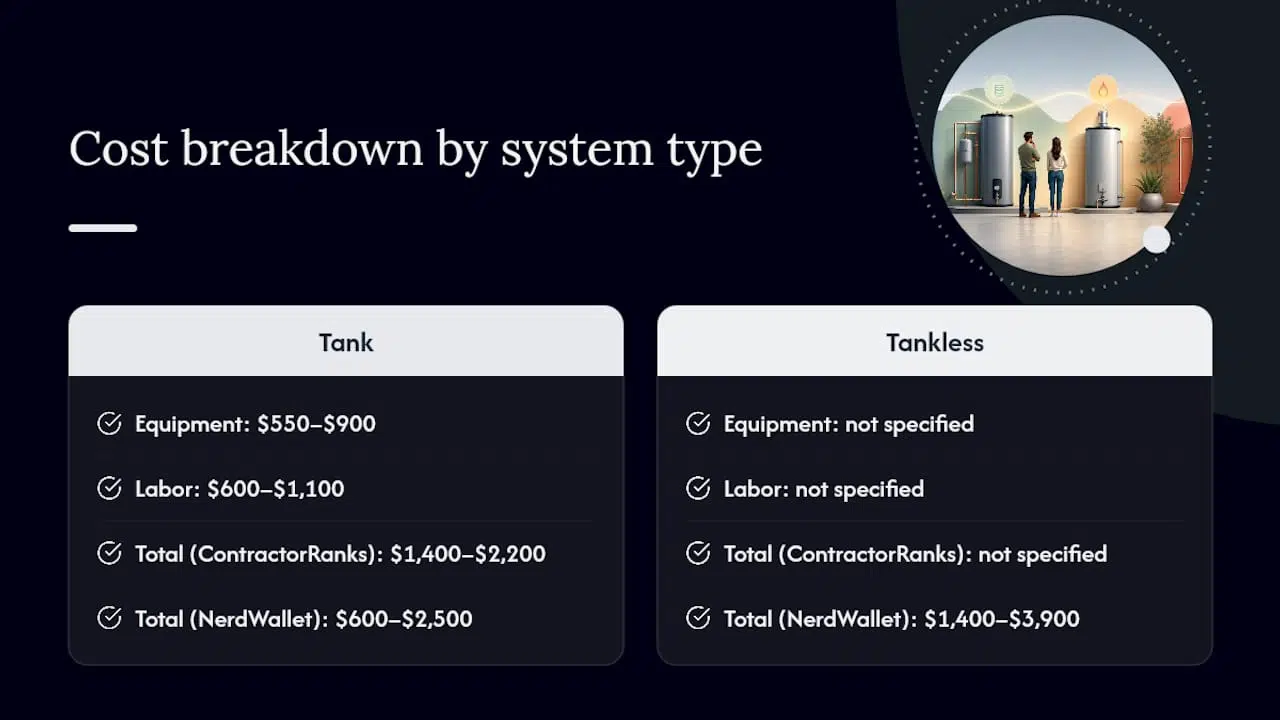
These totals typically include the unit, standard labor, a basic permit, and haul-away of the old tank. They usually don’t include new venting, gas line upsizing, or electrical panel work, which get quoted separately.
A common real-world example: a 50-gallon gas tank replaced in the same spot, with no code upgrades needed, runs about $550 to $900 for equipment plus $600 to $1,100 in labor, for an installed total of roughly $1,400 to $2,200, a range confirmed by ContractorRanks’ 2026 quote data. NerdWallet reports a similar tank-style range of $600 to $2,500, with tankless systems landing between $1,400 and $3,900.
What’s Actually on the Invoice: Labor, Materials, and Add-Ons
Labor typically represents 30% to 50% of your total bill, according to Plumbing Sniper’s 2026 cost analysis, which puts national installed averages at $1,200 to $4,500. That share climbs when a plumber, HVAC technician, or electrician all need to touch the job, which happens often on fuel conversions or older homes.
Materials beyond the tank itself add up fast:
- Expansion tank: $50 to $150
- T&P (temperature and pressure) relief valve: $15 to $40
- Sediment trap and fittings: $20 to $60
- Venting kit (for gas or tankless): $150 to $500
- Dielectric union fittings: $10 to $30 each
Add-ons are where quotes diverge the most. Gas line upsizing can run $400 to $1,500, vent replacement $250 to $900, seismic strapping $75 to $200, and drain pan installation $50 to $150. Electrical panel upgrades, needed when converting to certain electric tankless units, can add $1,000 or more on their own.
Roughly a third of the installed price on many jobs is labor alone, which is why two contractors quoting the “same” tank can land $600 apart. The difference usually isn’t the equipment. It’s how much wiring, venting, or code work is baked into the labor line.
Pro Tip: Ask every contractor for a line-itemized estimate that separates the unit price, labor hours and rate, permit fees, and any code-required upgrades. If a bid is just one lump number, you can’t tell whether it’s competitive or missing something.
Cost by Tank Size and System Type: Which Fits Your Household
Bigger isn’t automatically better, and the wrong size wastes money two ways: too small means cold showers, too large means paying to heat water you don’t use.
- 30-gallon tank: $900 to $1,600 installed. Fits studios, one-bedroom homes, or a household of one to two people.
- 40-gallon tank: $1,100 to $1,900 installed. Common for two to three people with moderate simultaneous use.
- 50-gallon tank: $1,400 to $2,200 installed. The default for families of three to five, especially with a washing machine and dishwasher running the same day.
- 75-80 gallon tank: $1,800 to $3,200 installed. Suited to larger households or homes with soaking tubs and multiple bathrooms in use at once.
Tankless systems don’t work on a gallon rating since they heat water on demand, but sizing still matters. A gas tankless installed for a family that runs two showers and a dishwasher simultaneously needs more BTU capacity, which pushes cost toward the $6,500 end. Delta Plumbing’s cost breakdown shows tankless units ranging from $1,500 to over $4,000 depending on capacity and installation complexity, with heat pump systems sitting higher but often qualifying for federal tax credits. For a side-by-side look at how these systems perform long term, our tankless vs tank comparison breaks down energy costs beyond the install itself.
Why Your Quote Might Be Higher (or Lower) Than the Average
Where the unit sits in your house matters more than most homeowners expect. A tank in an easily accessible garage costs far less to swap than one wedged into a finished attic or behind a wall that needs to be opened.
- Access and location: tight closets, stairs, or finished interior spaces add labor hours
- Fuel conversions: switching gas to electric or electric to gas requires new lines, venting, or dedicated circuits, often adding $500 to $2,000
- Local labor market: contractors in high-cost metro areas like Los Angeles or Orange County typically charge more per hour than rural markets, per BLS regional wage data
- Code upgrades: older homes frequently need expansion tanks or seismic strapping added to pass inspection, per EERI’s bracing guidelines common in California and other seismic zones
How Long Installation Takes and When Inspections Happen
- Same-location tank swap: typically 2 to 3 hours, sometimes stretching to 4 with older, corroded fittings
- Tankless install or fuel conversion: often a full day, 6 to 9 hours, and may require a return visit for gas testing or final inspection
Permit review timing varies by city, and permit fees themselves typically run $50 to $300 depending on jurisdiction. Booking during normal business hours instead of treating a leak as an emergency can avoid the 25% to 50% premium that after-hours or same-day service often carries.
Is DIY Worth It, or Should You Hire a Pro?
Labor is often half the bill or more, which makes DIY tempting. But the math rarely works out the way homeowners hope once you account for tool rental, code compliance, and the risk of getting it wrong on a gas or electrical connection.
Unpermitted water heater work is one of the most common reasons insurance claims get denied after a leak or fire, and manufacturers can void warranty coverage entirely if installation wasn’t done to code.
- DIY might be reasonable for: replacing a like-for-like electric tank in an easily accessible spot with no code changes needed
- Red flags requiring a licensed pro: any gas line work, venting changes, electrical panel upgrades, or homes in seismic retrofit zones
A failed DIY install doesn’t just risk a leak. It can strip away warranty protection on a unit that cost hundreds of dollars, turning a repair into a full replacement.
Getting Quotes You Can Actually Compare
Contractors quote water heater jobs inconsistently, which makes side-by-side comparison hard unless you control for the same scope.
- Request a written, itemized quote separating unit price, labor hours and rate, permit fees, and any upgrades
- Ask directly: will the gas line need to be upsized? Is new venting required? Does code call for an expansion tank?
- Confirm what’s included: materials, disposal of the old unit, warranty terms, and the policy on return visits
Compare quotes using the same baseline, ideally a like-for-like swap, and treat a bid with no permit line item as a red flag rather than a bargain. Our water heater repair guide covers scenarios where repair makes more financial sense than a full quote-and-replace cycle.
What to Expect When You Book a Licensed Installer
A licensed technician handles more than the swap itself: pulling the permit, sizing the unit correctly, and testing for leaks and proper venting before signing off. Appliancesrepairmdtech provides line-item estimates upfront, so Orange County and Los Angeles County homeowners know exactly what’s covered before work starts.
The process typically runs: scheduling, an on-site assessment, a written quote, permit pull, installation, inspection, and a final walkthrough.
- Licensed technicians handle gas, electrical, and plumbing code requirements together
- Written estimates separate unit, labor, and any required upgrades
- Post-install testing confirms proper pressure, venting, and temperature settings
Pro Tip: Book your estimate before your current water heater fails completely. Scheduling ahead avoids emergency premiums and gives your installer time to source the right unit size for your household.
Permit Costs Vary a Lot Depending on Where You Live
Permit fees for water heater installation aren’t standardized nationally. Most municipal building departments charge somewhere between $50 and $300, but the exact figure depends on your city’s fee schedule, whether the job involves gas or electrical work, and how many inspections are required.
Some California jurisdictions, for instance, roll a plan-check fee into the permit cost when seismic strapping or venting changes are involved, pushing the total toward the higher end of that range. Other cities charge a flat fee regardless of scope. A handful of smaller municipalities skip permits for straight tank swaps but require one for any fuel conversion or new gas line.
The safest way to budget is to check your specific city or county building department’s fee schedule directly rather than relying on a national average, since permit costs genuinely differ block to block in some metro areas. A licensed contractor working in your jurisdiction regularly should already know the local fee structure and can usually fold that number into your written estimate rather than surprising you with it after the inspection is scheduled.
Skipping the permit to save $100 to $200 upfront is a common mistake. It can cost far more later if you sell the home and a buyer’s inspector flags unpermitted work, or if an insurance claim gets denied because the installation was never signed off by the city.
How Your Installation Choice Affects Future Maintenance Costs
The system you choose at installation shapes what you’ll spend on upkeep for the next decade. Tank water heaters need annual flushing to clear sediment, typically a $75 to $150 service call, and anode rod replacement every 3 to 5 years runs $150 to $300 including labor. Skip either one and you shorten the tank’s lifespan considerably.
Tankless units need less routine maintenance but aren’t maintenance-free: descaling in hard-water areas typically costs $150 to $250 annually, and skipping it can void the manufacturer’s warranty entirely. Heat pump systems need periodic air filter cleaning and occasional refrigerant system checks, generally cheaper per visit than tankless descaling but still a recurring line item.
Cutting corners at installation tends to backfire on maintenance costs down the road. A tank installed without an expansion tank on a closed plumbing system, for example, faces more pressure stress and often needs component repairs sooner. Choosing a reputable unit from a brand like A.O. Smith, Rheem, Bradford White, or Rinnai, paired with a proper installation, generally means fewer surprise repair calls in years two and three. Our water heater maintenance guide breaks down a full annual upkeep schedule by system type.
What surprises homeowners most about their final bill
The costs that blow past an initial estimate are almost always code upgrades, gas-line upsizing, or electrical panel work discovered mid-job, not the unit itself. Get a line-item quote before work starts, and confirm in writing who’s pulling the permit.
Book a Licensed Water Heater Installation with Appliancesrepairmdtech
Appliancesrepairmdtech gives Orange County and Los Angeles County homeowners something most quote-shopping doesn’t: a licensed technician who handles the permit, the code compliance, and the installation itself, so you’re not coordinating three separate trades for a gas conversion or seismic strap requirement.
Whether you need a straight tank swap or a full tankless conversion with new venting and gas-line work, our technicians provide a written, line-item estimate before anything gets installed, covering the unit, labor, permit fees, and any code-required upgrades. That transparency matters most on jobs where fuel-type conversions or older-home retrofits can push costs well past a generic online estimate. If you’re weighing repair against full replacement first, our repair versus replacement guide can help you decide before you book. Ready to get a real number for your home? Schedule a water heater installation estimate and get a written quote before you commit to a system.
Sources
- Water Heater Installation Cost in 2026 — Real Quotes by Type & Region | ContractorRanks
- How much does a water heater cost? | NerdWallet
- How Much Does It Cost to Replace a Water Heater in 2026? – Plumbing Sniper
- Guidelines for Earthquake Bracing Residential Water Heaters | EERI Mitigation
- Occupational Employment and Wage Statistics (OES) | Bureau of Labor Statistics