
TL;DR:
- Heat exchangers transfer thermal energy between fluids without mixing them, using conduction and convection. Regular inspection and maintenance, including monitoring pressure drops and performance metrics, prevent costly failures. Choosing the right type and timely repair or replacement extend their service life and ensure safety.
A heat exchanger is defined as a device that transfers thermal energy between two or more fluids without allowing those fluids to mix. This function sits at the core of your home’s HVAC system, your refrigerator, and countless industrial processes. Understanding how a heat exchanger works helps you spot problems early, make smarter repair decisions, and avoid costly replacements. Appliancesrepairmdtech sees heat exchanger issues regularly across Orange County and Los Angeles County, and the pattern is consistent: the homeowners who understand the basics catch problems months before they become emergencies.
What is a heat exchanger and how does it work?
A heat exchanger transfers thermal energy between fluids through two physical processes: conduction and convection. Conduction moves heat through a solid wall that separates the two fluid streams. Convection then carries that heat away from the wall surface into the cooler fluid on the other side.
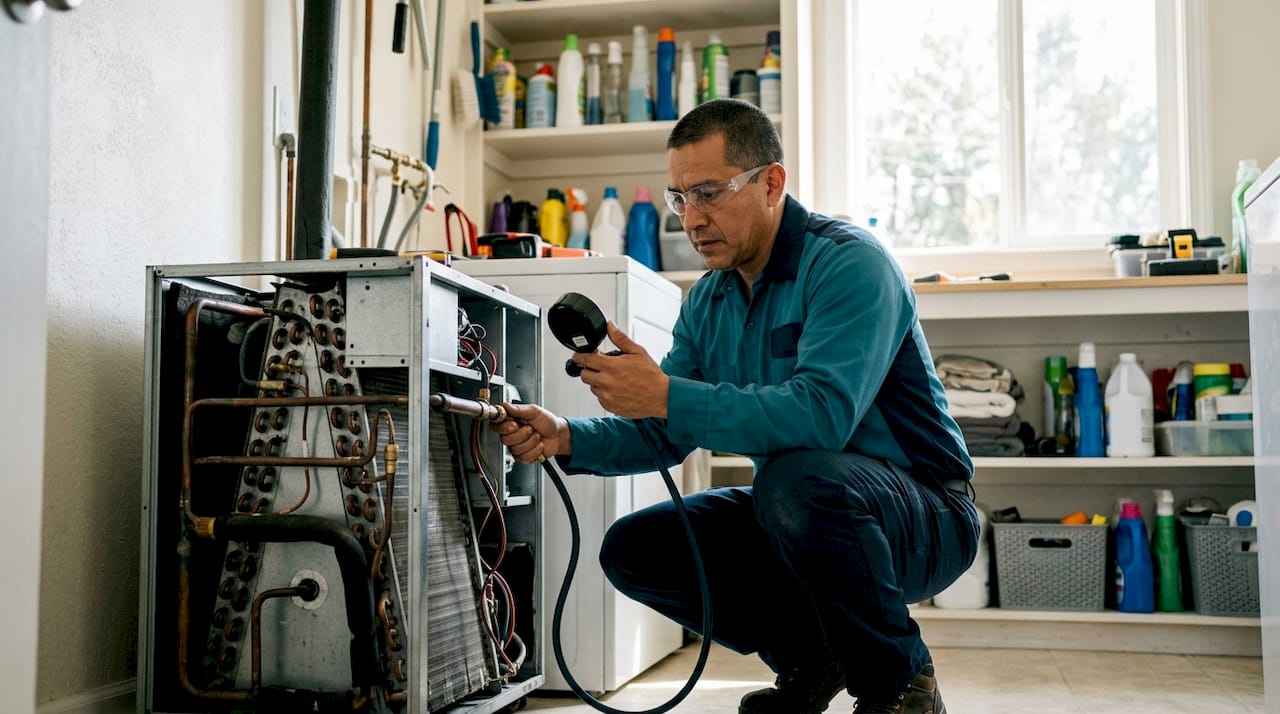
The wall separating the fluids is the most critical component. It must conduct heat well while keeping the two fluid streams completely isolated. In your furnace, for example, combustion gases pass on one side of a metal wall while household air circulates on the other. The air heats up without ever contacting the exhaust gases.
Engineers measure performance using the heat transfer coefficient, a number that reflects how efficiently the unit moves heat per unit of surface area. A declining heat transfer coefficient is the earliest measurable sign that something is wrong inside the unit. Pressure drop is the other key metric. A pressure drop increase of over 10% signals fouling or blockage and indicates the unit needs attention.
Key performance indicators to track:
- Heat transfer coefficient: drops when fouling builds up on internal surfaces
- Pressure drop: rises when flow paths narrow due to scale or debris
- Outlet temperature: deviates from design spec when efficiency falls
- Flow rate: changes signal blockage or pump degradation
Pro Tip: Install pressure gauges on both inlet and outlet ports. Comparing readings weekly takes less than two minutes and gives you an early warning system that no visual inspection can match.
What are the common types of heat exchangers and their applications?
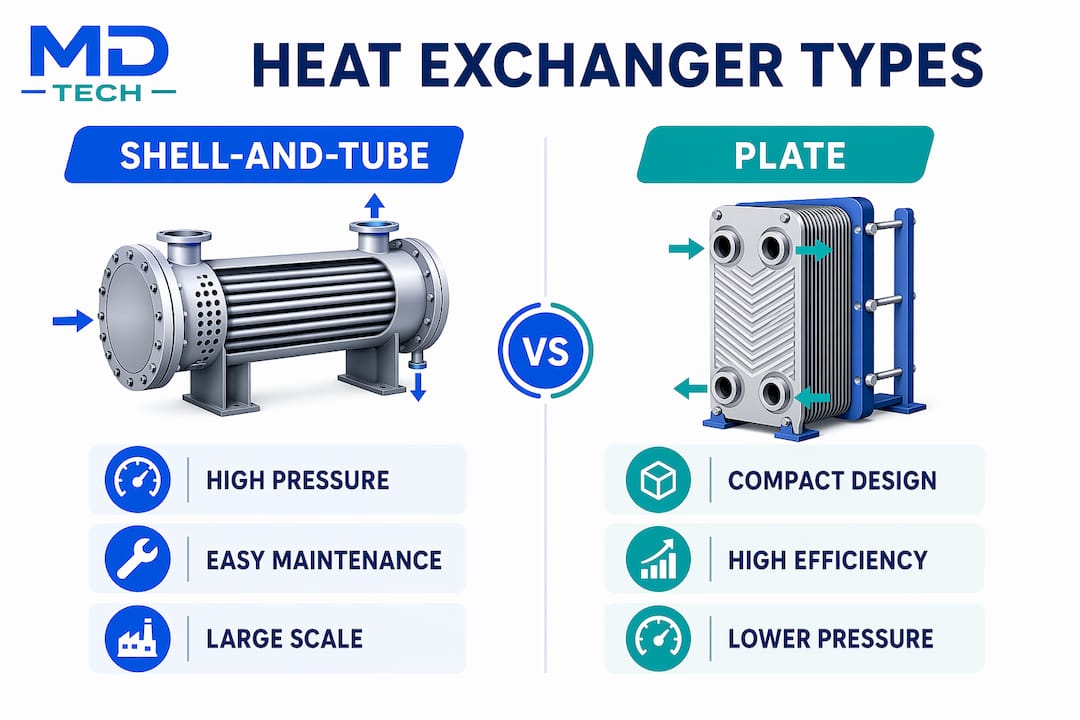
The two most widely used designs are shell-and-tube and plate heat exchangers. Each suits a different set of operating conditions, and choosing the wrong type for an application shortens service life significantly.
Shell-and-tube heat exchangers
Shell-and-tube units consist of a large outer cylinder (the shell) containing a bundle of smaller tubes. One fluid flows through the tubes while the other flows around them inside the shell. Shell-and-tube exchangers suit high-pressure, high-temperature applications because the cylindrical shell handles mechanical stress well. Power plants, oil refineries, and chemical processing facilities rely on this design. They are also the standard choice when one fluid is corrosive, since tube materials can be selected independently of the shell.
Plate heat exchangers
Plate units stack corrugated metal plates with alternating flow channels between them. The corrugated surface creates turbulence, which dramatically increases heat transfer efficiency in a compact footprint. Plate designs favor HVAC systems, food processing, and pharmaceutical applications where space is limited and frequent cleaning is required. The plates can be disassembled for inspection and cleaning without cutting any piping.
| Type | Best for | Pressure rating | Maintenance access |
|---|---|---|---|
| Shell-and-tube | High pressure, high temperature, industrial | High | Moderate, requires tube cleaning |
| Plate | Compact HVAC, food processing, pharmaceuticals | Moderate | High, plates disassemble easily |
| Double-pipe | Small-scale, laboratory, pilot systems | Moderate | High, simple construction |
| Air-cooled | Remote locations, water-scarce environments | Varies | Moderate, fan and fin cleaning |
Other designs include double-pipe units for small-scale applications and air-cooled units for locations where water is scarce. The heat recovery principle applies across all types: capture heat that would otherwise be wasted and redirect it where it is needed.
What are typical maintenance needs and signs of heat exchanger issues?
Heat exchangers degrade gradually. Operators often assume sudden failure, but fouling and corrosion silently reduce efficiency and structural integrity long before any visible failure occurs. Recognizing the six fouling types is the foundation of any maintenance program.
- Particulate fouling: suspended solids in the fluid settle on heat transfer surfaces, reducing conductivity
- Crystallization fouling (scaling): dissolved salts precipitate out of solution when temperature changes, forming hard deposits
- Biological fouling: microorganisms colonize surfaces in systems using untreated water or process fluids
- Chemical reaction fouling: fluid components react with surface materials or each other, creating deposits
- Corrosion fouling: oxidation products accumulate on surfaces, both reducing heat transfer and attacking the base metal
- Freezing fouling: fluid solidifies near the wall when operating temperatures drop below the fluid’s freezing point
Annual inspections following API 510 standards detect early degradation before it causes failure. API 510 covers pressure vessel inspection intervals, inspector qualifications, and documentation requirements. For residential HVAC systems, an annual inspection by a licensed technician serves the same purpose at a smaller scale.
Common failure modes include pitting corrosion, thermal fatigue cracking, and flow-induced vibration damage to tubes. Pitting is particularly dangerous because it progresses internally and is invisible from the outside. Thermal fatigue occurs when units cycle repeatedly between temperature extremes without adequate allowance for expansion. Vibration damage appears in shell-and-tube units when tube support spacing is incorrect or flow velocities exceed design limits.
Pro Tip: Check weep holes on gasketed plate units during every inspection. A weep hole showing fluid signals liner failure and requires immediate attention, not a scheduled repair.
Maintenance timelines vary by application. Industrial units in continuous service typically require cleaning every 6–12 months. Residential HVAC heat exchangers benefit from annual cleaning aligned with the HVAC maintenance checklist your technician follows each season.
How to decide between repairing, retubing, or replacing a heat exchanger?
The repair-versus-replace decision follows a clear framework when you have accurate inspection data. Visual inspections alone cannot reveal internal metallurgical defects, which is why non-destructive testing is the professional standard for evaluating damage extent.
The two primary non-destructive testing methods are:
- Eddy current testing (ECT): sends electromagnetic signals through tube walls to detect thinning, pitting, and cracks without removing tubes from service
- Ultrasonic testing (UT): measures wall thickness at multiple points to map corrosion patterns across the entire tube bundle
Damage thresholds guide the decision directly. Localized tube damage under 15% of the total tube area supports repair or selective retubing. Damage exceeding 25% of tube area makes full replacement the better choice on lifecycle cost grounds. Between 15% and 25%, economic analysis determines the outcome.
Economic factors include remaining service life of the shell, current cost of replacement units, downtime costs during the project, and whether the existing design still meets current process requirements. A unit that was correctly sized ten years ago may now be undersized if production volumes have increased.
Replacement projects follow a defined sequence. The unit must be isolated, drained, and purged before removal. Installation includes alignment, connection, and hydrostatic pressure testing. ASME Section VIII certification is required for pressure vessels operating above 15 psi, which covers most industrial and many commercial heat exchangers. Standard replacement projects take 3–7 days. Complex retrofits in confined spaces or with significant piping modifications take 10–14 days.
For homeowners facing a repair vs. replacement decision on an HVAC system, the same logic applies at a smaller scale. A cracked residential furnace heat exchanger is a safety issue, not just an efficiency issue, because combustion gases can enter the living space.
Key Takeaways
A heat exchanger transfers thermal energy between fluids through conduction and convection, and its long-term performance depends entirely on the quality of inspection, maintenance, and operational discipline applied to it.
| Point | Details |
|---|---|
| Core function | Heat exchangers transfer thermal energy between fluids without mixing them, using conduction and convection. |
| Fouling is the main threat | Six fouling types progressively reduce efficiency; pressure drop over 10% signals a maintenance need. |
| Type selection matters | Shell-and-tube suits high-pressure industrial use; plate designs suit compact HVAC and food processing. |
| Damage thresholds guide decisions | Tube damage under 15% supports repair; damage over 25% favors full replacement on cost grounds. |
| Compliance is non-negotiable | ASME Section VIII certification applies to pressure vessels above 15 psi, including most commercial units. |
What I’ve learned from years of heat exchanger calls
The most expensive heat exchanger failures I’ve seen share one cause: the owner treated the unit as maintenance-free until it stopped working. Degradation is gradual. Fouling and corrosion do not announce themselves. They quietly reduce efficiency for months or years before any visible symptom appears.
The second most common mistake is improper installation. Rigid mounting without allowance for thermal expansion causes micro-cracking at connection points. Those cracks are invisible until they become leaks or fractures. Every unit has a design expansion specification. Ignoring it is not a shortcut; it is a scheduled failure.
One detail that surprises most homeowners: gaskets are single-use components. Reusing a compressed gasket after opening a plate unit causes leaks within weeks. The cost of a new gasket set is trivial compared to the labor cost of reopening the unit a second time.
My recommendation is a data-driven maintenance program. Track pressure drop and outlet temperature at regular intervals. Schedule eddy current testing every three to five years on shell-and-tube units in demanding service. Combine that data with annual visual inspections, and you will never face a surprise replacement. You will know the unit’s condition and make the replacement decision on your schedule, not the equipment’s.
— MDTECH
Professional heat exchanger and HVAC repair in Orange County
When a heat exchanger in your HVAC system shows signs of fouling, cracking, or efficiency loss, the next step is a professional inspection by a licensed technician who can measure actual performance rather than guess from symptoms.
Appliancesrepairmdtech serves homeowners and property managers across Orange County and Los Angeles County with licensed HVAC repair, appliance diagnostics, and component replacement. Whether your furnace heat exchanger needs cleaning, testing, or full replacement, the team at Appliancesrepairmdtech brings the right tools and certifications to the job. Book an HVAC repair appointment online, or review the repair vs. replacement guide to understand your options before the technician arrives.
FAQ
What is the heat exchanger definition in simple terms?
A heat exchanger is a device that moves heat from one fluid to another without letting the two fluids touch or mix. Your home furnace, refrigerator, and air conditioner each contain one.
How does a heat exchanger work in an HVAC system?
In a furnace, hot combustion gases pass on one side of a metal wall while household air circulates on the other side. Heat conducts through the wall and warms the air, which is then distributed through your home’s ductwork.
What are the most common heat exchanger materials?
Stainless steel, copper, titanium, and carbon steel are the most widely used materials. Material selection depends on fluid chemistry, operating temperature, and pressure requirements.
How do I know if my heat exchanger needs repair?
A pressure drop increase of over 10% from baseline, reduced heating or cooling output, and unusual odors from vents are the primary warning signs. A licensed technician can confirm the diagnosis with non-destructive testing. You can also review appliance failure signs to understand what to watch for before calling a professional.
When should a heat exchanger be replaced rather than repaired?
Replacement is the better choice when tube damage exceeds 25% of total tube area, when the shell has structural damage, or when the unit no longer meets current capacity requirements. ASME Section VIII compliance must be verified on any replacement unit operating above 15 psi.