
TL;DR:
- California law mandates urgent repairs for safety and habitability issues within 24 hours.
- Proper preparation and documented communication speed up repair processes and prevent disputes.
- Reliable local repair services with 7-day availability ensure quick, compliant appliance and HVAC fixes.
Your refrigerator dies on a Friday night, or your heater stops working in January. In Orange County and Los Angeles County, these moments hit hard and fast, leaving you scrambling for answers. Most guides online are vague, generic, or written for landlords in other states. This guide is different. It walks you through the exact local repair process, from identifying what qualifies as urgent to booking a technician and verifying the job is done right, using real California rules and the realities of managing property in Southern California.
Table of Contents
- Know your responsibilities and local rules
- Gather your tools and information
- Step-by-step local repair process explained
- Troubleshooting, verification, and next steps
- The truth about local repair: Why speed isn’t everything
- Need help? Connect with trusted local repair experts
- Frequently asked questions
Key Takeaways
| Point | Details |
|---|---|
| Urgent vs non-urgent repairs | Not all repairs are equal; know which ones must be fixed immediately by law. |
| Document everything | Always communicate repairs and responses in writing for legal protection and smooth coordination. |
| Step-by-step works best | Following a clear process saves time, avoids stress, and ensures compliance in Orange and LA counties. |
| Verification matters | Double-check repairs before closing requests to ensure safety and habitability are restored. |
Know your responsibilities and local rules
Not every broken appliance triggers the same response. A cracked oven handle is not the same as a heater that stops working in December. Understanding the difference between urgent and non-urgent repairs is the foundation of any smart repair process, whether you are a homeowner, a property manager, or a tenant working with a landlord.
Urgent repairs involve a direct threat to health or safety. Think: no hot water, a broken furnace during cold weather, a gas leak, a sewage backup, or a refrigerator failure that threatens food safety. These require immediate action. Non-urgent repairs include things like a slow dishwasher cycle, a microwave with a flickering light, or a dryer that takes an extra cycle to finish. These can typically be scheduled within a reasonable window.
Here is where California law draws the line clearly. Landlords must repair habitability issues including plumbing, heating, electrical, and appliances like stoves and refrigerators under AB 28 immediately if there is a health or safety risk, and within 30 days for non-urgent issues. This applies throughout Los Angeles and Orange Counties.
| Repair type | Example | Legal deadline |
|---|---|---|
| Urgent (health/safety) | No heat, gas leak, sewage backup | Immediately |
| Urgent (habitability) | Broken fridge, no hot water | Immediately |
| Non-urgent | Slow dishwasher, broken microwave | Within 30 days |
| Cosmetic | Cracked cabinet, scuffed floor | No fixed deadline |
Common urgent appliance and HVAC failures in local homes include:
- Heating or air conditioning units that stop working entirely
- Refrigerators that lose cooling function
- Gas stoves with ignition or supply issues
- Water heaters that stop producing hot water
- Washers that flood or leak significantly
Ignoring mandated repair timelines carries real consequences. In LA County, tenants can escalate through county agencies, request rent reductions, or pursue repair-and-deduct remedies. For property managers, the liability is even higher if habitability issues are left unaddressed. Written notification is a non-negotiable step. Tenants should send repair requests in writing, and landlords or managers should confirm receipt and response timelines in writing as well. This protects everyone involved.
If you are not sure whether your situation qualifies as urgent, err on the side of caution. You can also reference our quick appliance fixes guide to assess common appliance issues before making the call to a technician.
California law is clear: Health and safety repairs cannot wait for “convenient scheduling.” If your rental unit has a broken heater or non-functional refrigerator, the clock starts the moment the tenant notifies you in writing.
Gather your tools and information
Once you know what category your repair falls into, the next move is preparation. Property managers who call a repair service with incomplete information consistently experience longer wait times, more callbacks, and sometimes delayed parts ordering. A few minutes of preparation before you pick up the phone can cut hours off your repair timeline.
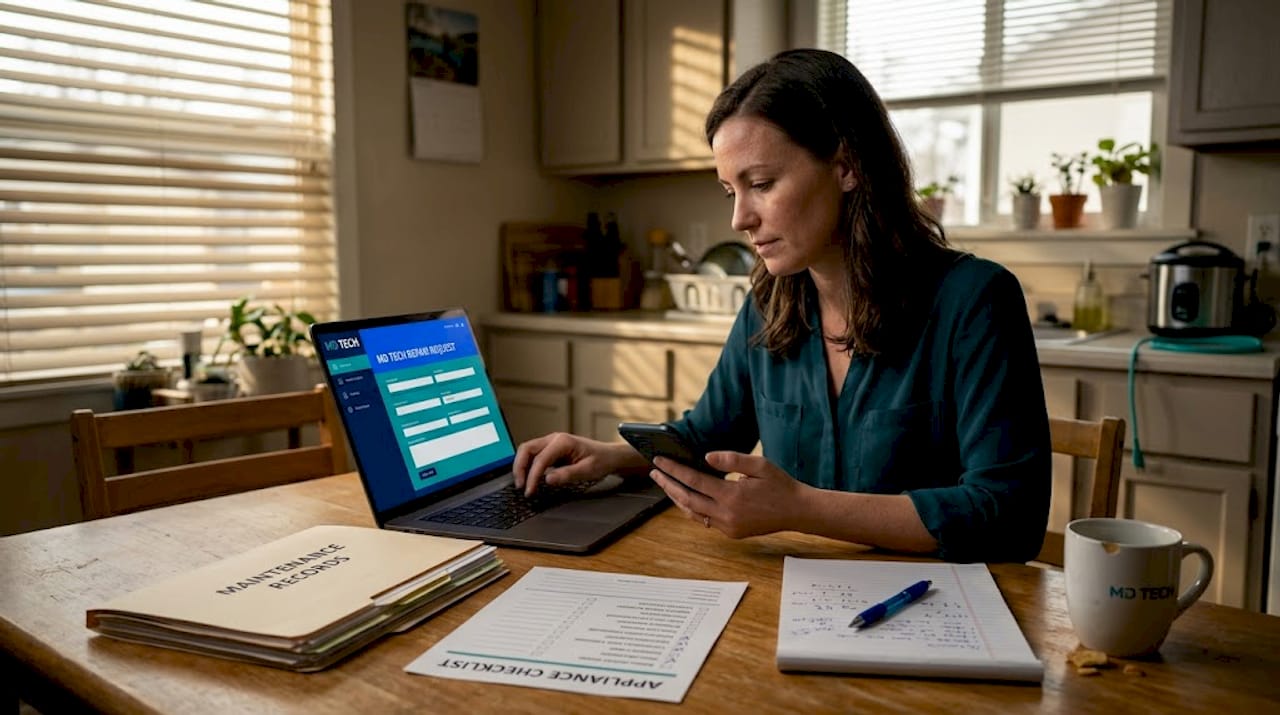
Here is a quick reference table of the information every technician or dispatcher needs from you upfront:
| Information needed | Why it matters |
|---|---|
| Full property address | Routes the right local tech to you |
| Appliance make, model, serial number | Determines part availability and tech specialization |
| Description of the problem | Helps tech arrive prepared with likely parts |
| Warranty status | Affects cost and required documentation |
| Last service date | Reveals patterns or recurring issues |
| Tenant contact info (for rentals) | Enables direct coordination for access |
Official LA sources stress written notices and legal timelines for rentals, so your documentation habits matter from the very first step. When you contact Los Angeles repair services, having this packet ready means the scheduler can match the right licensed technician to your issue without multiple rounds of follow-up calls.
Documenting the problem visually is just as important as describing it verbally. Take photos or a short video of:
- The appliance or HVAC unit, including its nameplate with model number
- The visible damage, error code, or symptom (water pooling, visible frost, error display)
- The area around the unit, especially if there is a safety concern like water near electrical outlets
A written notification format for rental situations should include: the date, the property address, the specific appliance or system affected, a description of the problem, and a request for repair by a specific deadline based on urgency level. Keep a copy for your records.
Pro Tip: If you are a property manager handling multiple units, create a simple digital template with fields for each of these items. Filling it out before every service call will save you significant time over the course of a year and make your communication with technicians and tenants far more professional and efficient.
The more specific your problem description, the better. “The washer makes a loud grinding noise during the spin cycle and stops mid-cycle with an E3 error code” gets a faster, more accurate response than “the washer is broken.” Technicians can often pre-diagnose and bring the most likely replacement part on the first visit, eliminating a second trip entirely.
Step-by-step local repair process explained
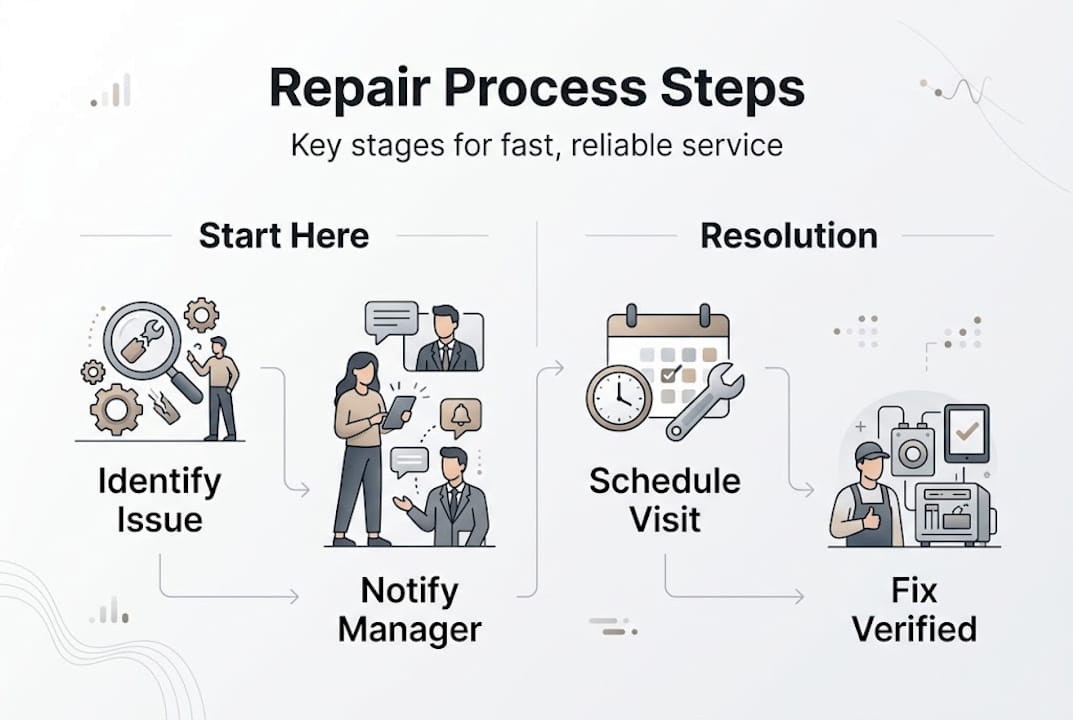
With your information gathered and urgency level confirmed, here is how the actual repair process unfolds from first contact through completed work.
- Contact a local repair service. Call or book online. For urgent repairs, always call directly rather than booking online so a dispatcher can prioritize your case immediately. Many services, including those covering cities from Los Alamitos to Studio City, offer same-day or next-day appointments for urgent cases.
- Confirm appointment details in writing. Whether via email, text confirmation, or a booking receipt, get the appointment time, technician name, and service fee structure in writing. This protects you and sets clear expectations for tenants.
- Notify tenants (for rental properties). Give at least 24 hours notice before entering a rental unit, except in genuine emergencies where immediate entry is required. Confirm this notification in writing and keep a record.
- Prepare the access area. Make sure the appliance or HVAC unit is accessible. Move furniture if needed, ensure pets are secured, and have the warranty documents or any prior repair records ready for the technician.
- Be present or designate a point of contact. Someone who understands the problem should be available during the visit to answer the technician’s questions and review the work before sign-off.
- Review the diagnostic and quote before work begins. A reputable technician will tell you what they found, what needs to be done, and what it will cost before starting the repair. Do not let work proceed without agreeing to a written estimate.
- Test the appliance before the technician leaves. Run a full cycle, check the temperature, or confirm the HVAC is reaching the set temperature. Do not accept “it should work now” without a live demonstration.
Local services emphasize priority for property managers, 7-day availability, and direct tenant coordination. This matters for urgent compliance situations where repair timelines are legally enforced.
For context, a roof repair workflow comparison shows that any home repair process follows the same essential sequence: assess, document, authorize, execute, and verify. Appliance and HVAC repairs in LA and Orange County are no different, and skipping any step creates gaps that lead to disputes or repeat service calls.
Pro Tip: For property managers with multiple units, establish a standing relationship with one local repair service. Many services offer priority scheduling to repeat clients, which means your urgent calls jump the queue during high-demand periods like summer heat waves or winter cold snaps.
Statistic callout: Services with 7-day technician availability reduce average resolution time for urgent repairs by an estimated 40% compared to services that only operate Monday through Friday during standard business hours.
Troubleshooting, verification, and next steps
The technician has packed up and left. Most homeowners and property managers assume the job is done. In reality, the verification step is where a significant number of repair problems are discovered, and where future disputes are either prevented or created.
Here is a numbered checklist for post-repair verification:
- Test the repaired appliance through a full operational cycle. For a washer, run a complete wash cycle. For a refrigerator, check the temperature after 30 minutes. For an HVAC unit, run it through both heating and cooling modes if applicable.
- Check for secondary symptoms. A repaired appliance sometimes reveals a second underlying issue. Watch for unusual sounds, error codes, or performance that does not match the technician’s description of the fix.
- Review the written repair report. Every reputable service provides a record of what was diagnosed, what parts were replaced, and what labor was performed. File this document immediately.
- Confirm warranty coverage on the repair itself. Most quality repair services offer a 30 to 90-day warranty on parts and labor. Know what yours covers before the technician leaves.
- Follow up with the tenant (for rental properties). Confirm in writing that the repair was completed and ask the tenant to notify you if any issues persist. Document their response.
If problems persist after a repair, tenants notify in writing and have options including complaining to county agencies, seeking mediation, or pursuing the repair-and-deduct remedy allowed under California law.
Understanding when emergency repairs are truly urgent versus when they are follow-up issues matters for managing next steps calmly and without over-reacting to normal post-repair settling.
Here is what to check for appliance-specific post-repair issues:
- Refrigerator: Temperature stability within 24 hours, no unusual sounds, compressor not running continuously
- HVAC: Even airflow across all vents, thermostat response within 5 minutes, no burning smell
- Washer: No leaks during fill or spin, complete cycle without error codes
- Oven or stove: Accurate temperature, consistent ignition, no gas smell
For Santa Monica repairs and other coastal areas, humidity can sometimes accelerate secondary failures after an initial repair, especially in HVAC systems. Knowing this helps you monitor more carefully in those environments.
Safety reminder: After any urgent habitability repair, perform a visual safety check of the surrounding area. Look for water damage near electrical panels, gas line connections, or any signs that the original failure caused secondary damage that was not part of the repair scope.
The truth about local repair: Why speed isn’t everything
Here is something most repair guides will not tell you: rushing the process often creates more problems than it solves.
We see it constantly. A property manager panics over a broken appliance, skips the written notification step, arranges access without tenant consent, and books the first available service without confirming credentials. The repair gets done, but three weeks later there is a dispute about liability, a follow-up issue that was not documented, or a tenant complaint that escalates because no one kept records.
Speed is valuable. Seven-day availability matters enormously for urgent cases. But speed without process is just controlled chaos.
Our experience handling repairs across Orange County and LA County shows that the best long-term repair outcomes always come from methodical communication rather than fast, undocumented fixes. The most common reason a repair leads to a follow-up call is not a bad part or a poor technician. It is an unclear expectation that was never communicated before or after the visit.
The single hardest-won lesson we can share: prevention and preparation matter as much as urgent action. Appliances that are serviced on a regular schedule, documented carefully, and monitored after each repair rarely become emergency situations. The homeowners and property managers who call us in a panic are almost always the same ones who have no maintenance records for the appliance that just failed.
Slow down just enough to do it right. That is what separates a one-visit repair from a recurring problem.
Need help? Connect with trusted local repair experts
You now have a clear picture of the full repair process, from identifying urgency to verifying the final fix. Putting it into practice is easiest when you have a reliable local team ready to move quickly.
At Appliances Repair MD Tech, we cover appliance repair, HVAC service, and plumbing across Orange County and Los Angeles County with 7-day availability and direct coordination for property managers. Whether you need same-day appliance repair in Los Angeles or a scheduled service visit in a specific neighborhood, our licensed technicians are ready to respond. We work directly with tenants when needed, provide written reports after every visit, and back our work with repair warranties so you stay compliant and confident every step of the way.
Frequently asked questions
What qualifies as an urgent repair in Los Angeles or Orange County?
Urgent repairs include health or safety risks like no hot water, a broken heater in winter, or pest infestations, all of which require immediate attention under California habitability law.
How should tenants notify landlords about needed repairs?
Tenants should notify landlords in writing for all repair requests to satisfy legal requirements and formally start the clock on mandatory response timelines.
What if the landlord does not make the repair in time?
Tenants can file complaints with county agencies, seek mediation, or use the repair-and-deduct remedy allowed under California law if repair deadlines are missed.
Who pays for urgent appliance or HVAC repairs?
Landlords are responsible for paying for repairs needed to maintain habitability, especially urgent health or safety issues covered under California’s implied warranty of habitability.
How fast can local repair services respond?
Many local services offer 7-day availability and will prioritize property managers and urgent repair requests for same-day or next-day appointments throughout LA and Orange counties.