
TL;DR:
- A thermal fuse is a single-use safety device that permanently cuts power when an appliance overheats, preventing fires. It responds solely to temperature, melting irreversibly and requiring replacement, unlike resettable circuit breakers or thermostats. Proper diagnosis and fixing underlying issues are essential to ensure safety and prevent repeated fuse blowouts.
A thermal fuse is a single-use safety device that permanently cuts power to an appliance the moment its internal temperature exceeds a manufacturer-defined limit, stopping fires before they start. You will find one inside nearly every heat-producing appliance in your home, from your dryer and coffee maker to your rice cooker and clothes iron. Unlike a circuit breaker you can reset or a thermostat that cycles on and off, a thermal fuse trips once and never again. When it blows, the appliance stays off until the fuse is replaced and the root cause of overheating is fixed. That design is intentional, and understanding it can save you from a costly mistake.
What is a thermal fuse and how does it protect your appliances?
A thermal fuse is defined in the electronics industry as a thermally activated cutoff device, and that label tells you exactly what it does. It monitors the ambient temperature around a heating element and severs the electrical circuit the instant that temperature crosses a preset threshold. The threshold is set by the manufacturer based on the appliance’s safe operating range, and common trip points run from around 167°F (75°C) for low-heat appliances up to 309°F (154°C) for dryer heating elements.
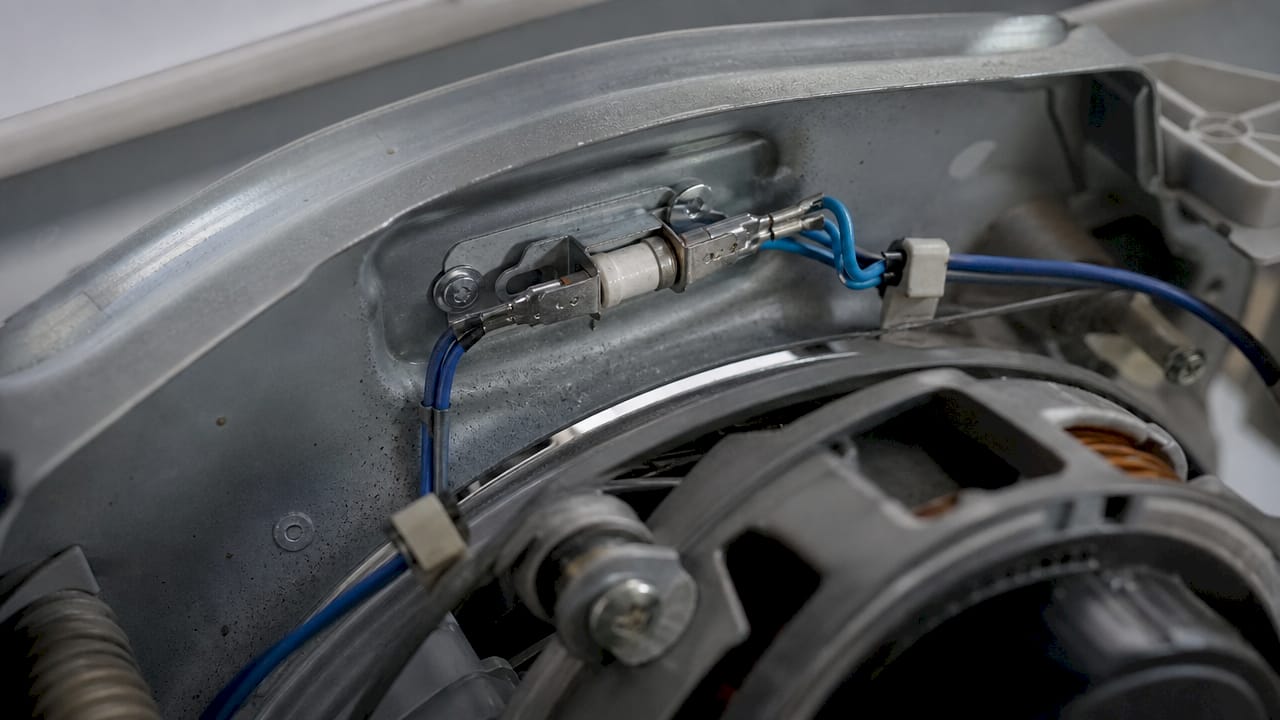
The device sits physically close to the heat source it monitors. In a clothes dryer, it mounts directly on or near the heating element housing. In a coffee maker, it sits against the boiler plate. This placement is deliberate: the fuse reads the actual temperature at the most dangerous point in the appliance, not the average room temperature. Thermal fuses installed near heating elements act as a last-resort protective device specifically because thermostats can fail silently without any visible warning.
The “last resort” framing matters. Most appliances have a thermostat that regulates temperature during normal operation. The thermal fuse only activates when the thermostat has already failed to do its job. Think of the thermostat as the traffic light and the thermal fuse as the concrete barrier at the end of the road.
How thermal fuses work: the mechanism inside
Inside the small cylindrical or axial body of a thermal fuse, three components do all the work: a fusible pellet, a spring-loaded contact, and a metal casing that holds everything together. At normal operating temperatures, the pellet stays solid and holds the spring-loaded contact in place, keeping the circuit closed and current flowing freely.
When the surrounding temperature reaches the rated trip point, the fusible pellet melts and releases the spring. The spring snaps back instantly, pulling the contact away from the circuit and permanently opening it. No current flows after that point, regardless of whether the appliance cools back down. The irreversible melting of the fusible element is what makes this a one-time device. The physics cannot be undone without replacing the part.
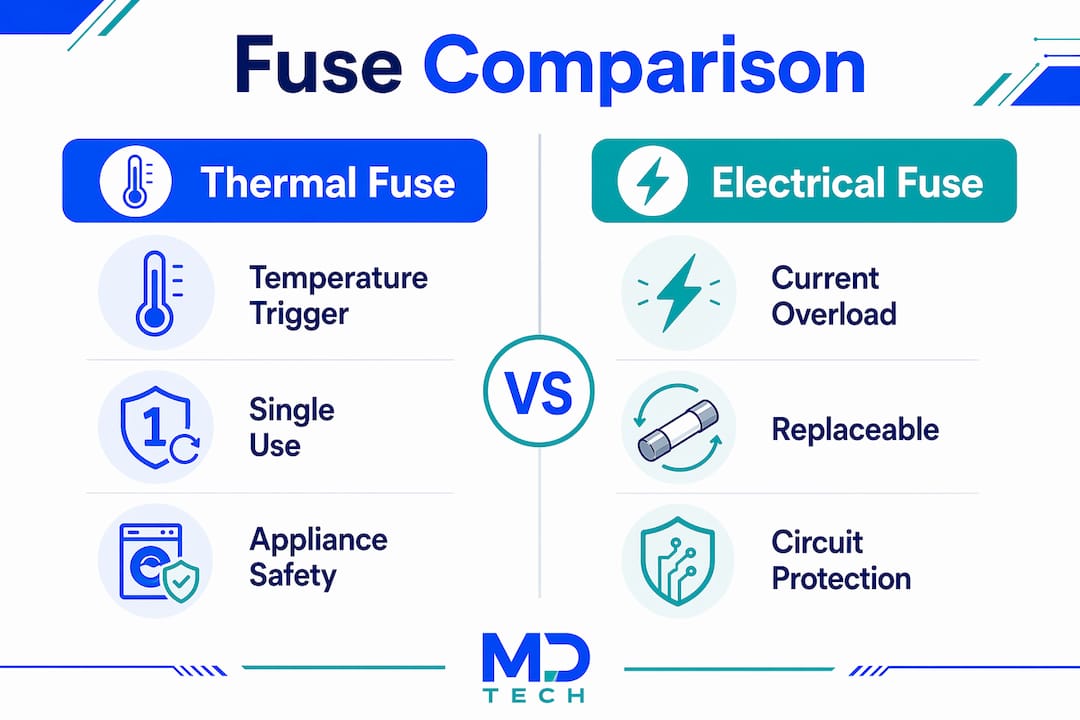
This is a fundamentally different response than what an electrical fuse does. An electrical fuse reacts to excess current, not heat. A thermal fuse reacts to excess temperature, not current. You could run a perfectly normal current through a thermal fuse and it would still blow if the surrounding air got hot enough. That distinction is why both devices exist in the same appliance and why one cannot substitute for the other.
- Normal operation: Fusible pellet is solid, spring-loaded contact is held closed, current flows.
- Temperature rises: Ambient heat around the fuse climbs toward the rated trip point.
- Trip point reached: Pellet melts, spring releases, contact opens permanently.
- Circuit interrupted: Appliance loses power and will not restart until the fuse is replaced.
Pro Tip: When installing a new thermal fuse, avoid using a soldering iron directly on the fuse leads. The heat from soldering can prematurely trip the new fuse before you even reassemble the appliance. Use crimp connectors instead to make the connection without applying heat.
Thermal fuse vs. electrical fuse: what’s the real difference?
Homeowners frequently confuse these two components because they look similar and both protect against damage. The difference in what triggers them is the entire point.
| Feature | Thermal fuse | Electrical fuse |
|---|---|---|
| Activation trigger | Excess temperature | Excess electrical current |
| Resettable | No, single-use only | No (but circuit breakers are) |
| Typical location | Near heating elements | In the main electrical panel or appliance wiring |
| Primary protection | Fire and heat damage | Short circuits and overloads |
| Common appliances | Dryers, irons, coffee makers | Panels, motors, electronics |
Thermal fuses respond exclusively to temperature, while electrical fuses respond to current overloads. This means a dryer with a failing heating element that draws normal current but generates dangerous heat would never trigger an electrical fuse. Only the thermal fuse catches that failure. That is precisely why heat-producing appliances carry both types of protection and why removing either one creates a genuine safety gap.
A thermal fuse also differs from a circuit breaker in one critical way: a circuit breaker can be reset after it trips. A thermal fuse cannot. That irreversibility forces a physical inspection before the appliance runs again, which is the whole point of the design.
How to troubleshoot and replace a blown thermal fuse
The most common sign of a blown thermal fuse is an appliance that simply will not start or that shuts off immediately after being turned on. No heat, no sound, no response. These bad thermal fuse symptoms overlap with other failures, so confirming the diagnosis with a multimeter is the right move before buying parts.
Signs that point to a blown thermal fuse:
- Dryer runs but produces no heat, or will not turn on at all
- Coffee maker powers on but the heating plate never warms
- Iron does not heat up despite the power light being on
- Rice cooker fails to start or shuts off before cooking completes
To test the fuse, set your multimeter to continuity mode and touch the probes to each lead of the fuse. A working fuse shows continuity. A blown fuse shows none. The test takes under two minutes and removes all guesswork.
Replacement costs are low. Most thermal fuses cost between $5 and $20 at hardware stores or through appliance parts suppliers. The critical step is matching the replacement fuse to the exact specifications printed on the original. Using a fuse with incorrect temperature ratings causes two distinct failure modes: a fuse rated too low trips during normal operation, and a fuse rated too high fails to trip when temperatures become genuinely dangerous.
Pro Tip: Before you replace the fuse, fix the reason it blew. A clogged dryer vent, a faulty thermostat, or a failing heating element will blow the new fuse just as fast. Preventative home care that addresses airflow and thermostat health is what makes a fuse replacement last.
Thermal fuses cannot be reset and must be replaced after activation. Some homeowners attempt to bypass the fuse with a wire jumper to get the appliance running again. This is one of the most dangerous shortcuts in home repair. Bypassing a thermal fuse eliminates the appliance’s last line of heat protection, voids safety certifications, and dramatically increases fire risk. No repair is worth that trade-off.
Common applications and why thermal fuses are non-negotiable
Thermal fuses appear in virtually every appliance that generates heat as part of its normal function. Their presence is not optional. Safety standards from organizations like UL (Underwriters Laboratories) and IEC (International Electrotechnical Commission) require thermal protection in these devices before they can be sold in the United States.
Appliances that rely on thermal fuses:
- Clothes dryers: Mounted on the heating element housing; the most common appliance where homeowners encounter a blown thermal fuse
- Coffee makers: Positioned against the boiler plate to prevent dry-boil fires
- Clothes irons: Located near the soleplate heating element
- Rice cookers: Installed close to the inner pot heating coil
- Space heaters and baseboard heaters: Placed near the heating coils as a fire prevention measure
- Hair dryers: Tucked near the heating element to prevent scalp burns from runaway heat
The sacrificial nature of thermal fuses is a deliberate engineering choice. By designing a component that forces the appliance off and requires physical replacement, manufacturers and safety regulators prevent homeowners from unknowingly continuing to use a dangerous appliance. The fuse blowing is not the problem. It is the signal that a problem already exists.
Understanding which appliances carry thermal fuses also helps you make smarter purchasing decisions. Appliances on the energy-saving appliances list for 2026 typically incorporate better thermostat controls alongside thermal fuses, reducing the frequency of thermal fuse activation through better temperature management.
Key takeaways
A thermal fuse is a non-resettable, temperature-activated safety device that permanently opens an appliance’s circuit when heat exceeds a safe threshold, and replacing it without fixing the root cause of overheating will always result in repeated failure.
| Point | Details |
|---|---|
| Single-use by design | A thermal fuse permanently opens the circuit and cannot be reset; replacement is the only option. |
| Temperature triggers it, not current | Thermal fuses respond to heat, not electrical overload, making them distinct from electrical fuses. |
| Fix the root cause first | Replacing a blown fuse without addressing airflow blockage or thermostat failure causes immediate re-failure. |
| Match exact specifications | Use a replacement fuse with the same rated temperature, voltage, and current as the original. |
| Never bypass a thermal fuse | Jumping a thermal fuse removes the appliance’s last heat protection and creates a serious fire hazard. |
What I’ve learned from years of thermal fuse calls
After handling hundreds of appliance repair calls across Orange County and Los Angeles County, the pattern around thermal fuses is consistent. The fuse is almost never the original problem. It is the messenger. Homeowners call because their dryer stopped working, and the thermal fuse is blown, but the real issue is a vent line packed with lint that has not been cleaned in three years. Replace the fuse without clearing the vent and the new fuse blows within a week.
The other mistake I see regularly is the wrong replacement part. Someone orders a thermal fuse for their dryer model but grabs a version with a slightly different temperature rating because it was cheaper or faster to ship. That small difference in the “Tf” rating printed on the casing matters more than most people realize. Too low and the dryer shuts off mid-cycle. Too high and the fuse never trips when it should.
My honest advice: if you are comfortable with a multimeter and basic disassembly, testing and replacing a thermal fuse is a reasonable DIY job. But if the fuse blows again within a few cycles after replacement, stop replacing fuses and call a technician. Repeated thermal fuse failure means the appliance has an underlying problem that a fuse swap will never solve. Chasing it with parts is expensive and, more to the point, dangerous.
— MDTECH
Get your appliance diagnosed and repaired the right way
When a thermal fuse blows in your dryer, coffee maker, or iron, the repair is only complete when the root cause is identified and fixed. Appliancesrepairmdtech serves homeowners across Orange County and Los Angeles County with licensed technicians who diagnose the full picture, not just the failed part.
If you want to make sure the repair holds, the Appliancesrepairmdtech team follows a complete appliance parts replacement guide process that covers thermal fuse diagnosis, correct part matching, and root cause resolution in a single visit. Booking is available online, and same-day appointments are offered throughout the service area. A properly repaired appliance protects your home and extends the life of the machine.
FAQ
What is a thermal fuse in a dryer?
A thermal fuse in a dryer is a single-use safety device mounted near the heating element that permanently cuts power if the dryer overheats. It is the most common reason a dryer runs but produces no heat.
Can a thermal fuse be reset after it blows?
No. A thermal fuse cannot be reset because the internal fusible element melts permanently when the trip temperature is reached. The fuse must be physically replaced to restore appliance function.
What are the symptoms of a bad thermal fuse?
The most common bad thermal fuse symptoms are an appliance that will not start, produces no heat, or shuts off immediately after being turned on. A multimeter continuity test confirms the diagnosis in under two minutes.
Is it safe to bypass a thermal fuse?
Bypassing a thermal fuse is never safe. It removes the appliance’s last heat protection, voids safety certifications, and significantly increases the risk of an appliance fire.
How do I know which replacement thermal fuse to buy?
Match the replacement fuse exactly to the temperature rating, voltage, and current specifications printed on the original fuse casing. Using a fuse with the wrong rated temperature can cause either nuisance tripping or a failure to trip at dangerous temperatures.