
TL;DR:
- Diagnostic testing is essential for identifying and monitoring diseases, guiding effective patient treatment. Properly ordered tests depend on clinical reasoning, pre-test probability, and context, to ensure accurate interpretation and avoid unnecessary harm. Global access gaps and policy shortcomings hinder the timely use of diagnostics, limiting their impact on personalized medicine.
Diagnostic testing is the process by which healthcare providers identify, confirm, and monitor diseases to guide effective patient care. The role of diagnostic testing sits at the center of every clinical decision, from a routine blood panel to an advanced Alzheimer’s biomarker test. Without accurate test results, even the best available treatments cannot be matched to the right patients. The World Health Organization and researchers at UC San Francisco both recognize diagnostics as a foundational pillar of healthcare, not a secondary step. Getting this process right determines whether a patient receives targeted therapy or an ineffective one.
How does diagnostic testing influence clinical decision-making?
Diagnostic testing shapes clinical decisions at four distinct stages: screening, diagnosis, prognosis, and ongoing monitoring. Each stage demands a different type of test and a different level of certainty before a clinician acts. A screening test for colorectal cancer, for example, does not need the same precision threshold as a confirmatory biopsy. Understanding which stage you are in changes everything about how a test result gets used.
Clinicians do not order tests randomly. Effective diagnostic testing uses clinical reasoning, integrating patient symptoms, risk factors, and pre-test probability rather than indiscriminate testing. Pre-test probability is the clinician’s estimate of how likely a disease is before any test is run. A high pre-test probability means a positive result is more meaningful. A low pre-test probability means even a positive result may be a false alarm.
Treatment thresholds guide clinicians in choosing whether to test at all, balancing the risk of false positives against the necessity of confirming disease. This is one of the most underappreciated skills in medicine. Ordering a test when the result will not change management is not neutral. It can cause real harm through unnecessary follow-up procedures, patient anxiety, and added cost.
- Establish pre-test probability. Review symptoms, risk factors, and patient history before selecting any test.
- Choose the test that matches the clinical question. A confirmatory test differs from a screening tool in sensitivity and specificity requirements.
- Set a treatment threshold. Decide in advance what result would change your management plan.
- Interpret results in context. A single abnormal value rarely confirms a diagnosis on its own.
- Reassess after results. New data shifts the probability estimate and may require additional testing.
Pro Tip: Before ordering any test, ask yourself: “If this result comes back positive, what will I do differently?” If the answer is nothing, reconsider whether the test is warranted.
What are the benefits and limitations of diagnostic testing?
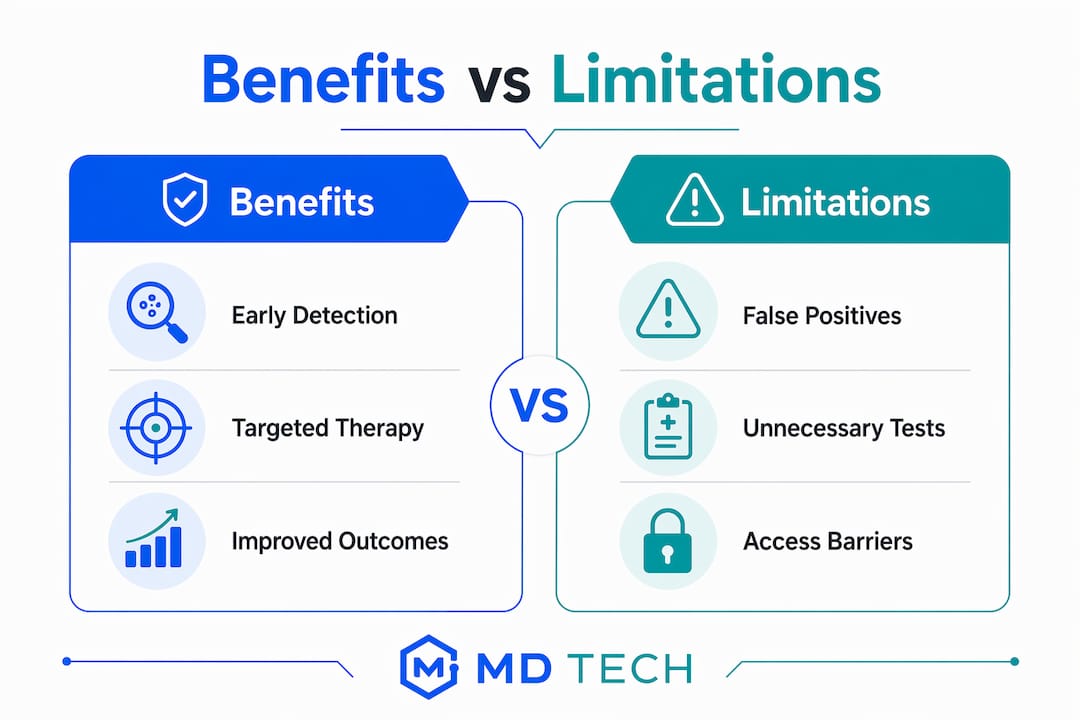
Early detection is the most cited benefit of diagnostic testing, and for good reason. Catching a disease before symptoms appear gives clinicians more treatment options and patients better odds. Mammography for breast cancer and HbA1c testing for prediabetes are two examples where early identification directly changes long-term outcomes. The benefit is not just clinical. It is economic, since treating early-stage disease costs far less than managing advanced illness.

The limitations are real and often underreported. Ordering diagnostic tests without clear clinical purpose raises risks of false positives, unnecessary invasive procedures, patient anxiety, and higher costs. A false positive result can send a patient through months of follow-up testing, emotional distress, and procedures that carry their own risks. This is not a theoretical concern. It is a documented pattern in over-screened populations.
Cost and access create a second layer of limitation. Advanced diagnostic blood tests for diseases like Alzheimer’s cost about $1,000 but may lack insurance coverage despite expensive therapies being available. That gap is not a minor inconvenience. It means patients who qualify for a targeted therapy cannot access the test that would confirm their eligibility.
The global picture is even more stark:
- Access gap: Nearly 50% of the world’s population lacks access to essential diagnostics, limiting their ability to receive accurate, targeted treatments.
- False result risk: Both false positives and false negatives carry clinical consequences, including missed diagnoses and unnecessary procedures.
- Insurance misalignment: Many advanced tests are not reimbursed at rates that reflect their clinical value.
- Equity disparities: Access gaps fall disproportionately on low-income and rural populations worldwide.
| Benefit | Limitation |
|---|---|
| Early disease detection | Risk of false positive results |
| Targeted therapy selection | High cost of advanced tests |
| Disease monitoring over time | Inconsistent insurance coverage |
| Reduced unnecessary treatment | Global access disparities |
How should patients prepare for diagnostic tests?
Preparation directly affects the accuracy of test results. Patients preparing for diagnostic tests should compile symptom timelines, medication lists, and family health histories to aid interpretation of results. A clinician who knows a patient takes a blood thinner will interpret a clotting test very differently than one who does not. That context is not optional. It is part of the diagnostic process.
What patients should bring to any diagnostic appointment:
- A written timeline of when symptoms started and how they have changed
- A complete list of current medications, including supplements and over-the-counter drugs
- Family history of relevant conditions, especially for genetic or hereditary disease screening
- Previous test results, even from years ago, to establish a baseline for comparison
- A list of questions about what the test measures and what results would trigger next steps
One of the most common misconceptions patients hold is that a single test will deliver a definitive answer. Test results shift probabilities. Clinicians view results as one piece of a larger diagnostic puzzle that needs interpretation and sometimes repeat testing. A normal result does not always mean no disease is present. An abnormal result does not always confirm one. Patients who understand this are better equipped to have productive conversations with their providers.
Pro Tip: Ask your provider before the test: “What are the possible outcomes, and what would each one mean for my care?” This single question prevents most post-result confusion.
What is the future role of diagnostics in personalized medicine?
Personalized medicine depends entirely on diagnostics. A targeted cancer therapy that works only for patients with a specific gene mutation is useless without a test that identifies who carries that mutation. This is the core logic of companion diagnostics, tests developed alongside specific drugs to identify which patients will respond. The clinical value is clear. The system supporting it is not keeping pace.
Advances in therapies are outpacing diagnostics development, resulting in treatment decisions made without appropriate testing guidance. That gap creates a situation where a drug exists, a patient may qualify, but no validated test is available or covered to confirm eligibility. The result is either undertreated patients or expensive therapies given to patients who will not benefit.
Diagnostics receive less R&D investment and lower insurance reimbursement than drugs, slowing innovation and limiting patient access. This funding imbalance reflects a broader policy failure. Regulators and payers evaluate drugs and their companion tests separately, even when clinical benefit depends on using both together.
| Current challenge | Recommended direction |
|---|---|
| Tests and drugs reviewed separately | Joint regulatory and reimbursement review |
| Low R&D investment in diagnostics | Dedicated funding streams for companion tests |
| Insurance gaps for advanced tests | Coverage aligned with companion therapy approval |
| Access concentrated in high-income settings | Global equity frameworks for essential diagnostics |
Policy experts recommend treating diagnostics and therapeutics as integrated products for review and reimbursement to better benefit patients. That shift would not just improve access. It would change how the entire drug development pipeline is structured, building the test into the therapy from the start rather than adding it as an afterthought.
Key Takeaways
Diagnostic testing is the foundation of accurate clinical decisions, and its value is undermined when access, cost, and policy fail to keep pace with medical advances.
| Point | Details |
|---|---|
| Pre-test probability matters | Clinicians should estimate disease likelihood before ordering any test to avoid unnecessary results. |
| False results carry real costs | Both false positives and false negatives lead to harm through unnecessary procedures or missed diagnoses. |
| Access is a global crisis | Nearly half the world lacks essential diagnostics, making targeted treatment impossible for millions. |
| Patient preparation improves accuracy | Symptom timelines, medication lists, and family history directly affect how results are interpreted. |
| Policy must integrate tests and drugs | Evaluating diagnostics and therapies together is the only way to close the innovation and access gap. |
Diagnostics deserve the same respect as the drugs they guide
The medical system treats drugs as the headline act and diagnostics as the opening act nobody remembers. That framing is wrong, and it costs patients. A $30,000-per-year Alzheimer’s therapy delivers no benefit to a patient who cannot access the $1,000 blood test that confirms they need it. The test is not a formality. It is the decision.
What I have seen, working at the intersection of technical diagnostics and real-world outcomes, is that the most common failure is not a bad test. It is a test ordered without a clear clinical question, or a result interpreted without the patient’s full context. Clinicians who treat testing as a structured reasoning process, not a reflex, consistently make better decisions. Patients who arrive prepared, with their history documented and their questions ready, get more from every appointment.
The future of personalized medicine is built on diagnostics. Without serious investment in test development, coverage, and global access, the most targeted therapies in history will reach only a fraction of the patients who need them. That is not a technical problem. It is a policy choice, and it is one that can be changed.
— MDTECH
Precision diagnostics at home: how Appliancesrepairmdtech applies the same logic
The same principle that drives medical diagnostics drives appliance repair. Before any fix, you need an accurate diagnosis. Appliancesrepairmdtech applies structured appliance diagnostic methods to identify the exact cause of a malfunction before any part is replaced or service is performed. That approach saves homeowners in Orange County and Los Angeles County from paying for repairs that do not solve the actual problem.

Appliancesrepairmdtech’s licensed technicians use the same logic a clinician uses: gather the history, test with purpose, and interpret results in context. Whether your Samsung refrigerator is failing to cool or your dryer is running but not heating, expert Samsung appliance repair starts with a precise diagnosis, not a guess. Book an appointment online and get a clear answer before any repair work begins.
FAQ
What is the role of diagnostic testing in healthcare?
Diagnostic testing identifies, confirms, and monitors disease to guide clinical decisions and treatment selection. Without accurate test results, clinicians cannot match patients to the therapies most likely to help them.
How do diagnostic tests affect patient outcomes?
Tests that are ordered with clear clinical purpose and interpreted in context improve outcomes by directing targeted treatment. Tests ordered without a defined clinical question increase the risk of false results, unnecessary procedures, and patient harm.
Why do patients lack access to diagnostic tests?
Nearly half the world’s population lacks access to essential diagnostics due to cost, insurance gaps, and geographic disparities. Advanced tests like Alzheimer’s blood biomarker panels often cost around $1,000 and are not covered by insurance despite companion therapies being available.
What should patients do before a diagnostic test?
Patients should prepare a symptom timeline, a full medication list including supplements, and a family health history before any diagnostic appointment. This context directly affects how a clinician interprets the results.
Can a single test confirm a diagnosis?
A single test result rarely confirms a diagnosis on its own. Clinicians treat results as probability shifts within a broader clinical picture, and repeat or additional testing is often required before a definitive conclusion is reached.